
Oct 23, 2026
PHP2Shell: PHP Security Risks and Mitigation Strategies
Explore PHP2Shell claims, potential PHP security risks, and mitigation strategies. Learn how SECURESYS helps organizations assess and secure their systems.
DDR watches behaviour around your data while DLP blocks egress. They are not rivals: together they build a far stronger data security architecture.
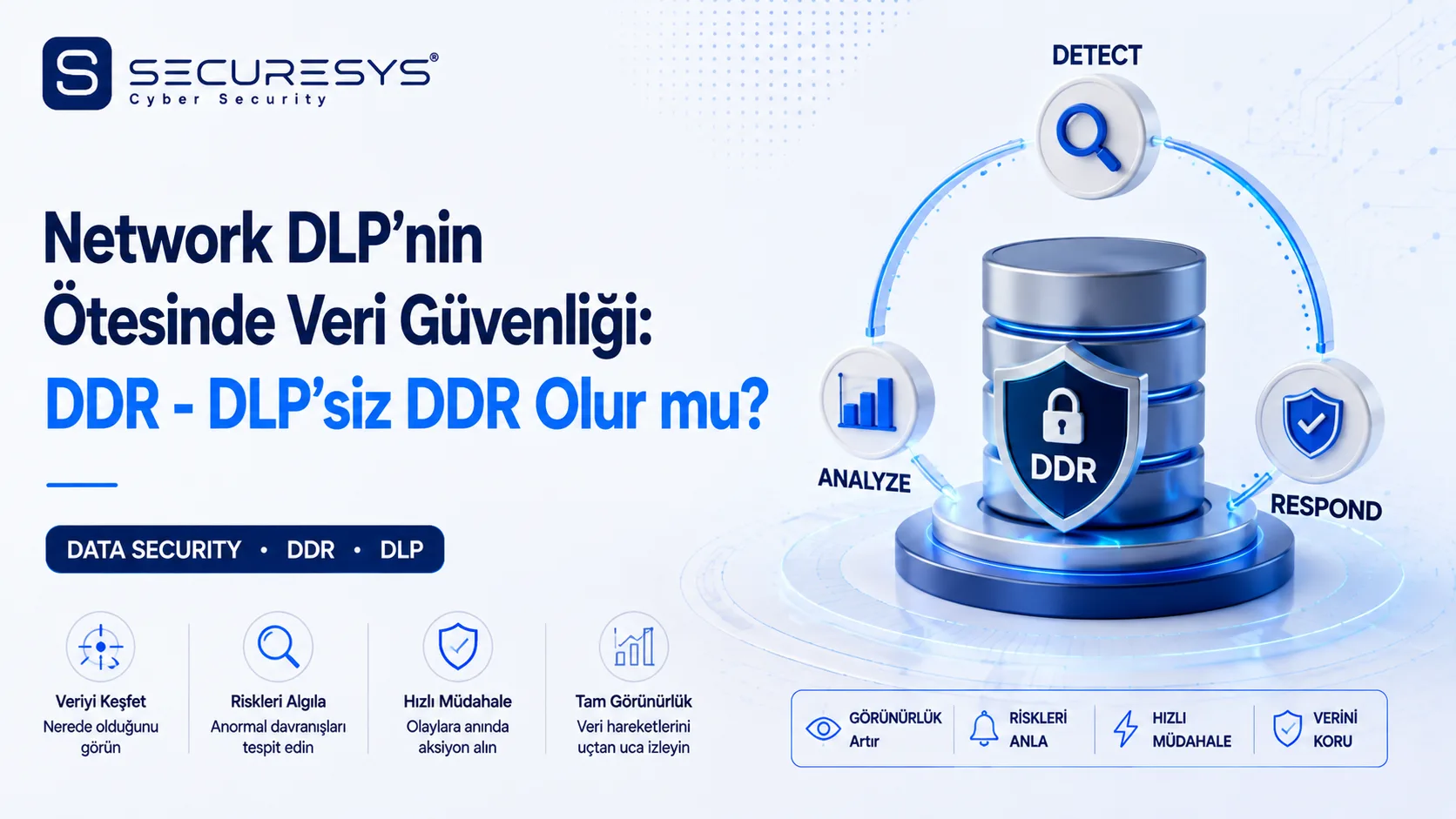
For many years, one of the three-letter acronyms we have heard most in the data security world has been DLP.
Data Loss Prevention solutions took an important place in many organisations' security architecture, aiming to stop sensitive data leaving the organisation, enforce defined policies and reduce the risk of data loss.
But is our data genuinely safe just because we use DLP?
More importantly:
If an attacker spends days moving around inside, discovering sensitive files, using access privileges and staging data before exfiltrating it, how early can we notice?
The DDR — Data Detection & Response — approach, increasingly discussed in the data security world, takes shape precisely around this question.
And naturally it brings a new debate with it:
Can you have DDR without DLP?
The short answer:
Yes, you can.
But rather than seeing DDR and DLP as alternatives to one another, it is far more accurate to treat them as two approaches that address different problems and, used together, form a stronger data security architecture.
DDR — Data Detection & Response — is, at its simplest, about detecting and responding to what happens around data.
DDR's core purpose is not only to prevent data from leaving the organisation.
The real aim is to understand the activity taking place around the data and to detect risky behaviour as early as possible.
The DDR approach essentially pursues these questions:
Where is the data?
Who is accessing this data?
Does this user normally access it?
What operations are being performed on the data?
Between which systems is the data moving?
Is this behaviour normal, or a sign of a potential security incident?
When risky activity is detected, what should we do?
So DDR should not be thought of merely as a data classification or data loss prevention technology.
At the centre of DDR sit data + behaviour + context + detection + response.
This is where the most important distinction needs to be made.
In the classic DLP approach, the core question is usually:
"Is this data allowed to leave from here?"
For example, company policy may say credit card details cannot be sent by email.
A document at a certain confidentiality level cannot be copied to a USB drive.
A file containing personal data cannot be uploaded to an unauthorised cloud storage service.
The DLP system knows the policy and tries to block or report violations when they occur.
DDR asks a different question:
"What is happening around this data right now?"
That seemingly small difference actually changes the approach considerably.
Because in modern attacks a data breach is rarely a single event.
The attacker first gets into the system.
Then compromises user accounts.
Investigates privileges.
Scans file servers.
Discovers databases.
Finds sensitive data.
Collects the data.
Sometimes compresses it.
Sometimes moves it to a different system.
And finally tries to move it outside the organisation.
While DLP mostly comes into play at critical control points in that chain, the DDR approach tries to understand the behavioural chain around the data much earlier.
Imagine an employee in the finance department who normally accesses 20-30 customer records a day.
One night, that user account:
begins querying 5,000 customer records.
Then accesses files belonging to other departments.
Connects to a server they do not normally use.
Reads a large number of files in a short period.
And then starts gathering some of those files in a different directory.
The data may not have left the company yet.
So in the classic sense no "data loss" has occurred.
But from a security standpoint there is a very serious signal here.
This is exactly where the value of the DDR approach emerges:
rather than waiting for data loss, trying to catch abnormal behaviour around the data.
Let's come to the question in the title.
Technically, yes.
For a DDR solution to work, it is not mandatory in every case to have a classic DLP product in front of it.
DDR can form an independent security layer by analysing:
data access,
user behaviour,
data movement,
risky activity
and various data security signals.
But concluding from this that:
"So we no longer need DLP."
would not be right.
Because the areas in which the two approaches are strong differ.
Put simply:
While DLP tries to stop a particular piece of data leaving through a particular channel, DDR tries to detect risky behaviour developing around the data and enable the security team to respond to the incident.
So the real question should not be:
"DLP or DDR?"
The better question is:
"How can DLP and DDR together form a stronger data security architecture?"
Because organisations' data architecture has changed completely.
Data used to sit largely in specific systems inside the company.
Today data is everywhere.
On file servers.
In databases.
On employee computers.
In Microsoft 365 environments.
In Google Workspace.
In SaaS applications.
In cloud storage services.
On AWS, Azure and Google Cloud.
In APIs.
In data lakes.
In backups.
In software development systems.
And now in generative AI applications.
That makes controlling data security purely at the network's exit point steadily harder.
Because first you need to know where the data is.
Then who is accessing it.
Then whether that access is normal.
And only after that can you make the right security decision.
One of the most valuable elements in modern security systems is context.
A user downloading a file is not, on its own, an indicator of attack.
But if that same user:
is accessing a file they do not normally access,
is working at 03:00,
is reading thousands of files in a short time,
is carrying out unusual activity across different systems,
and then starts moving large volumes of data…
the same action now looks very different.
One of DDR's main advantages is that it tries to give security teams this context.
The aim is not merely to say:
"A file was downloaded."
The real question should be:
"Is it normal for this file to be downloaded by this user, at this time, in this way?"
One of the important use cases for the DDR approach is insider threat.
Not every data breach is carried out by an outside hacker.
Sometimes an employee shares data by mistake.
Sometimes they abuse their privileges.
Sometimes they download a large number of corporate files before leaving the company.
Sometimes a compromised employee account is used by an attacker.
In all of these scenarios the account used may technically be "authorised".
And that is where the problem begins.
The firewall may not block the user.
The VPN connection may look normal.
The username and password may be correct.
MFA may even have completed successfully.
But the user's behaviour around the data is not normal.
This is precisely one of the areas DDR focuses on.
In fact one of the easiest ways to understand DDR is to compare it with EDR.
What did EDR — Endpoint Detection & Response — do?
It moved endpoint security beyond the logic of:
"Block the malicious file."
It began monitoring the behaviour taking place on the system.
A process was created.
PowerShell ran.
Credential access occurred.
A suspicious connection was established.
Persistence was created.
EDR correlates these to understand the incident as a whole.
DDR applies a similar idea, but centred on data.
Put simply:
EDR tries to understand what is happening on the endpoint.
NDR tries to understand what is happening on the network.
DDR tries to understand what is happening around the data.
DDR can therefore be seen as one of the important data-side components of a modern Detection & Response architecture.
There is no reason to think DLP is disappearing.
On the contrary, DLP is still a critical security layer.
Particularly where policy needs to be enforced on:
email,
web,
USB,
endpoints,
cloud applications
and specific data transfer channels, DLP remains an important control mechanism.
But a data security strategy consisting of DLP alone may not be sufficient in today's threat environment.
Because rather than waiting for the attacker to move data out, we want to see their behaviour the moment they begin turning towards the data.
This is where DDR's complementary value appears.
In the ideal scenario the two technologies complement each other.
DDR detects risky data behaviour.
For example:
a user is accessing an unusual volume of sensitive data.
DDR can assess this as behavioural risk.
The incident can then be passed to the SOC or SIEM environment.
The user's endpoint activity can be examined through EDR/XDR.
Identity activity can be checked.
Specific data egress channels can be blocked through DLP policies.
In this way the security architecture starts answering not only:
"Did data leave?"
but:
"What is happening to the data, and how can we stop it?"
That means data security becomes more holistic.
Absolutely.
Because the signals DDR produces do not have to be assessed in isolation.
Consider abnormal data access by a user.
DDR may say:
"This user is accessing a great deal of sensitive data."
EDR may say:
"There is suspicious PowerShell activity on the same user's computer."
Identity security may say:
"An unusual sign-in was observed on the user's account."
NDR may say:
"An unusual amount of outbound traffic is leaving this device."
When SIEM brings all these signals together, what we have is no longer a single alert but a potential attack story.
This is where the strength of modern SOC operations shows itself:
assessing signals from different security layers within a single incident context.
It is not hard to predict that AI will play an important role in the future of data security.
Because in large organisations it is impossible to analyse billions of data access events manually.
AI and behavioural analytics can be used to:
learn normal user behaviour,
identify abnormal access,
correlate risky data movement,
reduce false positive rates
and present security teams with more meaningful incidents.
So in the data security architecture of the future, behavioural and contextual analysis — not only static policy — can be expected to matter more.
When assessing a DDR approach, five simple questions are really enough:
1. Where is the data?
2. Who is accessing the data?
3. What is being done with the data?
4. Is this behaviour normal?
5. What do we do when risk arises?
If you answer the first four but cannot produce any action on the fifth, all you have achieved is visibility.
This is exactly where DDR's "Response" element matters.
Detected risk has to be turned into a security operation.
Assessing data security architecture through a single product is becoming steadily harder.
DLP.
DDR.
DSPM.
DAM.
PAM.
SIEM.
SOAR.
EDR/XDR.
NDR.
Identity Security.
Each of these sees a different part of the problem.
Real success lies in running all of these technologies together within the right context.
So we can summarise the new equation of data security like this:
You cannot protect data you cannot see.
You cannot understand risk without understanding behaviour.
And if you cannot respond to the threat you detect, the security chain is not complete.
DDR without DLP is technically possible.
But approaching the topic purely as a product comparison would not be the right way to look at it.
DLP and DDR answer different security problems.
DLP's strength lies in policy enforcement and preventing data loss.
DDR's focus is detecting behaviour around data, making sense of it and turning it into response.
So:
DLP → Prevent
DDR → Detect + Analyse + Respond
In a modern data security strategy these should be treated not as rivals but as complementary security layers.
Because attackers' methods are changing.
Data infrastructure is changing.
Cloud usage is increasing.
SaaS is growing.
Artificial intelligence is reshaping how organisations use data.
And as a result of all this, the same thing returns to the centre of security:
DATA.
In the coming period it will not be enough for organisations to say "data must not leave".
The new question is far broader:
Where is our data, who is using it, what are they doing with it, and how quickly can we notice and respond when risky behaviour begins?
That is precisely the question DDR is trying to answer.
At SecureSys we assess data security not through a single product or technology, but as an integrated security architecture covering DLP, DDR, DAM, PAM, SIEM/SOAR, EDR/XDR, NDR and 24/7 SOC components.
Data must be protected not only at the moment it is lost, but from the moment risk begins.
Get weekly threat intel, case studies, and technical content delivered to your inbox.
No spam. Unsubscribe anytime.
Explore PHP2Shell claims, potential PHP security risks, and mitigation strategies. Learn how SECURESYS helps organizations assess and secure their systems.

OpenAI'ın deneysel yapay zekâ modelinin yetkisiz kripto cüzdanı işlemi, otonom yapay zekâ sistemlerinde güvenlik, yetki kontrolü ve denetim risklerini gündeme taşıdı.

From data leakage and prompt injection to over-privileged agents and model supply chain: nine enterprise risks, each with a concrete control.