What Is Database Hardening? Secure Database Configuration
What is database hardening and how is secure database configuration done? Baselines, default accounts, network limits, TLS, audit and platform notes.
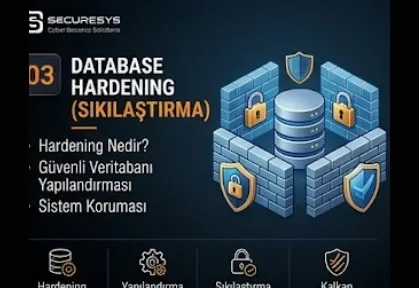
A database system being installed and running does not mean it is secure.
After the installation completes;
default accounts,
unnecessary services,
open ports,
excessive privileges,
weak authentication methods,
old protocols,
missing patch levels
and insufficient logging
many risks such as these can persist.
For this reason, on corporate database systems, not only installation but also:
Database Hardening
that is, the secure configuration process, must be applied.
Database hardening aims at turning off the database's unneeded features, narrowing the access area, restricting privileges, applying secure authentication methods and reducing the system's attack surface as far as possible.
The core approach is this:
An unused feature must be turned off.
An unnecessary user must not exist.
An unnecessary port must not be open.
An unnecessary privilege must not be granted.
Although these principles look simple, in real-world attacks it is most often these basic security controls that make the most critical difference.
What Is Database Hardening?
Database Hardening is the process of reducing unnecessary services, default configurations and excessive privileges so that the database system runs securely.
The purpose is to shrink the database's attack surface.
Within the scope of hardening;
network,
authentication,
authorization,
the operating system,
database configuration,
logging,
encryption,
patch management
are assessed together.
Are Hardening and Security the Same Thing?
Hardening is an important part of database security.
However, database security is broader.
For example;
DAM,
SIEM,
backup security,
incident response,
data classification
also fall within the scope of database security.
Hardening, meanwhile, focuses predominantly on the secure configuration of the system.
What Is a Database Security Baseline?
A Security Baseline defines the minimum security standard for database systems.
For example, the organization can determine that:
All database management connections must use TLS.
Default accounts must be disabled.
DBA accounts must be personal.
Audit must be active.
The production database must not be exposed to the internet.
These rules form the organization's database security baseline.
Why Is a Standard Baseline Needed?
Let us imagine the organization has 100 database servers.
If every DBA uses different security settings;
some servers become secure,
some become weak
as a result.
A standard baseline ensures all systems are at a minimum security level.
What Is the CIS Benchmark?
The CIS Benchmark is one of the widely used guides for the secure configuration of systems.
Different benchmark documents may also exist for database systems.
These guides offer recommendations in areas such as;
authentication,
network,
logging,
permissions,
configuration
as their scope.
Should the CIS Benchmark Be Applied Automatically?
Every recommendation must not be applied blindly to a production system.
Because;
application compatibility,
performance,
business requirements
can be affected.
For this reason the baseline must be adapted to the organization's own environment.
What Is a Vendor Hardening Guide?
Database vendors can publish their own security configuration guides.
For example;
PostgreSQL,
Microsoft SQL Server,
Oracle Database
vendor best-practice documents can be used for these.
Where Should Database Hardening Start?
The first step must be:
Asset Inventory
as the foundation.
Hardening cannot be done without knowing which database systems exist.
In the inventory;
DBMS type,
version,
IP,
port,
owner,
criticality,
environment
this information can be held.
Should Production, Test and Development Be Separated?
Yes.
Production databases must be kept apart from test or development environments.
The same;
credentials,
network,
admin accounts
must not be used.
Why Is the Test Environment Risky?
Test environments generally have a lower security level.
If production data has been copied into the test environment, the attacker can reach critical data from there.
Should Production Data Be Used in the Test Environment?
As far as possible, masked or anonymized data must be used.
Copying real customer data directly into the development environment creates a significant security and privacy risk.
What Is a Default Account?
They are the user or administrator accounts created automatically during database installation.
Some of them can have well-known names.
Why Is a Default Account Risky?
The attacker does not have to guess the username.
For example, if the administrator account name is known, only the password can be targeted.
For this reason unused default accounts;
must be disabled,
must be deleted
or must be made secure.
Should Sample Databases and Demo Users Be Removed?
In production environments the unused;
sample databases,
demo users,
test schemas
must be removed.
These can increase the attack surface.
What Should the Database Administrator Account Be Like?
DBA accounts must be personal.
For example:
dbadmin
instead of a shared account like this:
dbadmin.ali
dbadmin.ayse
personal accounts such as these can be used.
This way an audit becomes possible.
Why Is a Shared DBA Account Risky?
If 10 DBAs use the same account, who performed a given operation cannot be known.
This creates an accountability problem.
Should the DBA Account and the Normal User Account Be Separated?
Yes.
The same person;
as a normal user
and
as a privileged database administrator
must use separate accounts.
What Is a Privileged Account?
It is an account with broader privileges than normal users.
DBA accounts are considered privileged accounts.
Is Privileged Account Management Part of Database Hardening?
Yes.
For privileged accounts;
MFA,
PAM,
JIT access,
session recording
controls such as these can be applied.
Why Is Least Privilege Critical for Database Hardening?
A user must be granted only as much permission as they need.
This approach reduces the impact of an attack.
For example, if the application will only read data;
DROP TABLE
it has no need for this privilege.
Why Must the Application Database User Have Minimum Privileges?
If the web application contains a SQL Injection vulnerability, the attacker can use the application's database privileges.
If the application account is highly privileged, the impact of the attack grows.
Should the Application Account Be a DBA?
Generally no.
This is one of the most serious database security mistakes.
In most cases the web application account has no need for database administrator privileges.
What Is a Read-Only Account?
It is a user with data read privileges only.
It can be used in reporting and BI systems.
Can Even the SELECT Privilege Be Risky?
Yes.
If a user holds SELECT on the entire customer table they can pull millions of records.
For this reason table- and column-based authorization can be evaluated.
What Is Schema-Based Authorization?
It is users being able to reach only certain schemas.
This method provides application- and team-based separation.
What Is Row-Level Security?
It enables the user to see only certain rows.
For example, a regional manager can see only the customers in their own region.
What Is Column-Level Security?
It is the restriction of access to certain columns.
For example, the user;
the customer name
can see this
but
the national ID number
may not be able to see this.
What Is Database Authentication?
It is the verification of the user's identity.
Authentication methods can vary according to the platform.
Is Password-Based Authentication Secure?
It can be used with a strong password policy.
However, where possible, central identity or certificate-based methods can be evaluated.
What Should a Strong Database Password Be Like?
The password;
long,
unique,
hard to guess
must be all of these.
The same password must not be used on different systems.
Is Password Rotation Necessary?
It can be applied on a risk basis.
Especially;
DBA,
service account,
privileged account
credentials must be checked regularly.
Is Password Expiry Suitable for Every Service Account?
Not always.
For automated applications an unplanned expiry can create an outage.
For this reason secret management and controlled rotation must be used.
What Is a Service Account?
It is the account applications or services use to connect to the database.
Should a Service Account Log In Interactively?
As far as possible, no.
A service account must not perform a desktop login like a normal user.
Should a Service Account Be Shared?
Different applications must use separate service accounts as far as possible.
This is important both for least privilege and for audit.
Why Is a Hard-Coded Database Password Risky?
If a password is present inside the source code;
the Git repository,
a developer laptop,
a CI/CD log
the credential can leak through these.
What Is Secret Management?
It is holding information such as passwords and API keys in a secure vault system.
The application obtains the secret in a controlled way when needed.
Database Connection String Security
Inside the connection string;
server,
username,
password
information can be present.
For this reason application configuration files must be protected.
Is Using an Environment Variable Enough?
It can be better than hard-coding.
However, an environment variable can also be read.
In critical environments a secret manager can be preferred.
Should Database Ports Be Exposed to the Internet?
Generally no.
A production database server being reachable directly over the public internet is risky.
How Should Database Network Access Be Restricted?
For example, only;
the application server,
the backup server,
the management network
can reach the database.
What Is an IP Allow-List?
It is permitting only certain IP addresses to connect to the database.
Is a Firewall Enough for Database Hardening?
No.
The firewall is an important layer.
However, the database must apply its own authentication and authorization controls as well.
Why Is Defense in Depth Necessary?
A single control can fail.
For example, if the firewall is configured wrongly, database authentication must still provide protection.
What Is a Database VLAN?
It is keeping database servers in a separate network segment.
For example:
User network
↓
Web tier
↓
Application tier
↓
Database tier
a layered architecture along these lines can be built.
Should the User VLAN Reach the Database Directly?
Generally no.
Users' direct connections to the database must be at a minimum level.
What Is a Database Management Network?
It is the separate and more secure network segment where DBA management operations are performed.
Can a Bastion Host Be Used?
Yes.
The DBA can first connect to the bastion host and reach the database from there.
This reduces direct access.
Is VPN Enough for Database Management?
VPN can be an important control.
However, it;
MFA,
RBAC,
PAM
must be used together with these.
Can ZTNA Be Used in Database Management?
Yes.
Zero Trust Network Access can provide controlled access based on user and device verification.
What Is Database TLS?
It enables the connection between the client and the database to be encrypted.
What Happens If TLS Is Not Used?
Database traffic can be carried in the clear over the network.
Inside that traffic;
queries,
usernames,
sensitive data
may be present.
Should Old TLS Versions Be Disabled?
According to current security requirements, old and weak protocols must be disabled.
Why Is Database Certificate Management Important?
If the TLS certificate expires, the application may be unable to connect to the database.
For this reason expiration monitoring must be performed.
Can a Self-Signed Certificate Be Used?
Technically it can be used.
However, trust management and validation can be weak.
A corporate PKI can be preferred.
Is Database Encryption at Rest Part of Hardening?
Yes.
If the disk or database file is seized, it makes reading the data harder.
Is TDE Enough for Database Hardening?
No.
TDE provides protection only against certain risks.
In a DBA account compromise the authorized user can read the data.
Why Is Column Encryption Used?
It provides additional protection for very sensitive fields.
For example;
national ID numbers,
card information,
health data
it can be used for these.
Why Is Database Backup Encryption Included in Hardening?
Even if the production database is encrypted, data can leak if the backup is unencrypted.
For this reason the backup must be brought into the encryption policy as well.
Is Database Audit Part of Hardening?
Yes.
A secure database does not merely block access.
It also records the access.
What Should a Database Audit Record?
On a risk basis;
login,
failed login,
privilege change,
user creation,
DDL operations,
sensitive table access
can be logged.
Should Every Query Be Audited?
It may not always be appropriate.
A very high log volume can arise.
For this reason critical data and privileged user activity can be prioritized.
Should DBA Activity Be Monitored?
Yes.
Because the DBA holds very high privileges, their activity must be audited.
Can the DBA Delete the Audit Log?
Where possible, audit logs must be transferred to an independent system.
For example, SIEM or immutable storage can be used.
Should Database Logs Be Sent to SIEM?
On critical databases, yes.
SIEM;
failed logins,
privilege escalation,
suspicious queries,
bulk data access
can correlate events such as these.
Why Is Failed Login Monitoring Important?
A large number of failed logins;
brute force,
credential stuffing,
a wrong configuration
can be an indicator of these.
How Is Database Brute Force Limited?
As a general defence approach;
network restriction,
account lockout,
MFA,
monitoring
can be applied.
Should Account Lockout Be Used for Every Service Account?
It must be applied carefully.
An attacker can use the lockout mechanism to lock a critical application service account.
For this reason a risk-based policy is necessary.
Can Database Error Messages Leak Sensitive Information?
Yes.
A detailed error message;
table names,
schema,
the database version
can show information such as this.
The application must show the user minimum error detail.
Should the Database Version Information Be Hidden?
Unnecessary banner and version disclosure can make it easier for the attacker to pick a target.
Unnecessary information disclosure must be reduced as far as possible.
What Is Unused Feature Disablement?
It is turning off unused database features.
Why Are Unnecessary Features Turned Off?
Every feature;
code,
a port,
a permission
can add these.
This enlarges the attack surface.
Are Database Extensions and Plugins Risky?
Yes.
Unnecessary or old extensions can create vulnerabilities.
Should PostgreSQL Extensions Be Checked?
Yes.
Only genuinely necessary extensions must be used.
Should MSSQL Extended Features Be Checked?
Yes.
Unused advanced features or integration mechanisms can be kept disabled.
Should Oracle Optional Components Be Checked?
Yes.
Unused components can increase the attack surface.
What Is Database OS Hardening?
It is the secure configuration of the database server's operating system as well.
Should There Be Unnecessary Software on the Database Server?
No.
The database server must be as dedicated as possible.
Should a Web Browser Be Used on the Database Server?
Generally no.
Internet browsing on the server increases malware and phishing risk.
Should the Database Server Be Used for E-mail?
No.
The database server must do only its own job.
Should the Number of Local Administrators Be Limited?
Yes.
Local admin privileges on the database server must rest with the minimum number of people.
Are OS Patching and Database Patching the Same?
No.
Both the operating system and the DBMS must be patched.
Is Database Patch Management a Core Part of Hardening?
Yes.
Old database versions can have known vulnerabilities.
Why Is Testing Done Before a Patch?
An application compatibility problem can arise.
For this reason the patch can first be tested in a staging environment.
How Should an Emergency Security Patch Be Managed?
In the case of a critical vulnerability an accelerated change process can be applied.
However, a backup and a rollback plan must exist.
What Is a Database Vulnerability Assessment?
It is the assessment of risks on the database such as;
missing patches,
wrong configuration,
weak accounts,
permissions
as its scope.
Should the Vulnerability Scanner Use Database Credentials?
A credentialed scan can provide deeper configuration checking.
However, on a production database it must be designed safely and in a controlled way.
Is a Hardening Check a One-Off?
No.
Over time;
a new user,
a new role,
a configuration change,
an upgrade
can break the hardening level.
For this reason periodic assessment must be performed.
What Is Configuration Drift?
It is the system moving away from the security baseline over time.
For example, at first installation the port is closed.
Six months later it is opened for troubleshooting and forgotten.
This is configuration drift.
What Is Configuration Compliance?
It is checking whether the database conforms to the organization's security baseline.
Can an Automated Compliance Scan Be Used?
Yes.
Database configuration can be checked automatically at regular intervals.
The Relationship Between Database Hardening and Change Management
Hardening settings must not change without authorization.
For this reason critical configuration changes must be subject to the change process.
Should the Database Configuration Be Backed Up?
Yes.
The database's;
configuration,
security settings,
user-role mapping
information such as this must have a recovery plan.
Should Application Testing Be Done After Hardening?
Absolutely.
A security setting can break the application's operation.
For this reason functional validation is required.
Can Hardening Affect Performance?
Some controls can create additional overhead.
For example, heavy audit logging can affect performance.
However, the solution is not to turn off security but to tune correctly.
How Is the Balance Between Security and Performance Struck?
The decision must be made on a risk basis.
If a security control necessary to protect critical data creates only a small performance cost, it must not be removed.
Database Hardening and High Availability
The same security baseline must be applied on all HA nodes.
The primary must not be secure while the secondary is weak.
Should DR Database Hardening Be Forgotten?
No.
The Disaster Recovery environment must be as secure as production.
Why Is the DR Environment Sometimes Riskier?
Because it is not in constant use;
patch,
password,
configuration
checks can be forgotten.
It can be an easy target from the attacker's perspective.
Is Backup Database Server Hardening Necessary?
Backup repositories and management servers must also be treated as critical systems.
Should the Database Backup Account Have Minimum Privileges?
Yes.
The backup service account must hold only the permissions it needs.
Should the Database Backup Use Separate Credentials?
As far as possible, yes.
The production DBA account and the backup service account must not be the same.
How Should the Database Replication Account Be Protected?
The replication account;
holding only the privileges necessary for replication,
restricted at the network level,
using strong credentials
must be such an account.
What Is Cloud Database Hardening?
Even when a managed database is used, on the customer side;
IAM,
network,
encryption,
audit,
backup
settings fall within the scope of hardening.
Should the Cloud Database Public Endpoint Be Disabled?
If there is no need, yes.
Using a private endpoint can reduce the attack surface.
Why Is Cloud IAM Critical for Database Security?
A cloud administrator account can change database access.
For this reason cloud IAM is part of database security too.
What Is a Cloud Database Security Group?
It is the firewall-like rule set controlling database network access.
Unnecessarily broad CIDR permissions must not be granted.
Why Is 0.0.0.0/0 Risky for a Database?
This definition can permit access from the entire internet.
It creates serious risk for a production database.
Is Cloud Database Encryption Being On by Default Enough?
Encryption's;
key ownership,
rotation,
backup encryption
dimensions must be assessed as well.
Is Key Management Part of Database Hardening?
Yes.
If the encryption key is protected wrongly, the encryption control can lose its meaning.
What Is a KMS?
A Key Management Service enables encryption keys to be managed centrally.
The Relationship Between HSM and KMS
A KMS provides logical key management.
Some KMS systems can use an HSM in the background.
Database Hardening and Data Classification
Which database holds which sensitive data must be known.
More sensitive data can require a stronger security baseline.
Should Every Database Be at the Same Hardening Level?
The minimum baseline can be the same.
However, additional controls can be applied on critical databases.
Tier-Based Database Hardening
For example:
Tier 1 – Critical Database
MFA + PAM + DAM + Encryption + SIEM + Immutable Backup
Tier 2 – Important Database
RBAC + Encryption + Audit + SIEM + Backup
Tier 3 – Low Criticality
Minimum security baseline + Backup
a risk-based model along these lines can be built.
How Does Sensitive Data Discovery Affect Hardening?
If a national ID number, IBAN or health data is discovered inside the database, additional;
encryption,
masking,
audit
can be applied.
Is Data Masking Part of Database Hardening?
In non-production environments in particular, yes.
What Is Dynamic Data Masking?
It enables an unauthorized user to see sensitive data in masked form.
Does Masking Replace Encryption?
No.
Masking limits the view.
Encryption protects the data itself.
Database Hardening and SQL Injection
SQL Injection is mostly an application vulnerability.
However, database hardening limits the impact of the attack.
Why Is Least Privilege Important After SQL Injection?
If the application account holds only the SELECT privilege, the attacker's impact can be more limited.
But if it holds DBA privileges, the outcome can be far more serious.
Should Stored Procedure Privileges Be Checked?
Yes.
A privilege escalation risk can arise through a stored procedure.
Is Dynamic SQL Risky?
If it is combined with unsafe user input it can create SQL Injection risk.
The Relationship Between Database Hardening and API Security
If an API backend reaches the database, an API compromise can turn into a database risk.
For this reason application identity and minimum database permissions are important.
The Difference Between Database Audit and DAM
Audit is the database's own recording mechanism.
DAM, meanwhile, can be a separate solution monitoring database activity centrally and with a security focus.
Does DAM Replace Hardening?
No.
DAM provides attack detection.
Hardening, meanwhile, reduces the attack surface.
The two must be used together.
Database Hardening and SIEM
Database security events can be sent to SIEM.
For example:
Admin Login
Privilege Granted
User Created
Failed Login
Audit Disabled
an alarm can be generated.
Should an Alarm Be Generated If Audit Is Disabled?
Yes.
The audit mechanism being turned off can be a critical security event.
Should the Database Administrator Be Able to Disable Audit?
As far as possible this privilege must be separated.
Separation of Duties can be applied.
What Is Separation of Duties?
It is a single user not being able both to perform all operations and to erase their traces.
Can a Security Auditor Role Be Created?
Yes.
The auditor can read only logs and security configuration.
They may hold no privilege to change the database.
Database Hardening and Insider Threat
Malicious employees can use legitimate credentials.
For this reason authentication alone is not sufficient.
Audit and behaviour monitoring are required.
Should Bulk Data Export Be Monitored?
Yes.
Millions of records being pulled may not be normal user behaviour.
Should the Database Dump Privilege Be Restricted?
Yes.
A database dump can take all the data out in a single file.
This is a high-risk privilege.
Should Backup File Permissions Be Restricted?
Yes.
A database backup file can be a full copy of the production data.
Database Hardening and KVKK
On databases containing personal data, hardening;
preventing unauthorized access,
logging,
encryption,
access restriction
is important in these respects.
Database Hardening and ISO/IEC 27001
From an ISO/IEC 27001 perspective;
access control,
secure configuration,
logging,
cryptography,
vulnerability management
are directly related to database hardening.
Database Hardening and PCI DSS
On databases processing card data;
minimum privilege,
audit,
encryption,
patching
controls such as these become more critical.
Database Hardening Checklist
A corporate checklist can include these headings:
- Asset inventory
- Supported database version
- Security patches
- Default account review
- Unique DBA accounts
- Least Privilege
- RBAC
- Service account review
- Password policy
- Secret management
- MFA/PAM
- Network segmentation
- Public access control
- Firewall allow-list
- TLS
- Encryption at Rest
- Backup encryption
- Audit logging
- SIEM integration
- Unused feature removal
- OS hardening
- Vulnerability assessment
- Configuration compliance
- Backup and restore test
The Basic Approach for PostgreSQL Hardening
In a PostgreSQL environment in particular;
pg_hba.conf access rules,
role and permission management,
TLS,
extension control,
logging,
superuser accounts,
network binding
are important.
However, the settings must be designed according to the application's needs.
Should PostgreSQL Superuser Usage Be Restricted?
Yes.
Daily application operations must not be performed with a superuser.
Why Is pg_hba.conf Critical?
It is one of the core control points determining which users can connect to PostgreSQL from which network and with which authentication method.
Should the PostgreSQL Listen Address Be Checked?
Yes.
The database must listen only on the necessary network interfaces.
The Basic Approach for MSSQL Hardening
In an MSSQL environment;
logins,
server roles,
database roles,
SQL Server authentication,
Windows authentication,
TLS,
audit,
extended features
must be checked.
Why Is the SA Account Critical?
It is the highly privileged administrator account in MSSQL.
If it is not in use, disabling it securely or protecting it strongly can be evaluated.
Can Windows Authentication Be Preferred?
It can provide an advantage in terms of corporate identity integration.
However, AD security then becomes critical too.
The Basic Approach for Oracle Hardening
In Oracle environments;
privileged users,
listener security,
roles,
profiles,
audit,
TDE,
patch level
are important.
Why Must the Oracle Listener Be Protected?
It is the important network component enabling client connections to reach the database.
Unnecessary network access must be restricted.
Should the SYS and SYSTEM Accounts Be Used Daily?
No.
Highly privileged accounts must be used only for necessary management operations.
How Is a Database Hardening Project Carried Out?
A sample process:
- The database inventory is produced.
- Critical systems are classified.
- The current configuration assessment is made.
- A security baseline is created.
- The gaps are identified.
- A risk analysis is performed.
- Hardening is applied in the test environment.
- Application tests are performed.
- It is applied to production through change management.
- Compliance is monitored regularly.
What Is a Hardening Gap Analysis?
It is the identification of the differences between the current configuration and the target security baseline.
How Are the Gaps Prioritized?
For example:
Public database exposure → Critical
Default admin password → Critical
Missing audit → High
A minor logging setting → Medium
they can be classified on a risk basis along these lines.
Should All Hardening Items Be Applied at Once?
Not always.
On critical applications, splitting them into controlled phases can be safer.
How Is Security Validation Done After Hardening?
The configuration is scanned again.
Network access is verified.
User privileges are tested.
It is verified that the application works.
It is checked that the logs are being produced.
What Are the Database Hardening KPIs?
For example:
Security Baseline Compliance
Patch Compliance
Privileged Account Count
Public Database Exposure
Audit Coverage
Encrypted Database Coverage
Open Critical Findings
What Is Security Baseline Compliance?
It is the conformity rate of databases to the defined security standard.
For example, if 92 of 100 databases conform to the baseline:
92% compliance
can be reported.
Can Public Database Exposure Be a KPI?
Yes.
For example, the target:
0 Critical Production Databases Publicly Exposed
can be set.
Should the Privileged Account Count Be Monitored?
Yes.
Unnecessary privileges can accumulate over time.
How Often Should Database Hardening Be Checked?
It must be checked periodically and after;
a major upgrade,
a migration,
a security incident,
a configuration change
as the trigger.
The Most Common Mistakes in Database Hardening
The mistakes frequently encountered in organizations are as follows:
- Exposing the production database to the internet
- Leaving default accounts in place
- Using a shared DBA account
- Granting DBA privileges to the application account
- Permitting database access from every network
- Not using TLS
- Using an old database version
- Leaving unnecessary extensions and features in place
- Storing the backup unencrypted
- Keeping audit turned off
- Not monitoring DBA activity
- Using hard-coded database passwords
- Using production credentials in the test environment
- Opening the public cloud security group too broadly
- Not creating a security baseline
Questions Management Should Ask About Database Hardening
Management or IT leaders must be able to get answers to these questions:
How many production databases do we have?
How many of them are publicly reachable?
On how many is an unsupported database version in use?
How many privileged DBA accounts do we have?
Are database connections encrypted?
Are the database backups encrypted?
Is audit active?
Are database security logs monitored centrally?
When was the last hardening assessment performed?
These questions are valuable for measuring the organization's database security posture.
Frequently Asked Questions
What is database hardening?
It is making the database system more secure by clearing it of unnecessary features, excessive privileges and weak configurations.
Why is database hardening necessary?
The default configuration is most often not optimized for the organization's security need.
What is the CIS Benchmark?
It is one of the widely used security baseline guides for the secure configuration of databases and other systems.
Should the database port be exposed to the internet?
For critical production databases, generally no. Access must be provided only from the necessary application and management networks.
Can the application user be a DBA?
In most cases it must not be. Minimum privilege must be used.
Is database TLS necessary?
It is strongly recommended for protecting sensitive data over the network.
Should the database backup be encrypted?
Yes. Backup data can contain a full copy of the production database.
Should database administrator activity be monitored?
Yes. Privileged account activity must be audited.
Is hardening done once and left?
No. Because of configuration drift it must be verified periodically.
Does database hardening hurt performance?
Some security controls can create additional load, but security and performance must be balanced with correct tuning.
Conclusion: Database Hardening Makes the Attack Harder Before It Starts
In cyber security, focusing only on detecting the attack is not sufficient.
The stronger approach is:
to reduce the paths the attacker can use from the outset.
This is the core purpose of Database Hardening.
If there are no unnecessary accounts, the number of users to attack drops.
If the database is not public, the internet-based attack surface shrinks.
If the application holds minimum privileges, the impact of a SQL Injection attack is limited.
If TLS is in use, the data on the network is protected.
If audit is on, suspicious activity can be investigated.
If DBA accounts are protected with PAM and MFA, a privileged account compromise becomes harder.
For this reason a strong database hardening approach;
Secure Configuration,
Least Privilege,
RBAC,
Network Segmentation,
TLS,
Encryption,
Patch Management,
Audit Logging,
Secret Management
and Security Monitoring
must address these controls together.
The most critical principle, meanwhile, is quite simple:
A database must hold only the access, the features and the privileges it needs in order to run.
Every other open port, every unused account, every unnecessary privilege and every feature that is enabled but unused is a part of the attack surface.
For this reason the strong foundation of corporate database security is the:
Minimum Surface + Minimum Privilege + Maximum Visibility
approach.
That is:
minimum attack surface,
minimum privilege
and maximum visibility.
Real Database Hardening must be built on these three principles.
Related Articles
Database Security
What Is a Database? Why Is Database Security Critical for Organisations?
What is a database and why is database security critical? Attack surface, authorization, encryption, audit, DAM and a corporate checklist.
What Is Database Maintenance? How Is It Carried Out?
What is database maintenance and how is it done? Index, statistics, VACUUM, transaction log, capacity, patching, restore testing and daily checklists.
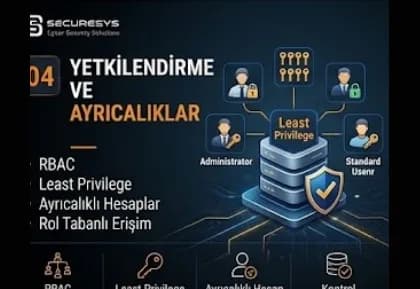
Database Authorisation: RBAC, Least Privilege and Privileged Accounts
A database authorization guide: RBAC, least privilege, privileged accounts, PAM, JIT access, access review and segregation of duties.
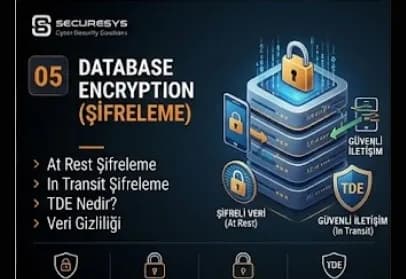
Database Encryption: What Are At Rest, In Transit and TDE?
A database encryption guide: at rest, in transit, TDE, column encryption, KMS/HSM key management, backup encryption and common mistakes.
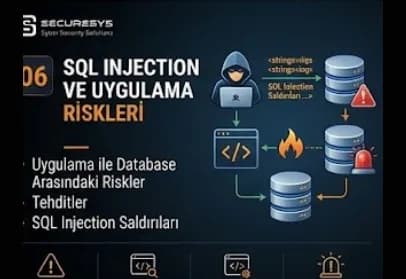
SQL Injection and Database Security: Risks Between Application and Database
SQL Injection and database security: parameterized queries, least privilege, ORM and stored procedure traps, WAF limits, SAST/DAST and incident response.
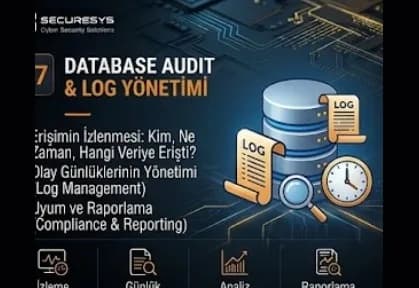
Database Audit and Log Management: Who Accessed What, and When?
Database audit and log management: who reached which data and when? Login/DDL/DML audit, log integrity, SIEM integration and detection scenarios.
Looking for professional support on this topic?
Our expert team will reach out for a free consultation as soon as possible.