Is SAST Enough on Its Own? Automated Scanning and Manual Source Code Review
What automated SAST can and cannot see: business logic flaws, false positives and negatives, and the role of manual code review.
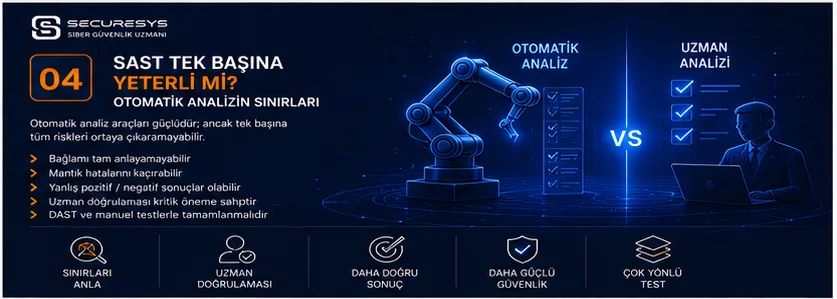
SAST is one of the most important tools in modern software security programmes.
It can analyse the data flows within source code.
It can detect many security problems — SQL Injection, Cross-Site Scripting, Command Injection, Path Traversal and more — before the software reaches production.
It can be integrated into CI/CD pipelines.
It can run automatically after every commit.
It can give developers security feedback while they write code.
All of this makes SAST an extremely powerful technology.
But there is a critical question here:
When an organisation buys a strong SAST product and scans all of its source code, can it then say the application is secure?
The answer is:
No.
Because SAST is a very important part of source code security but cannot see every security problem on its own.
An automated analysis engine can analyse the patterns, functions, data flows and potential security risks within source code.
But it cannot always understand the application's real business logic.
It cannot know which operations a particular user should be able to perform in a banking application.
It may not understand the conditions under which a discount code can be used on an e-commerce platform.
It cannot assess which manager should have access to which personnel file in an HR system without knowing the organisation's business rules.
The strongest approach in application security is therefore the combination:
Automation + Human Expertise
In modern Application Security programmes, SAST should be used as an important first line of defence but supported by methods such as manual source code analysis, business logic assessment and penetration testing.
1. Where SAST Is Strong
First it is worth understanding correctly why SAST matters so much.
One of the greatest advantages of SAST systems is that they can analyse very large code bases in a short time.
An application may contain millions of lines of source code.
Reviewing all of that code line by line by hand would take a very long time and would not be economically sustainable.
Through automation, SAST takes on a significant part of that burden.
It can be particularly successful with certain security problems.
For example, many areas are suitable for automated analysis:
- SQL Injection
- Command Injection
- Path Traversal
- Cross-Site Scripting
- Insecure use of cryptography
- Risky function calls
- Hard-coded credentials
- Error handling problems
- Insecure data flows
SAST also enables recurring security problems to be detected systematically.
If an organisation has 200 different repositories, for example, the same security rules can be applied automatically across every one of them.
That is an important standardisation advantage that is hard to achieve through manual analysis.
2. The Basic Limit of Automated Security Analysis
The fundamental problem with SAST systems is not that the technology is poor.
The real problem is that source code security does not consist only of technical patterns.
A vulnerability sometimes stems from a function call or incorrect API usage.
In such cases an automated system can be very successful.
But some flaws stem from how the application works.
To understand vulnerabilities of that kind, you need to know not only the code's syntax but what the application is trying to do.
An application may contain this code, for example:
if user.isAuthenticated():
transferMoney()
There is an authentication check in the code.
The SAST system may think this is secure.
But the real business rule may be:
A user must be able to transfer money only from their own account.
If the code verifies that the user is logged in but does not check whether the account being transferred from really belongs to that user, there is a serious Broken Access Control problem.
The flaw here is not a syntax error.
It is a business logic error.
3. What Is a Business Logic Vulnerability?
A business logic vulnerability is a security problem arising from an application's business rules being applied incorrectly or incompletely.
Flaws of this kind can differ from classic vulnerabilities.
In an SQL Injection attack the attacker sends a malicious SQL payload.
In a business logic attack the attacker can abuse the application's normal functions.
In an e-commerce application, for example, a discount code may be meant to be used only once.
But if the back end does not check how many times the code has been used, an attacker can use the same code repeatedly.
Here the attacker has not run malicious code.
They have not performed SQL Injection.
They have not sent an XSS payload.
They have simply used the system's normal function in an unexpected way.
Business logic flaws are therefore one of the areas automated security tools struggle with most.
4. Examples of Business Logic Flaws
Business logic security problems vary by sector and application.
In a financial application, for example, problems such as:
- exceeding a transfer limit,
- performing a transaction with a negative amount,
- initiating a transaction from another customer's account,
- skipping the approval process
can arise.
In an e-commerce application, flaws such as:
- unlimited use of a discount code,
- the product price being changed on the client side,
- a negative product quantity being sent,
- an order being created before payment is completed
can exist.
In a reservation system, security problems such as:
- another user's reservation being cancelled,
- a free reservation being created,
- date restrictions being bypassed
can emerge.
What these flaws have in common is that they depend on the application's business rules.
It is therefore not always possible for an automated SAST engine to understand them.
5. What Is Manual Source Code Analysis?
Manual source code analysis is a security specialist examining an application's source code from a security perspective.
This process is not merely reading code line by line.
The specialist first tries to understand the application's architecture.
For example:
- which modules the application consists of,
- how the authentication mechanism works,
- how the authorisation structure is implemented,
- how user roles are defined,
- in which systems data is held,
- what the critical business functions are,
- how external service integrations are performed
are analysed.
Attention then focuses on the security-critical areas of the code.
This approach deepens the general visibility SAST provides with human expertise.
6. What Is the Advantage of Manual Code Analysis?
The greatest advantage of manual source code analysis is its ability to understand context.
A security specialist does not assess code only in terms of the programming language.
They can also ask these questions:
What does this function do?
Who can call this function?
Why is this data used here?
Is authorisation really applied to the correct user?
Could an attacker run this flow in a different order?
Does a security problem arise when several functions come together?
Assessments of this kind are areas where automated systems are limited.
7. Are SAST and Manual Analysis Alternatives to Each Other?
No.
These two methods are complementary, not alternatives.
SAST analyses a very large amount of code quickly.
Manual analysis assesses critical points more deeply.
The strongest model works like this:
SAST → Automated Findings → Triaging → Manual Analysis → Risk Validation
This approach can significantly increase the security team's efficiency.
SAST identifies potential risk points among thousands of lines of code.
The security specialist then assesses whether a real security risk exists at those points.
8. The False Positive Problem
One of the problems encountered most often in SAST systems is false positives.
A false positive is a situation the tool believes to be a vulnerability but which is not actually exploitable.
The SAST system may see that user input reaches an SQL query, for example.
But the application may be using automatic parameterization at framework level.
If the tool cannot understand the framework's behaviour correctly, it may raise an SQL Injection finding.
In that case a vulnerability appears in the report while the system is actually secure.
As the number of false positives rises, security operations become harder.
Because the team starts spending its time investigating findings that are not real.
9. Why Are False Positives Dangerous?
At first glance a false positive may look like nothing more than a waste of time.
But in the long run it can create a more serious problem.
If developers constantly receive incorrect security warnings, trust in the tools declines.
This situation is sometimes called alert fatigue.
If a developer sees dozens of unimportant warnings every day, they may in time stop paying attention to warnings at all.
The real critical vulnerability can then be lost in the same list.
The aim of a successful SAST programme is therefore not to produce the maximum number of findings.
The aim is:
to produce highly accurate and actionable security findings.
10. The False Negative Problem
A false negative is a real vulnerability not being detected by SAST.
This can be more critical than a false positive.
Because the system produces no warning at all.
The team may believe the code is secure.
Yet a real security problem may have reached the production environment.
A complex authorisation problem may not be visible to SAST, for example.
A business logic flaw may go undetected.
A framework-specific security problem may not exist in the analysis engine's rules.
The absence of critical findings in a SAST report therefore does not mean:
"The application is secure."
11. Why Can No Tool Provide 100% Security?
Software security is not a deterministic problem.
An application's security cannot be determined solely by the list of functions used.
Application architecture,
business rules,
user roles,
deployment environment,
data flows,
external integrations,
network access
must be assessed together.
No automated security tool, SAST included, can therefore guarantee 100% security.
The aim was never to load all security onto a single product.
In a modern security architecture, different security layers work together.
12. What Is Security Triaging?
The process of security specialists reviewing the findings SAST produces and identifying the real risks is generally called security triaging.
During triaging the security specialist assesses the finding.
For example:
- Is the code really reachable?
- Is user input really controllable?
- Is the security control applied in another layer?
- Is the finding valid in the production environment?
- Under what conditions could an attacker exploit it?
- What could the real business impact be?
As a result of this assessment the finding can be classified as:
- True Positive
- False Positive
- Accepted Risk
- Not Exploitable
- Needs Investigation
This is one of the most important stages of SAST operations.
13. What Is a True Positive?
A true positive is a finding detected by the SAST tool that really is a vulnerability.
But there is an important distinction here too.
Not every true positive carries the same risk level.
There may be two different SQL Injection findings, for example.
The first may be in a critical payment system reachable over the internet.
The second may be in a tool used only in a local test environment.
Even though the technical weakness is the same, the business risk is entirely different.
In professional security assessment, technical severity alone is therefore not sufficient.
14. Risk Is Not the Same as a Technical Flaw
One of the mistakes made often in Application Security programmes is treating technical severity and real risk as the same thing.
In real risk assessment, different factors must be considered together.
It can be thought of like this, for example:
Risk = Technical Impact × Exploitability × Reachability × Business Criticality
A vulnerability may be technically critical.
But if the code in question is not used in production, the real risk may be lower.
Conversely, an authorisation problem that looks technically medium may have critical business impact if it gives access to highly sensitive customer data.
SAST scores should therefore not be accepted blindly.
15. Why Does Reachability Analysis Matter?
The presence of a security-risky library or function in a code base does not always mean that weakness is exploitable.
The risky function may never be called, for example.
It may exist only in old test code.
It may be in a part of the application not reachable from outside.
Reachability Analysis is therefore becoming steadily more important in modern security programmes.
The basic question is:
Can an attacker actually reach this security problem?
Reachability assessment both reduces the number of false positives and enables real risks to be prioritised more accurately.
16. Why Does the Runtime Environment Matter?
Static analysis examines source code.
But real security risk sometimes depends on the runtime environment.
A function may theoretically contain an SSRF flaw, for example.
But because of network policy in production the server may not be able to reach any internal system.
The risk still exists but its impact may be different.
The opposite is also possible.
An SSRF problem that looks minor in the code can become highly critical if it can reach metadata services in a cloud environment.
Deployment context therefore matters when assessing code security.
17. Runtime Security Problems
Some security problems cannot be fully assessed without the application running.
For example:
- Session management
- Cache behaviour
- HTTP security headers
- CORS configuration
- TLS settings
- Reverse proxy behaviour
- WAF effect
- Authentication token life cycle
can be assessed better in the runtime environment.
Dynamic testing methods such as DAST and manual pentesting are therefore important alongside SAST.
18. The Complementary Relationship Between SAST and DAST
SAST sees inside the application.
DAST looks at the application from outside.
These two perspectives complement each other.
SAST may find a potential XSS in the source code, for example.
DAST can test whether that XSS is actually triggered in the running application.
SAST can show the risky data flow reaching an SQL query.
DAST can assess attack behaviour through a real HTTP request.
In a security programme, therefore, the combination:
SAST + DAST
forms a strong foundation.
But manual pentesting is still needed for business logic and advanced attack scenarios.
19. Why Is Manual Pentesting Still Necessary?
Despite the rapid development of automation, manual penetration testing retains its importance.
Because attackers do not use only known patterns.
They can chain several functions together.
They can manipulate the application's business logic.
They can compare user roles.
They can change the order of API calls.
They can combine a low-severity flaw with another to create a critical attack.
Scenarios of this kind can be called attack chaining.
SAST can see a security problem in a single area of code.
A pentest specialist can bring different weaknesses together to assess the real attack impact.
20. What Is Attack Chaining?
Attack chaining is creating a more serious attack by using several security problems together.
There may be a low-risk information disclosure on its own, for example.
There may be a weak authorisation problem elsewhere.
There may be a predictable identifier structure at a third point.
Used together, these three problems can let an attacker reach sensitive data.
Automated tools may report these findings separately.
But a human specialist can see the attack chain.
The value of manual security testing is therefore not only in finding new issues.
It is in understanding the relationships between findings.
21. Are Code Review and Security Code Review the Same Thing?
No.
Normal code review generally focuses on:
- code quality,
- readability,
- performance,
- naming conventions,
- architectural standards.
Security code review assesses from an attacker's perspective.
For example:
- where does user-controlled data come from?
- can authorisation be bypassed?
- is sensitive information being logged?
- is insecure cryptography in use?
- can a race condition arise?
- can the file operation be manipulated?
Adding security checklists to classic code review processes therefore matters.
22. Is Peer Review Enough for Security?
Peer review is very useful.
Having one developer's code reviewed by another catches many errors early.
But security expertise is a separate competence.
Developers know the application's functional and architectural structure very well.
Security specialists specialise in attacker behaviour and vulnerabilities.
The strongest model combines these two perspectives.
For critical applications, therefore:
Developer Peer Review + SAST + Security Code Review
can be used together.
23. Where Does a Security Specialist Look in Source Code?
Manual source code analysis does not mean reviewing all the code at equal depth.
A risk-based approach is used.
These areas in particular can be more critical:
- Authentication modules
- Authorisation checks
- Payment operations
- File upload functions
- SQL and database access
- Use of cryptography
- API endpoints
- Admin functions
- Password reset flows
- Token generation
- External service calls
- Serialization operations
These areas can be analysed in more detail because they carry higher value for an attacker.
24. Manual Review of Authentication Code
Authentication is one of the most critical parts of a security system.
During manual analysis, checks such as these can be made:
- How are passwords stored?
- Is password hashing secure?
- Is there brute force protection?
- Is MFA bypass possible?
- Are session IDs generated securely?
- Are password reset tokens predictable?
- Is the token lifetime correct?
- Does logout really invalidate the session?
Some of these checks can be analysed to a limited extent by SAST.
But assessing the whole authentication life cycle may require human analysis.
25. Manual Review of Authorization Code
Authorisation is one of the most critical areas for manual analysis.
The security specialist tries to understand the different user roles.
There may be roles such as:
- User
- Manager
- Administrator
- Auditor
- API Service Account
Which roles critical endpoints and functions are open to is then assessed.
Object-level authorisation checks are examined in particular.
This question matters:
Beyond the user being signed in, is their right to access the object in question really verified?
This check plays a critical role in detecting security problems such as BOLA and IDOR.
26. Race Conditions and Operation Order Problems
Some business logic flaws stem from concurrent operations.
A user may be meant to use a coupon only once, for example.
But when two HTTP requests are sent at the same time, both operations may see the coupon as unused.
The coupon is then used twice.
Situations of this kind are called race conditions.
SAST can detect some technical race conditions.
But understanding the real business impact usually requires dynamic testing.
This example shows why the SAST + manual pentest combination is strong.
27. Mass Assignment Problems
In modern API applications it is common for JSON data sent by the user to be bound directly to a model object.
For a profile update, for example, this data may be sent:
{"name":"Ali","surname":"Yılmaz"}
But if the back end automatically accepts all fields, an attacker may try adding this field:
{"name":"Ali","role":"admin"}
If the application also binds the role field into the model, a serious authorisation problem can arise.
Because flaws of this kind depend on framework behaviour and business logic, automated analysis systems may not always detect them correctly.
28. What Is a Second-Order Vulnerability?
In some vulnerabilities the attack does not occur at the moment malicious data enters the system.
The data is first saved to the database.
The vulnerability is triggered later when a different function uses it.
This can be called a second-order vulnerability.
User input is saved to the database, for example.
Months later that data is used insecurely in an SQL query or HTML output in the admin panel.
Analysing data flows this long automatically is quite difficult.
Advanced SAST systems can detect them in some cases, but manual analysis remains valuable.
29. Can Framework Security Features Mislead SAST?
Yes.
Modern frameworks apply many security features automatically.
For example, controls such as:
- automatic output encoding,
- CSRF protection,
- parameterized ORM queries,
- authentication middleware
may be present.
If the SAST engine does not model framework behaviour correctly, it can produce false positives.
The opposite is also possible.
The framework may be secure by default, but the developer may have disabled the security control manually.
Analysis by a security specialist who understands the technology stack therefore matters.
30. The Custom Framework and Internal Library Problem
Large organisations often use frameworks and internal library systems they have built themselves.
The SAST product may not know the security behaviour of these bespoke libraries.
An organisation may have its own sanitization function, for example.
Because the tool does not recognise it, thousands of false positives can be produced.
In that case custom rules or custom sanitizer definitions must be created in the SAST solution.
These settings are an important part of professional SAST operations.
31. What Is SAST Tuning?
Running a SAST tool across thousands of repositories immediately after installation is not the ideal approach.
The system must be optimised for the organisation's technology landscape.
This process can be called SAST tuning.
Tuning can include settings such as:
- false positive rules,
- custom source definitions,
- custom sink definitions,
- sanitizer functions,
- framework behaviours,
- severity mapping,
- exclusion lists.
The aim is to help the tool understand the organisation's real software structure better.
32. How Should SAST Policies Be Set?
How SAST findings will be managed must be defined through clear policies.
An organisation might create a policy like this, for example:
Critical: the release is blocked.
High: remediation is required before release.
Medium: fixed within a defined SLA.
Low: added to the backlog.
But this policy should not depend on the tool's severity value alone.
Business criticality and real exploitation conditions must also be taken into account.
33. Should a Security Quality Gate Stop the Pipeline for Every Finding?
No.
This is one of the DevSecOps mistakes made most often.
If every low-severity SAST warning stops the build, developers start seeing the security system as an obstacle.
That can in time lead to controls being bypassed.
The Quality Gate should be risk-based.
The pipeline can be stopped in cases such as:
- a new critical finding,
- a validated high-severity vulnerability,
- hard-coded production credentials,
- a critical injection in an internet-facing application.
Lower-risk findings can be passed to the ticketing system.
34. How Should SAST Be Applied to Legacy Code?
When SAST is run for the first time on a large application developed over many years, thousands of findings can appear.
Trying to fix every flaw at once may not be realistic.
A more workable approach is to use a new code policy.
Existing technical debt is managed as a backlog.
But newly written code is not allowed to lower the security standard.
The basic principle is:
Do not create new vulnerabilities.
Old security debt is then reduced on a risk basis.
35. What Is Security Debt?
Security debt refers to security problems inherited from the past that have not yet been resolved.
It resembles the concept of technical debt.
An old application may contain hundreds of low and medium severity security problems, for example.
Fixing all of them at once may not be possible.
Security debt must therefore be measured and managed.
Critical risks must be prioritised,
the root cause of recurring security errors must be identified,
and the debt must be reduced over time.
36. How Should SAST Findings Be Presented to Developers?
A security team's success does not depend only on finding the vulnerability.
The finding must also be understood by the developer.
A poor finding might read:
"CWE-89 found. Fix it."
A good finding shows:
- the risky line of code,
- the source point,
- the sink point,
- the attack scenario,
- the secure alternative code.
A developer being able to understand the problem within a few minutes significantly reduces remediation time.
37. Why Does Developer Experience Matter?
Developer experience is critically important to the success of DevSecOps programmes.
If the security system constantly produces false alarms,
if scans take too long,
if reports are unintelligible,
if the developer has to keep raising tickets with the security team,
the system will not be sustainable.
A good AppSec programme integrates security into the developer's workflow.
The finding can be shown directly inside the pull request, for example.
The secure code recommendation can be presented on the same screen.
The developer can solve the problem without switching to another platform.
38. Where Is Human Expertise Most Valuable?
Automation is strong particularly on scale and speed.
Human expertise is strong on context and creativity.
The areas where a manual security specialist adds the most value are generally:
- Business logic
- Authorisation
- Authentication
- Attack chaining
- Complex data flow
- Race conditions
- Custom cryptography
- Critical architectural decisions
- Application-specific security models
The best security programme therefore does not set automation against people.
It uses both together.
39. The Ideal Source Code Security Model
A modern enterprise source code security model can be structured like this:
Layer 1 – Developer Controls
Secure Coding
IDE Security Plugin
Peer Review
Layer 2 – Automated Security
SAST
SCA
Secret Scanning
Layer 3 – Security Review
SAST Triaging
Manual Code Review
Architecture Review
Layer 4 – Runtime Testing
DAST
API Security Testing
Pentest
Layer 5 – Continuous Improvement
Retest
Metrics
Secure Coding Training
Security Champion
This approach takes security beyond a single product and spreads it across the whole software life cycle.
40. The SAST + Manual Code Analysis + Pentest Model
In practical terms, one of the strongest approaches is to combine three different perspectives.
SAST
Provides broad automated analysis across the whole code base.
Manual Source Code Analysis
Performs contextual, in-depth analysis in critical areas of the code.
Pentest
Assesses the running application from a real attacker's perspective.
When these three methods come together, different security blind spots are significantly reduced.
SAST sees the code.
The pentest sees the application's behaviour.
The manual specialist can interpret the relationship between the two.
The SecureSys Approach to SAST and Manual Source Code Analysis
At SecureSys we do not regard reporting automated scan output alone as a sufficient security approach in source code security work.
SAST is critically important for providing visibility across large code bases and identifying security problems at an early stage.
But for the real security risk to be surfaced, findings must be assessed in the application's context.
Depending on project scope, therefore, these layers can be used together:
SAST + Security Triaging + Manual Source Code Analysis + SCA + Secret Scanning + DAST + Pentest
High-risk areas in particular, such as:
- critical authentication functions,
- authorisation mechanisms,
- financial transaction flows,
- sensitive data operations,
- API services,
- file operations,
- admin functions,
can be taken into deeper manual assessment.
Our core goal is not to produce the greatest possible number of security findings.
It is to surface real, exploitable security risks that matter to the business.
Because the value of a security report is not measured by page count or number of findings.
The real value is
being able to show correctly which risks the organisation should solve first.
Frequently Asked Questions
Is SAST enough on its own?
No. SAST is a strong automated security control but may not detect flaws such as business logic issues, complex authorisation problems and runtime security problems.
Is manual source code analysis necessary?
It is recommended particularly for critical applications. Manual analysis lets a security specialist assess the application's business logic, authentication, authorisation and complex data flows.
What is a false positive?
It is when a SAST tool reports as a vulnerability something that is not actually exploitable.
What is a false negative?
It is when a real vulnerability is not detected by SAST.
What is the difference between SAST and pentest?
SAST analyses source code. A pentest approaches the running application from an attacker's perspective. The two methods complement each other.
What is a business logic vulnerability?
It is a vulnerability arising from an application's business rules being applied incorrectly or incompletely. It can be difficult for automated security systems to detect.
Do SAST findings need manual validation?
It is recommended particularly for critical findings. False positives can then be filtered out and the real risk level determined more accurately.
Can SAST replace manually analysing all the source code?
SAST can significantly reduce the amount of code manual analysis needs to cover, but it cannot entirely replace human expertise in critical business functions.
Conclusion: Automation Provides Speed, People Understand Context
SAST is one of the indispensable technologies of modern Application Security programmes.
It can analyse millions of lines of source code.
It can move security controls into the CI/CD pipeline.
It can give developers feedback while they write code.
It can detect known security problems systematically.
But understanding whether an application is genuinely secure is not possible through pattern matching or data flow analysis alone.
Because software security is also:
business logic.
user privilege.
architecture.
data flow.
attacker behaviour.
A strong security approach therefore does not ask:
People or automation?
The right question is:
How can human expertise and automation be used together most effectively?
That is where modern Application Security's answer lies:
Automation provides scale.
Manual analysis provides context.
Pentesting provides the attacker's perspective.
When these three approaches are used together, the journey towards secure software development becomes far stronger.
Related Articles
Source Code Analysis (Code Security)
What Is Source Code Analysis? A Guide to SAST and Code Security
What is source code analysis, how does SAST work and why does code security come before infrastructure? Concepts, methods and enterprise approach.
Vulnerabilities Start While Code Is Written: Secure Coding and Secure SDLC
Vulnerabilities are not born in production; they are created in design and code. A guide to Secure Coding, Shift Left, DevSecOps and Secure SDLC.
What Is SAST? How Static Application Security Testing Works
What is SAST and how does it work? Source-sink, taint analysis, false positives, CI/CD integration and tool selection in one guide.
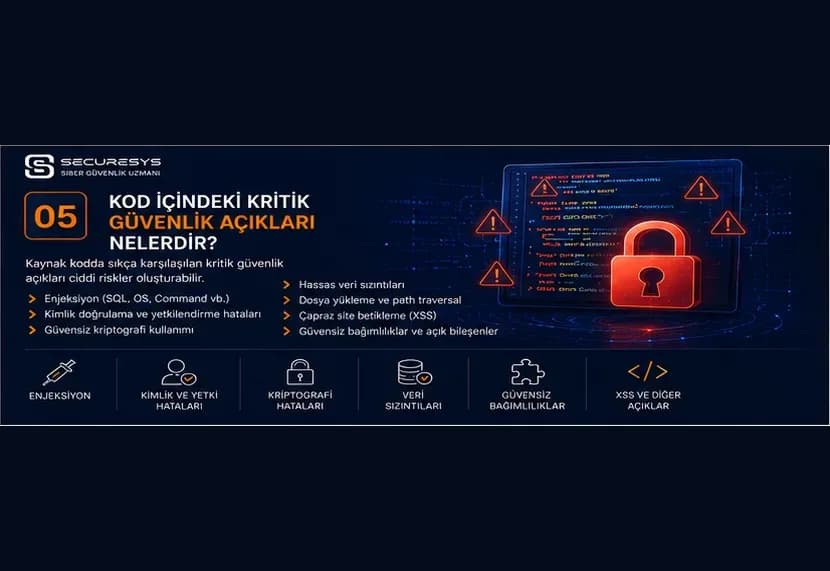
Critical Vulnerabilities in Code: A CWE and OWASP Perspective
The most critical vulnerabilities in source code — injection, XSS, broken access control, SSRF and more — through the CWE and OWASP lens.
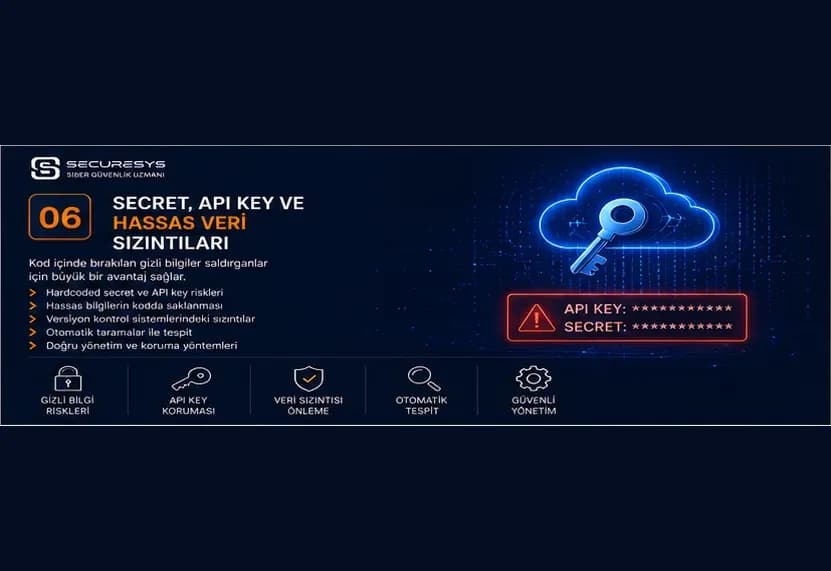
Secrets, API Keys and Sensitive Data Leaks: The Hidden Danger in Code Repositories
The invisible danger in code repositories: secret, API key and credential leaks — detection, rotation and secrets management.
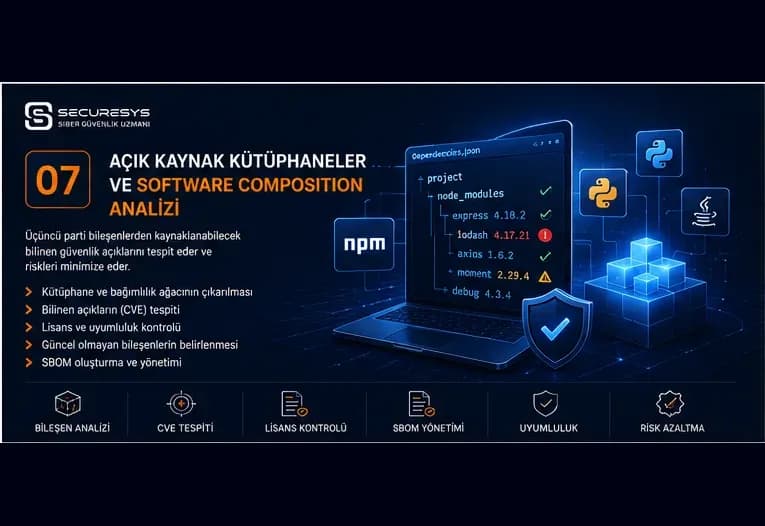
Open Source Libraries and Software Supply Chain Security: An SCA and SBOM Guide
Open source dependencies are part of your attack surface: SCA, SBOM, transitive dependencies and supply chain attacks.
Looking for professional support on this topic?
Our expert team will reach out for a free consultation as soon as possible.