What Is System and Cloud Security? How Is Enterprise Infrastructure Protected?
System and cloud security is not a product but a continuously managed discipline. This chapter covers the shared responsibility model, hardening and baselines, identity security, and the CSPM, CWPP and CNAPP concepts.
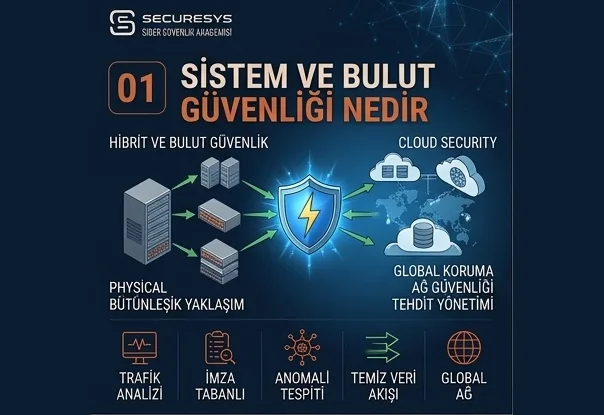
An organisation's information systems consist of far more than a few servers and security devices.
In modern environments;
Windows and Linux servers,
Active Directory,
Microsoft 365,
AWS,
Microsoft Azure,
Google Cloud,
databases,
container platforms,
Kubernetes clusters,
backup systems,
VPN and remote access infrastructure
can all be parts of the same ecosystem.
For that reason system security and cloud security can no longer be treated as two entirely separate topics.
A server may be misconfigured.
A cloud storage bucket may be exposed to the internet.
An Active Directory account may hold more privileges than it needs.
An API key may be sitting openly in a code repository.
A backup server may be reachable by a ransomware attacker.
All of these examples look like different technical areas but point to a shared problem:
Corporate infrastructure must be configured securely, monitored and continuously verified.
System and cloud security is therefore the holistic security approach aimed at protecting the servers, identities, networks, application components and data in organisations' on-premise and cloud infrastructure against cyber threats.
But the purpose of a strong system and cloud security programme is not merely to find vulnerabilities.
The real objective is:
To shrink the attack surface, reduce unnecessary privileges, identify misconfigurations, monitor critical activity and verify that the security controls genuinely work.
What Is System Security?
System security means protecting operating systems, servers, user accounts, services, file systems, network connections and management interfaces against unauthorised access and attack.
System security can cover topics such as;
- Windows Server security,
- Linux server security,
- Active Directory security,
- privileged account management,
- patch management,
- configuration hardening,
- endpoint protection,
- logging and monitoring.
All of them together.
A server not being exposed to the internet does not automatically make it secure.
Because the threat does not only come from outside.
A compromised user account,
an attacker on the internal network,
malware,
faulty permissions
can each create system security risk.
Corporate system security must therefore be handled with a defence in depth approach.
What Is Cloud Security?
Cloud security is the set of controls and processes for securely protecting the applications, data, identities, networks and services running in cloud environments.
When cloud security is mentioned, concepts such as;
AWS security,
Microsoft Azure security,
Google Cloud security,
Microsoft 365 security,
cloud IAM,
cloud network security,
cloud workload protection,
cloud security posture management
generally come up.
But cloud security consists of more than switching on the cloud provider's security services.
The most critical topic is configuration and identity management.
Because many cloud security incidents stem not from a software vulnerability directly but from problems such as;
a faulty IAM policy,
open storage,
an incorrect security group,
public service exposure,
excessive privilege.
What Is the Difference Between System Security and Cloud Security?
In traditional system security the organisation generally manages most of the infrastructure itself.
For example;
the physical server,
the hypervisor,
the operating system,
the network,
the firewall
can all be the organisation's responsibility.
In a cloud environment, responsibility is shared between the cloud provider and the customer.
This model is called:
The Shared Responsibility Model
and it changes everything.
The cloud provider protects the physical data centre and certain infrastructure layers.
But the customer's responsibility continues over their;
users,
IAM permissions,
application settings,
data,
security groups,
cloud workloads.
The approach:
“The cloud provider is secure, therefore so are we.”
is therefore wrong.
What Is the Shared Responsibility Model?
The shared responsibility model expresses how security responsibilities are divided between the cloud provider and the customer.
The general approach can be thought of as follows:
Cloud Provider
The physical data centre,
hardware,
the core cloud infrastructure,
the hypervisor or certain managed service layers.
Customer
Identity,
access permissions,
the application,
data,
configuration,
workload security.
But the level of responsibility varies with the service model used.
IaaS,
PaaS,
SaaS
each have a different responsibility split.
What Is IaaS Security?
Infrastructure as a service (IaaS) is the model in which infrastructure resources such as virtual servers, networking and storage are provided through the cloud.
In this structure the organisation is usually responsible for;
the operating system,
patching,
the application,
firewall rules,
IAM,
data
security.
Hardening a Windows Server running on an Azure virtual machine or AWS EC2 instance is mostly the customer's responsibility.
The cloud provider has only supplied the infrastructure.
What Is PaaS Security?
Platform as a service (PaaS) is the service model in which certain infrastructure layers such as the operating system are managed by the cloud provider.
Managed databases or application platforms come close to this category.
The organisation still carries responsibility for;
access permissions,
application security,
data protection,
IAM,
configuration.
Using PaaS does not remove security responsibility.
It merely hands certain infrastructure tasks to the provider.
What Is SaaS Security?
Software as a service (SaaS) is the model in which the application is used directly as a service.
Platforms such as Microsoft 365 are an example.
In this structure the customer's responsibility continues for topics such as;
identity,
MFA,
conditional access,
data sharing,
mail security,
user permissions.
SaaS therefore does not mean:
“We don't need to make any security configuration.”
What Are the Core Components of System Security?
Corporate system security can be handled through several main areas:
Configuration Hardening
Switching off unnecessary services and settings.
Patch Management
Applying security updates.
Identity & Access Management
User and privilege management.
Endpoint Protection
EDR/XDR and malware protection.
Network Security
Firewall, segmentation and access control.
Logging & Monitoring
Monitoring system activity.
Backup & Recovery
Protecting data securely and recoverably.
When any one of these areas is weak, a new entry or progression route opens for the attacker.
What Is Hardening?
Hardening is the application of security configurations to reduce the unnecessary attack surface on a system.
For example;
switching off unnecessary services,
disabling default accounts,
using secure protocols,
restricting firewall rules,
strengthening password policies
all fall within hardening.
But hardening is not a one-off operation.
New applications,
updates,
business needs
change the configuration over time.
Hardening must therefore be verified regularly.
What Are CIS Benchmarks?
CIS benchmarks are among the most widely used reference sets providing secure configuration recommendations for different operating systems, cloud platforms and applications.
Different benchmarks exist for;
Windows Server,
Linux,
AWS,
Azure,
Google Cloud,
Kubernetes.
Organisations can use CIS benchmarks as a reference in hardening work.
But every control must not be applied blindly.
Business requirements and operational needs must be taken into account.
What Is a Security Baseline?
A security baseline defines the organisation's minimum security configuration for particular system types.
A Windows Server baseline may contain;
password policy,
audit policy,
firewall settings,
RDP settings,
service configuration.
This approach prevents new servers being built at different security levels by different people.
It provides standardisation.
What Is Configuration Drift?
A system may be secure when first built.
But changes made over time degrade the security level.
This situation is called configuration drift.
For example;
a temporarily opened firewall rule is forgotten,
a debug service is left running,
a user is given temporary admin rights,
an old protocol is re-enabled.
The secure baseline and the current configuration must therefore be compared regularly.
What Is Patch Management?
Patch management is the controlled management of updates to operating systems, applications and other software.
The aim is to prevent known vulnerabilities being used by an attacker.
The patch process generally includes the stages of;
asset inventory,
vulnerability assessment,
risk prioritisation,
testing,
deployment,
verification.
But not all patches carry the same priority.
Critical vulnerabilities under active exploitation must be handled faster.
Are Vulnerability Management and Patch Management the Same Thing?
No.
Patch management focuses on applying updates.
Vulnerability management is far broader.
It covers the process of a vulnerability being;
identified,
risk-assessed,
prioritised,
remediated,
retested.
Some vulnerabilities cannot be solved with a patch.
A configuration change or network control may be required.
What Is Risk-Based Vulnerability Management?
Risk-based vulnerability management (RBVM) is the approach of prioritising by real attack risk rather than treating every vulnerability with the same urgency.
These factors can be assessed together, for example:
CVSS,
exploit availability,
internet exposure,
asset criticality,
threat intelligence.
Security teams can thereby focus on genuinely critical risks rather than thousands of low-value findings.
Why Is Active Directory Critical for System Security?
Active Directory is the centre of identity management in many organisations.
Users,
groups,
computers,
service accounts,
GPOs
can all be managed through AD.
Compromising Active Directory therefore provides broad system access.
AD security consists of far more than the Domain Admin password.
Relationships such as;
ACLs,
delegation,
service accounts,
group membership,
attack paths
matter too.
Is Identity Now the New Security Perimeter?
The modern security approach frequently uses the phrase:
Identity is the new perimeter
and for good reason.
Employees no longer work only from the company network.
A user can gain access with the same identity;
from the office,
from home,
from a mobile device,
from a cloud application.
Identity security has therefore moved to the centre of both system and cloud security.
What Is IAM?
Identity and access management (IAM) governs which resources users and services can access and with which privileges.
One of the core principles in IAM security is the:
Least privilege
approach.
A user should hold only the privileges needed to do their job.
This approach limits what an attacker can do with a compromised account.
What Is Privileged Access?
Privileged access describes the access of administrator or highly privileged accounts.
For example;
Domain Admin,
server administrator,
cloud global administrator,
database administrator
can each be privileged accounts.
These accounts are high-value targets for attackers.
Controls such as PAM, JIT and MFA can therefore be used.
Why Does PAM Matter in System and Cloud Security?
Privileged access management (PAM) allows highly privileged accounts to be managed under control.
Through PAM, controls such as;
password vaulting,
credential rotation,
session recording,
approval,
temporary access
can be applied.
Privileged access security is a shared risk area in cloud and on-premise systems alike.
Why Is MFA Not Enough?
MFA is an important security control.
But it does not solve every identity risk on its own.
An attacker can consider various routes such as;
session tokens,
OAuth permissions,
legacy authentication,
MFA fatigue.
MFA must therefore be handled together with;
conditional access,
identity monitoring,
ITDR,
PAM.
What Is Zero Trust?
Zero Trust is the approach of not treating a user or device as trustworthy simply because it is inside the network.
The core principle:
Never trust, always verify.
Every access is assessed against;
identity,
device,
location,
risk,
resource sensitivity.
Zero Trust is an important architectural approach for both cloud and corporate system security.
Why Does Network Segmentation Matter?
When an attacker compromises one system, they must not be able to reach the whole network.
Different areas such as;
the user network,
the server network,
the management network,
the database network,
the backup network
can therefore be separated.
Network segmentation reduces the attacker's lateral movement capability.
But creating VLANs alone is not enough.
Access rules between segments must also be kept minimal.
What Is Microsegmentation?
Microsegmentation is the approach of restricting network access in more detail and at workload level.
Two application servers in the same server VLAN may not need to communicate directly, for instance.
Microsegmentation can close that unnecessary access.
It has become particularly important in cloud and data centre environments.
What Is Cloud Network Security?
Cloud network security covers the correct configuration of components such as;
VPC,
VNet,
subnets,
security groups,
network ACLs,
cloud firewalls,
private endpoints.
One of the most important principles is reducing unnecessary public exposure.
A database being directly reachable from the internet is unnecessary in most architectures.
What Is a Security Group?
On AWS and similar cloud platforms, a security group is one of the network security mechanisms determining which traffic can reach a workload.
A misconfigured security group can expose critical services such as;
SSH,
RDP,
a database port
to the internet.
This is one of the best-known examples of cloud misconfiguration risk.
Why Can “0.0.0.0/0” Be Risky?
This notation represents the entire internet on the IPv4 side.
A management port being open to:
0.0.0.0/0
means anyone on the internet can reach that port.
But a public web server's port 443 being open to the whole internet is normal.
Broad access alone is therefore not an “exposure”.
It must be assessed alongside the service's purpose.
Why Is Public Cloud Storage Risky?
Cloud storage services can hold sensitive files.
Because of a faulty access policy, data can become exposed to the internet.
For example;
backups,
customer data,
logs,
documents,
source code
can be made public by accident.
Cloud security posture management processes must therefore continuously check for public storage exposure.
What Is Cloud Misconfiguration?
Cloud misconfiguration is a cloud service being configured in an insecure or unintended way.
Examples are;
public storage,
an excessively broad IAM role,
a public database,
an open management port,
logging switched off,
missing encryption.
It is one of the most critical risk areas in cloud security.
Because infrastructure changes constantly.
Why Does Infrastructure as Code Security Matter?
Modern cloud infrastructure is built with Terraform or similar infrastructure as code tools.
This provides a major automation advantage.
But if a faulty security rule is written into the code, it can be applied to hundreds of resources at once.
It is therefore important that IaC files pass through security scanning before deployment.
What Is Shift Left Cloud Security?
Shift left is moving security controls into the early stages of development and deployment rather than after production.
Terraform code can be scanned within CI/CD, for instance.
A faulty security group is caught before it reaches production.
This approach is one of the core principles of DevSecOps.
What Is CSPM?
Cloud security posture management (CSPM) is the security approach of continuously analysing misconfigurations and compliance problems in cloud environments.
CSPM can detect;
public storage,
open security groups,
missing encryption,
logging problems,
IAM risks.
It is therefore an important tool category for visibility in cloud security.
What Is CWPP?
A cloud workload protection platform (CWPP) focuses on the security of workloads running in the cloud.
It can monitor security risks on;
virtual machines,
containers,
serverless workloads.
While CSPM focuses more on cloud posture and configuration, CWPP focuses on the running workloads.
What Is CNAPP?
A cloud-native application protection platform (CNAPP) is the modern security approach attempting to combine CSPM, CWPP and other cloud security capabilities under a single platform.
A CNAPP can assess;
cloud posture,
workloads,
identity,
containers,
IaC
risks together.
But buying a platform does not mean establishing a cloud security programme.
Corporate process and expertise are still required.
What Is Container Security?
Container security covers the secure use of Docker and similar container technologies.
The risks may be;
a vulnerable image,
a root container,
an exposed secret,
an unsafe capability,
a faulty network policy.
Containers being short-lived does not reduce the security need.
On the contrary it increases the need for automation.
Why Does Kubernetes Security Matter?
Kubernetes is one of the important orchestration platforms for modern cloud-native applications.
But it creates complex permission and network structures.
From a security perspective;
RBAC,
secrets,
network policies,
pod security,
ingress,
the API server
are critical areas.
Faulty Kubernetes configurations create serious cloud security risks.
What Is Secret Management?
Applications need sensitive information such as;
database passwords,
API keys,
certificates,
tokens.
This information must not be written into source code in plain text.
Secret management is the secure storage and distribution of that information.
Managed secret vault services can be used in cloud environments.
Why Is a Hardcoded Secret Risky?
A password or API key sitting openly in code can leak through;
the Git repository,
a developer laptop,
CI/CD logs.
Secret scanning must therefore be built into DevSecOps processes.
And an exposed secret must not merely be deleted; it must be rotated.
What Are Encryption at Rest and Encryption in Transit?
Encryption at Rest
Keeping data encrypted on disk or storage.
Encryption in Transit
Encrypting data while it travels across the network.
The two controls are not alternatives to one another.
Both must be assessed in modern system and cloud security.
Why Is Key Management Critical?
The data may be encrypted.
But if the encryption key is not secure, the protection weakens.
Mechanisms such as;
KMS,
HSM,
key rotation,
access control
therefore matter.
The provider's managed key services can be used in cloud environments.
Why Is Logging a Security Control?
Being able to detect an attack matters as much as blocking it.
In system and cloud environments, therefore;
authentication logs,
admin activity,
configuration changes,
network logs,
application logs
must be collected.
But producing logs alone is not enough.
They must be analysed centrally.
What Does a SIEM Do in System and Cloud Security?
Security information and event management (SIEM) centrally collects and correlates logs from different systems.
Events from;
Windows Server,
Linux,
Active Directory,
cloud IAM,
the WAF,
the firewall
can be analysed on a single platform.
The attack chain thereby becomes far more visible.
Why Do Cloud Audit Logs Matter?
In cloud environments, management operations are usually carried out through APIs.
Audit logs therefore provide critical information such as;
who created which resource,
which IAM policy changed,
which security group was opened,
which storage access changed.
They are one of the most important data sources for cloud incident response.
Should EDR Be Used on Cloud Servers?
A virtual machine running in the cloud does not remove the need for endpoint security.
A cloud VM can also carry risk from;
malware,
credential theft,
web shells,
ransomware.
EDR/XDR should therefore be considered in suitable environments.
But container and serverless architectures may require different workload protection approaches.
What Is ITDR?
Identity threat detection and response (ITDR) focuses on detecting attacker behaviour in identity infrastructure.
It can detect;
anomalous privileged logins,
unexpected role assignments,
Active Directory changes,
cloud identity abuse.
The centralisation of identity has made ITDR one of the important components of system and cloud security.
Is Backup Security Part of System Security?
Absolutely.
Backup systems are targeted specifically in ransomware attacks.
If the attacker can delete the backups, the organisation's recovery capacity is seriously damaged.
For that reason backups;
must be separated from the production network,
highly privileged access must be restricted,
methods such as immutable backup must be considered,
restore tests must be carried out.
What Is Immutable Backup?
Immutable backup is a backup approach in which data cannot be modified or deleted for a defined period.
It makes it harder for a ransomware attacker to delete backup files.
But immutable backup does not solve every backup security problem on its own.
Access control and recovery testing matter too.
What Is Disaster Recovery?
Disaster recovery (DR) covers the plans and technologies for restoring systems after a major outage or cyber incident.
DR is not only for natural disasters.
Ransomware,
a cloud outage,
the compromise of a critical system
can each be a DR scenario.
There is therefore a direct relationship between system security and cyber resilience.
What Are RTO and RPO?
Recovery Time Objective (RTO)
States how quickly the system must return.
Recovery Point Objective (RPO)
Expresses the acceptable amount of data loss.
These values must not be set by the technical team alone.
They must be defined together with business units.
What Should Monitoring Cover in System and Cloud Security?
Modern monitoring is not merely CPU and RAM tracking.
From a security perspective, events such as;
failed logins,
privileged access,
network changes,
IAM changes,
security group changes,
new public assets,
secret exposure,
backup deletion
must also be monitored.
This approach combines operational monitoring with security monitoring.
The Relationship Between Observability and Security Monitoring
Observability provides an understanding of system behaviour through;
logs,
metrics,
traces.
Security teams can make use of that telemetry too.
An unexpected rise in API errors may not only be a performance problem.
It can be an indicator of an attack.
Modern cloud security and observability are therefore becoming increasingly intertwined.
Why Is Asset Inventory the First Step?
You have to know a system before you can protect it.
One of the most fundamental components of system and cloud security is therefore asset inventory.
The organisation must know:
How many Windows servers are there?
How many Linux servers?
Which cloud accounts are in use?
How many public IPs are there?
Which databases are critical?
How many Kubernetes clusters are there?
Is there shadow cloud?
Without that visibility, risk management remains incomplete.
What Are Shadow IT and Shadow Cloud?
Employees or teams can use SaaS or cloud services outside central IT's knowledge.
This situation is called shadow IT or shadow cloud.
A project team may have opened a separate cloud account on a credit card, for instance.
If the security team does not know about that environment, monitoring and security policy cannot be applied.
Cloud asset discovery therefore matters.
What Is Attack Surface Management?
Attack surface management (ASM) tries to continuously discover the organisation's assets visible to an attacker and assess their risks.
For example;
public IPs,
domains,
subdomains,
cloud services,
internet-facing applications
can be identified.
This approach strengthens the external visibility side of system and cloud security.
What Is External Attack Surface Management?
EASM focuses particularly on assets visible from the internet.
A forgotten test server or an old cloud IP address can be identified.
Such “forgotten assets” are valuable entry points for attackers.
Can System and Cloud Security Be Achieved with Security Products Alone?
No.
An organisation may use;
EDR,
SIEM,
CSPM,
CNAPP,
PAM.
But if the processes are wrong, the risk continues.
For example;
if the joiner-mover-leaver process is not working, a former employee's account stays open.
If cloud admin rights are never reviewed, privilege creep forms.
Technology, process and people must therefore be considered together.
What Is Security Validation?
Security validation is testing whether security controls genuinely work as expected.
For example;
hardening checks,
cloud configuration assessment,
penetration testing,
Red Team,
Purple Team,
restore tests
can each be part of this approach.
The aim is not to say:
“We have the control.”
but to be able to say:
“We verified that our control works.”
How Is a System Security Assessment Carried Out?
A professional system security assessment can cover these areas:
Asset Inventory
Identifying the assets.
Configuration Review
Security configurations.
Hardening Assessment
CIS or the corporate baseline.
Vulnerability Assessment
Known vulnerabilities.
Identity Review
Users and permissions.
Network Review
Access routes.
Logging Review
The visibility level.
Backup & Recovery
Resilience.
This work is far broader than vulnerability scanning alone.
How Is a Cloud Security Assessment Carried Out?
During a cloud security assessment;
the cloud account structure,
IAM,
the network,
storage,
logging,
encryption,
workloads,
containers,
backups,
security services
can be evaluated.
The aim is not merely to find misconfigurations.
It is to understand the real attack routes.
A permission chain may exist through which a low-privileged cloud identity can reach critical storage.
What Is a Cloud Attack Path?
Cloud environments also contain permission relationships between users, roles, workloads and services.
An attacker can start with a low-privileged identity and reach more critical resources through other permissions.
Cloud attack path analysis is therefore gaining importance.
The attack path logic of on-premise Active Directory applies to cloud IAM too.
Why Is Hybrid Identity Critical?
Many organisations are neither entirely cloud nor entirely on-premise.
Active Directory and Microsoft Entra ID can be used together.
This model is called hybrid identity.
An identity risk on one side affects the other.
On-premise AD and cloud identity must therefore be assessed together rather than separately.
What Is the Biggest Mistake in System and Cloud Security?
One of the biggest mistakes is seeing security only as vulnerability scanning.
A system may carry no critical CVE.
But it may have;
excessive IAM permissions,
open storage,
a weak admin account,
a faulty network rule,
backup access.
These faults are not always sufficiently visible to a classic vulnerability scanner.
System and cloud security therefore requires a broader configuration + identity + workload + monitoring approach.
Core Controls for Corporate System and Cloud Security
These layers must generally be considered together:
Asset Visibility
Know what you have.
Secure Configuration
Apply a baseline and hardening.
Patch & Vulnerability Management
Manage the vulnerabilities.
Identity Security
Use MFA, PAM and least privilege.
Network Segmentation
Restrict the access routes.
Cloud Posture Management
Monitor cloud misconfigurations.
Workload Protection
Protect servers, containers and workloads.
Logging & SOC
Monitor activity centrally.
Backup & Recovery
Prepare for post-attack recovery.
Security Validation
Test the controls regularly.
What Should a System and Cloud Security Report Contain?
A professional assessment report should not contain merely hundreds of technical findings.
It can include these sections:
Executive Risk Summary
The critical risks for management.
Asset & Architecture Overview
On-premise and cloud assets.
Hardening Findings
System configuration problems.
Identity Risks
IAM and privileged access issues.
Cloud Misconfiguration
Faulty cloud configurations.
Network Exposure
Unnecessary access routes.
Monitoring Gaps
SOC and logging shortfalls.
Backup & Recovery Risks
Cyber resilience problems.
Attack Path Analysis
How the findings connect to one another.
Remediation Roadmap
A prioritised action plan.
This approach turns a technical report into a corporate risk management tool.
How Is System and Cloud Security Measured?
Metrics across different areas can be used rather than a single security score.
For example:
Hardening Compliance
The rate of conformance to the baseline.
Critical Vulnerability Exposure
The number of critical vulnerabilities.
Public Cloud Exposure
Critical resources exposed to the internet.
Privileged Account Count
The number of highly privileged accounts.
MFA Coverage
The proportion of accounts protected by MFA.
Logging Coverage
The proportion of critical systems sending logs to the SIEM.
Backup Restore Success
Successful restore tests.
These metrics help measure the security programme's progress over time.
Conclusion: System and Cloud Security Is Not a Product but a Continuously Managed Security Discipline
The infrastructure of modern organisations is becoming steadily more complex.
On one side there are traditional systems such as;
Windows,
Linux,
Active Directory,
databases,
backups.
On the other side there are;
AWS,
Azure,
Google Cloud,
Microsoft 365,
Kubernetes,
serverless,
SaaS
environments in use.
Managing all of these as separate security islands is not sustainable.
Because the attacker does not care about technology boundaries.
They can move from an on-premise user account to the cloud.
They can reach a SaaS system with a cloud credential.
They can progress from a misconfigured server to Active Directory.
They can target the backup system with a compromised administrator account.
Strong system and cloud security therefore requires this approach:
Asset Visibility
↓
Hardening
↓
Identity Security
↓
Network Security
↓
Cloud Posture
↓
Workload Protection
↓
Monitoring
↓
Backup & Recovery
↓
Security Validation
The core objective here is not simply reducing the vulnerability count.
The more important question is this:
When an attacker reaches one of your systems, how far can they progress and how quickly can you see it?
The modern system and cloud security approach therefore brings together various security layers such as;
hardening,
least privilege,
Zero Trust,
CSPM,
CNAPP,
EDR/XDR,
SIEM,
PAM,
backup security.
And the starting point of this whole architecture is usually the most fundamental systems:
Windows and Linux servers.
Because even when running in the cloud, most critical workloads still sit on an operating system.
And a misconfigured server can be the attacker's first door into the corporate infrastructure.
Related Articles
System & Cloud Security
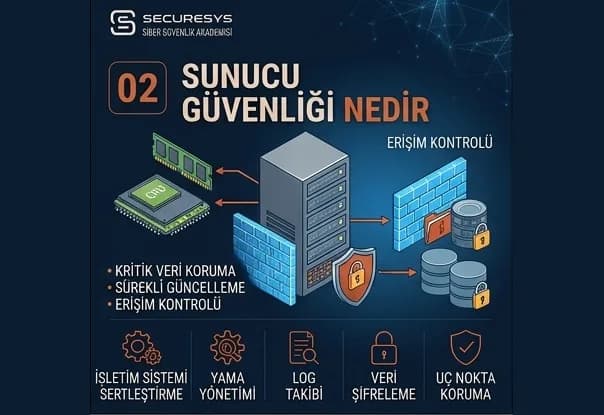
What Is Server Security? How Is Windows and Linux Server Hardening Done?
A secure server is more than a secure build. This chapter covers Windows and Linux hardening, CIS benchmarks and baselines, RDP/SSH security, privileged access and the logging layers.
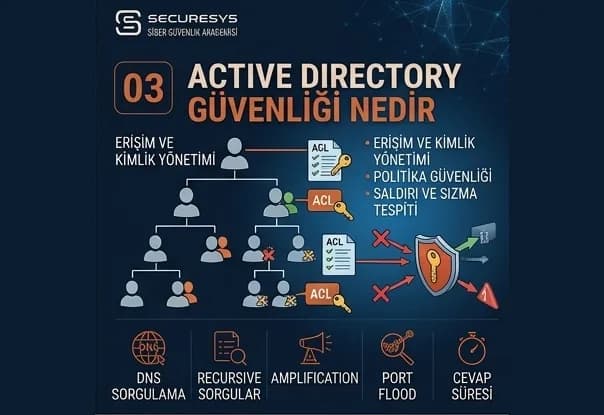
What Is Active Directory Security? Preventing Domain, Privilege and Identity Risks
Active Directory security is about protecting the identity graph. This chapter covers Kerberos and NTLM risks, ACLs and delegation, LAPS/gMSA and tiering, attack path analysis and AD recovery planning.
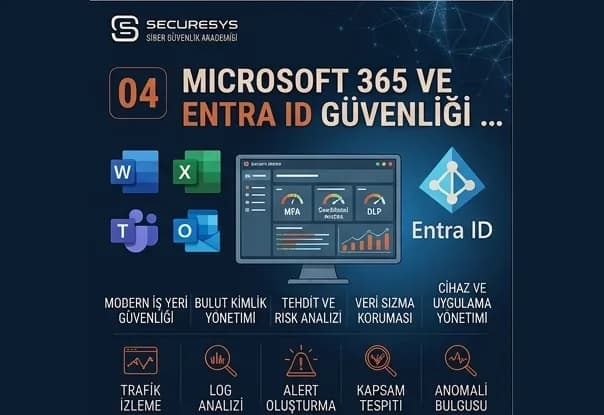
How Is Microsoft 365 and Entra ID Security Achieved?
How is Microsoft 365 and Entra ID security achieved? MFA, conditional access, PIM, OAuth governance, session security and identity incident response together.
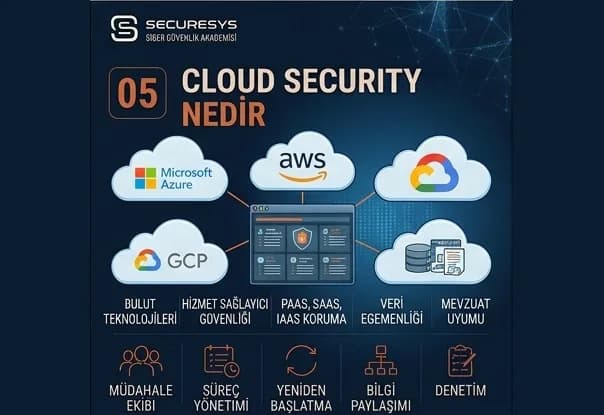
What Is Cloud Security? Securing AWS, Azure and Google Cloud
What is cloud security? How are the IAM, network, storage, logging and CSPM layers secured on AWS, Azure and Google Cloud?
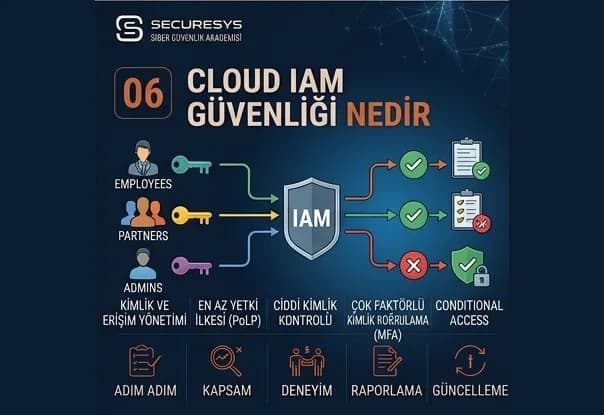
What Is Cloud IAM Security? Managing Permission, Role and Privileged Access Risk
What is cloud IAM security? Overprivilege, privilege escalation, service account risks and the CIEM approach on AWS, Azure and GCP.
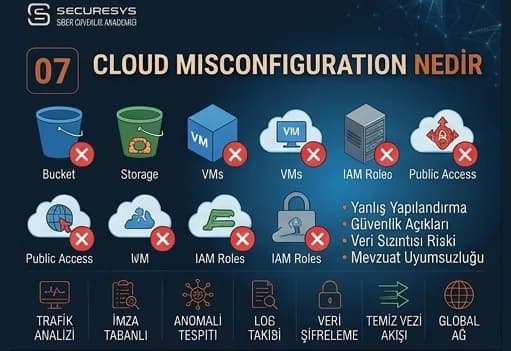
What Is Cloud Misconfiguration? How Are Faulty Cloud Configurations Detected?
What is cloud misconfiguration? How are public storage, open ports and disabled logging detected with CSPM?
Looking for professional support on this topic?
Our expert team will reach out for a free consultation as soon as possible.