What Is API Security? OWASP API Security Top 10 and BOLA Risks
What is API security, what are the OWASP API Security Top 10 risks and how are BOLA vulnerabilities prevented? A SecureSys expert guide.
What Is API Security?
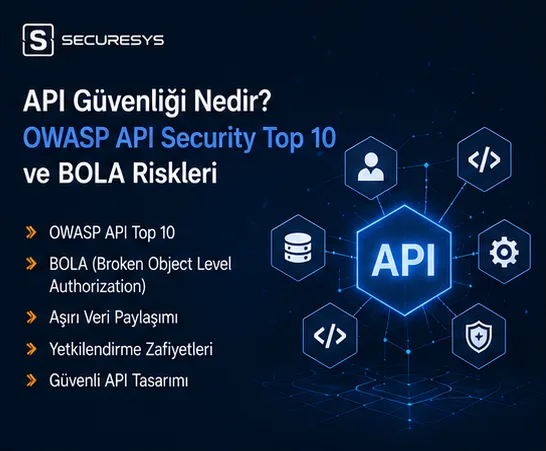
An Application Programming Interface (API) is the interface that allows different software to communicate with each other in a secure and controlled way. Today, most of the data exchange between web applications, mobile applications, desktop software, cloud services and third-party integrations takes place through APIs.
API security covers the evaluation of these services' controls for authentication, authorization, data validation, rate limiting, error handling and data sharing. APIs that are not designed securely can allow attackers to reach the data and business logic behind the application directly.
Why Are APIs a Primary Target for Attackers?
- APIs provide direct access to business logic.
- The same API can be used by both the web and mobile applications.
- Functions not visible in the user interface may be accessible via the API.
- Misconfigured APIs can return large amounts of data in a single request.
- In micro-service architectures, trust relationships between services can be mismanaged.
The Difference Between Web Security and API Security
| Web Application Security | API Security |
|---|---|
| Interfaces accessed through a browser are evaluated | Service endpoints are evaluated directly |
| HTML, JavaScript and client behaviour are examined | JSON, XML, GraphQL and service responses are analysed |
| User-experience focused | Data-flow and business-logic focused |
OWASP API Security Top 10 — The Most Common Risks
1. Broken Object Level Authorization (BOLA)
A user making a GET /api/orders/45872 request should only be able to see their own order. If the attacker changes the request to GET /api/orders/45873 and can access another customer's information, there is a serious authorization vulnerability. BOLA can lead to major data breaches in banking, healthcare, e-commerce and public-sector applications.
2. Broken Authentication
Accepting invalid tokens, allowing the use of expired sessions or JWT validation gaps can enable attackers to act as legitimate users.
3. Excessive Data Exposure
If the API returns more data than the client needs (national ID number, e-mail, phone, internal system notes, etc.), even if the client does not display it, the attacker can obtain that information by inspecting the API response.
4. Unrestricted Resource Consumption
The absence of rate limiting can allow attackers to send thousands of requests in a very short time, leading to service disruptions and brute-force attacks.
5. Security Misconfiguration
Leaving debug mode on, returning detailed error messages, enabling unnecessary HTTP methods, incorrect CORS settings and default accounts can broaden the attack surface.
A Real-World Scenario
During a security assessment of a customer portal running through a mobile application, it was found that on the API endpoint returning user profile information, simply changing the user identifier gave access to the full name, contact details, address records and order history of different customers. Even though no security problem was visible in the web interface, these sensitive data could be reached when the API calls were examined directly.
SecureSys API Penetration Testing Approach
Our tests cover the examination of REST API and GraphQL services, verification of JWT and OAuth flows, testing of BOLA and IDOR scenarios, parameter manipulation, mass-assignment checks, verification of rate-limiting mechanisms, and examination of CORS configurations.
Key Recommendations for API Security
- Object-level authorization must be checked at every endpoint.
- Returned data must be limited to only the fields the client needs.
- JWTs and access tokens must be validated securely.
- Rate limiting and quota mechanisms must be applied.
- All API calls must be centrally monitored and logged.
To have your APIs tested against BOLA, Broken Authentication and other OWASP API Security Top 10 risks, get in touch. You can also review our Web Application Penetration Testing Service page.
Related Articles
Web Application Security
What Is Web Application Penetration Testing?
What is web application penetration testing, why is it needed and how is it performed? OWASP Top 10, business logic flaws, manual testing methodology and the SecureSys approach.
What Is Cross-Site Scripting (XSS)? Stored, Reflected, DOM-Based XSS and Prevention Methods
What is XSS (Cross-Site Scripting), what are its types and how do you protect your web application? A comprehensive guide from SecureSys experts.
What Is Broken Access Control? IDOR, BOLA and Authorization Vulnerabilities
What are Broken Access Control, IDOR and BOLA? Horizontal/vertical privilege escalation scenarios and prevention methods. A SecureSys expert guide.
Authentication and Session Management Security: MFA, Brute Force, Session Hijacking
Authentication and session management security: MFA, brute force, credential stuffing and session hijacking risks. A SecureSys expert guide.

Business Logic Security Vulnerabilities: Price Manipulation and Coupon Abuse
What are business logic security vulnerabilities? Price manipulation, coupon abuse and race condition risks. A SecureSys guide.
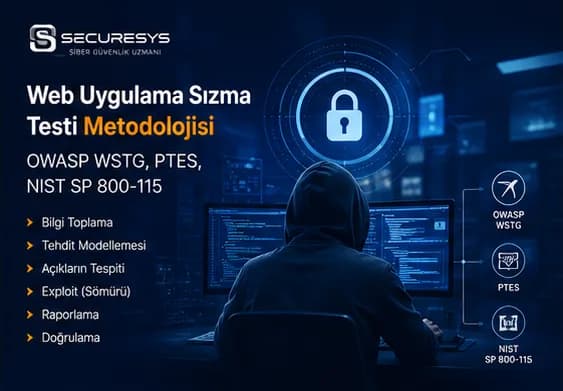
Web Application Penetration Testing Methodology: OWASP WSTG, PTES, NIST SP 800-115
SecureSys web application penetration testing methodology: planning, information gathering, manual testing, risk assessment and reporting stages.
Looking for professional support on this topic?
Our expert team will reach out for a free consultation as soon as possible.