Authentication and Session Management Security: MFA, Brute Force, Session Hijacking
Authentication and session management security: MFA, brute force, credential stuffing and session hijacking risks. A SecureSys expert guide.
The First Line of Defence in Digital Security
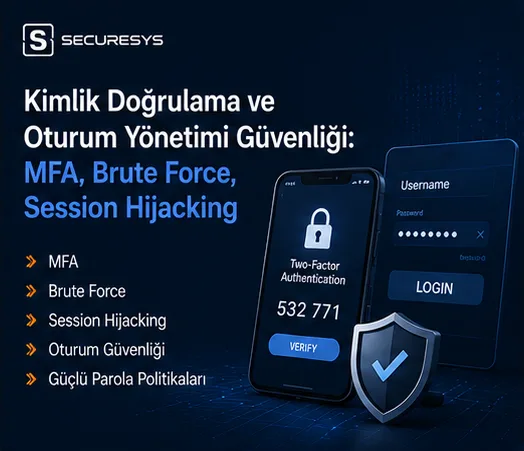
The security of a web application does not depend on the robustness of its code alone. Even an application with the strongest infrastructure can fall under an attacker's control because of weaknesses in its authentication or session management mechanisms.
Authentication is the process of verifying that the person trying to access the system really is who they claim to be. Session Management then ensures that the trust relationship created after this verification is maintained securely. One of the most valuable targets for attackers is obtaining a valid user session — because with a hijacked session they can often act as an authorised user inside the system without having to defeat complex attack techniques (see Broken Access Control).
The Difference Between Authentication and Authorization
| Authentication | Authorization |
|---|---|
| Verifies who the user is | Determines what the user can do |
| Involves username, password, MFA, etc. | Involves roles, permissions and access policies |
| Answers "Is this person really Ahmet?" | Answers "Can Ahmet delete this record?" |
A strong authentication system cannot compensate for faulty authorization controls — both mechanisms must work correctly.
Common Risks in Authentication Systems
- Weak password policies, default or predictable passwords
- Missing or incorrectly implemented multi-factor authentication (MFA)
- Lack of protection against brute-force attacks
- Credential stuffing attacks
- Security weaknesses in password-reset processes
- JWT (JSON Web Token) and OAuth 2.0 / OpenID Connect misconfiguration
- Session cookie security and missing session termination
Brute Force and Credential Stuffing Attacks
Attackers frequently make use of leaked databases containing millions of username/password combinations to carry out automated login attempts. This method is called credential stuffing and can be highly successful because users reuse the same password across different platforms. In brute-force attacks the attacker systematically tries a large number of password combinations. Account lockout, rate limiting, CAPTCHA, MFA and behavioural analysis should be evaluated together against these attacks.
Multi-Factor Authentication (MFA)
Having MFA enabled is not sufficient on its own. During penetration tests the following should be checked: is MFA mandatory for all critical operations, is the trusted-device logic implemented correctly, can MFA be bypassed, are recovery codes secure, can the password-reset process disable MFA, and do API calls actually enforce MFA controls?
Session Management
Penetration tests examine: is the Session ID predictable, is it renewed after login, can an old session be used after logout, does the session timeout work correctly, and are the cookie attributes (HttpOnly, Secure, SameSite) configured securely?
A Real-World Scenario
In a corporate management panel, the session identifier created after users logged in remained valid even after they logged out. During the penetration test it was found that the old session identifier could be reused to access the system again. Without any password cracking, solely because of this session-management flaw, access to the administrator account could be regained. This example shows why secure session-termination mechanisms are critical.
Key Security Recommendations
- MFA should be enabled by default on critical accounts.
- Failed login attempts should be monitored and rate limiting applied.
- All session identifiers should be random and unpredictable.
- Authentication mechanisms should be enforced at the same level not only in the web interface but also at the API layer.
To have your authentication, MFA and session-management mechanisms tested, review our Web Application Penetration Testing Service page.
Related Articles
Web Application Security
What Is Web Application Penetration Testing?
What is web application penetration testing, why is it needed and how is it performed? OWASP Top 10, business logic flaws, manual testing methodology and the SecureSys approach.
What Is Cross-Site Scripting (XSS)? Stored, Reflected, DOM-Based XSS and Prevention Methods
What is XSS (Cross-Site Scripting), what are its types and how do you protect your web application? A comprehensive guide from SecureSys experts.
What Is Broken Access Control? IDOR, BOLA and Authorization Vulnerabilities
What are Broken Access Control, IDOR and BOLA? Horizontal/vertical privilege escalation scenarios and prevention methods. A SecureSys expert guide.
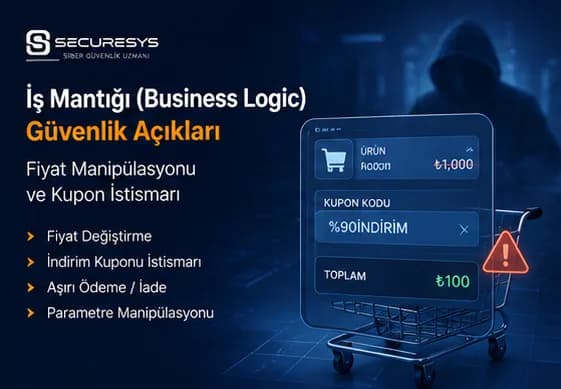
Business Logic Security Vulnerabilities: Price Manipulation and Coupon Abuse
What are business logic security vulnerabilities? Price manipulation, coupon abuse and race condition risks. A SecureSys guide.
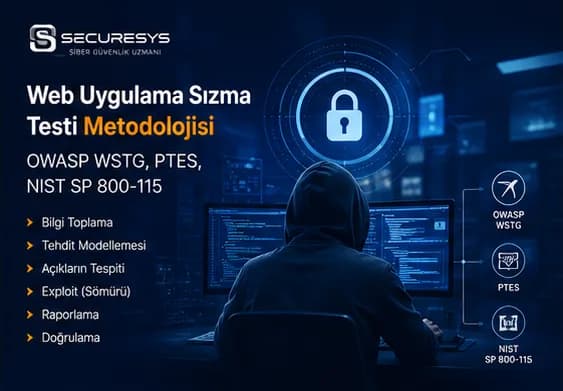
Web Application Penetration Testing Methodology: OWASP WSTG, PTES, NIST SP 800-115
SecureSys web application penetration testing methodology: planning, information gathering, manual testing, risk assessment and reporting stages.
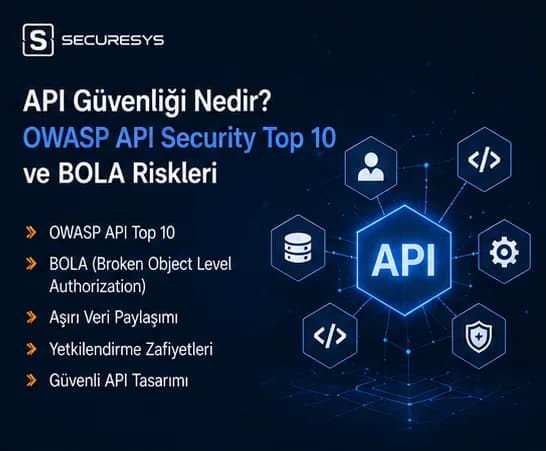
What Is API Security? OWASP API Security Top 10 and BOLA Risks
What is API security, what are the OWASP API Security Top 10 risks and how are BOLA vulnerabilities prevented? A SecureSys expert guide.
Looking for professional support on this topic?
Our expert team will reach out for a free consultation as soon as possible.