Business Logic Security Vulnerabilities: Price Manipulation and Coupon Abuse
What are business logic security vulnerabilities? Price manipulation, coupon abuse and race condition risks. A SecureSys guide.
What Are Business Logic Vulnerabilities?
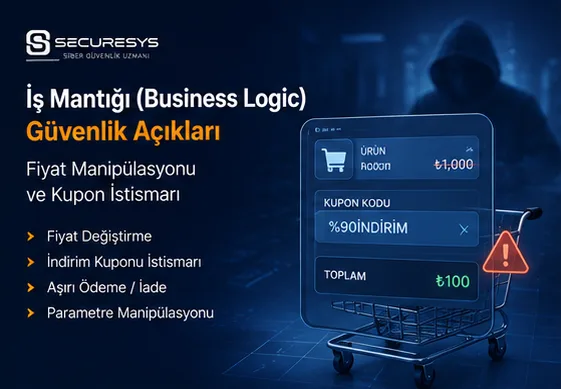
A web application may technically pass every security control — it may have no SQL Injection, its XSS vulnerabilities may be fixed, and its authentication may be securely configured. Yet the application can still be open to attack because its business processes are poorly designed or insufficiently checked.
Business logic vulnerabilities are weaknesses arising from gaps in the application's operating rules that allow attackers to use the system in ways the developer did not anticipate. The problem is not in the technology used, but in the difference between how the application "should work" and how it "actually works".
Why Do Automated Security Tools Miss These Vulnerabilities?
Automated tools can quickly scan for predefined technical vulnerabilities such as SQL Injection or XSS. However, an automated tool cannot answer questions like: how many times can a user redeem the same discount coupon? Is an order confirmed even though payment failed? Can the same campaign be abused with different accounts? The answers to these questions can only be found through the manual analysis of experienced penetration testers who understand how the application works.
The Most Common Business Logic Vulnerabilities
1. Price Manipulation
Some applications calculate the product price based on data sent by the client. If there is no server-side validation, the attacker can modify the request to buy a product far below its real value — for example, manipulating the request {"productId": 2501, "price": 1500} to {"productId": 2501, "price": 15}.
2. Campaign and Coupon Abuse
The same coupon being usable across different sessions, race conditions being altered, or expired coupons becoming active again all lead directly to revenue loss.
3. Bypassing the Process Order
In a sequential flow such as Basket → Address → Payment → Order Confirmation, if the attacker can send the request for the final step directly, the process is bypassed. Such vulnerabilities can have critical consequences, especially in payment systems.
4. Race Condition
When the same operation is submitted concurrently multiple times, the application may behave unexpectedly — the same gift card being used twice, a balance being spent twice, or the same product being deducted from stock more than once.
A Real-World Scenario
On an online sales platform, order creation and payment were handled by separate services. During the penetration test it was found that even when the payment request was cancelled, the order service did not verify this. As a result, a user could create an order without paying, the order moved to "successful" status, and the logistics process started automatically. Even though the system had no classic vulnerabilities such as SQL Injection, XSS or RCE, this single flaw in the workflow created a serious risk of financial loss.
SecureSys Business Logic Testing Approach
Our tests cover step-by-step verification of workflows, analysis of permission and role changes, testing of payment and order processes, examination of campaign/coupon mechanisms, and the creation of race-condition scenarios. This approach reveals critical business logic vulnerabilities in applications that appear technically secure.
Business Logic Flaws and Their Potential Outcomes
| Business Logic Flaw | Potential Outcome |
|---|---|
| A discount coupon being reusable | Revenue loss |
| Product price alterable on the client side | Financial damage |
| The payment step being skippable | Unauthorised orders |
| Bypassing the approval process | Unauthorised operations |
Detecting business logic vulnerabilities requires an experienced manual testing team — reach out via our Web Application Penetration Testing Service page.
Related Articles
Web Application Security

What Is Web Application Penetration Testing?
What is web application penetration testing, why is it needed and how is it performed? OWASP Top 10, business logic flaws, manual testing methodology and the SecureSys approach.
What Is Cross-Site Scripting (XSS)? Stored, Reflected, DOM-Based XSS and Prevention Methods
What is XSS (Cross-Site Scripting), what are its types and how do you protect your web application? A comprehensive guide from SecureSys experts.
What Is Broken Access Control? IDOR, BOLA and Authorization Vulnerabilities
What are Broken Access Control, IDOR and BOLA? Horizontal/vertical privilege escalation scenarios and prevention methods. A SecureSys expert guide.
Authentication and Session Management Security: MFA, Brute Force, Session Hijacking
Authentication and session management security: MFA, brute force, credential stuffing and session hijacking risks. A SecureSys expert guide.

Web Application Penetration Testing Methodology: OWASP WSTG, PTES, NIST SP 800-115
SecureSys web application penetration testing methodology: planning, information gathering, manual testing, risk assessment and reporting stages.
What Is API Security? OWASP API Security Top 10 and BOLA Risks
What is API security, what are the OWASP API Security Top 10 risks and how are BOLA vulnerabilities prevented? A SecureSys expert guide.
Looking for professional support on this topic?
Our expert team will reach out for a free consultation as soon as possible.