OWASP Top 10 and the Security Vulnerabilities Tested in Web Applications
What is the OWASP Top 10 and which security vulnerabilities are tested in a web application penetration test? A comprehensive SecureSys guide.
What Is the OWASP Top 10?
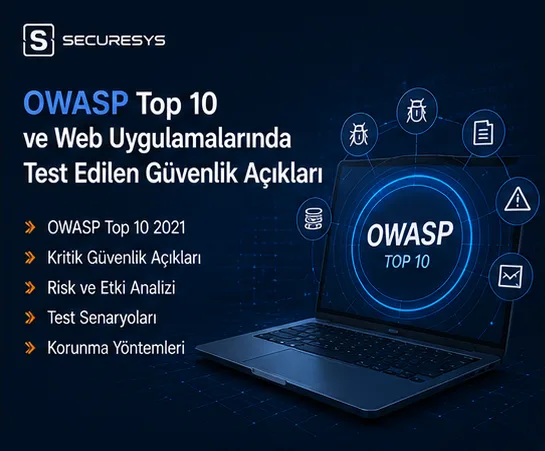
OWASP (Open Worldwide Application Security Project) is a globally recognised, independent security community that identifies the most common and most critical security risks in web applications. The OWASP Top 10 list is compiled by analysing millions of real security vulnerabilities and is regarded as one of the most important references for assessing the security level of web applications. Web application penetration tests carried out by SecureSys are performed in line with the OWASP Web Security Testing Guide (WSTG) and OWASP Top 10 methodologies.
OWASP Top 10 (2021) Categories
| Security Risk | Description | Business Impact |
|---|---|---|
| Broken Access Control | Bypassing authorization controls | Unauthorised access to critical data |
| Cryptographic Failures | Faulty encryption or data protection | Disclosure of sensitive data |
| Injection | SQL, NoSQL, LDAP and similar injection attacks | Database breach and data loss |
| Insecure Design | Lack of security-focused design | Business logic vulnerabilities |
| Security Misconfiguration | Incorrect system or server configuration | Unauthorised access and system compromise |
| Vulnerable & Outdated Components | Out-of-date software components | Exploitation of known vulnerabilities |
| Identification & Authentication Failures | Authentication weaknesses | Account takeover |
| Software & Data Integrity Failures | Gaps in code and data integrity | Execution of malicious code |
| Security Logging & Monitoring Failures | Insufficient logging and monitoring | Attacks going unnoticed |
| Server-Side Request Forgery (SSRF) | The server making requests on the attacker's behalf | Access to internal network resources |
Key Security Controls Evaluated in SecureSys Tests
Because of their frequency and impact, some OWASP Top 10 categories are covered by dedicated, in-depth pages at SecureSys:
- SQL Injection — the most critical sub-topic of the Injection category.
- Cross-Site Scripting (XSS) — Stored, Reflected and DOM-Based types.
- Broken Access Control — IDOR, BOLA, horizontal/vertical privilege escalation.
- Identification & Authentication Failures — MFA, brute force, session management.
- API Security — the scope of the OWASP API Security Top 10.
- Business Logic — the practical extension of the Insecure Design category.
Other Critical Areas Also Tested
Cryptographic Failures
TLS configurations, SSL certificates, encryption algorithms, hash algorithms, password storage methods and key management are tested to assess whether user information is protected securely.
Security Misconfiguration
Configuration-related risks such as debug modes left on, default user accounts, incorrect CORS settings, directory listing and out-of-date software versions are checked.
Cross-Site Request Forgery (CSRF)
Whether operations such as changing a password, transferring money or granting privileges can be performed without the user's knowledge while their session is open is tested; CSRF token usage and SameSite cookie settings are examined.
Server-Side Request Forgery (SSRF) and XML External Entity (XXE)
SSRF vulnerabilities can allow the server to reach systems on the internal network, while XXE can allow access to server files through misconfigured XML parsers. Both scenarios are tested with techniques targeting classic and cloud environments.
Insecure File Upload
File extension filters, MIME-type validation, magic-byte checks and web-shell upload attempts are evaluated.
Secure Session Management
Secure cookie, HttpOnly, SameSite, session timeout, session fixation and session hijacking scenarios are analysed.
Why Is the OWASP Top 10 Alone Not Enough?
One of the common mistakes organisations make is to assess security only against the items on the OWASP Top 10 list. Yet today a significant proportion of successful attacks stem not from direct technical vulnerabilities but from logical gaps in the application's workflow. For example, in a finance application a user may appear to be able to view only their own accounts, but if another customer's data can be reached by changing a parameter in the request, this is a classic business logic and authorization problem. Such vulnerabilities often cannot be detected by automated scanners; experienced experts must perform manual analysis and develop attack scenarios.
At SecureSys, we use automated tools and manual analysis together in our tests, give special attention to business logic and authorization controls, and report risks not only by detecting them but also with actionable remediation recommendations.
To have your web application tested against the OWASP Top 10 and beyond, reach out via our Web Application Penetration Testing Service page.
Related Articles
Web Application Security
What Is Web Application Penetration Testing?
What is web application penetration testing, why is it needed and how is it performed? OWASP Top 10, business logic flaws, manual testing methodology and the SecureSys approach.
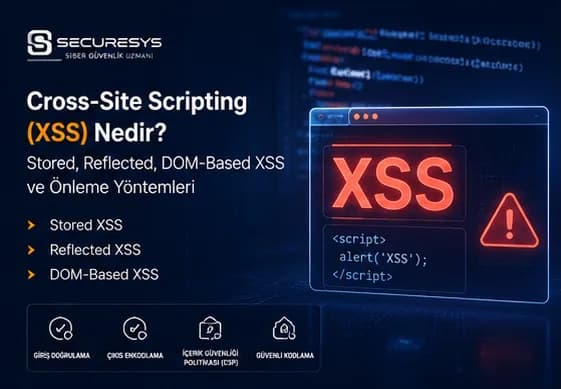
What Is Cross-Site Scripting (XSS)? Stored, Reflected, DOM-Based XSS and Prevention Methods
What is XSS (Cross-Site Scripting), what are its types and how do you protect your web application? A comprehensive guide from SecureSys experts.
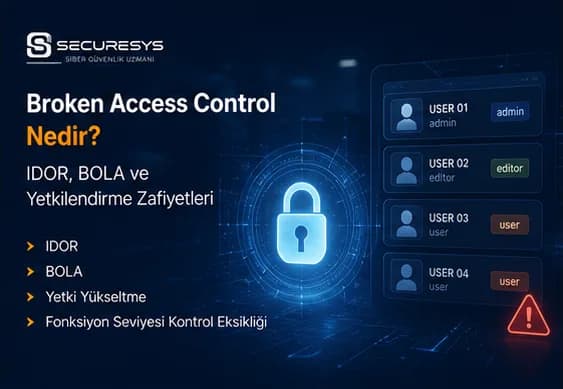
What Is Broken Access Control? IDOR, BOLA and Authorization Vulnerabilities
What are Broken Access Control, IDOR and BOLA? Horizontal/vertical privilege escalation scenarios and prevention methods. A SecureSys expert guide.
Authentication and Session Management Security: MFA, Brute Force, Session Hijacking
Authentication and session management security: MFA, brute force, credential stuffing and session hijacking risks. A SecureSys expert guide.

Business Logic Security Vulnerabilities: Price Manipulation and Coupon Abuse
What are business logic security vulnerabilities? Price manipulation, coupon abuse and race condition risks. A SecureSys guide.

Web Application Penetration Testing Methodology: OWASP WSTG, PTES, NIST SP 800-115
SecureSys web application penetration testing methodology: planning, information gathering, manual testing, risk assessment and reporting stages.
Looking for professional support on this topic?
Our expert team will reach out for a free consultation as soon as possible.