What Is Cross-Site Scripting (XSS)? Stored, Reflected, DOM-Based XSS and Prevention Methods
What is XSS (Cross-Site Scripting), what are its types and how do you protect your web application? A comprehensive guide from SecureSys experts.
What Is Cross-Site Scripting (XSS)?
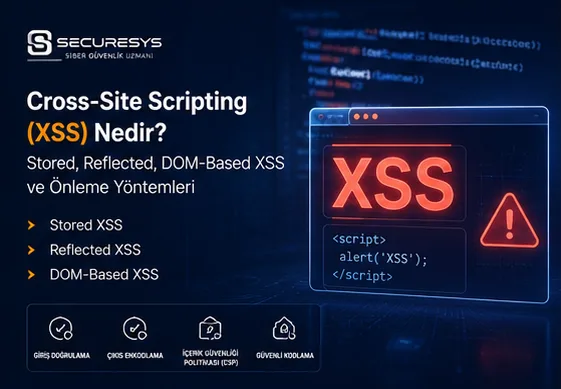
Cross-Site Scripting (XSS) is a critical security vulnerability that allows an attacker to inject malicious client-side code (usually JavaScript) into a web application so that it runs in the browsers of other users. While SQL Injection targets the database directly, XSS targets the user — so session information, user accounts and any sensitive data accessible through the browser are also put at risk.
In modern web applications, XSS vulnerabilities can appear in comment fields, messaging modules, search boxes, profile information, management panels and when data returned from an API is processed on the client side. Many organisations see XSS merely as a "printing JavaScript to the screen" problem, but a successful XSS attack can lead to serious consequences such as hijacking user sessions, phishing and unauthorised operations.
Why Is XSS a Critical Security Risk?
Even though XSS attacks do not compromise the server directly, they are extremely dangerous because they target real users who trust the application to carry out their operations. Malicious code running in the browser of a user with administrator privileges in particular can give the attacker indirect but powerful control over the system — leading to the hijacking of administrator sessions, viewing of corporate data on the client side, and theft of authentication credentials.
Types of XSS
1. Stored XSS (Persistent XSS)
Occurs when the attacker saves malicious code into the application's database. The malicious content is then served to every user who views the page — through fields such as product reviews, support tickets, forum messages or profile descriptions. This type of XSS is among the highest-impact scenarios.
2. Reflected XSS
Occurs when malicious input is returned directly to the user by the application; usually seen through search pages, error messages or URL parameters. The attacker sends a specially crafted link to the user, and when opened the malicious code runs in the browser. It is often used together with social engineering attacks.
3. DOM-Based XSS
One of the most common XSS types in modern JavaScript applications. The vulnerability originates not from the server but from the client-side JavaScript code. It must be examined carefully in single-page applications (SPA) and systems using frameworks such as React, Angular or Vue.
A Real-World Scenario
In an organisation's help-desk application, users could add descriptions to support tickets. During the penetration test it was found that malicious JavaScript added to the description field was not filtered. Each time the support team viewed the ticket, the malicious code ran and session information was sent to a server under the attacker's control. The attacker did not hack the system directly, yet by hijacking the administrator account gained full control over the application.
SecureSys XSS Testing Approach
We do not settle for automated scanner output alone in XSS testing. Every application is analysed manually, examining all points where user input is processed: reflected/stored/DOM-based XSS scenarios, HTML injection checks, rich-text editor security, Content Security Policy (CSP) configuration and cookie security flags (HttpOnly, Secure, SameSite).
How Can XSS Be Prevented?
- User input must be encoded appropriately for its context.
- HTML output must be filtered securely.
- Safe DOM methods should be preferred over unnecessary
innerHTMLusage. - Content Security Policy (CSP) must be enabled.
- HttpOnly, Secure and SameSite attributes must be used on cookies.
- Regular code reviews and independent penetration tests must be carried out.
Potential Outcome and Business Impact
| Potential Outcome | Business Impact |
|---|---|
| Hijacking of session information | Unauthorised user access |
| Takeover of the administrator account | Loss of control over critical systems |
| Display of phishing screens | Erosion of user trust |
| Reading sensitive data on the client side | KVKK and data-breach risk |
To have your application tested against XSS and other client-side vulnerabilities, review our Web Application Penetration Testing Service page.
Related Articles
Web Application Security

What Is Web Application Penetration Testing?
What is web application penetration testing, why is it needed and how is it performed? OWASP Top 10, business logic flaws, manual testing methodology and the SecureSys approach.
What Is Broken Access Control? IDOR, BOLA and Authorization Vulnerabilities
What are Broken Access Control, IDOR and BOLA? Horizontal/vertical privilege escalation scenarios and prevention methods. A SecureSys expert guide.
Authentication and Session Management Security: MFA, Brute Force, Session Hijacking
Authentication and session management security: MFA, brute force, credential stuffing and session hijacking risks. A SecureSys expert guide.

Business Logic Security Vulnerabilities: Price Manipulation and Coupon Abuse
What are business logic security vulnerabilities? Price manipulation, coupon abuse and race condition risks. A SecureSys guide.

Web Application Penetration Testing Methodology: OWASP WSTG, PTES, NIST SP 800-115
SecureSys web application penetration testing methodology: planning, information gathering, manual testing, risk assessment and reporting stages.
What Is API Security? OWASP API Security Top 10 and BOLA Risks
What is API security, what are the OWASP API Security Top 10 risks and how are BOLA vulnerabilities prevented? A SecureSys expert guide.
Looking for professional support on this topic?
Our expert team will reach out for a free consultation as soon as possible.