ISO 27001 ISMS Consulting Service
Protect your information assets and manage security risk systematically: gap analysis, risk assessment, policy set, Annex A and SoA, internal audit and ISO/IEC 27001:2022 certification readiness.
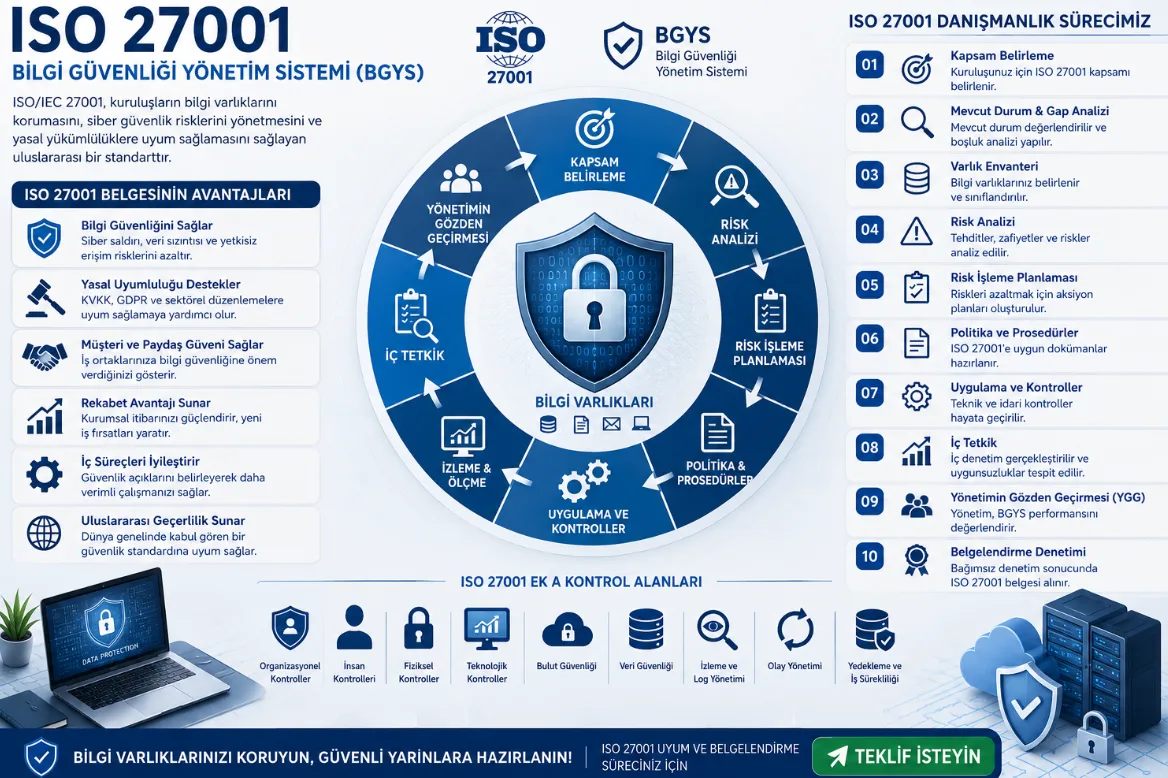
ISO/IEC 27001 is an internationally recognised standard for Information Security Management Systems (ISMS). It helps organisations protect the information assets they hold, manage information security and cyber security risks, and run their security processes within a systematic structure.
The ISO 27001 standard provides a comprehensive framework covering policy, process, procedure, risk management and technical controls within information security management.
By achieving ISO 27001 compliance, organisations aim to protect the:
- Confidentiality
- Integrity
- Availability
of their information assets and to manage information security risks in a controlled way.
Under its ISO 27001 ISMS consulting service, SecureSys supports the entire ISO 27001 compliance process — from current-state analysis and risk assessment to the development of policies and procedures, internal audit and certification readiness.
What Advantages Does ISO 27001 Certification Bring Your Organisation?
An ISO 27001 certificate is not merely a certificate. It demonstrates that the organisation manages its information security processes systematically and has established a defined management model for information security risk.
It strengthens information security
It ensures that cyber attacks, data leakage, unauthorised access, account takeover and other information security risks are assessed systematically.
It supports legal compliance
ISO 27001 work contributes to establishing many of the security processes required under KVKK, GDPR and sector-specific information security requirements.
It builds trust with customers and partners
It shows your customers, business partners and suppliers that you apply a systematic management approach to information security.
It provides competitive advantage
An ISO 27001 certificate can be a significant advantage particularly with corporate customers, in public tenders, in supplier assessments and on international projects.
It improves internal processes
It helps standardise risk analysis, asset management, access control, incident management and other security processes.
It offers international recognition
ISO/IEC 27001 is one of the information security management system standards recognised worldwide, and it helps organisations build trust on international projects.
The Transition From ISO/IEC 27001:2013 to ISO/IEC 27001:2022
The ISO/IEC 27001 standard has been updated over the years to keep pace with the changing technology and threat landscape.
The ISO/IEC 27001:2013 version has been updated by ISO/IEC 27001:2022.
Cyber security now sits at the top of the strategic agenda for many organisations. Ransomware, data breaches, identity-based attacks, cloud security risks and remote working models have all made it necessary for information security management systems to develop as well.
In particular:
- The spread of cloud services
- Remote and hybrid working models
- The increase in cyber attacks
- The growth of supplier and third-party risk
- The rising importance of data privacy
- Growing needs around security monitoring and threat intelligence
made an update to the ISO 27001 control structure necessary.
The ISO/IEC 27001:2022 version offers a control approach better suited to this changed risk environment.
What Changed With ISO 27001:2022
The ISO/IEC 27001:2022 version brought a significant restructuring of the information security controls.
Under the new approach, controls are addressed in simpler categories better suited to modern security needs.
Controls aimed at today's information security needs stand out in particular:
- Threat intelligence
- Cloud service security
- ICT readiness for business continuity
- Physical security monitoring
- Configuration management
- Information deletion
- Data masking
- Data leakage prevention
- Monitoring activities
- Web filtering
- Secure coding
Organisations holding an ISO 27001:2013 certificate therefore need to do more than update their documentation: they need to reassess their existing technical and operational security controls from an ISO 27001:2022 perspective.
How Does the ISO 27001 Consulting Service Work?
The SecureSys ISO 27001 consulting service is tailored to the organisation's existing structure.
It generally proceeds through the following stages:
1. Scope definition
The organisational units, systems, locations and processes to be included in the ISO 27001 ISMS scope are determined.
2. ISO 27001 gap analysis
The extent to which the existing information security structure meets the ISO/IEC 27001 requirements is assessed.
3. Asset inventory
Information assets, systems, applications, data sources and critical business processes are identified.
4. Risk analysis
Information security risks are determined by assessing the threats to and vulnerabilities of the information assets, together with the existing controls.
5. Risk treatment plan
Actions are defined for mitigating, accepting, transferring or avoiding the risks identified.
6. Development of policies and procedures
The policies, procedures, instructions and records required under ISO 27001 are prepared, or existing documents are updated.
7. Assessment of technical controls
The extent to which the information security policies are applied in the technical environment is examined.
8. Internal audit
The ISMS structure's conformity with the ISO 27001 requirements is assessed through an internal audit.
9. Management review
ISMS performance is assessed from a senior management perspective.
10. Certification readiness
Final preparation and conformity checks are carried out before the audit by the certification body.
What Is an ISO 27001 Gap Analysis?
An ISO 27001 gap analysis is an assessment carried out to determine how far an organisation's existing information security structure meets the requirements of the ISO/IEC 27001 standard.
The gap analysis establishes the relationship:
Requirement → Current State → Gap → Risk → Recommended Action → Owner → Target Date
This allows the organisation to see where the gaps lie before starting the ISO 27001 certification process, and to direct its resources towards the priority actions.
ISO 27001 Risk Analysis
One of the core components of ISO 27001 is information security risk management.
The risk analysis identifies the organisation's critical information assets and assesses the threats to them, their vulnerabilities and the existing security controls.
Risk assessment considers the criteria of:
confidentiality + integrity + availability
together with the likelihood of the risk materialising and its potential impact on the organisation.
The risk analysis produces the organisation's information security risk register and risk treatment plan.
ISO 27001 Technical Work
ISO 27001 compliance cannot be achieved by preparing documentation alone.
The information security policies have to be genuinely applied within the organisation's technical infrastructure.
Depending on need, the ISO 27001 consulting service can assess technical areas such as:
- Active Directory security controls
- User and permission management
- MFA control
- Password policies
- Firewall security policies
- Network segmentation
- VPN and remote access
- Log management
- SIEM infrastructure
- EDR/XDR deployment status
- Vulnerability and patch management
- Backup controls
- Disaster recovery infrastructure
- DLP and data security
- PAM and privileged access
- Cloud security
- Email security
- EOL/EOS system checks
This approach supports ISO 27001 being applied in the real IT environment, not only on paper.
ISO 27001 Training
The ISO/IEC 27001:2022 training delivered by SecureSys helps organisations understand the requirements of the standard and manage their ISMS processes sustainably in-house.
The training can cover topics such as:
- ISO 27001 core concepts
- The ISO 27001:2022 changes
- Risk management
- ISMS scope
- Annex A controls
- Policy and procedure management
- Internal audit
- Management review
- The certification process
The ISO 27001 Certification Process
In the ISO 27001 certification process, the organisation first establishes and implements its ISMS.
The audit process carried out by an accredited certification body then begins.
The process generally proceeds as:
ISMS Implementation → Internal Audit → Management Review → Certification Audit → Surveillance Audits → Recertification
SecureSys supports the organisation in preparing for the audit from a consulting perspective independent of the certification body.
Who Is ISO 27001 Consulting Suitable For?
ISO 27001 consulting can be applied for:
- Public institutions
- Defence industry companies
- Financial institutions
- Software companies
- SaaS firms
- Data centre operators
- Cloud service providers
- Healthcare organisations
- Manufacturing companies
- Energy companies
- E-commerce firms
- Technology companies
- Organisations processing personal or otherwise critical data
It can also be an important requirement for organisations serving large customers and encountering ISO 27001 conditions in supplier assessments.
Why SecureSys for ISO 27001 Consulting?
SecureSys does not treat ISO 27001 work as an exercise in producing policies and procedures.
Risk management + documentation + technical security + internal audit + certification readiness are addressed together.
The aim is for the ISO 27001 requirements to be met not only on paper but applied within the organisation's real IT and security environment.
How Is an ISO 27001 Certificate Obtained?
An organisation wishing to obtain an ISO 27001 certificate first has to establish an Information Security Management System (ISMS) conforming to ISO/IEC 27001 and put that system into practice.
The ISO 27001 certification process does not consist of preparing a few policies and procedures. The organisation's information assets have to be identified, information security risks analysed, the necessary security controls applied, responsibilities defined and the system operated sustainably.
The process of obtaining ISO 27001 certification generally consists of the following steps:
- Defining the ISO 27001 scope
- Carrying out an ISO 27001 current-state and gap analysis
- Identifying the information assets
- Performing the ISO 27001 risk analysis
- Preparing the risk treatment plan
- Developing the policies and procedures
- Assessing the ISO 27001 Annex A controls
- Applying the technical and organisational security controls
- Producing the ISMS records
- Carrying out the ISO 27001 internal audit
- Holding the management review
- Closing the gaps and non-conformities
- Entering the certification audit
The certification audit is carried out by an accredited certification body independent of the consulting service.
Before certification, SecureSys supports the organisation in establishing its ISMS structure, carrying out its risk analyses, preparing the documentation and becoming ready for audit.
Is an ISO 27001 Certificate Mandatory?
An ISO 27001 certificate is not generally mandatory for every organisation. It can nonetheless become a requirement in practice because of the sector the organisation operates in, the legislation it is subject to, customer contracts, public tenders or supplier security requirements.
An ISO 27001 certificate can be an important customer or contractual requirement in particular for:
- Companies serving public institutions
- Organisations operating in the financial sector
- Defence industry companies
- Software and technology firms
- SaaS service providers
- Data centre and cloud service providers
- Suppliers serving large corporate customers
- Organisations processing critical or personal data
Many large organisations assess information security levels when selecting suppliers and treat an ISO 27001 certificate as an important indicator of trust.
The question "is ISO 27001 mandatory?" should therefore be considered not only in terms of legal obligation but also in terms of customer requirements, competitive advantage and supplier security.
How Long Does It Take to Obtain an ISO 27001 Certificate?
The time needed to obtain an ISO 27001 certificate varies according to the organisation's size, headcount, locations, the complexity of its information systems and its existing information security maturity.
The preparation time for an organisation starting ISO 27001 work from scratch will not be the same as for one that has already established information security policies, risk management processes and technical controls.
The main factors affecting the duration are:
- The size of the organisation
- The number of locations to be included in the ISO 27001 scope
- Headcount
- The number of critical information systems
- The state of existing policies and procedures
- Information security maturity level
- Technical security gaps
- The scope of the risk analysis
- Additional security controls that need to be applied
- Internal audit results
- The time needed to complete corrective actions
The process can move faster in a small, well-prepared organisation, while a more comprehensive exercise may be needed in organisations with multiple locations and complex IT infrastructure.
Following an ISO 27001 gap analysis, SecureSys can produce a roadmap setting out an estimated project duration and the actions to be applied, based on the organisation's current position.
How Are ISO 27001 Consulting Fees Determined?
ISO 27001 consulting fees should not be assessed on the basis of a fixed package price. The consulting scope varies according to the organisation's size, the ISO 27001 scope, existing ISMS maturity and the volume of work required.
The main factors affecting ISO 27001 consulting cost include:
- The organisation's headcount
- The number of locations
- The processes to be included in the ISO 27001 scope
- The size of the IT infrastructure
- The level of existing documentation
- The scope of the risk analysis
- The need for policies and procedures
- Technical security controls
- The need for internal audit
- ISO 27001 training
- Certification readiness
- The need for on-site or remote working
To prepare an accurate ISO 27001 consulting proposal, the organisation's current position and the intended scope therefore have to be established first.
Following a preliminary assessment by SecureSys, an ISO 27001 consulting scope, project plan and pricing tailored to your organisation can be produced.
What Is the Relationship Between ISO 27001 and KVKK?
ISO 27001 and KVKK are not the same thing.
KVKK sets out the legal obligations for protecting personal data, whereas ISO 27001 enables an organisation to establish an Information Security Management System covering all of its information assets.
There is nonetheless an important relationship between the two.
Controls applied under ISO 27001 such as:
- Access control
- Authorisation
- Log management
- Asset management
- Risk analysis
- Data classification
- Backup
- Incident management
- Supplier security
- Physical security
- Personnel security
can contribute to the information security measures required under KVKK.
Holding an ISO 27001 certificate does not, however, automatically mean KVKK compliance. Equally, having carried out KVKK work does not mean the organisation conforms to ISO 27001.
The right approach is to manage the ISO 27001 ISMS and the KVKK processes within a structure in which each supports the other.
What Is the Difference Between ISO 27001 and ISO 27017?
ISO/IEC 27001 is the core information security standard for establishing an Information Security Management System.
ISO/IEC 27017 is a guideline focused specifically on information security controls for cloud services.
ISO 27001 addresses a broader scope:
- Information security management
- Risk management
- Policies and procedures
- Organisational security
- Technical security
- Physical security
whereas ISO 27017 supports the management of security responsibilities between the customer and the cloud service provider, particularly in cloud environments.
In organisations making heavy use of AWS, Microsoft Azure, Google Cloud or other cloud services, assessing ISO 27001 + ISO 27017 together can produce a stronger cloud security management model.
What Is an ISO 27001 Internal Audit?
An ISO 27001 internal audit is a systematic internal review carried out to assess whether the Information Security Management System the organisation has established meets the requirements of the standard.
The internal audit examines:
- The ISO 27001 requirements
- Corporate policies
- Procedures
- Risk management processes
- Annex A controls
- Technical security practices
- Records
- Responsibilities
- Previously defined actions
The internal audit identifies non-conformities, observations and opportunities for improvement.
This allows the organisation to see its own gaps before the certification audit, and it is one of the most important stages of ISO 27001 certification readiness.
SecureSys can carry out the ISO 27001 internal audit from an independent assessment perspective and produce corrective action recommendations for the gaps identified.
What Is the ISO 27001 Management Review?
Under ISO 27001, senior management is required to assess the effectiveness of the Information Security Management System at defined intervals.
An ISO 27001 management review meeting generally assesses:
- ISMS objectives
- Risk status
- Security incidents
- Internal audit results
- Non-conformities
- Corrective actions
- Performance indicators
- Resource requirements
- Business and technology changes
- Continuous improvement opportunities
The purpose of the management review is not simply to produce meeting minutes. Senior management is expected to assess information security performance and take the necessary decisions.
The ISO 27001 management review therefore demonstrates that information security is not the responsibility of IT or cyber security teams alone; it is a corporate process that has to be followed at management level.
How Is an ISO 27001 Risk Analysis Carried Out?
An ISO 27001 risk analysis is the process of determining information security risks by assessing the threats to the organisation's information assets, their vulnerabilities and the existing security controls.
The risk analysis begins by defining the critical information assets.
The following relationship is then established:
Asset → Threat → Vulnerability → Existing Control → Likelihood → Impact → Risk Level
Risks are assessed against the three fundamental properties of information:
Confidentiality: only authorised people can access the information.
Integrity: the information is not altered without authorisation or control.
Availability: the information and systems are usable when needed.
A risk treatment plan is prepared for the risks that remain above the acceptable level after the analysis.
Four fundamental approaches can be applied to risk:
Mitigate the risk Accept the risk Transfer the risk Avoid the risk
An ISO 27001 risk analysis is not a one-off exercise. It has to be reassessed at defined intervals in line with new systems, projects, suppliers, threats and organisational changes.
What Are the ISO 27001 Annex A Controls?
ISO 27001 Annex A contains the reference information security controls organisations can consider when managing information security risk.
In the ISO/IEC 27001:2022 version, the Annex A controls are structured under four main headings:
Organisational controls
Covering information security policies, roles and responsibilities, supplier security, incident management, asset management and organisational information security processes.
People controls
Covering personnel security, awareness, training, confidentiality obligations and the information security controls associated with human resources processes.
Physical controls
Covering the protection of physical areas, secure zones, the physical security of equipment and measures against environmental threats.
Technological controls
Covering access control, authentication, logging, cryptography, vulnerability management, backup, network security, secure software development and other technical security controls.
It is not correct to assume that every control in Annex A has to be applied directly by the organisation.
The organisation assesses which controls are applicable as a result of its own ISO 27001 risk analysis and explains those decisions in its Statement of Applicability (SoA).
What Is the ISO 27001 Statement of Applicability (SoA)?
The Statement of Applicability (SoA) is one of the core ISMS documents, showing which Annex A controls apply to the organisation under ISO 27001, which do not, and the justification for those decisions.
The SoA allows the following to be tracked centrally:
- The controls applied
- The controls not applied
- The justification for applying each control
- Control status
In ISO 27001 certification audits, the risk analysis, the risk treatment plan and the Statement of Applicability have to be assessed as consistent with one another.
ISO 27001 Consulting Proposal
If you are considering starting an ISO 27001 consulting and compliance process, SecureSys can build a scope of work tailored to your organisation — including current-state analysis, ISO 27001 gap analysis, information security risk analysis, development of policies and procedures, assessment of the Annex A controls, technical security controls, internal audit, management review and certification readiness.
We provide ISO/IEC 27001:2022 consulting for a range of needs, from organisations seeking ISO 27001 certification for the first time to companies wanting to develop an existing ISMS.
Get in touch for ISO 27001 certification, ISO 27001 compliance consulting, ISO 27001 risk analysis or ISO 27001 internal audit services.
Want to learn more about this service?
Our expert team will reach out for a free consultation as soon as possible.