What Is Identity and Access Management? IAM, PAM, IGA and Modern Identity Security
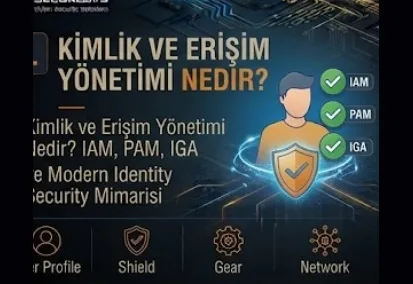
What is identity and access management? IAM, PAM, IGA, ITDR, CIEM, non-human identity and a Zero Trust based modern identity security architecture.
Corporate cyber security was for many years designed predominantly through the network perimeter. It was accepted that the users and systems behind the firewall were more trustworthy and that connections coming from the external network carried a higher risk.
The spread of cloud computing, SaaS applications, remote working, hybrid infrastructure, mobile devices, APIs, DevOps processes and artificial intelligence based systems changed this model significantly.
Today an employee can access a corporate application from the office.
The same employee can a few hours later connect from home to a SaaS platform such as Microsoft 365.
An administrator can carry out a privileged operation on a cloud console.
An application can access another service through an API.
A Kubernetes workload can use another cloud resource.
An AI Agent, on the other hand, can carry out operations on more than one system on behalf of the user.
In this environment the traditional:
Inside Network = Trusted
approach is no longer sufficient.
The fundamental question of a modern security architecture is this:
"Where is this connection coming from?"
before this question:
"Who or what is trying to access, with which authority are they accessing and is this access really necessary?"
these questions should be asked.
For this reason Identity Security has become one of the most critical areas of modern cyber security.
Identity is no longer only a username and password.
In a modern corporate environment an identity can be:
an employee,
an administrator,
a contractor,
a customer,
a service account,
an application,
an API,
a workload,
a container,
a virtual machine,
an IoT device
and even an autonomous AI Agent.
Therefore today's Identity and Access Management approach is not limited only to IAM – Identity and Access Management.
The modern Identity Security ecosystem;
IAM + PAM + IGA + MFA + SSO + ITDR + CIEM + Secrets Management + Machine Identity + Non-Human Identity Security + Identity Governance + Zero Trust
requires many security layers such as these to work together.
The fundamental principle, on the other hand, is extremely simple:
The right identity + the right device + the right authority + the right resource + the right time + continuous verification.
What Is Identity and Access Management?
Identity and Access Management – IAM is the body of processes, policies and technologies that manage under which conditions users and other digital identities can access corporate systems.
The fundamental aim of IAM is to answer three critical questions:
Who?
What do they want to access?
Should this access be permitted?
These three questions, which look quite simple at first glance, can become extremely complex inside modern enterprise environments.
In an organization there can be thousands of employee accounts, hundreds of SaaS applications, dozens of cloud platforms, service accounts, administrator accounts, APIs and machine identities.
All these identities not being managed correctly can create serious security risks.
For example the account of an employee who has left staying open can create unauthorized access.
The old permissions of a user who moves to another department not being removed can create Permission Creep.
An administrator account being obtained, on the other hand, can provide the attacker with broad authority over critical infrastructure.
For this reason IAM is not only an authentication system.
IAM is at the same time:
Identity Lifecycle + Authentication + Authorization + Access Control + Governance + Monitoring
a security area that covers all of these processes.
What Is Identity Security?
Identity Security is a broader approach that handles the security of the whole identity lifecycle from the creation of digital identities to the granting of access rights, from authentication processes to privileged access and identity-based threat detection.
While traditional IAM mostly focuses on the question:
"Can the user access the system?"
modern Identity Security:
"Is this identity really trustworthy, is its current authority necessary, is its behaviour normal and did the risk level change during access?"
also asks these questions.
This difference is quite important.
Because attackers do not always have to load malware onto the system.
When a valid account is obtained the attacker can behave like a legitimate user.
For this reason within modern cyber attacks:
Identity = Attack Surface
it has become this.
The large part of attack techniques such as Credential Theft, Account Takeover, MFA Fatigue, Session Hijacking, Token Theft, Privilege Escalation and Lateral Movement is directly related to the identity layer.
What Is the Difference Between Authentication and Authorization?
One of the most important distinctions for IAM to be understood is the difference between Authentication and Authorization.
Authentication tries to verify who the user is.
For example:
Password
MFA
Passkey
Security Key
Biometric Authentication
can be used.
Authorization, on the other hand, determines what the verified identity can do.
For example the user can log in to the system but may not have the authority to access financial reports.
Therefore:
Authentication = Who are you?
Authorization = What can you do?
it can be thought of in this way.
Modern Identity Security manages these two processes together.
Why Is IAM at the Centre of Corporate Cyber Security?
Because almost all digital systems are used through an identity.
The user accesses e-mail with an identity.
They connect to the VPN with an identity.
They log in to the cloud console with an identity.
They connect to the database with an identity.
An API accesses another API with an identity or credential.
An administrator connects to a server with a privileged identity.
Therefore when the attacker obtains an identity, instead of breaking many security controls directly they can abuse legitimate access.
This situation changes the attack model.
In the past the main question of security teams was:
"Who entered the network?"
while today:
"Which identity accessed which resource in which context?"
this question is much more important.
What Is a Digital Identity?
A Digital Identity is the identity that represents a user, device, application or workload in the digital environment.
For example for an employee:
a username,
a corporate e-mail,
a directory account,
an SSO identity
can be parts of a digital identity.
However, in modern systems an identity is not only a human.
This distinction is of critical importance especially in terms of the new generation security architecture.
Human Identity and Non-Human Identity
We can separate corporate identities into two large categories:
Human Identity
and
Non-Human Identity – NHI
Human identities:
Employees
Administrators
Contractors
Customers
Partners
represent real people such as these.
Non-Human Identities, on the other hand:
Applications
Service Accounts
APIs
Bots
Workloads
Containers
Automation Systems
AI Agents
represent non-human systems such as these.
As cloud and automation adoption increases the number of Non-Human Identities can grow very quickly.
For this reason modern IAM is no longer only managing employee accounts.
What Is Non-Human Identity Security?
Non-Human Identity Security manages the security of the digital identities and credentials used by applications, workloads, APIs, bots and automation systems.
These identities generally use:
API Keys
Secrets
Certificates
Tokens
Service Account Credentials
these.
One of the biggest risks is these credentials being used for a long time without being changed.
Another important risk, on the other hand, is secrets being kept inside source code.
For this reason NHI Security;
Secrets Management + Machine Identity + Workload Identity + Credential Rotation + Least Privilege
is evaluated together with technologies such as these.
What Is Machine Identity?
Machine Identity is the digital identity approach that enables non-human systems to authenticate each other.
For example:
Application → Database
API → API
Container → Cloud Service
Server → Management Platform
machine identity can be used in these connections.
The management of these identities is different from human accounts.
Because machine credentials can be used much more frequently and in an automated way.
What Is a Service Account?
A Service Account is the account an application or service uses in order to carry out an operation on another system.
Service accounts are generally not used for interactive login.
However, in many organizations service accounts:
high privilege,
a password that does not change for a long time,
an unknown owner
can create security problems such as these.
For this reason service account inventory and lifecycle management is an important part of Identity Security.
What Are the Fundamental Components of IAM?
A modern IAM architecture can consist of many components.
The main ones of these:
Identity Directory
Authentication
MFA
SSO
Federation
Provisioning
Authorization
Access Policies
Identity Lifecycle Management
can be thought of as these.
However, at the enterprise level IAM most of the time works together with additional platforms such as PAM and IGA.
What Is an Identity Directory?
An Identity Directory is the structure in which fundamental identity information about users and groups is kept.
Active Directory and cloud-based directories can be examples of this.
Inside the directory:
user,
group,
device,
organizational structure
information can be found.
However, the directory itself is not the whole of IAM.
IAM manages the relationship of the identities on the directory with applications and resources.
What Is SSO?
SSO, that is, Single Sign-On, enables the user to access more than one application through a single authentication experience.
For example after the user logs in with a corporate identity:
e-mail,
CRM,
the HR application,
the collaboration platform
they can access systems such as these without entering a password again.
SSO provides centralized identity control while improving the user experience.
However, when an SSO account is compromised the impact can grow.
For this reason SSO must be protected with strong MFA and Conditional Access.
What Is MFA?
Multi-Factor Authentication enables more than one different factor to be used during authentication.
The fundamental authentication factors:
Something You Know
Something You Have
Something You Are
can be classified as these.
Password + a mobile authenticator can be an example of this.
However, not all MFA methods have the same security level.
What Is Phishing-Resistant MFA?
Phishing-resistant MFA aims to provide stronger authentication against credential phishing and adversary-in-the-middle attacks.
FIDO2,
WebAuthn,
Hardware Security Keys,
Passkeys
are important technologies in this area.
A modern Identity Security architecture should where possible evaluate the transition to phishing-resistant authentication for high-risk identities.
What Is a Passkey?
A Passkey is the modern authentication method that aims to reduce or completely remove the use of passwords.
It is built on public-key cryptography.
The user does not need to send a reusable password.
For this reason it can provide an important advantage in terms of phishing resistance.
Passkeys are one of the most important technologies of the Passwordless Authentication transformation.
What Is Passwordless Authentication?
Passwordless Authentication is the identity verification approach without a traditional password.
For example:
Passkey
FIDO2 Security Key
Certificate
Biometric + Device Credential
can be used.
The aim is not only user convenience.
It is to reduce the password-based attack surface such as password reuse, credential stuffing and phishing.
What Is Federation?
Identity Federation enables a trust relationship to be established between different organizations or identity systems.
For example an employee can log in to an external SaaS application over the corporate identity provider.
The application does not have to manage the user password directly.
This architecture provides centralized identity governance.
What Is SAML?
SAML is one of the standards widely used especially in enterprise SSO and federation scenarios.
The Identity Provider carries out authentication and sends an identity assertion to the Service Provider.
In this way the user can access different applications over a centralized identity.
What Is OAuth 2.0?
OAuth 2.0 is essentially a delegated authorization framework.
It enables an application to access another service on behalf of the user with particular permissions.
For example the application:
calendar read,
profile read,
file access
can request permission.
OAuth should not be thought of as an authentication protocol.
For authentication layers such as OpenID Connect can be used.
What Is OpenID Connect?
OpenID Connect supports authentication scenarios by adding an identity layer on top of OAuth 2.0.
It can be used widely inside modern web and mobile applications.
OIDC is one of the important standards of cloud-native identity architecture.
What Is SCIM?
SCIM, that is, System for Cross-domain Identity Management, is the protocol that aims to standardize user provisioning and deprovisioning processes.
For example when a new employee is created in the HR system an account can be opened automatically in a SaaS application over the IAM platform.
When the employee leaves the account can be closed automatically.
This is important in terms of identity lifecycle automation.
What Is Identity Lifecycle Management?
An identity is not only created.
It changes over time and is finally closed.
The employee lifecycle is generally explained with the model:
Joiner → Mover → Leaver
this model.
Joiner:
The new employee joins the organization.
Mover:
They change role or department.
Leaver:
They leave the organization.
In these three stages access rights must be managed correctly.
The Joiner Process
When a new employee starts the necessary accounts and permissions are created.
However, excessive access should not be given "just in case".
Role-based provisioning can be used.
This initial access is sometimes called Birthright Access.
The Mover Process
When an employee moves from the Finance department to Sales the old Finance permissions must be removed.
If only new permissions are added Permission Creep arises over time.
For this reason the mover process is extremely important in terms of identity governance.
The Leaver Process
When an employee leaves the organization:
accounts disable,
sessions revoke,
tokens invalidate,
privileged access remove,
devices revoke
operations such as these must be carried out quickly.
A delay in the leaver process increases the orphaned account risk.
What Is an Orphaned Account?
An Orphaned Account is an account that no longer has an active owner but stays open on the system.
A former employee's or no longer used application accounts can be examples of this.
The attacker can use these accounts without being noticed.
For this reason periodic identity discovery is important.
What Is a Dormant Account?
A Dormant Account is an account that has not been used for a long time.
The account can be legitimate but there may no longer be a business requirement.
Dormant privileged accounts in particular create a high risk.
What Is Least Privilege?
Least Privilege is the principle of an identity having only the minimum permissions necessary to carry out its duty.
For example if a developer does not have to be an administrator on the production database this privilege should not be given.
Least Privilege is the common foundation of modern IAM, PAM and Zero Trust architecture.
What Is RBAC?
RBAC, that is, Role-Based Access Control, enables permissions to be managed through roles instead of users.
For example:
Finance Analyst
HR Specialist
Database Administrator
roles such as these can be defined.
The user is assigned to the role and automatically gains the relevant permissions.
This can make access management easier.
What Is ABAC?
ABAC, that is, Attribute-Based Access Control, uses attributes when giving the access decision.
For example:
Department = Finance
Device = Managed
Location = Trusted
Data Classification = Confidential
conditions such as these can be evaluated together.
This provides more dynamic access control.
Policy-Based Access Control
Modern identity systems can give access decisions over policy.
For example:
User in the Finance department + Device Compliant + MFA Completed → Financial Application Access
This approach provides context-aware security.
What Is Conditional Access?
Conditional Access enables different risk signals to be evaluated during authentication and the access decision.
For example:
User Identity
Device Status
Location
Application
Risk Level
Authentication Strength
can be evaluated together.
When the risk rises additional MFA can be requested or access can be blocked completely.
What Is Risk-Based Authentication?
Risk-Based Authentication aims to apply different authentication requirements according to the risk level of the login event.
Normal behavior:
Standard Authentication
Suspicious Behavior:
Strong MFA
High Risk:
Block / Investigation
This is an important part of the Adaptive Access approach.
What Is Adaptive Authentication?
Adaptive Authentication does not evaluate every login attempt of the user in the same way.
As the context changes the security requirement can change.
This is one of the most important differences of modern Identity Security from static password-based authentication.
What Is Continuous Authentication?
In the traditional authentication model when the user logs in the session can be accepted as trusted for a long time.
In the Continuous Authentication approach risk signals can continue to be evaluated during the session.
For example if the device risk level rises access can be re-evaluated.
This is compatible with Zero Trust principles.
What Is PAM?
PAM, that is, Privileged Access Management, manages the security of high-privilege identities and privileged sessions.
PAM is used especially for:
Administrator
Root
Domain Admin
Database Admin
Network Admin
Cloud Admin
Service Accounts
high-privilege identities such as these.
Because when a privileged account is compromised the impact can be much larger than with a normal user account.
What Is the Difference Between IAM and PAM?
IAM manages the general access lifecycle of all users and identities.
PAM, on the other hand, focuses on identities with high privilege being managed with stricter security controls.
If we simplify:
IAM → Who can access?
PAM → How is high-privilege access made secure?
These two systems are not alternatives to each other.
They work together.
What Is a Privileged Account?
A Privileged Account is an account that has higher system permissions than a normal user.
For example:
Domain Administrator
Root
Database Administrator
Cloud Global Administrator
can fall into this category.
From the attacker's point of view privileged credentials are extremely valuable.
What Is a Credential Vault?
A Credential Vault enables privileged credentials to be kept inside a secure repository.
The user may not have to know the administrator password directly.
The PAM platform can use the credential in a controlled way.
This can reduce the shared administrator password risk.
What Is Password Rotation?
It is privileged passwords being changed automatically at particular intervals or after use.
Static privileged passwords can cause the attacker to have access for a long time.
Automated rotation reduces this risk.
However, modern PAM is not only password rotation.
What Is Privileged Session Management?
Privileged Session Management enables the administrator's sessions on critical systems to be controlled over a proxy and where necessary recorded.
In this way:
who,
to which system,
when,
with which session
they accessed can be seen.
Additional controls can be applied for high-risk commands.
What Is Session Recording?
Privileged sessions can be recorded in video or command-level audit format.
This is valuable for:
audit,
forensics,
accountability
these.
However, privacy and retention requirements should be taken into account.
What Is Just-in-Time Access?
JIT, that is, Just-in-Time Access, is providing the user with temporary privilege only for the time they need it instead of giving continuous privileged access.
For example an administrator:
production server access for 30 minutes
can receive this.
When the period ends the permission is removed automatically.
This reduces the standing privilege risk.
What Is Just-Enough-Access?
JEA, that is, Just-Enough-Access, aims for the user to be given only the minimum privileges necessary for the task they need to carry out.
JIT:
For how long?
JEA:
How much authority?
they answer these questions.
When used together they provide strong privileged access security.
What Is Zero Standing Privilege?
Zero Standing Privilege – ZSP is the modern PAM approach that aims not to keep continuous high privilege on users.
The privilege is given at the moment of need and removed after the operation.
In this way when the attacker compromises an account they may not find a ready administrator privilege.
It is one of the important transformation areas of modern privileged access security.
What Is Privilege Elevation and Delegation Management?
PEDM aims to provide temporary elevation for a particular application or command instead of giving the user a full administrator account.
For example the user can receive privilege elevation on a particular installer in order to be able to carry out a software update.
This is useful for reducing local admin rights.
Which Technologies Do PAM Products Offer?
PAM products can offer different capabilities according to vendor and architecture.
Among example product families:
CyberArk,
BeyondTrust,
Delinea,
One Identity Safeguard,
WALLIX,
ManageEngine PAM360,
Keycyte
platforms such as these can be found.
In these products generally:
Credential Vaulting
Password Rotation
Privileged Session Management
Access Approval
JIT Access
Audit
Secrets Management
capabilities such as these can be seen.
However, a PAM product choice should not be made only with a feature list comparison.
Architecture, integration, scalability, operational usability and security requirements should be evaluated together.
What Is IGA?
IGA, that is, Identity Governance and Administration, focuses on the governance processes of identities and access rights.
IAM provides access.
IGA, on the other hand:
"Does this user really need this access?"
asks this question continuously.
IGA is important for access governance especially inside large organizations.
What Is the Difference Between IAM and IGA?
IAM runs the authentication and access management processes.
IGA, on the other hand:
Access Review
Access Certification
Entitlement Management
Segregation of Duties
Role Management
focuses on governance processes such as these.
For this reason IAM and IGA complement each other.
What Is an Access Review?
An Access Review is the periodic evaluation of whether users' current permissions are still necessary.
The manager or resource owner:
Approve
Revoke
Modify
can give this decision.
This reduces permission creep.
What Is Access Certification?
Access Certification is the process of particular access rights being formally verified by authorized people.
It can be important in terms of compliance requirements.
It can be applied especially for privileged and sensitive access.
What Is an Entitlement?
An entitlement is a particular access right or permission that an identity has.
For example:
Read
Write
Admin
Approve Payment
Database Access
can be an entitlement.
Modern IGA systems can manage millions of entitlement relationships.
What Is Segregation of Duties?
SoD, that is, Segregation of Duties, aims to prevent a critical business process being controlled from start to finish by a single person.
For example the same user:
Supplier Create
and
Payment Approve
may need not to have these authorities.
This reduces the fraud risk.
What Is a Toxic Combination?
A user having permissions that look normal separately but together create a high risk can be evaluated as a Toxic Combination.
For example:
Create Vendor
Approve Payment
can create a high risk.
IGA and CIEM systems can analyze these relationships.
What Is CIEM?
CIEM, that is, Cloud Infrastructure Entitlement Management, focuses on the visibility and governance of the permissions and entitlements inside cloud environments.
Cloud IAM can be extremely granular.
A user or workload can gain more permission than necessary over time.
CIEM helps to detect these excessive permissions.
Why Is Cloud IAM Different?
Inside cloud environments there are not only human users.
At the same time:
Service Principals
Roles
Workloads
Functions
Containers
Applications
many identities such as these can be found.
For this reason cloud permissions can become much more complex than the traditional Active Directory model.
What Are Excessive Permissions?
It is an identity having more permission than the business requirement.
For example while an application requires only storage read access it can have full administrator permission.
This increases the compromise impact.
Cloud Least Privilege
Cloud Least Privilege aims for only the permissions genuinely used to be given for users and workloads.
CIEM tools can detect unused permissions over actual usage analytics.
These permissions can be removed.
What Is Secrets Management?
Secrets Management:
API Keys,
Passwords,
Tokens,
Certificates,
Database Credentials
enables sensitive authentication secrets such as these to be stored and distributed safely.
Secrets should not be kept hardcoded inside source code.
What Is a Hardcoded Secret?
A developer can write an API key or password directly inside the source code.
When the repository is compromised the secret is also exposed.
For this reason application secrets should be kept in an external secret management platform.
What Is a Secrets Vault?
A Secrets Vault is the system in which application secrets are kept centrally in encrypted form.
The application can obtain a secret in an authenticated way when necessary.
HashiCorp Vault and cloud-native secrets management services can be examples of this technology category.
What Are Dynamic Secrets?
A Dynamic Secret is a credential created at the moment of need and expiring a short time later.
Instead of a static database password a temporary database credential can be produced for the application.
This reduces the long-lived secret risk.
Why Are Short-Lived Credentials Important?
Even if a credential is obtained by the attacker, if the lifetime is short the period for which it can be used decreases.
For this reason modern Identity Security supports the transformation:
Static Credentials → Short-Lived Credentials
this transformation.
What Is Workload Identity?
Workload Identity is the identity approach that enables an application or computing workload to authenticate to cloud resources without using a password or static secret.
This is important especially in terms of cloud-native security.
The aim is not to keep long-lived credentials inside the application.
What Is ITDR?
ITDR, that is, Identity Threat Detection and Response, is the security approach that aims to detect and respond to attacks and suspicious behaviors taking place on identity systems.
IAM manages access.
PAM protects privileged access.
IGA provides governance.
ITDR, on the other hand:
Is an identity attack taking place?
focuses on this question.
What Is an Identity Threat?
Identity Threat examples:
Credential Theft
Password Spraying
MFA Fatigue
Account Takeover
Privilege Escalation
Session Hijacking
Token Theft
Suspicious Privileged Access
can be these.
These events can be analyzed over identity telemetry.
How Does Identity Threat Detection Work?
ITDR can analyze different identity signals.
For example:
New Device
Unusual Location
Privilege Change
Large Data Access
when these are seen on the same identity the risk can increase.
SIEM and XDR integration can broaden this context.
What Is Identity Threat Response?
When a threat is detected:
Session Revoke
Account Disable
Credential Reset
MFA Re-registration
Privilege Removal
Device Isolation
response actions such as these can be applied.
The aim is to stop the attacker moving over the stolen identity.
What Is Session Hijacking?
Session Hijacking is the attacker trying to behave like the user without carrying out authentication again by obtaining the authenticated user session.
For this reason security should not end only at the moment of login.
Session Security is becoming increasingly more important.
What Is Token Theft?
Modern cloud applications can use access or session tokens after authentication.
If the attacker obtains a token they can try to use particular session privileges without entering the password or MFA again.
For this reason concepts such as:
Token Protection
Session Monitoring
Continuous Access Evaluation
are gaining importance.
What Is Identity Security Posture Management?
ISPM, that is, Identity Security Posture Management, is the approach class that aims to evaluate continuously the identity-related configuration and exposure risks inside the organization.
For example:
Dormant Admin Accounts
Excessive Privileges
Weak MFA Coverage
Unmanaged Service Accounts
Risky Trust Relationships
posture problems such as these can be detected.
While ITDR focuses on attack detection, ISPM tries more to reduce the identity exposure before the attack.
What Is Identity Fabric?
Identity Fabric can be thought of as the approach that expresses different identity systems and security capabilities working together inside a common architecture.
For example:
IAM
PAM
IGA
CIEM
ITDR
Directory
MFA
Identity Analytics
can form a single identity security ecosystem.
The aim is not to manage every system as a separate silo.
Why Are Identity Silos Risky?
The HR system keeps a different identity.
Active Directory keeps a different identity.
The cloud provider keeps a different account.
The SaaS application creates a separate account.
PAM manages another privileged identity.
If these systems are disconnected from each other orphaned or duplicate accounts can arise.
The Identity Fabric approach aims to reduce this fragmentation.
Where Are Microsoft Entra ID, Okta and Ping Identity Positioned in IAM?
In the enterprise IAM and workforce identity area platforms such as Microsoft Entra ID, Okta and Ping Identity:
SSO,
MFA,
Federation,
access controls similar to Conditional Access,
application integration
can provide capabilities such as these.
The architecture and ecosystem approach of every platform is different.
The product choice should be made according to the existing infrastructure, cloud strategy and integration requirements.
Where Are CyberArk, BeyondTrust, Delinea and Other PAM Platforms Positioned?
PAM vendors provide more specialized security controls for privileged identities.
For example:
Vault
Password Rotation
Session Proxy
Session Recording
Privilege Elevation
JIT Access
capabilities such as these can be found.
Solutions such as CyberArk, BeyondTrust, Delinea, One Identity Safeguard, WALLIX and Keycyte can be evaluated for different architectures and use cases.
The important point here:
Buying a PAM product is not the same thing as building a PAM programme.
First a privileged identity inventory and access model must be created.
What Is PAM Discovery?
One of the most critical starting points of a PAM implementation is privileged account discovery.
The organization:
how many administrator accounts there are,
which service accounts exist,
where shared accounts are,
which credentials are embedded inside applications
should know these.
An unknown privileged account cannot be protected.
What Is Identity Inventory?
As important as an Asset Inventory is for devices, an Identity Inventory is that important for IAM.
The organization:
Human Identities
Privileged Identities
Service Accounts
Machine Identities
External Identities
AI Agent Identities
should have visibility about these.
This is the starting point of modern identity governance.
What Is an External Identity?
Suppliers, consultants, business partners or guests can access corporate resources.
These identities can be managed differently from the employee lifecycle.
Access should where possible be:
time-limited,
sponsor-based,
reviewable
these.
When the project ends access must be able to expire automatically.
What Is B2B Identity?
Business-to-Business identity management manages identity federation or guest access relationships with external organizations and partners.
This is important in terms of third-party risk.
What Is Customer Identity and Access Management?
CIAM, that is, Customer Identity and Access Management, provides identity services for customers or consumers.
Registration,
Login,
Consent,
MFA,
Social Login,
Profile Management
it includes capabilities such as these.
Even though workforce IAM and CIAM are located within the same security domain the business requirements are different.
The Relationship Between Zero Trust and IAM
At the centre of Zero Trust architecture lies identity.
Instead of the "trusted because it is on the internal network" approach:
Explicit Verification
is applied.
The access decision:
Identity
Device
Application
Data
Risk
Context
is given through these.
For this reason it is quite hard to apply Zero Trust without strong IAM.
What Does Never Trust, Always Verify Mean?
This expression does not mean that no user should be trusted.
The more correct interpretation:
Do not automatically accept access as trusted based only on network location.
Every access request must be verified with the appropriate context.
What Is an Identity-Aware Proxy?
An Identity-Aware Proxy is the proxy architecture that applies identity and access policy checking before application access.
It can provide application-level authorization instead of traditional network access.
A similar approach can be used inside ZTNA architectures.
The Relationship Between IAM and ZTNA
ZTNA needs strong identity signals in order to be able to give an access decision.
For example:
User Authenticated
MFA Completed
Device Compliant
Low Risk
↓
Application Access
For this reason IAM and ZTNA complement each other.
The Relationship Between PAM and Zero Trust
Even if a privileged user is inside the corporate network they should not automatically be trusted.
Administrator access:
JIT,
MFA,
approval,
session monitoring
should be controlled with these.
This is the privileged access application of Zero Trust.
What Is AI Agent Identity?
With the spread of Agentic AI systems a new identity category is arising:
AI Agent Identity
An AI Agent may not be only a chatbot that produces information.
Some agents:
can call an API,
can open a ticket,
can query a database,
can send an e-mail,
can carry out an operation on a cloud resource.
In this case the AI Agent is no longer only software.
It becomes a digital actor.
And a digital actor needs an identity and permissions.
Which Authorities Should Be Given to an AI Agent?
Giving an AI Agent broad administrator access can create a serious risk.
For the agent too:
Least Privilege
JIT Access
Scoped Permissions
Approval Workflow
Audit Logging
should be applied.
This is one of the important areas of the IAM and PAM architectures of the future.
Agentic AI and Delegated Authorization
An AI Agent can carry out some operations on behalf of the user.
In this case the critical question:
Is the agent working with its own identity, is it using the user's identity, or is it using delegated authorization?
This distinction is important in terms of audit and accountability.
The operation's:
by which user it was started,
by which agent it was carried out,
which permission was used
must be able to be seen.
AI Agent Secrets Management
AI agents can use API keys and access tokens.
These secrets should not be kept openly inside a prompt, source code or log.
Inside Agentic AI architecture the use of Secrets Management and short-lived credentials is becoming increasingly more important.
Zero Standing Privilege for an AI Agent
An autonomous agent working continuously with administrator privileges is risky.
The safer model of the future:
Agent Request
↓
Policy Evaluation
↓
Temporary Permission
↓
Action
↓
Permission Revocation
can be in this way.
That is, JIT and Zero Standing Privilege can be applied not only for human administrators but for AI Agents too.
The Relationship Between Identity Security and the SOC
Identity events are a critical telemetry source for the SOC.
The SOC can monitor these events:
Failed Logins
Risky Sign-Ins
MFA Changes
Privilege Changes
New Administrator
Suspicious Sessions
Service Account Activity
PAM Alerts
Identity Threats
These events can be correlated on the SIEM.
Should IAM Logs Be Sent to the SIEM?
Yes.
Identity Provider,
PAM,
Active Directory,
Cloud IAM,
MFA,
IGA
logs should where possible be included in centralized monitoring.
Identity attacks may not be seen only over the endpoint.
Identity + Endpoint Correlation
For example:
Risky Login
New MFA Device
EDR Credential Theft Alert
if these are seen on the same user the incident severity can increase.
This is an important use case of XDR and SIEM correlation.
Identity + Data Correlation
Another example:
New Privileged Role
Large Data Download
External Sharing
if these take place on the same identity potential data exfiltration can be investigated.
For this reason Identity Security should not be thought of separately from other security domains.
How Should a Modern Identity Security Architecture Be?
A modern enterprise architecture can be thought of with the following layers:
Identity Source / HR
↓
Directory / Identity Provider
↓
IAM / SSO / MFA
↓
IGA / Governance
↓
PAM / Privileged Access
↓
CIEM / Cloud Entitlements
↓
NHI / Secrets / Machine Identity
↓
ITDR / Identity Threat Detection
↓
SIEM / XDR / SOC
The whole of this architecture can be supported with Zero Trust principles.
Defense in Depth for Identity Security
A single IAM or PAM platform cannot solve all identity risks.
A Defense in Depth approach is necessary.
For example:
The password was stolen.
MFA can protect.
The MFA was bypassed.
Conditional Access can detect the risk.
The session was obtained.
ITDR can detect unusual behavior.
An attempt was made to access a privileged resource.
PAM JIT access can block it.
An attempt was made to download data.
DLP or UEBA can produce an alert.
For this reason identity security is multi-layered.
Where Should an IAM and PAM Project Be Started?
One of the most frequently made mistakes is buying a product directly.
First the identity landscape should be understood.
In the first stage:
Identity Inventory
Privileged Account Discovery
Application Inventory
Access Mapping
Risk Assessment
should be carried out.
Afterwards the target architecture should be created.
Identity Security Roadmap
Example roadmap:
1. Discover
Determine the Human and Non-Human Identities.
2. Centralize
Increase the use of the Identity Provider and SSO.
3. Strengthen Authentication
Apply MFA and phishing-resistant authentication.
4. Govern
Create IGA and access reviews.
5. Protect Privilege
Apply PAM, JIT and Zero Standing Privilege.
6. Secure Machines
Manage Service Accounts, Secrets and Workload Identities.
7. Detect
Create ITDR, SIEM and SOC integration.
8. Continuously Improve
Continuously measure the identity posture and access risks.
The Most Frequently Made Mistakes in IAM and PAM
The mistakes frequently seen in organizations are these:
- Not creating an identity inventory
- Closing the accounts of users who have left late
- Keeping dormant accounts
- Not detecting orphaned accounts
- Using a separate password for every application
- Not applying SSO
- MFA coverage being incomplete
- Not using phishing-resistant MFA for privileged accounts
- Giving users more permission than necessary
- Not controlling permission creep
- Not carrying out access reviews
- Using shared administrator accounts
- Managing privileged passwords manually
- Seeing PAM only as a password vault
- Using permanent admin privileges
- Not applying JIT Access
- Not taking service accounts into the inventory
- Using hardcoded secrets
- Not rotating API keys for a long time
- Not controlling cloud entitlements
- Leaving Non-Human Identities outside the IAM programme
- Not sending identity logs to the SIEM
- Not creating an ITDR capability
- Giving AI Agents broad and permanent permissions
IAM and PAM Security Checklist
Organizations can evaluate the following controls:
- Is a central Identity Provider being used?
- Is the SSO coverage sufficient?
- Is MFA active for all critical applications?
- Do privileged users use phishing-resistant MFA?
- Is a Passkey/FIDO2 roadmap present?
- Are the Joiner-Mover-Leaver processes automated?
- Is SCIM provisioning being used?
- Are leaver accounts closed quickly?
- Are dormant accounts being detected?
- Are orphaned accounts being cleaned up?
- Are external identities reviewed regularly?
- Are Access Reviews being carried out?
- Has the use of IGA been evaluated?
- Are SoD policies defined?
- Is a privileged account inventory present?
- Is PAM being used?
- Are shared admin passwords being removed?
- Is a Password Vault being used?
- Are privileged sessions being recorded?
- Is JIT Access being applied?
- Has Zero Standing Privilege been evaluated?
- Are local administrator rights being controlled?
- Are service accounts in the inventory?
- Are the service account owners known?
- Are API keys managed centrally?
- Are secrets kept outside source code?
- Is secrets rotation automated?
- Has the use of Workload Identity been evaluated?
- Are cloud entitlements being analyzed?
- Has a CIEM capability been evaluated?
- Is ITDR being applied?
- Are identity events being sent to the SIEM?
- Does the SOC use a playbook for identity incidents?
- Are AI Agent identities being recorded?
- Do AI Agents use Least Privilege?
- Is the Identity Security posture measured regularly?
Identity Security Maturity Model
Level 1 – Password and Directory-Focused Identity Management
The organization uses a traditional directory and username-password authentication.
Manual provisioning is widespread.
Privileged accounts have not been separated sufficiently.
Level 2 – Central IAM and MFA
SSO and MFA are made widespread.
Joiner-Mover-Leaver processes start to be managed centrally.
A privileged accounts inventory is created.
Level 3 – PAM and Identity Governance
PAM, Access Review, IGA and automated provisioning are applied.
Privileged sessions are controlled.
Service accounts are taken into the governance scope.
Level 4 – Zero Trust Identity Security
Conditional Access, phishing-resistant MFA, JIT, CIEM, ITDR and Machine Identity Security are applied together.
Access decisions are given through identity, device and risk context.
Level 5 – Adaptive Identity Security
Human, Machine and AI Agent identities are managed in a common governance model.
Standing privileges are brought down to the minimum level.
Short-lived credentials and Zero Standing Privilege are made widespread.
Identity threats are detected in real time.
As the access risk changes permissions are dynamically re-evaluated.
At this level Identity Security:
Continuous + Context-Aware + Risk-Based + Adaptive
becomes this.
Frequently Asked Questions
What is IAM?
IAM, Identity and Access Management, is the body of technology, policy and processes that manages the access of users and other digital identities to applications and systems.
What is PAM?
Privileged Access Management is the security approach that aims to manage safely the credentials and sessions of administrator and other high-privilege identities.
What is the difference between IAM and PAM?
While IAM manages the general identity and access lifecycle, PAM focuses on the stricter control of high-privilege access.
What is IGA?
Identity Governance and Administration manages identity governance processes such as access review, certification, entitlement management and segregation of duties.
What is ITDR?
Identity Threat Detection and Response aims to detect and respond to identity-based attacks and suspicious identity behaviors.
What is CIEM?
Cloud Infrastructure Entitlement Management focuses on the analysis and governance of the permissions and excessive entitlements inside cloud environments.
What is a Non-Human Identity?
It is a non-human digital identity such as an application, API, service account, workload, bot or AI Agent.
What is Machine Identity?
It is the identity approach that enables machines and applications to authenticate with each other safely.
What is a Service Account?
It is the account an application or service uses in order to carry out automated operations on other systems.
What is Secrets Management?
It is the process of authentication secrets such as API keys, passwords, certificates and tokens being stored, distributed and rotated safely.
What is JIT Access?
It is the approach of privilege being given only for the short period in which it is needed.
What is JEA?
Just-Enough-Access aims for the user to be given the minimum privilege only for the necessary task.
What is Zero Standing Privilege?
It is the approach of permissions being given temporarily at the moment of need instead of keeping continuous high privilege on users or workloads.
What is a Passkey?
It is the modern authentication method that uses public-key cryptography and aims to reduce the need for a traditional reusable password.
What is Passwordless Authentication?
It is authentication being carried out with methods such as FIDO2, a passkey, a security key or similar without using a traditional password.
What is Identity Security Posture Management?
It is the approach class that focuses on the continuous evaluation of exposures such as excessive privilege, weak authentication, dormant accounts and risky configuration inside the identity environment.
What is Identity Fabric?
It can be used as the approach that expresses IAM, PAM, IGA, ITDR, directories and other identity security technologies working together inside an integrated architecture.
What is AI Agent Identity?
It is the digital identity an autonomous or semi-autonomous AI Agent uses in order to be able to carry out operations on APIs, applications and data.
Should an AI Agent be given administrator authority?
The general approach should be Least Privilege. It is safer for the agent to receive permission only for the necessary resources and actions; and where possible for it to be controlled with JIT, approval and detailed auditing.
What is the relationship between Zero Trust and IAM?
Zero Trust requires strong identity verification, MFA, device context and continuous risk assessment for access decisions. For this reason IAM is one of the fundamental components of Zero Trust architecture.
Does buying a PAM product mean carrying out a PAM project?
No. A successful PAM programme also requires privileged identity discovery, policy, architecture, onboarding, operational process, monitoring and incident response processes.
Conclusion: The New Security Boundary Is Identity
A modern organization no longer consists only of the employees inside the office network.
Inside the organization's digital ecosystem there are:
Employees
Administrators
Contractors
Customers
Partners
Applications
Service Accounts
APIs
Workloads
Machines
Cloud Roles
AI Agents
these.
All of these in some way form an identity.
For this reason the most critical question of a modern cyber security architecture:
"Are you inside the network?"
is not this,
"Who are you, which authority do you have and is the operation you are carrying out right now really trustworthy?"
it should be this.
This transformation has also changed the role of IAM.
IAM is no longer only the system that opens and closes accounts.
PAM is not only the vault that stores administrator passwords.
IGA is not only the platform on which access review is carried out during the audit period.
Modern Identity Security combines all these capabilities inside a single security model.
The fundamental structure:
IAM
↓
Strong Authentication / Passwordless
↓
IGA
↓
PAM
↓
JIT / Zero Standing Privilege
↓
CIEM
↓
Non-Human Identity / Secrets Management
↓
ITDR
↓
SIEM / XDR / SOC
can be thought of in this way.
Above all these layers, on the other hand:
Zero Trust
this approach is located.
However, in the new period one more layer is being added:
AI Agent Identity.
Because as autonomous agents start to access applications, call APIs, process data and take action on behalf of the user, identity security stops being only the problem of verifying who people are.
Now organizations also need to answer this question:
"Did a human carry out this operation, did an application carry it out, or did an AI Agent carry it out?"
For this reason the Identity Security architecture of the future has to manage three main identity groups together:
Human Identity + Machine Identity + AI Agent Identity
And the formula that will form the foundation of the whole series is this:
Verify Identity + Enforce Least Privilege + Protect Privileged Access + Govern Entitlements + Secure Non-Human Identities + Detect Identity Threats + Continuously Re-Evaluate Access
In shorter expression:
The right identity → the right authority → the right duration → the right resource → continuous verification
The most important sentence of this chapter, on the other hand, is this:
In modern cyber security entering the network does not mean being trustworthy; trust must be continuously re-evaluated according to the identity, authority, device, behaviour and risk context.
Related Articles
Identity & Access Management (PAM - IAM)
What Is IAM? Identity and Access Management, SSO, MFA and the User Lifecycle
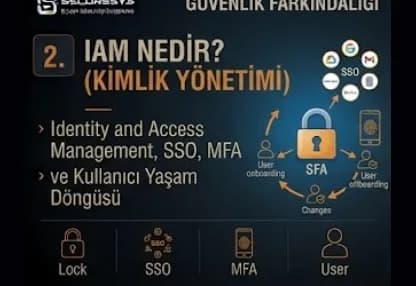
What is IAM? A guide to the Identity Provider, SSO, MFA, passkeys, SAML/OIDC, SCIM and the joiner-mover-leaver user lifecycle.
What Is PAM? Privileged Access Management and Privileged Account Security
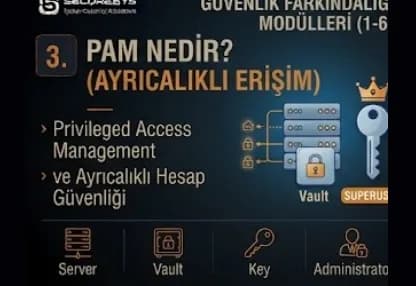
What is PAM? A guide to privileged account security, credential vaults, session recording, JIT/JEA, PEDM and Zero Standing Privilege.
How Is a PAM Architecture Built? Vault, Session Management, JIT Access and Zero Standing Privilege
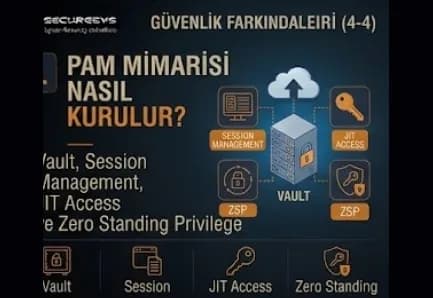
How is a PAM architecture built? Credential vault, session proxy, password rotation, JIT/JEA, Zero Standing Privilege, HA/DR and SIEM integration.
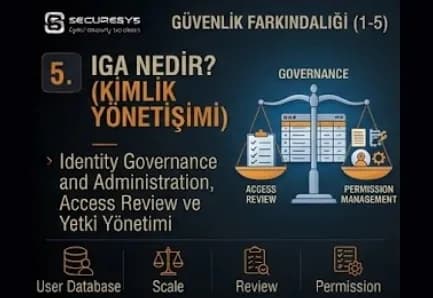
What Is IGA? Identity Governance and Administration, Access Review and Entitlement Management
What is IGA? A guide to entitlement management, access review, access certification, SoD, role mining and fighting permission creep.
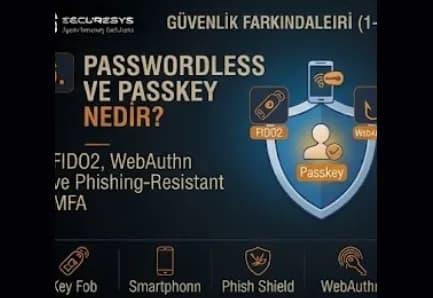
What Are Passwordless Authentication and Passkeys? FIDO2, WebAuthn and Phishing-Resistant MFA
What are passwordless authentication and passkeys? FIDO2, WebAuthn, phishing-resistant MFA and protection against MFA fatigue and AiTM attacks.
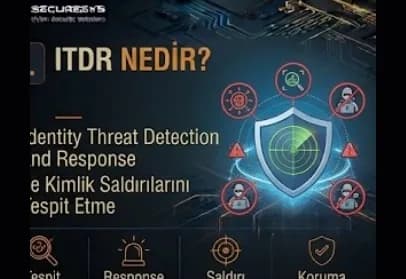
What Is ITDR? Detecting Identity Attacks With Identity Threat Detection and Response
What is ITDR? Detecting identity attacks: account takeover, MFA fatigue, token theft, session hijacking and privilege escalation.
Looking for professional support on this topic?
Our expert team will reach out for a free consultation as soon as possible.