Secrets, API Keys and Sensitive Data Leaks: The Hidden Danger in Code Repositories
The invisible danger in code repositories: secret, API key and credential leaks — detection, rotation and secrets management.
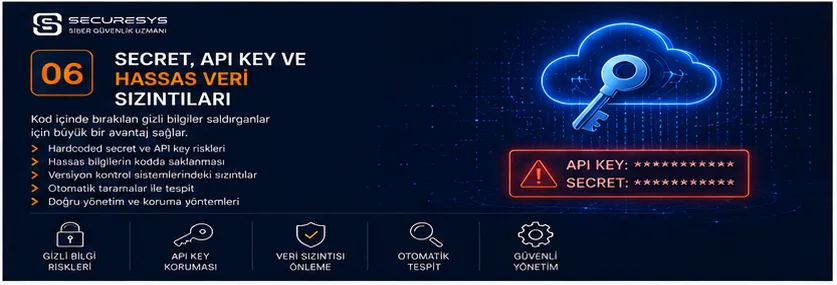
In modern software development processes, source code does not contain only application logic.
It usually also reveals, directly or indirectly, how the application communicates with other systems, which services it uses and with which credentials it gains access.
One of the most critical topics in source code security is therefore not only classic vulnerabilities.
Another critical risk area is this:
Secret Exposure.
That is:
- passwords,
- API keys,
- access tokens,
- private keys,
- database credentials,
- cloud credentials,
- service account information
and other sensitive data being exposed inside source code or in the code repository.
This problem may look simple at first glance.
A developer writes an API key temporarily into the code for testing.
Then it is forgotten.
The code is pushed to the Git repository.
Months later the API key in question is deleted.
The team believes the problem is solved.
But the risk may in fact still be live.
Because Git holds not only the current state of the files but past commits too.
Once a secret has entered source code, deleting it from the file may therefore not be enough.
The real question is:
Who had access to the repository this information was in?
And more importantly:
Is this credential still valid?
In modern Application Security programmes, Secret Scanning, Credential Rotation, Secrets Management and Repository Security are therefore treated as a separate security layer.
1. What Is a Secret?
In the context of software security, a "secret" is authentication or access information that unauthorised people should not see.
Examples of secrets are:
- user passwords,
- database usernames and passwords,
- API keys,
- OAuth client secrets,
- access tokens,
- refresh tokens,
- SSH private keys,
- TLS private keys,
- cloud access keys,
- service account credentials,
- webhook secrets,
- encryption keys,
- signing keys.
If any of this information falls into an attacker's hands, unauthorised access can be gained to the relevant service or system.
Secret security is therefore not solely a matter for the software developer.
It also sits at the intersection of:
Identity Security, Cloud Security, DevSecOps and Application Security
.
2. What Is a Hard-Coded Credential?
A hard-coded credential is a password, token or similar sensitive piece of information written directly into source code.
A structure like this can create serious risk, for example:
db_password = "CompanyProdDb123"
or:
api_key = "sk_live_xxxxxxxxx"
This approach is easy for the developer.
The application can use the credential directly.
But it creates a major security problem.
Because everyone who can see the source code can reach the credential too.
Those people can include:
- developers,
- outsourced software teams,
- repository administrators,
- former employees,
- CI/CD services,
- attackers.
Keeping credentials inside code therefore widens the trust boundary unnecessarily.
3. Why Do Developers Write Secrets into Code?
The hard-coded credential problem usually has no malicious cause.
It generally arises out of development convenience.
A developer is integrating a new service, for example.
The service provider has issued an API key.
To test quickly, the developer writes the key straight into the code.
The test succeeds.
Then they move on to another task.
The credential stays inside the code.
Another common scenario is config files.
Sensitive information can be present in files such as:
.env
config.json
application.properties
settings.py
When these files are pushed to the repository by mistake, secret exposure can occur.
4. Is the "But the Repository Is Private" Approach Safe?
A private repository is safer than a public one.
But that does not mean secrets can be kept in it safely.
Because many people or services can reach a private repository.
For example:
- software developers,
- DevOps teams,
- QA teams,
- consulting firms,
- outsourced developers,
- CI/CD robot accounts.
A repository account can also be compromised.
An unauthorised user can be invited into the organisation.
An access token can leak.
A former employee's access may not have been closed.
The basic principle should therefore be:
A secret must not be present inside source code.
The repository being private does not change that principle.
5. Why Is Git History Critical?
One of the most powerful features of Git systems is version history.
When a developer changes code, the previous versions are not lost.
They are kept in the commit history.
This feature is extremely valuable for software development.
But it creates a significant risk for secret security.
Suppose a developer has pushed this line to the repository:
password = "ProdSecret123"
A day later they notice the mistake and delete the line.
The password no longer appears in the current code.
But when the previous commit is opened, the password can still be seen.
Therefore the statement:
"We deleted the secret from the code."
is usually not sufficient.
The real question should be:
"Has the credential been changed?"
6. What Should Be Done if a Secret Has Entered the Repository?
The safest approach is to consider the secret compromised.
If a production API key has been pushed to a Git repository, for example, these steps should be taken:
- The credential must be revoked or disabled immediately.
- A new credential must be created.
- The application must be updated with the new credential.
- The secret must be cleaned out of the repository.
- The Git history must be cleaned if necessary.
- The usage logs for the credential must be examined.
- Whether unauthorised use occurred must be investigated.
Simply deleting the line is not enough.
Because an attacker may already have reached the repository.
7. What Is Credential Rotation?
Credential Rotation is the changing of passwords, API keys, tokens and similar information at defined intervals or after a security incident.
Rotation is critically important when secret exposure is detected.
For example, the old API key:
KEY-001
is revoked.
A new API key:
KEY-002
is created.
The application starts using the new key.
Even if the old credential is in the attacker's hands, it can no longer be used.
In enterprise environments credential rotation should be automated as far as possible.
8. What Is Secret Scanning?
Secret Scanning is the security method that tries to detect sensitive credential information automatically inside source code, repositories or commit history.
Secret scanning systems can use different methods.
For example:
- pattern matching,
- regular expressions,
- entropy analysis,
- known token format detection,
- provider-specific signature detection
can be used.
If the API key formats of certain cloud providers are known, for example, the system can detect those structures automatically.
Similarly, private key headers or tokens with high entropy values can be analysed.
9. What Is Entropy Analysis?
Many secrets consist of random, complex characters.
A string such as:
h7sK92mDxT5pQ1zL
looks different from normal text.
Entropy analysis tries to measure how random and unpredictable a value is.
Long strings with high entropy values can be flagged as potential secrets.
But this method is not sufficient on its own.
Because hash values, UUIDs and test data can also show high entropy.
Advanced secret scanning systems therefore use different methods together.
10. Is Secret Scanning Different from SAST?
Yes.
SAST analyses the security weaknesses and data flows within source code.
Secret Scanning focuses specifically on detecting sensitive credential information.
SAST might find this problem, for example:
User input reaches an SQL query insecurely.
Secret Scanning might find this:
A production API key is present inside the source code.
In modern AppSec programmes the two are therefore used together:
SAST + Secret Scanning
But SCA is also important alongside them.
The basic trio then becomes:
SAST + SCA + Secret Scanning
11. At Which Stages Should Secret Scanning Be Done?
Secret scanning should not be used only as a periodic scan over the repository.
It should run as early as possible.
For example:
Developer Workstation
Local scanning can be done before the developer creates a commit.
Pre-Commit Hook
A secret check can be made before the commit is created.
Push
A scan can be run when the code is pushed to the remote repository.
Pull Request
A check can be made before merge.
CI/CD Pipeline
Secret scanning can be performed during the build.
Repository History
Current and old commits can be scanned periodically.
The aim is for the secret never to reach the repository at all, as far as possible.
12. Why Does Pre-Commit Secret Scanning Matter?
The best security control is the one that prevents the problem at the earliest stage.
If a secret is detected in the local environment before being pushed to the remote repository, the risk is reduced considerably.
A developer tries to commit a .env file by mistake, for example.
The pre-commit scanner can give this warning:
Potential API Secret Detected
The commit is blocked.
The developer removes the information in question.
The secret then never enters the repository history at all.
That is far easier than cleaning Git history after an incident.
13. Is .gitignore Enough?
.gitignore is quite useful for defining files that should not be pushed to a Git repository.
Files such as:
.env
secrets.json
private.key
can be added to the ignore list.
But .gitignore is not a security control on its own.
Because if the file has already been committed, adding it to .gitignore afterwards does not remove it from the repository history.
The developer can also misconfigure it.
.gitignore is therefore a good protective layer but is not a substitute for Secret Scanning.
14. Is Using Environment Variables Safe?
Environment variables are one of the methods used widely to prevent secrets being kept directly inside source code.
An application can read the value:
DATABASE_PASSWORD
through the environment, for example.
This method is safer than a hard-coded credential.
But environment variables are not the ideal secret management solution in every case either.
Because they:
- can be seen from within the process environment,
- can end up in debug output,
- can be exposed in container configuration,
- can leak through incorrect CI/CD logging.
In more critical environments, central Secrets Management systems can therefore be preferred.
15. What Is a Secrets Manager?
A Secrets Manager is a system that allows credential information to be stored centrally and under control.
These systems generally provide features such as:
- access control,
- encryption,
- audit logging,
- versioning,
- credential rotation.
Instead of reading the secret from source code, the application obtains it from the central system at runtime.
One of the important advantages of this approach is access control.
Only a particular production service can be permitted to reach the relevant database credential, for example.
The developer may not need to see the credential directly at all.
16. The Vault Approach
The vault model is one of the strongest examples of central secret management.
In this structure secrets are stored encrypted.
Applications can reach the credentials they need after being authenticated.
In more advanced systems, dynamic credentials can be created instead of static passwords.
When the application wants to connect to the database, for example, the vault can generate a temporary username and password.
The credential is valid only for a limited period.
This model can significantly reduce the attack surface.
17. What Are Dynamic Secrets?
A dynamic secret is a short-lived credential created automatically at the moment of need, instead of a fixed credential created in advance and used for months.
For example:
The application requests database access.
The secrets platform creates a temporary database account.
The credential is valid for 30 minutes.
At the end of that period it is revoked automatically.
This approach answers the question:
If a credential is compromised, how long can it be used?
A static password can remain valid for months.
A dynamic secret can become invalid within minutes.
18. Least Privilege Secret Management
In secret security, not only where the credential is stored but what privileges it holds matters.
If the application only needs to read certain database tables, for example, the account used should not have database administrator privileges.
The basic principle is:
Every credential should have only the minimum privileges it needs.
Thanks to this least privilege approach, the attacker's access can be limited even if a credential is stolen.
19. Why Are Cloud Credential Leaks Critical?
In cloud environments access keys and service account credentials can be extremely critical.
When a cloud credential falls into an attacker's hands, operations such as:
- creating new resources,
- storage access,
- reading secrets,
- creating compute instances,
- changing IAM configuration
can become possible.
Depending on the privilege level, the whole cloud account can be put at risk.
Cloud credentials must therefore never be kept inside source code.
20. What Should Be Used Instead of a Cloud Access Key?
In modern cloud architectures, workload identity or role-based access should be used instead of static access keys as far as possible.
If a compute instance needs to reach the storage service, for example, an instance role can be assigned instead of giving the application a hard-coded cloud access key.
There is then no secret in the application's source code.
The cloud platform generates a temporary credential.
This approach significantly reduces the need for secret management.
21. Service Account Security
In modern microservice architectures, services communicate with one another.
The use of service accounts is therefore widespread.
But writing service account credentials into the code creates a serious security risk.
For service accounts:
- minimum privilege,
- short-lived tokens,
- regular rotation,
- usage logging,
- environment isolation
should be applied.
Development and production service accounts should also be kept separate.
22. Separating Development and Production Credentials
Using the same credentials in the development environment as in production is a major security problem.
More developers can reach the development environment.
Test scripts may be present.
Debug logs may be more detailed.
If a development credential leaks, therefore, access to the production system should not be possible.
The ideal structure should be separated as:
Development Credential
Test Credential
Staging Credential
Production Credential
Every environment should have a different security boundary.
23. Private Key Leaks
Private keys are one of the most critical secret types.
If, for example:
- an SSH private key,
- a TLS private key,
- a JWT signing private key,
- a code signing key
enters the source code repository, serious risk can arise.
Depending on the type of private key, the attacker can carry out attacks such as:
- an SSH connection to the system,
- generating fake tokens,
- impersonating another server,
- signing fake software.
Private key exposure should therefore be treated as a critical security incident.
24. What Happens if a JWT Signing Key Leaks?
In JWT-based authentication systems, tokens can be signed with a secret or private key.
If the signing key falls into an attacker's hands, they can produce fake tokens that appear valid.
They can add:
role: admin
to their own token, for example.
If the back end only verifies the signature, the token can be accepted as valid.
Signing key security is therefore one of the fundamental security boundaries of an authentication system.
25. Can an Encryption Key Be Inside Source Code?
It should not be.
The security of encrypted data depends largely on the security of the encryption key.
If the application encrypts data with a strong algorithm but keeps the key inside the same source code, the attacker can obtain both the encrypted data and the key.
That does not provide real security.
Encryption keys should be kept as far as possible in secure systems such as:
- HSM,
- KMS,
- Vault,
- Secrets Manager.
26. Why Are CI/CD Systems Critical from a Secret Perspective?
CI/CD pipelines can reach many different production systems.
For example:
- the container registry,
- the cloud platform,
- the deployment server,
- the package repository,
- the code signing service.
A large number of secrets can therefore be present in CI/CD systems.
If pipeline logs or config files are not managed correctly, those credentials can be exposed.
The CI/CD system is a high-value target for an attacker.
27. Secret Leakage in Pipeline Logs
One of the most common DevSecOps problems is a secret being written into the pipeline log.
An environment variable may be printed to the screen for debugging purposes, for example.
The command:
echo $API_KEY
is run.
The secret can then remain in the build logs.
Everyone with access to the logs can see the credential.
A secret masking mechanism should therefore be used in CI/CD systems.
Sensitive values must be masked in log output.
28. Can There Be a Secret Inside a Build Artifact?
Yes.
Sometimes a secret is not present in the source code repository but is added into the build artifact by mistake.
During the build process of a front-end application, for example, environment configuration can be embedded in the JavaScript bundle.
As a result the user can see the secret through the browser.
This principle is important particularly in front-end applications:
No information sent to the user's browser can be regarded as genuinely secret.
The privileges of API keys present in the front end must be designed accordingly.
29. Can a Secret Be Stored in Front-End Code?
No.
A secret embedded in JavaScript, a mobile application or a desktop client is ultimately distributed to the user.
Code obfuscation can be applied.
The binary can be packaged.
But a sufficiently determined attacker can extract the credential.
Critical secrets should therefore not be present on the front end.
Operations requiring a secret should be performed through the back end.
30. API Keys Inside Mobile Applications
Mobile applications carry a similar risk.
APK or IPA files can be analysed.
Strings can be extracted.
Configuration files can be examined.
API credentials embedded in a mobile application can therefore be found by an attacker.
A mobile application's back-end API must not rely on the assumption that "the secret key is hidden inside the app".
Authentication and authorisation must be applied server-side.
31. Secret Leakage Inside Docker Images
Another critical risk emerges in container technologies.
A secret can be used inside a Dockerfile.
Credentials may be added during the build to reach a private package repository, for example.
Even if the file is deleted later, the secret can remain inside a previous image layer.
Secret security must therefore be designed carefully in container build processes.
BuildKit secret mounts or similar secure methods can be used.
32. Why Do Container Image Layers Matter?
Container images consist of layers.
A file is added in one layer.
It can be deleted in the next layer.
But the file can still be present inside the earlier layer.
The following approach may therefore not be safe:
- Copy the secret file into the image.
- Perform the build.
- Delete the secret file.
Even if the file is not visible in the final image, it can be extracted from the image history.
A secret should therefore never be written into an image layer at all, as far as possible.
33. Is a Kubernetes Secret Safe?
The Kubernetes Secret mechanism is useful for separating sensitive information from configuration.
But Kubernetes Secret values being merely Base64-encoded is not encryption.
The cluster's security configuration matters.
Controls such as:
- etcd encryption,
- RBAC,
- namespace isolation,
- audit logging,
- external secrets management
should be applied.
Kubernetes Secret does not solve the whole secret security problem on its own.
34. Infrastructure as Code and Secret Risk
In modern DevOps processes, infrastructure is managed as code too.
Credentials can be present in the configuration files of systems such as Terraform and Ansible.
Secret Scanning should therefore cover not only application source code but:
Infrastructure as Code
repositories as well.
For example:
- cloud access keys,
- database passwords,
- certificate private keys
can be kept in an IaC repository by mistake.
35. Are an API Key and a Password the Same Thing?
The two can be different mechanisms, but from a security perspective both should be treated as secrets.
An API key mostly enables the application to reach another service.
A password can be used in user or service authentication.
But the basic principle is the same:
Unauthorised people must not see it.
API keys are sometimes seen as less critical by developers.
That is a mistake.
Some API keys can hold high privileges.
36. Why Do a Secret's Privileges Matter?
Not all secrets carry the same risk level.
A key that only provides access to a read-only test API is not at the same risk level as a production cloud administrator key.
When secret exposure is detected, therefore, these questions should be asked in the risk assessment:
- Which system does the secret belong to?
- Is it production?
- What privileges does it hold?
- Can it be used over the internet?
- How long has it been valid?
- Has rotation been performed?
- Are usage logs available?
These questions determine the real business risk.
37. What Is a Secret Inventory?
Large organisations can have thousands of credentials.
Not knowing where a secret is used creates serious risk.
Creating a secret inventory is therefore useful.
This information can be held for every secret, for example:
- Owner
- Application it is used in
- Environment
- Privilege level
- Creation date
- Last rotation date
- Expiration
- Secret type
This inventory makes managing the credential life cycle easier.
38. Secret Lifecycle Management
Secret security does not consist only of storage.
A secret's entire life cycle must be managed.
The process can be thought of as:
Create → Store → Distribute → Use → Rotate → Revoke → Audit
Different security controls are needed at each stage.
A secret may have been created securely, for example, but if it is shared over Slack the security model breaks down.
39. Should Secrets Be Shared by Email or Messaging?
As far as possible, no.
Email and corporate messaging systems are not secret management platforms.
Message histories can be kept for a long time.
Credentials can be found through the search feature.
They can be forwarded.
Screenshots can be taken.
Credential sharing should therefore be done through controlled secret sharing mechanisms.
40. Secret Exposure Incident Response
A credential leak should not be assessed like an ordinary code error.
An incident response process may be required, particularly for a production secret.
The basic approach should be:
Revoke → Rotate → Investigate → Monitor
First the old credential is disabled.
A new credential is created.
The logs are examined.
Suspicious access is investigated.
If necessary, additional security controls are applied on the relevant systems.
41. Is Cleaning Git History Enough?
No.
Cleaning Git history only reduces the trace inside the repository.
The secret may already have been:
- cloned,
- forked,
- taken into a CI/CD cache,
- included in a backup,
- copied by someone else.
History cleaning is therefore not a substitute for rotation.
The correct order is:
Revoke the credential → Renew it → Then clean the repository.
42. Secret Leakage in Public Repositories
Pushing credentials to a public repository is especially critical.
Automated bots on the internet can scan GitHub and similar platforms continuously.
A newly committed cloud key or token can be detected within minutes or even seconds.
Therefore the assumption:
"Nobody will notice the repository."
is extremely risky.
When public secret exposure is detected, the credential must be considered compromised immediately.
43. Former Employees and Secret Risk
If credentials are used on a shared basis, closing former employees' access completely can become difficult.
If the whole team uses the same database password, for example, the password must be changed when one person leaves the organisation.
Personal identity should therefore be used as far as possible.
The number of shared secrets should be reduced.
Only the relevant user account then needs to be closed when an employee leaves.
44. Third-Party Developer Risk
Outsourced software development teams can reach the source code in many projects.
If production credentials are present inside the source code, third-party teams can also reach production systems indirectly.
That makes privilege management harder.
In a safer model, outsourced teams:
- reach only as much of the source code as they need,
- use development credentials,
- do not see production secrets.
This approach reduces supply chain risk.
45. Repository Access Control
Another part of secret security is repository access.
Not every developer may need access to every repository.
The least privilege approach should be applied here too.
For example, controls such as:
- team-based repository access,
- branch protection,
- MFA,
- SSO,
- audit logs,
- token expiration
can be used.
The repository is one of the most critical assets of a modern software organisation.
46. Personal Access Token Security
The use of Personal Access Tokens is widespread on Git platforms.
But these tokens can hold broad privileges.
A token can provide rights such as:
- reading repositories,
- changing code,
- running workflows,
- package access.
The minimum scope should be selected when creating a token.
An expiration period should be set where possible.
Unused tokens should be revoked.
47. What Happens if a CI/CD Token Is Compromised?
If a CI/CD token holds high privileges, an attacker can affect the software supply chain.
For example, they can:
- change source code,
- produce a malicious build,
- perform a production deployment,
- push a malicious package to the package repository.
CI/CD credentials should therefore be treated as among the organisation's most critical secrets.
48. The Relationship Between Supply Chain Security and Secret Security
In software supply chain attacks the attacker does not always have to use a code vulnerability.
A compromised developer token or CI/CD credential can be enough.
Secret Security is therefore an inseparable part of Software Supply Chain Security.
The next security layer emerges here:
Who can change the software?
Who can produce a build?
Who can publish a release?
These questions are as important as source code security.
49. How Should Secret Scanning Results Be Prioritised?
A secret scanner can produce hundreds of findings.
Some may be test credentials.
Some may have been invalid for a long time.
Others may be active production keys.
Findings can therefore be prioritised by these criteria:
Is it active?
Does the credential still work?
Is it production?
Does it reach a live system?
Privilege Level
What privileges does it hold?
Public Exposure
Was it found in a public repository?
Age
How long has it been inside the repository?
An active production administrator credential should always carry the highest priority.
50. Should a Validity Check Be Performed?
Some secret scanning systems can verify whether the credential found is genuinely active.
This approach can reduce the number of false positives.
But the validation mechanism must be applied carefully.
In critical systems in particular, automatic verification must not perform any unauthorised or harmful operation.
The aim is only to establish safely whether the credential is valid.
51. False Positive Secret Findings
Not every high-entropy string is a secret.
For example:
- test UUIDs,
- hashes,
- fixture data,
- sample documentation
can be flagged as a secret by the scanner by mistake.
A triage process is therefore needed for Secret Scanning results.
But before deciding that a finding is test data, it must be verified that it is genuinely not an active credential.
52. Is It Right to Trust the Secret Scanner and Do No Other Checks?
No.
Secret Scanning is a strong security layer but cannot see every secret risk.
A credential can be present:
- in a binary file,
- inside an encrypted archive,
- in image metadata,
- in the documentation system,
- in a CI/CD variable store.
A broader Secrets Management Programme is therefore needed.
53. Secret Security Within the Secure SDLC
Secret security should be present at many stages of the Secure SDLC.
For example:
Development
Hard-coded secrets are prohibited.
Commit
Pre-commit Secret Scanning is performed.
Repository
Push Protection is applied.
CI/CD
Secret masking and secure variable management are carried out.
Deployment
Runtime access is provided through the Secrets Manager.
Production
Rotation and audit are applied.
This structure takes secret security beyond a single tool and spreads it across the life cycle.
54. What Is Push Protection?
Push Protection is the security mechanism that automatically prevents a developer from pushing code containing a secret to the remote repository.
The system detects an API key during the Git push, for example.
The push is stopped.
The developer is shown which file the potential secret is in.
This method is stronger than producing a report after the event.
Because the problem is prevented before it occurs.
55. How Should a Security Warning Be Given to the Developer?
Secret Scanning should not make life unnecessarily hard for the developer.
The warning must be clear and actionable.
Instead of simply saying:
Secret detected.
it can show:
- which file it was found in,
- what type of secret it is,
- how to remove it,
- how to use the Secrets Manager.
This approach lets the developer solve the problem faster.
56. Is Cleaning Secrets Out of Code Part of Secure Coding?
Yes.
Secure Coding is not only about preventing injection or XSS.
Credential management is also a basic component of secure software development.
The developer should adopt this principle:
Code may need a secret in order to run; but the secret must not be part of the code.
This distinction is one of the fundamental principles of modern code security.
57. A Basic Checklist for Secret Management
In an enterprise secret security approach, at least these controls should be assessed:
- Hard-coded credentials must not be used.
- Production and development secrets must be separated.
- Secret scanning must be enabled.
- Pre-commit checks must be applied.
- Repository history must be scanned.
- A central secrets manager must be used.
- A rotation policy must exist.
- Least privilege must be applied.
- Secret masking must be in place in CI/CD logs.
- Secret access must be audited.
When these controls are used together, risk can be significantly reduced.
58. How Is Secret Security Measured?
Secret security can also be measured in an Application Security programme.
Metrics such as:
- number of secret findings per repository,
- number of active secrets,
- number of production secret exposures,
- average rotation period,
- number of push protection blocks,
- secrets manager adoption rate
can be tracked.
The aim is not to punish developers.
The aim is to see recurring problems and improve the processes.
59. The "Zero Secret in Code" Goal
One of the strong goals in enterprise code security programmes can be the:
Zero Secret in Code
approach.
This phrase represents the goal of no credential at all being kept inside source code in practice.
Reaching absolute zero can be difficult.
But the goal matters.
When a secret is found, the system must block it automatically or ensure rapid intervention.
60. The Human Factor in Secret Security
However far technology advances, the human factor retains its importance.
A developer can write a secret by mistake into:
- source code,
- a ticket,
- an email,
- a chat channel,
- a document.
Developer awareness therefore matters.
Secret management must be covered as a separate topic in Secure Coding training.
The SecureSys Secret Scanning and Code Security Approach
At SecureSys we do not assess source code security only through classic SAST vulnerabilities.
In the modern software ecosystem, credential and secret security is also one of the fundamental parts of Application Security.
Depending on project scope, therefore:
SAST, Secret Scanning, Repository Security, SCA, manual source code analysis and DevSecOps security controls
can be assessed together.
Whether critical secrets such as:
- production API keys,
- database credentials,
- cloud access keys,
- private keys,
- signing keys,
- service account information
are present in the source code and repository history can be analysed in particular.
But the aim is not merely to detect the secret.
Whether the credential found:
is active, which system it reaches, what privileges it holds and whether it requires rotation
must be assessed.
Because a single API key seen inside source code is sometimes not a simple coding error.
It can be the beginning of a security breach.
Strong secret management should therefore be approached with the:
Detect → Revoke → Rotate → Investigate → Prevent
model.
Frequently Asked Questions
What is Secret Scanning?
Secret Scanning is the security method that tries to detect passwords, API keys, tokens, private keys and similar sensitive information automatically inside source code and repositories.
Can an API key be kept in source code?
Critical and confidential API keys in particular should not be kept inside source code. Central secret management or runtime identity mechanisms should be preferred.
Is the problem solved if the secret is deleted from the code?
Not always. If the secret has already been pushed to the Git repository, it can be present in the old commit history. The credential must be changed or revoked.
What is credential rotation?
It is the process of revoking the current password, API key or token and creating a new credential.
Is .gitignore sufficient for secret security?
No. It is a useful control but does not clean files that have already been committed and does not entirely prevent human error. It should be supported with Secret Scanning.
Are environment variables safe?
They are safer than using hard-coded credentials, but in critical systems a central Secrets Manager or Vault solution can provide stronger control.
How should a secret in the Git history be handled?
The credential must be considered compromised, revoked or rotated first, and then the Git history cleaned if necessary.
Are Secret Scanning and SAST the same thing?
No. SAST analyses code security weaknesses, while Secret Scanning focuses on detecting credentials and sensitive access information.
Can an API secret be stored inside the front end?
Secrets that genuinely need to stay confidential should not be kept inside a front-end or mobile application. Code distributed to the user can be analysed.
How often should secrets be changed?
A rotation policy should be set according to the organisation's risk and access model. When a secret is thought to have leaked, it must be changed immediately without waiting for the periodic interval.
Conclusion: The Most Dangerous Line in Source Code Is Sometimes Not a Vulnerability but a Key
When source code security is discussed, the topics that first come to mind are usually classic vulnerabilities such as SQL Injection, XSS or Command Injection.
But in the modern software ecosystem a single line can sometimes have a far greater impact than any of those.
For example, a value such as:
AWS_SECRET_ACCESS_KEY = "..."
or:
PROD_DATABASE_PASSWORD = "..."
can open the door to critical systems directly.
The attacker may not need to develop a sophisticated exploit.
They may not need to research a code vulnerability.
Simply using the valid credential may be enough.
Code security therefore does not consist only of the question:
"Is the code open to attack?"
It also covers:
"Has a key been left inside the code that could give an attacker direct access?"
In a modern Application Security programme, Secret Scanning is therefore not a luxury security feature.
Alongside SAST and SCA it is one of the basic layers of code security.
But the strongest approach is not finding the secret.
It is preventing the secret from entering the repository in the first place.
And ideally applications should need long-lived static credentials as little as possible.
Because a secret you do not have to store
is not a secret you can leak.
Related Articles
Source Code Analysis (Code Security)
What Is Source Code Analysis? A Guide to SAST and Code Security
What is source code analysis, how does SAST work and why does code security come before infrastructure? Concepts, methods and enterprise approach.
Vulnerabilities Start While Code Is Written: Secure Coding and Secure SDLC
Vulnerabilities are not born in production; they are created in design and code. A guide to Secure Coding, Shift Left, DevSecOps and Secure SDLC.
What Is SAST? How Static Application Security Testing Works
What is SAST and how does it work? Source-sink, taint analysis, false positives, CI/CD integration and tool selection in one guide.
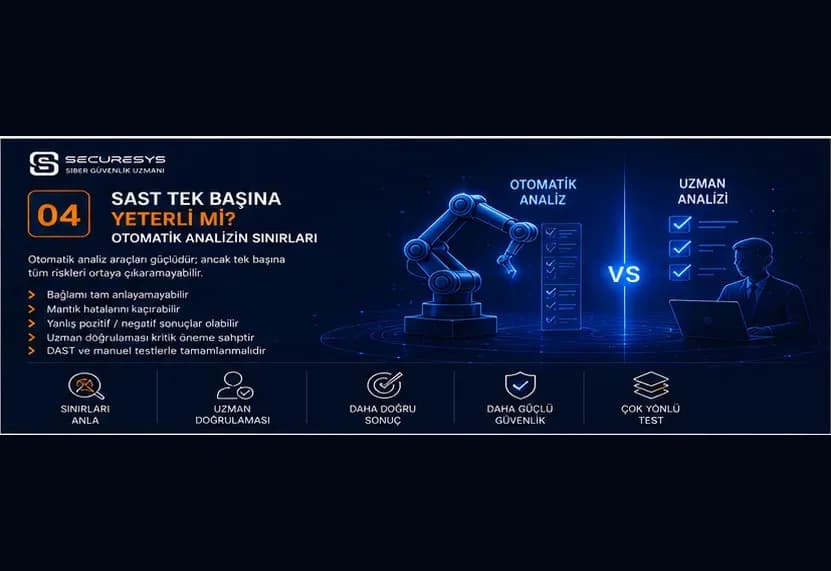
Is SAST Enough on Its Own? Automated Scanning and Manual Source Code Review
What automated SAST can and cannot see: business logic flaws, false positives and negatives, and the role of manual code review.
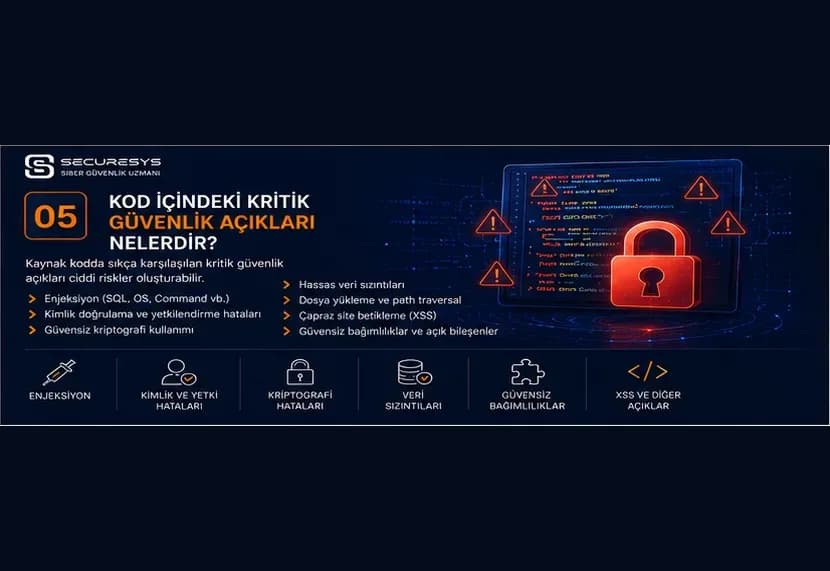
Critical Vulnerabilities in Code: A CWE and OWASP Perspective
The most critical vulnerabilities in source code — injection, XSS, broken access control, SSRF and more — through the CWE and OWASP lens.
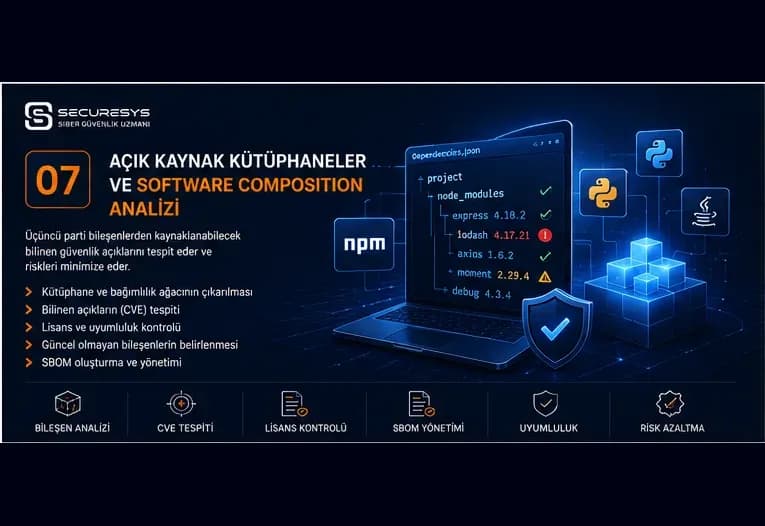
Open Source Libraries and Software Supply Chain Security: An SCA and SBOM Guide
Open source dependencies are part of your attack surface: SCA, SBOM, transitive dependencies and supply chain attacks.
Looking for professional support on this topic?
Our expert team will reach out for a free consultation as soon as possible.