What Is Red Teaming? Simulating a Real Cyber Attack
Red Teaming measures an organisation's resilience across people, process and technology by simulating a real attacker's tactics and techniques under control. In this chapter we walk through the stages of a Red Team operation using a real-world scenario.
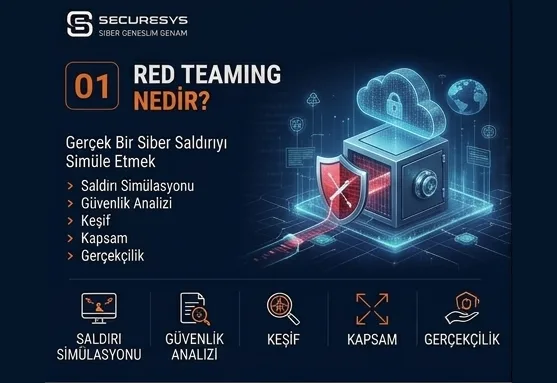
Having a firewall, running EDR, being monitored 24/7 by a SOC and commissioning regular penetration tests are all important security layers for an organisation.
Yet there is one critical question none of them answers:
If a real attacker targeted your organisation, how far could they get?
Red Teaming exists to chase down exactly that question.
The goal of a Red Team operation is not simply to find a vulnerability. The goal is to measure how resilient the organisation's people, processes and technology are when working together, by simulating in a controlled manner the methods a real threat actor could use.
A Red Team specialist may research what information about the organisation can be gathered from the outside, analyse employees and the technologies in use, map the attack surface, and simulate genuine attacker behaviour within an authorised scope.
For that reason Red Teaming has a very different perspective from a classic vulnerability scan or a standard penetration test.
A Red Team does not ask:
“Is there a vulnerability in your system?”
It asks a more critical question:
“If we genuinely wanted to attack this organisation, could we reach our objective?”
What Is Red Teaming?
Red Teaming is a controlled attack simulation that tests an organisation's cyber security defences using the tactics, techniques and procedures (TTPs) of real-world attackers.
The objective of the operation is not merely to identify technical vulnerabilities.
Red Team engagements also aim to evaluate;
- whether security technologies detect the attack,
- whether the SOC team notices anomalous behaviour,
- employee resilience against social engineering attacks,
- Active Directory security,
- identity and access management,
- network segmentation,
- incident response processes,
- the real-world effectiveness of security policies.
That is what the exercise sets out to assess.
This is why a successful Red Team operation does not end with just a “list of vulnerabilities”.
It ends with an attack narrative showing how resilient the organisation really is against a genuine attack.
An Ordinary Email One Morning
Let us walk through a scenario.
Imagine a fictional company operating in the finance sector:
ABC Finance Inc.
It has roughly 1,500 employees.
The organisation actively uses many security technologies, such as;
- a next-generation firewall,
- EDR,
- an email security solution,
- SIEM,
- MFA,
- a central Active Directory.
These are all in production.
Penetration tests are also carried out regularly.
Management's assumption is entirely natural:
“Our security investments are strong.”
But is that really the case?
To find out, ABC Finance management authorises a controlled Red Team operation.
The Red Team is given a fairly simple objective:
Can a level of access be reached that would allow unauthorised entry into one of the organisation's critical finance systems?
The Red Team operation begins.
But the attack does not start at the firewall.
Nor does it start at the web application.
The first step is far simpler:
The internet.
Stage 1: The Attacker Starts Getting to Know Your Organisation
A significant proportion of real attackers research their target before launching an attack.
This process is called reconnaissance.
The Red Team follows exactly the same approach.
Before any attack is launched against the organisation's systems, information gathering begins from open sources.
For example;
- the company website,
- social media accounts,
- LinkedIn employee profiles,
- job postings,
- GitHub repositories,
- DNS records,
- subdomain structures,
- the email formats in use,
- technology providers,
- historical data leaks,
- internet-facing systems
can all be examined.
Suppose a job posting contains the following wording:
“We are looking for a systems specialist experienced in Microsoft 365, Fortinet, VMware and Active Directory.”
This reads like an ordinary HR announcement.
But it carries a different meaning for an attacker.
They now hold clues about which technologies may exist in the organisation's infrastructure.
Another employee's LinkedIn profile might say:
“Microsoft 365 Migration Project – ABC Finance.”
A third employee may have used their corporate email address on GitHub.
When all of these small pieces are brought together, an increasingly complete picture of the organisation's digital footprint forms in front of the attacker.
Hence the first important lesson of Red Team operations:
The attack surface is not made up of IP addresses alone.
People, social media accounts, job postings, domain names and digital traces left on the internet are all part of the attack surface too.
Stage 2: The Target Is Selected
The Red Team analyses the information it has gathered.
The aim is not to attack a random employee.
User profiles that would be meaningful for reaching the operation's objectives are identified.
For example;
- finance staff,
- human resources,
- system administrators,
- IT support teams,
- procurement personnel,
- senior executives
may carry greater significance.
The critical point here is this:
Real attackers usually look not for the weakest system, but for the most convenient route to their objective.
Sometimes that route is an internet-facing server.
Sometimes it is a forgotten VPN account.
Sometimes it is an old password.
And sometimes it is a single employee.
Stage 3: Initial Access
09:02.
An entirely normal-looking email lands in the inbox of one of ABC Finance's employees.
The content has been crafted to match the user's daily workflow.
At first glance it raises no suspicion.
The user clicks the link.
And here one of the critical stages of the Red Team operation begins:
Initial Access.
In real attacks, initial access can be achieved through many different methods.
For example;
- social engineering,
- phishing,
- vulnerabilities in internet-facing applications,
- compromised user accounts,
- misconfigured remote access services,
- third-party systems
can all serve as an attacker's entry point.
Which techniques may be used in a Red Team operation must be clearly defined in the Rules of Engagement (RoE) agreed before the operation begins.
The goal is not to harm the organisation.
The goal is to measure how defence mechanisms react to genuine attacker behaviour.
Stage 4: What Happens if a User Account Is Compromised?
Many organisations build their security strategy on keeping the attacker outside.
But in modern attack scenarios a different assumption has become important:
Assume Breach – assume the compromise may already have happened.
In other words, the question asked is:
If an attacker compromises a user account or an endpoint, will we be able to stop them?
This is precisely where one of the most valuable benefits of Red Teaming emerges.
Compromising a user account is not the end of the operation.
The real test starts after that point.
Within the controlled scope, the Red Team can assess;
- the user's access rights,
- their visibility across the network,
- the services they can reach,
- the Active Directory structure,
- misconfigurations,
- authentication mechanisms.
All of these are evaluated in turn.
The aim is to understand whether the attacker can progress from the initial foothold towards critical assets.
Stage 5: Active Directory Takes the Stage
Active Directory usually sits at the centre of corporate Windows environments.
Users, computers, servers, groups and privileges are all related to one another inside this structure.
That makes Active Directory one of the most critical targets in Red Team operations.
From the attacker's point of view, holding a single user password is not what matters.
What matters is this question:
Where can this user take us?
A low-privileged user may well have no direct Domain Admin rights.
But because of various permission errors and configurations, an attack route like the following can form:
Standard User
↓
Local Administrator
↓
Server Access
↓
Service Account
↓
Highly Privileged Account
↓
Critical System
This is one of the key points where Red Teaming departs from a classic vulnerability scan.
Security problems that look unremarkable in isolation can form a serious attack chain once they are linked together.
A Red Team Does Not Look for a Vulnerability, It Looks for a Route
Understanding this approach is one of the easiest ways to understand Red Teaming.
A standard security assessment might produce findings like these:
Finding 1: Outdated software version.
Finding 2: Weak password policy.
Finding 3: Excessive user privileges.
Finding 4: Lack of network segmentation.
Finding 5: Service account configuration issue.
Reported individually, these findings might be rated as medium-level risks.
But the Red Team investigates something else:
Can we chain these five problems together?
If the answer is yes, a far more serious risk emerges.
For example:
Initial access → User account → Faulty permissions → Server → Service account → Privilege escalation → Critical system
That is no longer five separate security problems.
It is an attack path.
What Is the Difference Between Red Teaming and a Penetration Test?
Red Teaming and penetration testing are related concepts, but they are not the same exercise.
Penetration tests generally have a defined scope.
For example;
- a web application,
- a mobile application,
- an API,
- the internal network,
- the external network,
- Active Directory
may be tested.
The aim is to identify the security vulnerabilities present in those systems.
Red Teaming, by contrast, is mostly objective-driven.
The objective might be, for instance:
“Can access to the critical finance system be achieved?”
To reach that objective, the Red Team may evaluate several attack surfaces together within the authorised scope.
The web application alone is not the target.
The employee alone is not the target.
Active Directory alone is not the target.
All of them may be parts of the attack chain.
This is why the fundamental question in Red Team operations is not:
“How many vulnerabilities did we find?”
but rather:
“Did we reach the objective, and at which stage did the defence mechanisms detect us?”
What Red Teaming Really Tests: The Defence
The success of a Red Team operation should not be measured solely by whether the Red Team reached its objective.
One of the truly important matters is how early the organisation noticed the attack.
For example, during the attack chain;
Did the EDR raise an alert?
Did the SIEM build a meaningful correlation?
Did the SOC analyst notice the alert?
Was the incident prioritised correctly?
Was the user account disabled in time?
Was the relevant endpoint isolated?
Did the incident response process start?
Was the attacker's progress to other systems blocked?
These questions tie the Red Team operation directly to the Blue Team.
The Red Team simulates the attack.
The Blue Team carries out the defence.
And the two working together raises the organisation's security maturity.
This is where the Purple Team approach comes in.
A Purple Team does not have to be a separate team.
Its core purpose is to combine the Red Team's attack knowledge with the Blue Team's defensive knowledge.
Why Does MITRE ATT&CK Matter in Red Team Operations?
One of the most widely used structures for classifying attacker behaviour in modern Red Team operations is the MITRE ATT&CK framework.
MITRE ATT&CK classifies attacker behaviours observed in the real world under tactics and techniques.
The attack lifecycle may include stages such as;
- Reconnaissance,
- Resource Development,
- Initial Access,
- Execution,
- Persistence,
- Privilege Escalation,
- Defense Evasion,
- Credential Access,
- Discovery,
- Lateral Movement,
- Collection,
- Command and Control,
- Exfiltration,
- Impact.
Different phases like these can be present.
This structure allows the Red Team operation to be assessed far more systematically.
For instance, instead of a report simply stating;
“The user account was accessed.”
it can show which MITRE ATT&CK technique the attack behaviour maps to.
This approach is extremely valuable for Blue Team and SOC teams as well.
Because the organisation can see far more clearly which attacker behaviours it is able to detect and where its visibility is weak.
How Does Threat Intelligence Change Red Teaming?
This is where the second main subject of our series enters the picture:
Cyber Threat Intelligence.
Not every organisation is targeted by the same attackers.
A bank and a manufacturing company may not share the same threat profile.
The threat actors and attack methods a defence industry company faces can differ from those an e-commerce firm encounters.
For this reason, advanced Red Team operations should not consist of generic attack techniques alone.
The operation can be fed with real threat intelligence.
For example, for threat actors known to target the organisation's sector, one can examine;
- the attack methods they use,
- the initial access techniques they prefer,
- the malware families they deploy,
- the systems they target,
- their known infrastructure,
- their TTPs.
All of this can be studied in advance.
The Red Team scenario can then be shaped in line with that information.
The core question of this approach shifts from:
“Are we ready against any attacker?”
to;
“Are we ready against the attackers who could genuinely target us?”
How Is Success Measured in a Red Team Operation?
The outcome of a successful Red Team operation should not be judged merely as “we got in” or “we did not get in”.
There are far more valuable metrics.
For example:
Time to Detect
How long did it take for the attacker behaviour to be noticed?
Time to Respond
After the alert, how long did the security team take to respond?
Attack Path
Which systems did the attacker pass through as they progressed?
Detection Coverage
Which attack techniques were detected by the security systems?
Security Control Effectiveness
Did the firewall, EDR, SIEM, MFA and other controls work as expected?
Human Resilience
Were employees able to spot the social engineering attempts?
These measurements produce far more meaningful conclusions about the organisation's real security maturity.
Who Needs Red Teaming?
Not every organisation needs to begin straight away with a comprehensive Red Team operation.
For an organisation whose basic security controls are not yet settled, the priority may be to develop foundational capabilities such as;
- vulnerability management,
- regular penetration testing,
- secure configuration,
- log management,
- EDR,
- SIEM,
- IAM,
- backup,
- incident response processes.
These come first.
But for organisations that have reached a certain level of security maturity, Red Teaming becomes extremely valuable.
Particularly for;
financial institutions, holding groups, energy companies, defence industry organisations, telecommunications companies, critical infrastructure, large manufacturing enterprises and organisations that process high-value data
testing genuine attacker behaviour in a controlled way is an important security validation method.
Does a Red Team Operation Harm the Organisation?
One of the most important components of a professional Red Team operation is that it is conducted under control.
The scope and boundaries must be defined clearly before the operation begins.
This process is captured in the Rules of Engagement.
For example;
which systems are in scope,
which systems must not be touched under any circumstances,
whether social engineering may be used,
the limits of scenarios aimed at employees,
the hours during which the operation may be carried out,
at what point data access must stop,
how the operation will be terminated if a critical situation arises
are all determined in advance.
The purpose of Red Teaming is not to break the system.
It is to show, in a controlled way, how far the system could be broken.
That distinction is extremely important.
What Should a Red Team Report for Management Look Like?
A Red Team report should not be a document made up of hundreds of technical findings.
The core issue senior management wants to see is this:
“What would happen if a real attacker targeted us?”
For that reason a well-prepared Red Team report should tell the attack as a story.
For example:
09:02 – Attack scenario launched against the target user
↓
09:08 – Initial access obtained
↓
09:17 – Internal reconnaissance began
↓
09:31 – Active Directory structure analysed
↓
09:42 – Privilege escalation route identified
↓
10:04 – Access to the critical server achieved
↓
10:18 – Operation objective accomplished
A timeline like this is far more comprehensible for management.
Because beyond the technical vulnerabilities, it shows the attack's real impact on the organisation.
Owning Security Products and Being Secure Are Not the Same Thing
Organisations today invest in a great many cyber security technologies.
Firewall.
EDR.
XDR.
SIEM.
SOAR.
DLP.
PAM.
NAC.
MFA.
WAF.
But having purchased security technologies does not mean an attack will be stopped.
What really matters is how effectively these technologies work together.
Red Teaming tests exactly that.
Did the firewall see the attack?
Did the EDR detect the behaviour?
Did the SIEM correlate the events?
Did the SOC pick the right alert?
Did MFA break the attack chain?
Did PAM protect the critical account?
Did network segmentation prevent lateral movement?
At the end of a Red Team operation the organisation sees not only its vulnerabilities, but also the real effectiveness of the security investments it has made.
Conclusion: Test Yourself Before the Real Attacker Arrives
One of the most dangerous assumptions in cyber security is this:
“Our systems are secure.”
Because real attackers do not act according to security checklists.
They look for a route.
An employee.
A user account.
A misconfigured service.
A forgotten subdomain.
An over-generous permission.
An old password.
When these individually insignificant pieces come together, a route can appear that carries the attacker all the way to critical systems.
Red Teaming tries to find that route before the attacker does.
But we are only at the beginning of our story.
Because in the ABC Finance scenario the attacker has taken only their first steps.
A far more important question lies ahead:
If the Red Team is attacking, who will defend?
In the next chapter we will examine the roles of the Red Team, Blue Team and Purple Team, and look at how attack and defence teams should work with one another in a modern organisation.
Related Articles
Red Teaming & Threat Intelligence
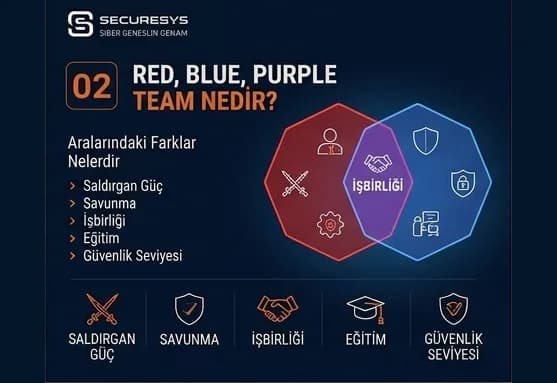
What Are Red Team, Blue Team and Purple Team? How Do They Differ?
The Red Team simulates the attack, the Blue Team runs the defence, and the Purple Team combines both to improve detection capability. This chapter covers the three roles, detection engineering and MITRE ATT&CK coverage analysis.
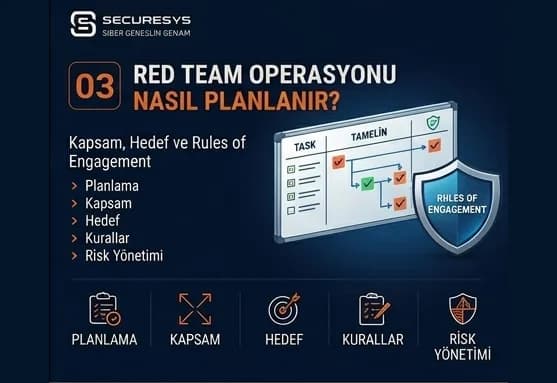
How Is a Red Team Operation Planned? Scope, Objectives and Rules of Engagement
A Red Team operation begins with correct planning, not with attack tools. This chapter covers objective setting, crown jewels, scope, rules of engagement, the White Team and stop conditions.
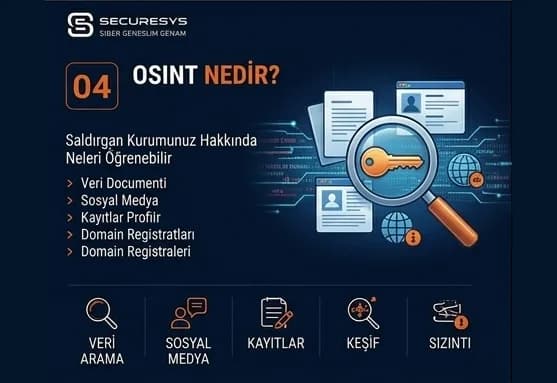
What Is OSINT? What Can an Attacker Learn About Your Organisation?
Attackers get to know an organisation before touching a single system. This chapter examines how open source intelligence — from domains and certificate transparency to LinkedIn and leaked credentials — builds a corporate attack surface.
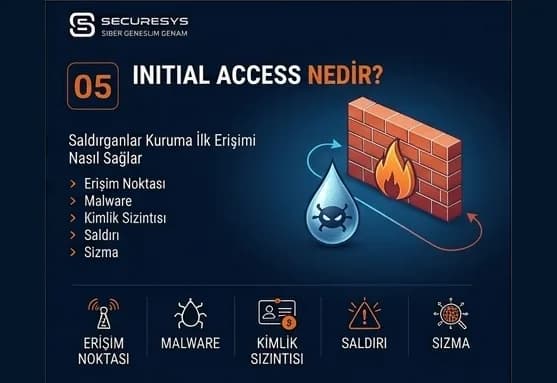
What Is Initial Access? How Do Attackers Gain Their First Foothold?
Initial access is the door to the attack, not its end. This chapter examines initial access methods — from phishing and valid accounts to internet-facing applications and the supply chain — along with the initial access broker ecosystem.
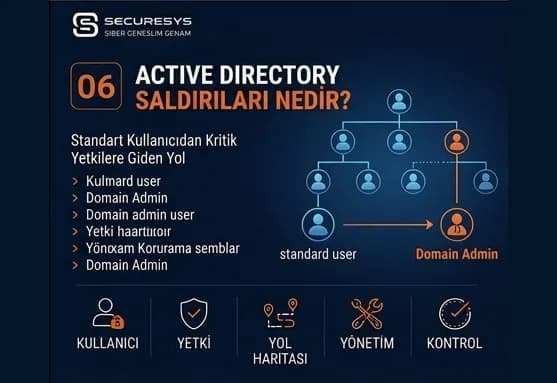
What Are Active Directory Attacks? The Path from Standard User to Critical Privileges
In Active Directory the real danger is not a single vulnerability but the route between them. This chapter covers Kerberos attacks, service accounts, ACL and delegation risks, and attack path analysis.
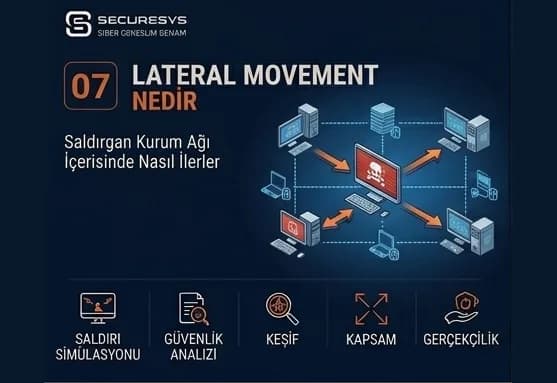
What Is Lateral Movement? How Does an Attacker Move Through a Corporate Network?
The real risk of an attack emerges not at initial access but in how far the attacker can move inside the network. This chapter covers RDP, SMB, WinRM, pass-the-hash, network segmentation, PAM and Zero Trust.
Looking for professional support on this topic?
Our expert team will reach out for a free consultation as soon as possible.