What Is Cloud IAM Security? Managing Permission, Role and Privileged Access Risk
What is cloud IAM security? Overprivilege, privilege escalation, service account risks and the CIEM approach on AWS, Azure and GCP.
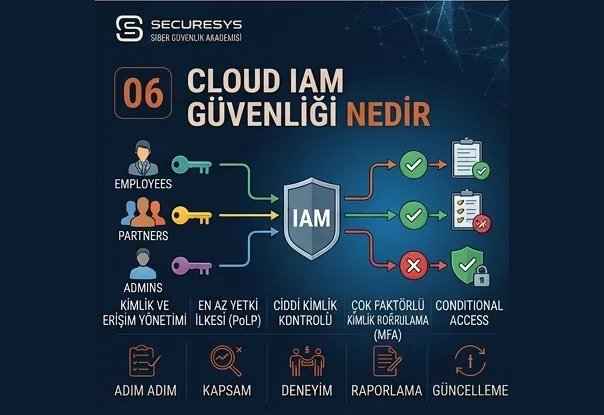
In cloud environments the most critical security matter is often not a vulnerability but privilege.
A user may have been given more roles than they need.
A service account may hold access it has not used for years.
An application may be running with far broader API permissions than it needs.
An access key may have been forgotten on a developer's computer or inside a repository.
An administrator account may be kept permanently active with full privilege.
All of these examples fall within Cloud IAM Security.
In a modern cloud architecture the attacker does not necessarily have to exploit a server.
Obtaining a valid identity or access token can be enough.
In cloud security, therefore, the basic question is not:
“Who can sign in to the system?”
The better question is this:
“Who, with which identity, can reach which resource, under which condition and at which privilege level?”
Cloud IAM security aims at keeping the answer to that question continuously under control.
What Is Cloud IAM?
Identity and Access Management (IAM) is the system managing the privileges with which users, services and applications in a cloud environment can reach resources.
Within IAM there can be;
- users,
- groups,
- roles,
- service accounts,
- application identities,
- access keys,
- tokens,
- permission policies.
These are all in scope.
AWS, Microsoft Azure and Google Cloud use different IAM models.
But the basic principle is the same:
Every identity must be able to reach only the resource it needs and only as far as the operation it needs.
That principle is known as least privilege.
Why Is Cloud IAM So Critical?
On cloud platforms many operations are carried out through APIs.
A privileged identity can, for instance;
create a new virtual machine,
read storage,
change a firewall rule,
create a new user,
take a snapshot,
reach a database,
switch logging off.
The compromise of a cloud identity can therefore create broader impact than reaching a physical server.
If the attacker uses valid credentials they can pass many security controls without looking like an attack.
Hence:
Identity is the control plane.
In cloud security, identity is at the same time the key to the management plane.
What Is AWS IAM?
AWS Identity and Access Management (AWS IAM) provides management of access to AWS resources.
An AWS environment contains objects such as;
users,
groups,
roles,
policies,
access keys.
An IAM role may be authorised only to read a particular S3 bucket, for instance.
Another role can be given EC2 management privilege.
The problem begins when those roles are broadened beyond need.
What Is Azure RBAC?
On the Microsoft Azure side, resource access is mostly managed through Azure Role-Based Access Control (Azure RBAC).
A user or service principal can receive;
Reader,
Contributor,
Owner
or more specific roles.
Owner and broadly scoped Contributor privileges in particular must be managed carefully.
Because a role at subscription or management group level can affect a very broad resource set.
What Is Google Cloud IAM?
Google Cloud IAM grants particular roles to principals such as;
users,
groups,
service accounts.
These roles can be applied at;
organization,
folder,
project,
resource
level.
Privileges at a higher level can pass down to lower resources through inheritance.
Permission assessment in GCP must therefore not be made by looking at the resource level alone.
Are Cloud IAM and Active Directory the Same Thing?
No.
Active Directory is more the classic on-premise domain identity management.
Cloud IAM is the cloud provider's resource and API access model.
But the two systems can integrate.
An Entra ID user can be Owner on Azure, for instance.
Identity risks can therefore link on-premise and cloud to one another.
The Difference Between Human Identity and Machine Identity
In a cloud environment it is not only people who use identities.
Two basic categories can be considered:
Human Identity
An employee,
an administrator,
a developer,
a third-party user.
Machine Identity
An application,
a service account,
a managed identity,
a workload identity,
a CI/CD pipeline.
In modern cloud environments the number of machine identities can be far greater than the number of human users.
Service identity security has therefore become critical.
What Is Least Privilege?
Least privilege is the principle that a user or system holds only the minimum privilege required to carry out their task.
If an application only needs to write a file to a particular storage bucket, for instance:
being administrator across the whole cloud account
is unnecessary.
Only:
write access to a specific bucket
must be given.
This principle limits the impact an attacker can create when they compromise an identity.
What Is an Overprivileged Identity?
An overprivileged identity is a user or service identity holding far more permission than it needs.
This is one of the most common risks in cloud environments.
For convenience, for instance, a developer is given:
Administrator
privilege.
The developer is in fact only managing a few resources in the test environment.
Hundreds of unused permissions then become attack surface.
What Is Permission Creep?
A user can receive new permissions as they move between projects.
But their old privileges are not removed.
Over time the user can reach many areas such as;
test,
production,
network,
database,
storage.
This situation is called permission creep or privilege creep.
It must be reduced with periodic access review.
What Is Role-Based Access Control (RBAC)?
RBAC is managing access privilege through roles rather than giving permissions to a user one by one.
For example:
Database Operator
Network Administrator
Security Reader
and similar roles can be defined.
This approach makes management easier.
But if the roles themselves are too broad, RBAC does not solve the security problem.
Role design therefore matters.
What Is ABAC?
Attribute-Based Access Control (ABAC) makes access decisions according to attributes.
Values such as;
resource tag,
department,
environment,
project
can be used.
A policy can be designed as:
“The finance team can manage only resources tagged Finance.”
and similar.
In large cloud environments RBAC and ABAC can be used together.
Why Must Cloud Admin Accounts Be Separate?
Carrying out cloud administrator operations with the daily email and web browsing account can create unnecessary risk.
If the user is exposed to a phishing attack, for instance, the privileged credential can be affected too.
Therefore:
the normal user account
and
the privileged cloud admin account
can be separated.
This approach resembles the logic of Active Directory tiering.
Why Is Standing Admin Privilege Risky?
If a user is an administrator 24/7, the attacker obtains high privilege whatever hour they compromise the account.
In the modern IAM approach, therefore, instead of permanent privilege:
Just-in-Time (JIT) Access
can be used.
Privilege is activated only when required and for a limited period.
How Does Just-in-Time Access Work in the Cloud?
An administrator wants to carry out an operation on production, for instance.
Normally they hold only read-only privilege.
Through PIM or a similar system;
they request a one-hour admin role.
They complete MFA.
They obtain manager approval if required.
When the period ends the role is removed automatically.
This model can seriously reduce standing privilege risk.
What Is Just-Enough-Access?
Just-Enough-Access (JEA) means giving a user only as much privilege as the operation they must carry out.
JIT focuses on:
For how long?
that question.
JEA focuses on:
How much privilege?
that question.
The two approaches together can form a strong privileged access model.
Is PAM Used for Cloud IAM?
Yes.
Privileged Access Management (PAM) can also manage cloud administrator access.
PAM can provide functions such as;
approval,
session recording,
a credential vault,
temporary access,
password rotation.
But because a modern cloud environment uses token and role-based access far more than passwords, PAM and cloud-native PIM/JIT solutions can be assessed together.
What Is PIM?
Privileged Identity Management (PIM) is the approach helping privileged roles be activated when required.
The concept is widespread in the Azure/Entra environment in particular.
Rather than being permanently a Global Administrator or Owner, a user can be eligible.
The role is activated when needed.
What Is CIEM?
Cloud Infrastructure Entitlement Management (CIEM) is the security approach providing analysis of identities and permissions in a cloud environment.
CIEM can focus on these questions:
Who holds which privilege?
How much of that privilege do they genuinely use?
Which account is overprivileged?
Which permission can provide privilege escalation?
Which dormant identity is still active?
CIEM is therefore particularly valuable in large multi-cloud structures.
What Are Effective Permissions?
In cloud IAM structures a user's visible role may not fully show their real access.
For example;
a direct role,
group membership,
inherited permission,
a resource policy
can together form the user's effective permissions level.
An IAM review is therefore not simply reading a list of roles.
Real permissions must be calculated.
What Is Inherited Permission?
Within the cloud hierarchy, permission given at a higher level can pass down to lower resources.
In Azure, a role at management group or subscription level can be applied to many resources.
In GCP, privilege at organization or folder level can be inherited by projects.
Therefore:
“Who is authorised on this resource?”
may not be answerable through the resource-local policy alone.
What Is a Cloud Root Account?
Some cloud platforms hold root or tenant owner style identities with the highest level of control.
These accounts must not be used for daily operations.
Because their compromise can affect the whole cloud environment.
On these accounts;
strong MFA,
very tight monitoring,
minimum use
must be applied.
Is Creating a Root Access Key Correct?
Creating a root-level static access key for daily automation is generally high risk.
The highest-privilege credential remaining usable over a long period enlarges the attack surface.
Role and temporary credential models must be preferred as far as possible.
What Is an Access Key?
An access key is one of the credential types used to reach cloud services, particularly through APIs.
It can generally have components such as;
an access key ID,
a secret key.
This credential can be used within;
the CLI,
automation,
an application.
But it must be stored securely.
Why Is a Static Access Key Risky?
A long-lived static credential;
can stay in a repository,
can be forgotten on a developer laptop,
can be written to logs,
can be found on an old server.
Once obtained, the attacker can gain API access without needing a password or MFA.
Temporary credential models must therefore be preferred.
What Is a Temporary Credential?
A temporary credential is short-lived access information valid for a particular period.
A short-lived token can be produced as the result of role assumption, for instance.
When the period expires the credential becomes invalid.
That reduces long-lived key risk.
Why Can an AWS IAM Role Be Better Than an Access Key?
An application running on EC2 does not have to keep an access key inside the source code to reach an AWS service.
An instance role can be used.
The application can obtain temporary credentials.
Static secret management is thereby reduced.
The same principle holds for Azure Managed Identity and GCP Workload Identity.
What Is a Managed Identity?
A managed identity helps Azure workloads authenticate to Azure resources without storing static credentials.
A VM can reach Key Vault with a managed identity, for instance.
But this identity's permissions must still be minimal.
The absence of a password does not automatically make an identity low risk.
What Is Workload Identity?
Workload identity is the model letting workloads such as applications or containers reach cloud services through a secure identity.
The aim is not to carry long-lived credentials inside the source code.
It is becoming steadily more important in Kubernetes and CI/CD environments.
What Is a Service Account?
A service account is an identity used by an application or service rather than a human user.
The term is very widespread in the GCP world in particular.
A service account can reach resources such as;
a database,
storage,
an API,
compute.
Configured wrongly it can be a powerful privilege escalation route.
Why Is a Service Account Key Risky?
A long-lived key file can be created for a service account.
If that file is stolen the attacker can act on behalf of the service account.
Keyless or workload identity-based methods can therefore be preferred.
For existing keys;
inventory,
rotation,
usage monitoring
must be carried out.
Why Is a Machine Identity Inventory Necessary?
Organisations generally know their employee accounts well.
But they may not know their service identities.
These questions must be answered:
How many service accounts are there?
Who owns them?
Which workload uses them?
Which permissions do they hold?
When were they last used?
Is there a static key?
Without that visibility, machine identity security cannot be managed.
What Is a Dormant Identity?
A user or service identity that has not been used for a long time can be called a dormant identity.
These accounts are risky.
Because there is no legitimate use, attacker activity can be harder to notice.
Unused identities must be disabled or deleted.
What Is an Orphaned Account?
An account with no clear owner, or with no remaining relevant employee or project, can be assessed as an orphaned account.
A service account created for an old project can still hold production access, for instance.
Ownership is therefore a critical governance matter in cloud IAM.
What Is Third-Party IAM Risk?
Third parties such as;
an MSP,
a vendor,
a consultant,
a partner
can reach the cloud environment.
That access often begins as temporary but becomes permanent.
For third-party accounts, therefore;
MFA,
time-limited access,
minimum privilege,
activity monitoring
must be applied.
What Is Federation?
Identity federation lets the organisation authenticate to a cloud service through its own identity provider.
A user can reach AWS with their corporate Entra ID account, for instance.
This approach reduces separate cloud passwords.
But the central identity provider becomes extremely critical.
Does SSO Strengthen Cloud Security?
Configured correctly, yes.
Through single sign-on (SSO);
central MFA,
conditional access,
user lifecycle
can be applied.
But if the SSO provider is compromised, many cloud services can be affected at once.
Central identity security must therefore be kept at a very high level.
Should MFA Be Mandatory on Cloud Admin Accounts?
On critical privileged accounts, strong MFA must be regarded as a basic security control.
But not all MFA methods sit at the same security level.
Phishing-resistant authentication can be preferred over SMS or basic push.
Stronger authentication matters particularly on tenant owner, root and cloud admin accounts.
Does MFA Protect a Cloud API Credential?
Not always.
If an attacker obtains a static access key they may not need the interactive MFA process.
Cloud IAM security must therefore not focus on user login MFA alone.
API credentials and machine identities must also be protected.
How Does Privilege Escalation Happen in the Cloud?
The attacker does not have to be an administrator directly.
Some permissions can indirectly allow higher privilege to be reached.
A user can, for instance;
create new credentials,
change a role policy,
change a high-privilege function,
impersonate a service identity.
Chains of this kind are cloud privilege escalation risk.
What Is the IAM PassRole Risk?
In an AWS environment, in certain scenarios, a user can hold privilege to assign a role to another service.
If that permission is excessively broad the user can create a resource with a role stronger than their own current privilege.
Privileges like PassRole must therefore be limited carefully.
This example shows that in cloud IAM a permission can create more impact than its visible name suggests.
What Is Service Account Impersonation?
On some cloud platforms a user can hold privilege to act on behalf of a particular service account.
If that service account holds higher privilege, the situation can turn into privilege escalation.
Impersonation privileges must therefore be assessed as critical.
Why Is Role Assignment Permission So Critical?
If a user can assign a new role they can give higher permission to themselves or to an identity they control.
Therefore;
role assignment,
policy modification,
IAM administration
privileges are among the highest-risk permission categories.
What Is Cloud Attack Path Analysis?
Assessing permissions one by one in a cloud IAM environment can be hard.
The privilege chains running from a user to a critical asset are therefore analysed.
For example:
Compromised Developer
↓
Can Modify Function
↓
Function Uses Privileged Identity
↓
Can Read Secret Vault
↓
Database Admin Credential
↓
Critical Database
This chain is a cloud attack path.
Why Can Attack Path Analysis Be Better Than a List-Based IAM Review?
An IAM review can show hundreds of permissions.
But they do not all carry the same risk.
The attack path approach asks this question:
“What does this permission actually give a real attacker?”
Security teams can thereby focus on the most critical privilege chains.
What Is a Choke Point in Cloud IAM?
An identity or permission through which several attack routes pass in common can be a choke point.
If a single service account sits at the centre of 40 different attack paths, for instance, fixing that account's privilege can provide very large risk reduction.
This approach is extremely valuable in remediation prioritisation.
How Does a Toxic Combination Form in IAM?
A few findings that do not look critical individually can together create major risk.
For example;
A public VM
A remote code execution vulnerability
A high-privilege managed identity
Secret vault access
can together form a critical cloud compromise path.
Cloud IAM must therefore not be examined separately from the other security layers.
How Does CIEM Detect Overprivilege?
CIEM platforms can compare granted permissions with used permissions.
A user, for instance:
Holds 600 permissions.
Has used only 15 permissions in the last 90 days.
The role can then be reduced.
This approach can be called rightsizing permissions.
What Is Rightsizing?
Permission rightsizing is the process of reducing an identity's privileges according to genuine usage need.
But automatic recommendations must not be applied directly to production.
Because some privileges can be needed for rarely used disaster recovery or emergency operations.
Business owner verification is required.
How Is Access Review Carried Out in Cloud IAM?
Periodically;
users,
roles,
service identities,
third-party access
are reviewed.
The questions:
Is this user still with the company?
Do they still need this role?
Should this vendor's access continue?
Is this service account still in use?
These checks reduce privilege creep.
Why Does Joiner-Mover-Leaver Matter in Cloud IAM?
When an employee joins the company the correct access must be given.
When they change department the old access must be removed.
When they leave the company all their cloud access must be closed.
Closing the corporate email account alone is not enough.
Separate cloud accounts or access keys may exist.
Why Is Group Use Preferred in Cloud IAM?
Giving privileges to users one by one creates management confusion.
Instead, groups such as;
Finance-ReadOnly,
Cloud-Network-Admins,
DevOps-Production
can be used.
But group membership must be reviewed continuously.
Can Nested Groups Create Risk?
When a group is a member of another group, understanding the real effective permission can become hard.
In large identity structures nested group relationships can reduce visibility.
Permission graph analysis therefore matters.
What Is a Resource-Based Policy?
On some cloud services, access is not determined by identity policy alone.
The resource itself can also contain a policy.
A storage bucket can say, for instance:
“This external account can access it.”
and similar.
An IAM assessment must therefore examine both identity-based and resource-based policies.
What Is Cross-Account Access?
One cloud account can reach a resource inside another account.
This is normal in large organisations.
But a wrongly configured cross-account trust can form an attack route.
Third-party and old account trusts in particular must be checked regularly.
What Is an External Principal?
If another account, tenant or identity outside the organisation reaches a cloud resource, it can be assessed as an external principal.
For every external trust there must be;
an owner,
a business justification,
an expiration.
Are Public Access and Authenticated External Access the Same Thing?
No.
Public access can let anyone reach the resource.
External authenticated access grants access to a particular other tenant or account.
The second is more controlled but still carries third-party trust risk.
Why Is Cloud IAM Logging Necessary?
IAM changes are critical security events.
For example;
a new admin role,
a new access key,
a policy update,
user creation,
MFA disable,
a trust policy change
must be logged.
These events are high-value use cases on a SIEM.
Should New Access Key Creation Produce an Alert?
According to the risk level, yes.
New access key creation for;
root,
a privileged user,
a rarely used service account
can be an important security event.
The SOC can compare it against a change record.
Why Must an IAM Policy Change Be Monitored?
An attacker can change IAM policy for persistence or privilege escalation.
They grant themselves extra permission, for instance.
High-risk policy changes must therefore produce an alert.
How Must Admin Role Assignment Be Monitored?
New Owner, Global Admin or Administrator role assignment happens rarely.
It can therefore be monitored at high priority.
The SOC can check these questions:
Who assigned it?
To whom was it assigned?
From which IP?
Is there a change request?
Was it a JIT activation?
Why Is an MFA Disable Event Critical?
MFA being switched off on a privileged account can be a very serious alert.
That operation can help an attacker establish persistence more easily.
MFA policy changes must therefore also be brought within security monitoring.
IAM Detection Use Case Examples
On the SOC side these use cases can be considered:
Privileged Role Assigned
New Access Key Created
MFA Disabled
Service Account Key Created
IAM Policy Modified
Cross-Account Trust Added
Dormant Identity Login
Unusual Role Assumption
High-Risk API Activity
These use cases must be tailored to the organisation's context.
What Is Unusual Role Assumption?
If a user assumes a privileged role they normally never use, from an unexpected location or hour, it can be an anomaly.
Normally a developer only uses a test role, for instance.
At night the production-admin role was activated.
That situation must be investigated.
Is Impossible Travel Used in Cloud IAM?
A geographic anomaly signal can be used on human user logins.
But in cloud CLI and automation activity the IPs can come from different cloud egress points.
Machine identity and human identity detections must therefore be designed separately.
How Is a Machine Identity Anomaly Detected?
A service account may normally use only a particular API.
If it suddenly begins using;
IAM,
KMS,
storage
APIs, it can be an anomaly.
A behaviour baseline can therefore be applied to machine identities too.
Cloud IAM and SIEM Integration
When cloud audit logs are sent to a SIEM, IAM events can be correlated with other security signals.
For example:
GitHub secret exposure
AWS unusual API login
New IAM role
S3 bulk download
can be a single attack chain.
That correlation is extremely valuable for cloud incident response.
How Are IAM and EDR Combined?
The attacker may have run an infostealer on a developer laptop.
EDR detects it.
The cloud access key on the same device can then be used.
If EDR and cloud IAM logs are seen together the attack is understood faster.
Endpoint and cloud identity telemetry must therefore be combined.
How Is Cloud IAM Incident Response Carried Out?
When an identity is compromised, a password change alone may not be enough.
What must be checked:
active sessions and tokens,
access keys,
new credentials,
role assignments,
policy changes,
resource changes,
secret access,
data downloads.
The attacker may have created a new persistence method.
What Is Done When an Access Key Is Compromised?
In general;
key disable/revoke,
activity review,
related resources analysis,
a new credential search
must be carried out.
But before the key is deleted immediately, which activities it was used in must be recorded for the investigation.
The incident response procedure must be determined by the organisation in advance.
What Is Credential Rotation?
Credential rotation is changing a password, key or secret at particular intervals or after an incident.
But blind, frequent rotation can create operational problems.
The stronger approach is to reduce static credential use.
Why Must Secret Rotation Be Automatic?
Manual rotation for hundreds of service accounts is not sustainable.
With a secret vault and automation;
credential creation,
distribution,
rotation
can be automated.
But applications must be able to move to the new credential without interruption.
What Is a Break Glass Cloud Account?
It is the account type usable for emergency access when the cloud identity system or federation infrastructure fails.
This account;
must not be used for normal operations,
must be protected very tightly,
must produce an alert on every use.
It must also be verified regularly that it works.
What Happens in a Federation Failure?
If the organisation reaches the cloud only through SSO, an identity provider outage can affect all management access.
An emergency access plan must therefore be prepared.
A balance must be struck between security and availability.
Can Cloud IAM Be Backed Up?
The concept of a “backup” of the IAM structure differs from classic file backup.
But versioning critical identity configuration such as;
policy,
roles,
groups,
trust configuration
through Infrastructure as Code or configuration export can be useful.
That provides value for recovery and audit.
How Does Infrastructure as Code Strengthen IAM Security?
If roles and policies are defined with IaC such as Terraform;
code review,
version control,
security scanning,
approval
can be applied.
Uncontrolled changes made through the portal are thereby reduced.
What Is IAM Policy as Code?
It is the definition of security policy in code.
For example, the rule:
“A wildcard admin policy cannot be created in the production environment.”
can be checked in CI/CD.
The risk is thereby caught before deployment.
Why Is a Wildcard Permission Risky?
Within an IAM policy:
*
can express a very broad resource or action scope.
Allowing all operations on all resources, for instance, is high risk.
But on some technical services particular wildcard uses can be operationally necessary.
They must therefore be assessed in context.
Why Does a Deny Policy Matter?
In some cloud IAM models an explicit deny mechanism can provide critical protection.
At organization level, for instance, a guardrail such as:
“No user can switch security logging off.”
can be applied.
That can provide protection above local administrator privilege.
What Is a Guardrail?
A guardrail is the central policy keeping cloud teams' room for movement within safe boundaries.
For example;
public storage forbidden,
deployment outside particular regions forbidden,
root keys cannot be created,
logging cannot be switched off.
A guardrail removes security's dependence on the developer making the right decision each time.
What Are AWS Service Control Policies (SCP)?
Within AWS Organizations, Service Control Policies (SCP) can be used to determine the maximum permission boundaries in accounts.
Even if a child account holds administrator privilege, for instance, it can be prevented from switching particular security services off.
This is a powerful governance control.
Why Does Azure Management Group Policy Matter?
In Azure, central guardrails can be applied to subscriptions through management group and policy structures.
Policies such as;
public IP creation,
allowed regions,
encryption
can be controlled.
IAM security must be handled together with cloud governance.
What Is an Organization-Level Policy?
On platforms such as GCP, applying policy at organization level can create central restrictions for all projects.
This structure preserves the security baseline in large cloud organisations.
How Is Separation of Duties Applied in Cloud IAM?
The same person;
developing code,
deploying to production,
changing security policy,
deleting logs
can create high risk.
Through separation of duties, critical operations can be distributed between different roles.
It matters particularly in financial and regulated systems.
What Is the Maker-Checker Model?
One person makes the change.
Another authorised person approves it.
This structure is known as maker-checker or the four-eyes principle.
It can be applied to cloud IAM role assignment and critical production changes.
What Is Cloud IAM Access Certification?
Periodically, managers can approve their own teams' access.
Every three months, for instance:
Should this user continue to be a Production Admin?
Does this vendor still need access?
This process is known as access certification or access review.
What Is a Cloud IAM Security Assessment?
A cloud IAM security assessment is the systematic examination of the users, roles, service accounts, credentials and permission relationships in a cloud environment.
This work can cover the areas of;
identity inventory,
privilege analysis,
effective permissions,
attack paths,
credential hygiene,
logging.
These areas are all in scope.
The aim is not merely to list the number of admin users.
It is to understand the genuine privilege risk.
How Is a Cloud IAM Assessment Carried Out?
The general approach can be as follows:
1. Identity Discovery
Human and machine identities are extracted.
2. Privileged Role Analysis
Admin roles are examined.
3. Effective Permission Analysis
Real privileges are calculated.
4. Credential Review
Static keys and secrets are assessed.
5. Dormant Identity Review
Unused accounts are detected.
6. Cross-Account Trust Review
External access is examined.
7. Attack Path Analysis
Privilege escalation routes are found.
8. Logging Review
SOC visibility of IAM events is checked.
9. Remediation
Privileges are reduced to the minimum.
10. Retest
The new structure is verified again.
The Difference Between an IAM Pentest and an IAM Assessment
An IAM assessment answers:
“Which permission is risky?”
that question.
An authorised cloud penetration test can test:
“Can this permission chain genuinely be used for privilege escalation?”
that question.
Both together provide a more accurate cloud identity picture.
What Is the Difference Between CIEM and CSPM?
CSPM
Focuses on cloud configuration posture.
For example:
Is there public storage?
Is a Security Group open?
CIEM
Focuses on identities and permissions.
For example:
Who is overprivileged?
Which role can provide privilege escalation?
Modern CNAPP platforms can bring these capabilities together.
How Does CNAPP Use Cloud IAM?
CNAPP can combine the contexts of;
identity,
configuration,
workload,
vulnerability,
data.
For example:
Internet-facing workload
Critical CVE
Privileged Identity
Sensitive Data Access
can together be shown as a single high-risk attack path.
The genuine context of the IAM risk is thereby better understood.
What Are the Cloud IAM KPIs?
Example metrics:
Privileged Identity Count
Standing Admin Count
Dormant Account Count
Long-Lived Key Count
MFA Coverage
Phishing-Resistant MFA Coverage
Overprivileged Identity Count
Unused Permission Ratio
Critical Attack Path Count
Third-Party Access Count
Access Review Completion Rate
These values can help measure the development of the IAM programme.
What Is the Unused Permission Ratio?
It is the proportion of permissions an identity holds but does not actually use.
For example:
200 permissions have been granted.
20 of them are being used.
There can then be a serious rightsizing opportunity.
But the usage period must be chosen correctly.
A DR permission used once a year must not be removed by mistake.
Can a Cloud IAM Security Score Be Used?
Yes, different areas can be scored for management visibility.
For example:
Privileged Access – 70/100
Credential Hygiene – 85/100
Machine Identity – 60/100
Monitoring – 90/100
But a score must not take the place of genuine risks.
A single critical attack path in particular can matter more than the whole score.
What Should a Cloud IAM Report Contain?
A professional report can include these areas:
Executive Identity Risk Summary
The management summary.
Identity Inventory
Human and machine identities.
Privileged Access
Admin roles and standing privileges.
Overprivilege Findings
Excessive privileges.
Credential Risks
Static keys and secrets.
Cross-Account / Third-Party Access
External trust relationships.
Attack Path Analysis
Privilege escalation routes.
Monitoring Coverage
SOC and SIEM visibility.
Remediation Roadmap
Prioritised improvements.
This approach turns hundreds of IAM findings into a genuine risk story.
What Is the Biggest Mistake in Cloud IAM Security?
The most common mistake is this:
“Let's give this user admin so the work gets done.”
Granting broad privilege in cloud environments is easy.
But those privileges can remain for years.
The organisation can eventually face dozens of permanent administrators and hundreds of overprivileged machine identities.
The secure approach must therefore be:
Default Deny + Least Privilege + Temporary Access
as a model.
Core Security Controls for Cloud IAM
These layers can be assessed within a corporate IAM strategy:
Central Identity
SSO and central user management.
Strong Authentication
MFA and phishing-resistant methods.
Least Privilege
Minimum permission.
JIT / PIM
Temporary privileged access.
Machine Identity Security
Service account and workload identity management.
Credential Hygiene
Reduction of static key use.
CIEM
Permission visibility.
Attack Path Analysis
Finding privilege chains.
IAM Monitoring
SIEM and SOC use cases.
Access Review
Periodic verification of privileges.
These controls complete one another.
How Is Cloud IAM Security Matured?
The starting level:
Can be listing admin accounts and access keys.
The next stage:
MFA and least privilege.
A more advanced level:
PIM, JIT, access review and machine identity governance.
The mature approach is:
Continuous IAM Monitoring + CIEM + Attack Path Analysis + Automated Guardrails
as a model.
The aim is to stop identity security being a static audit.
Conclusion: The Strongest Firewall in the Cloud Is Identity and Privilege Management
The modern cloud attacker does not always have to use an exploit.
A valid access key.
A stolen token.
An overprivileged service account.
A faulty role assignment.
A broad cross-account trust.
One of these can be enough.
In cloud IAM security, therefore, asking only:
“Are the passwords strong?”
is insufficient.
The real questions are these:
How many users are permanently admin?
How many service accounts are overprivileged?
How many static access keys are still active?
Where do third-party users have access?
Is there a permission chain providing privilege escalation?
Are admin role changes seen by the SOC?
By which routes can a compromised ordinary user reach a critical resource?
Genuine cloud IAM security is formed with;
Least Privilege + Strong Authentication + JIT + PAM/PIM + CIEM + Credential Security + Attack Path Analysis + Continuous Monitoring
together.
And another very important truth emerges here:
An IAM structure can be flawless.
But if the cloud resource is misconfigured, data leakage or internet exposure can still form.
A storage bucket can be public.
A database can be open to the internet.
A Security Group can open the management port to the whole world.
Audit logging can be switched off.
The next major risk area in cloud security is therefore cloud misconfiguration.
Related Articles
System & Cloud Security
What Is System and Cloud Security? How Is Enterprise Infrastructure Protected?
System and cloud security is not a product but a continuously managed discipline. This chapter covers the shared responsibility model, hardening and baselines, identity security, and the CSPM, CWPP and CNAPP concepts.
What Is Server Security? How Is Windows and Linux Server Hardening Done?
A secure server is more than a secure build. This chapter covers Windows and Linux hardening, CIS benchmarks and baselines, RDP/SSH security, privileged access and the logging layers.
What Is Active Directory Security? Preventing Domain, Privilege and Identity Risks
Active Directory security is about protecting the identity graph. This chapter covers Kerberos and NTLM risks, ACLs and delegation, LAPS/gMSA and tiering, attack path analysis and AD recovery planning.
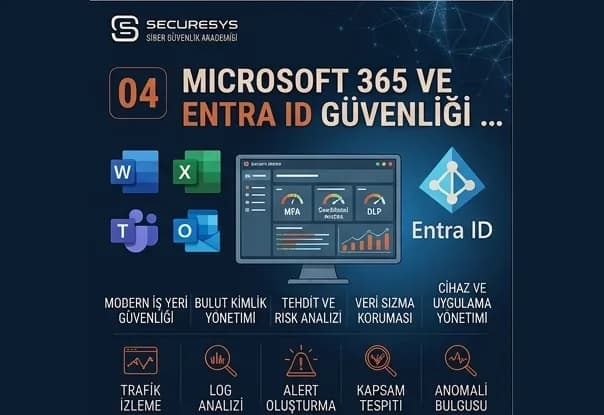
How Is Microsoft 365 and Entra ID Security Achieved?
How is Microsoft 365 and Entra ID security achieved? MFA, conditional access, PIM, OAuth governance, session security and identity incident response together.
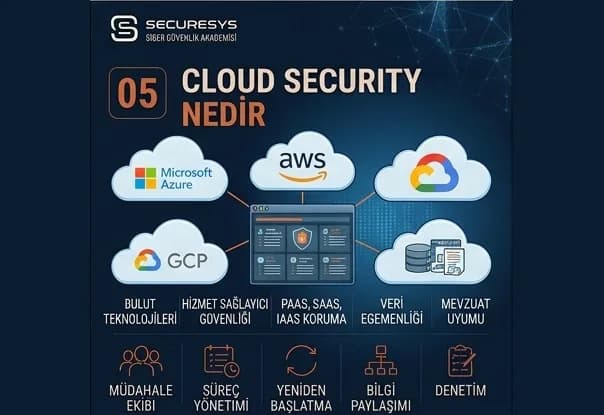
What Is Cloud Security? Securing AWS, Azure and Google Cloud
What is cloud security? How are the IAM, network, storage, logging and CSPM layers secured on AWS, Azure and Google Cloud?
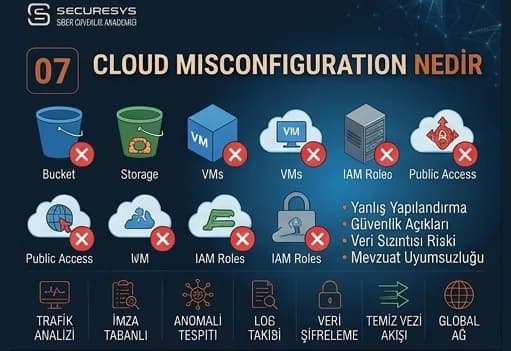
What Is Cloud Misconfiguration? How Are Faulty Cloud Configurations Detected?
What is cloud misconfiguration? How are public storage, open ports and disabled logging detected with CSPM?
Looking for professional support on this topic?
Our expert team will reach out for a free consultation as soon as possible.