What Is Database Security? Protecting PostgreSQL, MSSQL and Oracle Systems
What is database security? Privilege, network, encryption, audit and backup security on PostgreSQL, MSSQL and Oracle systems.
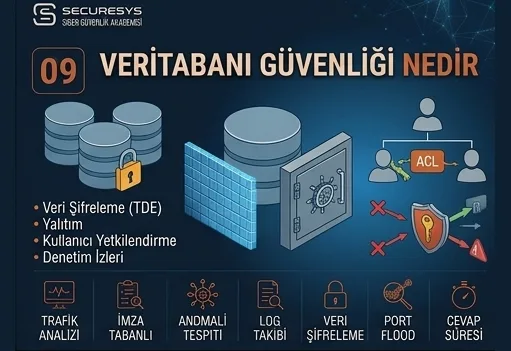
One of the most valuable components of corporate systems is often the database.
Customer records.
Financial information.
Identity data.
Orders.
Contracts.
Human resources records.
Application configuration.
Privilege information.
When an attacker compromises the application server, the real target is often not to stay there.
The real target is the data.
Database security is therefore one of the most critical areas of system and cloud security.
Although platforms such as PostgreSQL, Microsoft SQL Server and Oracle hold different technical features, the basic security principles are similar:
Minimum privilege, minimum network exposure, strong authentication, encryption, auditing, privileged access control and secure backup.
Database security is not merely preventing an SQL injection attack.
A database can be at risk entirely independently of the application because of;
faulty user privilege,
an open network port,
a weak DBA account,
an old version,
a faulty audit setting,
an unencrypted backup.
Any of these can create risk.
The modern database security approach must therefore handle the layers of;
Database Hardening + IAM/PAM + Network Security + Encryption + DAM + Monitoring + Backup Security + Vulnerability Management
together.
What Is Database Security?
Database security is the protection of database systems, the data within them, users, privileges and management interfaces against unauthorised access, data leakage, manipulation and service interruption risks.
Within that scope, areas such as;
- PostgreSQL security,
- Microsoft SQL Server security,
- Oracle security,
- database hardening,
- database access control,
- database activity monitoring,
- database encryption,
- database backup security
are assessed.
The real aim is not merely to keep the database available.
It is at the same time to be able to answer:
Who is reaching what?
Which data are they reading?
Which privileged operation is being carried out?
Is that activity being logged?
These questions must be answerable.
How Is PostgreSQL Security Achieved?
PostgreSQL is one of the most widespread corporate databases in the open source world.
From a security perspective;
pg_hba.conf,
the user/role structure,
network binding,
SSL/TLS,
logging,
extension use
are critical areas.
The first principle is that the database must not be unnecessarily open to the internet.
PostgreSQL must mostly be reachable only from the application server or particular admin networks.
What Is pg_hba.conf?
In PostgreSQL, pg_hba.conf is the critical configuration file determining which users can connect from which source IPs with which authentication method.
Faulty or very broad rules can create risk.
Rather than granting broad authentication permission to the whole network, for instance, dedicated access can be defined for sources such as;
the application subnet,
the DBA network,
the backup server.
How Is PostgreSQL Role Security Managed?
In PostgreSQL the user and role structure carries central importance.
Every application running with the database superuser account is a serious error.
The application must hold only the permissions it needs such as;
SELECT,
INSERT,
UPDATE,
EXECUTE.
This is the least privilege principle.
Why Is the PostgreSQL Superuser Critical?
The PostgreSQL superuser holds broad database privileges.
An application account being a superuser enlarges attack impact.
If the database account is compromised through a vulnerability on the application side, for instance, the attacker can obtain broad control over the whole database.
Superuser accounts must therefore be used only for DBA operations.
How Is MSSQL Security Achieved?
Microsoft SQL Server security requires the authentication, server role, database role, network, encryption and auditing layers to be protected together.
Critical areas include;
the sa account,
the sysadmin role,
Windows Authentication,
SQL Authentication,
TCP/IP access,
SQL Server Audit.
Membership of the sysadmin role in particular must be kept to a minimum.
What Is the sa Account?
sa is SQL Server's high-privilege SQL authentication account.
This account;
being active,
using a weak password,
being used by applications
can create high risk.
Where possible, personal DBA accounts, central identity and controlled privileged access must be preferred.
Is Windows Authentication More Secure for MSSQL?
In suitable corporate environments, Windows/AD-based authentication can provide advantages in central identity management, MFA/PAM layers and account lifecycle.
But that does not mean a faulty AD privilege is safe.
Database roles must still be kept to a minimum.
How Is Oracle Security Achieved?
In Oracle Database environments, components such as;
SYS,
SYSTEM,
the DBA role,
the listener,
TDE,
audit,
Database Vault
matter for security.
Because Oracle is generally used in critical financial and corporate systems, privileged DBA access must be managed particularly tightly.
Why Are the SYS and SYSTEM Accounts Critical?
On the Oracle side, SYS and SYSTEM are among the high-privilege accounts.
Using these accounts for daily application connections is not appropriate.
Personal DBA accounts and task-based roles must be preferred.
The use of these accounts must also be audited in detail.
What Is Database Hardening?
Database hardening is stripping the database of unnecessary features, broad privileges and risky configuration.
Within that scope, operations such as;
deleting unnecessary users,
disabling default accounts,
reducing network exposure,
secure TLS use,
enabling audit,
switching off unnecessary extensions or features
can be carried out.
What Is a Database Security Baseline?
It is the minimum security standard specific to the organisation.
For example;
The DB will run only on a private network.
DBA access will be through PAM.
Application accounts will not be superusers.
TLS will be mandatory.
Audit logs will be sent to the SIEM.
Backups will be kept encrypted.
This baseline can be applied as a common principle across all database platforms.
Can a CIS Database Benchmark Be Used?
Yes.
Hardening recommendations from CIS can be found for particular database technologies.
But not every control must be applied directly to a production environment.
Performance, compatibility and business requirements must be assessed.
A benchmark is a starting point, not the final security model.
How Is Database Network Security Achieved?
Database ports must as far as possible not be open directly to the internet.
For example, ports such as;
PostgreSQL 5432,
MSSQL 1433,
Oracle 1521
must be reachable only from the necessary application or admin subnets.
The secure flow can be thought of as:
User → Application → Database
The direct:
Internet → Database
architecture is not appropriate for most corporate systems.
Should a Database Use a Public IP?
As far as possible, no.
If a managed database is used in a cloud environment, a private endpoint or private network can be preferred.
If public access is required, additional controls such as;
source IP restriction,
strong authentication,
TLS,
monitoring
must be used.
What Is a Database Firewall?
It is the filtering mechanism at network or database level determining which sources can connect to the database.
In cloud managed databases, a provider firewall or security group can be used.
In an on-premise environment, network firewall and host firewall layers can be assessed.
Why Does Database Segmentation Matter?
Database servers must be separated from the user network.
An ordinary employee's laptop may not need to connect directly to the production database, for instance.
That reduces lateral movement risk.
In the ideal model only application servers and the authorised DBA management network can reach it.
How Must Database Admin Access Be Provided?
DBA users must not connect to the production database directly over the internet or from a normal laptop.
A more controlled model can be:
DBA → MFA/PAM → Bastion → Database
as a flow.
This structure makes it easier to log and limit privileged access.
What Is Database PAM?
Privileged access management can centrally manage the password or session access of DBA accounts.
A DBA can, for instance;
without seeing the database password,
after obtaining approval,
for a particular period
open a session.
The session can be recorded.
This is particularly valuable in critical financial systems.
Why Is a Shared DBA Account Risky?
If several DBAs use the same dba_admin account, who carried out which operation cannot be clearly understood.
That creates an accountability problem.
A personal account + role elevation model must be preferred.
What Is Just-in-Time DBA Access?
It is the DBA obtaining high privilege briefly only at the moment of maintenance rather than holding it permanently.
A one-hour admin role, for instance.
At the end of the period the privilege is removed automatically.
That reduces standing privilege risk.
What Should an Application Database Account Be Like?
Every application must use its own separate database account.
That account must reach only the necessary schemas and tables.
If the reporting application does not need DELETE privilege, for instance, it must not be given.
The impact of application compromise is thereby limited.
Is Using One Database Account for All Applications Risky?
Yes.
When one application is compromised, the same credential can endanger the other applications' database access too.
A separate identity must be preferred for each application or workload.
That also makes attribution easier.
Why Is a Service Account Critical in Database Security?
Database connections are mostly made with a service account or application credential.
Those credentials can be stored inside;
a config file,
an environment variable,
source code.
When exposed, the attacker can reach the database directly.
Secret management is therefore required.
Should a Database Password Be Kept Inside the Code?
No.
A plain-text database credential inside source code or a repository is a serious risk.
A secret vault can be used.
The credential can be supplied to the application securely at runtime.
What Is Database Secret Rotation?
It is changing database user passwords periodically or on an event basis.
But applications must move to the new credential without downtime.
Secret rotation must therefore be designed to be automatic as far as possible.
Is Passwordless Database Access Possible?
On some cloud and corporate platforms, IAM or managed identity-based database authentication can be used.
A workload can reach the database without holding a static password, for instance.
That can reduce static secret risk.
But IAM permission must still be managed correctly.
What Is Database Encryption at Rest?
It means the database files being encrypted on disk.
For example;
TDE,
storage encryption
can be used.
This provides data protection particularly if a disk or backup is stolen.
But an attacker logging into the database with privilege can still read the data.
Encryption is therefore not an alternative to access control.
What Is TDE?
Transparent Data Encryption (TDE) is the mechanism helping encrypt database files on storage.
It can be used on platforms such as Oracle and MSSQL.
Its advantage is providing encryption without requiring large changes on the application side.
But encryption key security becomes critical.
Why Does Encryption in Transit Matter for a Database?
If traffic between the application and the database travels without TLS, credentials or data can become readable on the network.
TLS must therefore be preferred on production database connections.
It matters particularly in hybrid and cloud networks.
Why Does Database Certificate Validation Matter?
Using TLS is not enough on its own.
If the client does not verify the server certificate, man-in-the-middle risk can continue.
The certificate chain and hostname validation must therefore be configured correctly.
What Is Column-Level Encryption?
It is the additional encryption of particular sensitive columns.
For example;
a national ID number,
a credit card,
health information,
particular financial data
can be covered.
This is a different level of data protection from whole-database encryption.
What Is Tokenization?
It is using a token in place of the real value rather than storing sensitive data directly.
It can be used particularly in payment and PCI DSS scope structures.
Tokenization can reduce data exposure impact.
What Is Data Masking?
It is the partial hiding of sensitive data for particular users or environments.
For example:
**** **** **** 1234
and similar.
It is valuable particularly for preventing the whole of the production data being visible in test and development environments.
What Is Dynamic Data Masking?
The data sits in its real form inside the database but appears masked when queried by particular users.
This supports access control.
But it does not take the place of strong encryption or permissions.
Is Using Production Data in the Test Environment Risky?
Yes.
Development and test environments are generally not protected as strongly as production.
Copying real customer data directly raises data exposure risk.
Data masking or synthetic data can be used.
What Is Database Audit?
Database auditing is the recording of the critical operations users and applications carry out on the database.
For example;
logins,
DDL,
privileged queries,
table access,
user creation,
role changes
can be monitored.
These records are valuable for incident response and compliance.
What Is Database Activity Monitoring (DAM)?
DAM is the security approach continuously monitoring database activity and trying to detect suspicious behaviour.
For example;
a DBA dumping the customer table at night,
an application account reading a table it does not normally reach,
a very high query volume
can be seen as anomalies.
Are DAM and Database Audit the Same Thing?
No.
Database audit can focus more on local logs and event records.
DAM can offer central;
monitoring,
behaviour analysis,
alerting,
policy enforcement.
The two can complete one another.
Why Does DAM Matter Particularly for DBA Accounts?
A DBA can technically reach the data anyway.
Rather than “is there access?”, therefore:
Is the access legitimate?
is the important question.
By monitoring high-privilege user activity, DAM can reduce insider threat risks.
How Must Privileged Database Activity Be Monitored?
For example;
a schema change,
user creation,
a role grant,
a mass export,
audit being disabled
are high-value events.
These activities can produce alerts on the SIEM/DAM.
Are SQL Injection and Database Security the Same Thing?
No.
SQL injection can be an input validation and query construction problem at the application layer.
Database security is far broader.
There is no SQL injection, for instance.
But the application database account is DBA privileged.
Another RCE flaw in the application can then still endanger the whole database.
AppSec and DB security must therefore be thought of together.
Does SQL Injection Impact Depend on Database Privilege?
Yes.
If the application account can read only a particular table, SQL injection impact can be limited.
But if the same account holds high privileges such as;
DROP TABLE,
CREATE USER,
filesystem access
the impact of the attack grows.
Least privilege is therefore an important compensating control for SQL injection too.
How Is Stored Procedure Security Managed?
Stored procedures can contain application logic and privileged operations.
Which users hold EXECUTE privilege must be checked.
Dynamic SQL use and input handling must also be assessed.
Database Extension and Plugin Security
PostgreSQL extensions or Oracle/MSSQL add-on components provide new functions.
But an unused extension can create attack surface.
Only the necessary components must be kept active.
What Is xp_cmdshell and Why Is It Risky?
On the SQL Server side, xp_cmdshell is the powerful feature allowing operating system commands to be run through the database.
Unless necessary it must be kept disabled.
If it is active, access to it must be controlled very tightly.
This is one of the classic examples of database compromise turning into OS compromise.
PostgreSQL COPY and File Access Risks
Database platforms can in some cases interact with the server filesystem.
These privileges must be limited to privileged users.
Application accounts must not hold unnecessary filesystem access.
Oracle UTL_FILE and External Procedure Risks
On advanced database platforms such as Oracle there can be features providing interaction with the filesystem or external services.
These features must be given only to the necessary accounts.
Because they can raise the risk of moving from the database to host level.
Database OS Account Security
The database engine generally runs on the operating system with a dedicated service account.
That account must not hold unnecessarily high privilege such as;
root,
Local Administrator.
The database service account must run with minimum OS privilege.
Why Is Database Server Hardening Necessary?
Even if the database engine is secure, the underlying Windows or Linux server can be weak.
Therefore;
OS patching,
EDR,
a host firewall,
SSH/RDP security,
CIS hardening
must be applied.
Database security and server security cannot be thought of separately.
How Is Database Patch Management Carried Out?
Database engines also receive regular security updates.
In the patch process;
the vendor advisory,
CVE severity,
exploitability,
downtime,
HA architecture
must be assessed.
On critical databases a pre-patch test and rollback plan are required.
What Is Database Version EOL Risk?
Database versions whose vendor support has ended may no longer receive security patches.
New flaws then create permanent risk.
PostgreSQL, MSSQL and Oracle version lifecycles must therefore be followed.
What Is a Database Vulnerability Assessment?
It is the evaluation of the database's;
version,
configuration,
accounts,
permissions,
known vulnerabilities.
A more accurate result can be obtained with a credentialed scan and configuration review.
A port scan alone is not enough.
What Is a Database Security Assessment?
It is a broader piece of work.
It can cover these areas:
Architecture
Authentication
Authorization
Network
Encryption
Audit
Backup
PAM/DAM
Patch
Hardening
The aim is not merely to find vulnerabilities but to understand the data exposure risk.
The Difference Between a Database Pentest and a Security Assessment
Database Security Assessment
Examines configuration and privilege risks.
Penetration Test
Tests how exploitable those risks are through authorised scenarios.
The assessment, for instance:
The application user is highly privileged.
The pentest:
Can the critical schema be changed through that privilege?
can verify that question.
Why Is Database Backup a Critical Security Area?
A backup mostly contains a complete copy of the database.
Even if production access is very tight, data can leak if the backup file is kept in the wrong place.
A backup must therefore be;
encrypted,
access-controlled,
retention-managed.
Should Database Backups Be Encrypted?
On systems holding sensitive data it must be strongly considered.
Because when a backup file is stolen the database authentication mechanisms may have been bypassed.
The attacker can try to reach the data offline.
Where Must the Backup Encryption Key Be Kept?
It must not be kept in the same place as the backup.
Key management must be separate and controlled.
Otherwise, if the backup file and the key are obtained together, encryption becomes ineffective.
Database Backup Ransomware Risk
Ransomware attackers can also delete or encrypt backups.
Therefore;
immutable backups,
an offline copy,
separate credentials,
network segmentation
can be assessed.
Why Is a Database Restore Test Necessary?
Taking a backup does not mean it can be restored.
Through periodic restore tests;
backup integrity,
RTO,
RPO,
application compatibility
must be verified.
This is a core part of cyber resilience.
Are Database High Availability and Backup the Same Thing?
No.
Replication or a cluster provides availability.
But if a faulty query deletes all the data, the change can spread to the replica too.
HA and backup therefore solve different problems.
Database Replication Security
The connection between primary and replica must be protected with;
authentication,
TLS,
network restriction.
The replication account must not hold more privilege than it needs.
Otherwise a compromise can create broad impact.
How Must Read Replica Privileges Be Managed?
Application or reporting users can work on a read-only replica.
But the replica's network and IAM access must still be controlled.
Being “read-only” does not remove the risk of sensitive data leakage.
How Is Database Cloud Security Achieved?
In managed services such as AWS RDS, Azure SQL or Google Cloud SQL, the provider can manage responsibility for;
the OS,
hardware,
certain patching.
But the customer is still responsible for areas such as;
network,
IAM,
user permissions,
data,
encryption,
backup policy.
Is Having No Root Access on a Managed Database More Secure?
On some managed database services there is no OS-level access.
That can reduce the attack surface.
But application and IAM risks continue.
An admin account making the database public is still possible.
Why Does a Private Endpoint Matter for a Managed Database?
It allows the database to be reached over the cloud private network rather than the public internet.
That reduces the internet attack surface.
It is a strong network control particularly on production databases.
Can Cloud IAM Be Used for Database Access?
Some platforms support native IAM authentication.
It can thereby be possible to reduce the use of static database passwords.
The advantages can be;
central identity,
temporary tokens,
MFA/JIT integration.
But authorization must still be limited with the correct roles.
Database Key Vault Integration
Database credentials and encryption keys can be managed through a central secret/key vault.
That provides advantages in;
rotation,
audit,
access control.
But vault access becomes a critical privilege.
Database Connection Pool Security
Applications can use a database connection pool.
Credentials can sit inside the pool config.
That config must not appear in log or debug output.
Idle connection and timeout settings also matter for availability.
What Is Database DoS Risk?
An attacker or a faulty query can consume;
CPU,
memory,
the connection pool,
locks,
disk IO
resources.
That affects database availability.
Controls such as resource limits and query timeouts matter.
Why Is a Connection Limit Necessary?
If a single application or user opens unlimited connections it can consume database resources.
A per-user or per-application connection limit can be applied.
That also reduces noisy neighbour risk.
What Is a Query Timeout?
It is long-running queries being terminated after a particular period.
Particularly in reporting or web applications it can prevent faulty queries consuming all the database resources.
But it must be tuned according to business needs.
What Is a Resource Governor?
Some database platforms can define different resource quotas or limits for workloads.
Reporting workloads must not affect production transactions, for instance.
This is valuable for availability security.
Is Database Locking a Security Matter?
Indirectly, yes.
An attacker or a faulty application can create table locks with long transactions.
That can cause service disruption.
Database monitoring can detect this behaviour.
How Is Mass Data Export Detected?
A normal user reads a few hundred records a day.
Suddenly they export millions of rows.
That behaviour can be an anomaly.
Through DAM or the SIEM;
query volume,
rows returned,
data transfer
can be monitored.
Why Is Insider Threat Critical for a Database?
A DBA or privileged user can technically reach a great deal of data.
Insider risks therefore cannot be solved with access control alone.
Monitoring and separation of duties are required.
How Is Separation of Duties Applied in a Database?
The same person;
database admin,
audit log admin,
backup admin
may need not to be all of these.
Through separation of duties it becomes harder for one person both to carry out an operation and to change the records.
Is Maker-Checker Used in Database Operations?
Two-stage approval can be applied to critical schema changes or privileged grants.
One person prepares the change.
Another authorised person approves it.
This is valuable particularly in financial and regulated systems.
What Is Database Change Management?
It is production database changes being made in a controlled way.
For example;
DDL,
an index,
a user grant,
a config change
can be linked to a change record.
That increases security and operational stability.
Should Database Audit Logs Be Sent to the SIEM?
Yes, it is useful on critical databases.
But the log volume can be very high.
High-value events such as;
privileged activity,
failed logins,
role changes,
schema changes,
sensitive table access
can therefore be prioritised.
Database SIEM Use Case Examples
For example;
Repeated Failed DBA Login
New Privileged User Created
Audit Disabled
Mass Data Export
Sensitive Table Access by Unusual User
Unexpected Schema Change
Database Login from New Source
use cases of this kind can be created.
Why Is an Audit Disable Event Critical?
If an attacker or insider tries to switch audit off, that can be a defence evasion indicator.
Audit configuration changes must be monitored at high priority.
How Is a Database Login Anomaly Detected?
Normally the application account connects only from the application server.
Suddenly a connection arrives from a DBA laptop or an IP in a different country.
That can be an anomaly.
Source, time and account behaviour must be assessed together.
Should an Application Account Make an Interactive Login?
Generally a service/application account must be used only by the application.
A human user must not log in manually with the same credential.
Interactive use can produce an alert as unexpected activity.
What Is a Database Activity Baseline?
It is the definition of the database behaviour of normal users and applications.
For example;
the normal query type,
the normal access time,
the normal source,
the normal data volume
is known.
Anomaly detection can be done against that baseline.
Is Database Threat Hunting Carried Out?
Yes.
A hypothesis, for instance:
“A privileged account may have exported sensitive customer tables unusually over the last 30 days.”
Retrospective analysis can be made in the audit and DAM records.
What Is Database Forensics?
It is the forensic analysis of database incidents.
The sources usable can be;
audit logs,
transaction logs,
database logs,
OS logs,
DAM telemetry,
backup history.
But log retention must be sufficient in advance.
Is Transaction Log Forensics Possible?
Depending on the platform, transaction or redo logs can help understand particular changes.
But that work requires specialist expertise.
A database specialist must therefore be brought into the process during incident response.
How Is Database Incident Response Carried Out?
On suspicion of a database compromise;
accounts,
sessions,
query history,
privilege changes,
data access,
backups,
OS telemetry
must be examined together.
Disabling the suspicious user alone may not be enough.
Persistence or a new account may have been created.
Credential Rotation After a Database Compromise
The credentials of the;
application account,
DBA account,
replication account,
backup account
may have been affected.
They must be rotated according to the risk scope.
Whether the same credential is used on other systems must also be checked.
How Is a Database Security Assessment Carried Out?
The general flow can be as follows:
1. Asset Inventory
Database instances are determined.
2. Architecture Review
On-prem/cloud and network structure are examined.
3. User & Role Review
Privileges are assessed.
4. Hardening
The CIS/vendor baseline is checked.
5. Network Exposure
Public and internal access is analysed.
6. Encryption
At-rest and in-transit are checked.
7. Audit & DAM
Monitoring coverage is examined.
8. Backup Security
Encryption and immutability are assessed.
9. Vulnerability/Patch
Version and CVE analysis is carried out.
10. Attack Path
Application → DB → OS/cloud routes are assessed.
What Is a Database Attack Path?
It is the relationship chain along which an attacker can advance from an application or identity to the database and to more critical resources.
For example:
Internet
↓
Web Application RCE
↓
Application Credential
↓
Database
↓
DBA Privilege
↓
OS Command Execution
↓
Production Server
This chain is not database security alone.
It also contains AppSec, secret management and server security.
A Database Toxic Combination Example
Individually the findings can be:
A medium-level SSRF in the web app.
A broadly accessible secret vault.
The database is not public.
The application DB account is DBA.
Looked at together, the attacker can reach critical data.
In modern database risk management, therefore, the relationship between findings matters.
How Are DAM and PAM Used Together?
PAM answers:
Who obtained privileged access?
that question.
DAM answers:
What did they do inside the database?
that question.
Used together, high-privilege access becomes far more visible.
What Are the Database Security KPIs?
Example metrics:
Privileged Account Count
Shared DBA Account Count
Public Database Count
Unencrypted Database Count
Unencrypted Backup Count
Critical DB Vulnerability Count
PAM Coverage
DAM Coverage
Audit Logging Coverage
Dormant Account Count
Restore Test Success Rate
These metrics can help measure database security posture.
Can a Database Security Score Be Used?
For management visibility, the areas of;
access control,
network,
encryption,
audit,
backup,
patch
can be scored.
But a single public production database can matter more than the average score.
The score and the critical risks must therefore be given together.
What Should a Database Security Report Contain?
A professional report can include these sections:
Executive Summary
Critical business and data risks.
Database Inventory
PostgreSQL, MSSQL and Oracle instances.
Architecture & Exposure
Network and public access.
User & Privilege Review
DBA and application accounts.
Hardening Findings
Configuration problems.
Encryption Status
At-rest and in-transit.
Audit & Monitoring
DAM/SIEM visibility.
Vulnerability & Patch
EOL and CVE risks.
Backup Security
Encryption and restore state.
Attack Path Analysis
Application-database-OS/cloud chains.
Remediation Roadmap
Prioritised improvements.
What Is the Biggest Mistake in Database Security?
One of the biggest mistakes is the approach:
“The database is not open to the internet, so it is secure.”
That assumption is wrong.
The database can be on a private network.
But the application account can be DBA.
A shared admin account can be in use.
Audit can be switched off.
The backup can be unencrypted.
The same password may not have changed for years.
A private network is therefore only one security layer.
Genuine database security is far broader.
Common Security Principles for PostgreSQL, MSSQL and Oracle
Although the platforms differ, the common approach is as follows:
Private Network
No unnecessary public exposure.
Least Privilege
Applications and users hold minimum privilege.
Privileged Access Control
DBA access is managed with PAM/JIT.
Encryption
At-rest and in-transit.
Audit
Critical activity is logged.
DAM
Sensitive data access is monitored.
Patch & Hardening
The database and OS are kept current.
Backup Security
Backups are encrypted and restorable.
SIEM Integration
Suspicious activity is seen by the SOC.
What Should the Database Security Lifecycle Be?
A healthy model can be thought of as follows:
Discover
The database inventory.
↓
Harden
A secure baseline.
↓
Control Access
IAM/PAM and least privilege.
↓
Protect Data
Encryption and masking.
↓
Monitor
Audit, DAM and SIEM.
↓
Patch
Vulnerability management.
↓
Backup
Secure recovery.
↓
Assess
Security assessment.
↓
Retest
Verification of the fixes.
This cycle must be applied continuously.
Conclusion: Database Security Is the Last Defence Layer on the Way to the Data Itself
The firewall can be strong.
Cloud IAM can be correct.
Kubernetes can be hardened.
The application can be secure.
But a single account connecting to the database with more privilege than it needs can weaken this whole security chain.
Database security is therefore not merely the DBA team's operational matter.
It sits directly at the centre of corporate data security.
A strong database security approach must be formed with the layers of;
Database Hardening + Least Privilege + PAM + Network Segmentation + Encryption + DAM + SIEM + Patch Management + Secure Backup
working together.
And this question must be asked constantly:
If an attacker compromised the application account today, how far could they advance inside the database?
Could they read only their own schema?
Could they export all the customer data?
Could they create a new admin user?
Could they move from the database to the operating system?
Could they reach the backups?
The real security level emerges in the answers to these questions.
But protecting the data does not mean protecting the production database alone.
Ransomware attacks have shown us another very critical truth:
Attackers now target the backups too.
Because if there is a secure and restorable backup the organisation can get back on its feet.
If there is no backup, or it has been deleted by the attacker, a technical incident can turn directly into a business continuity crisis.
Related Articles
System & Cloud Security
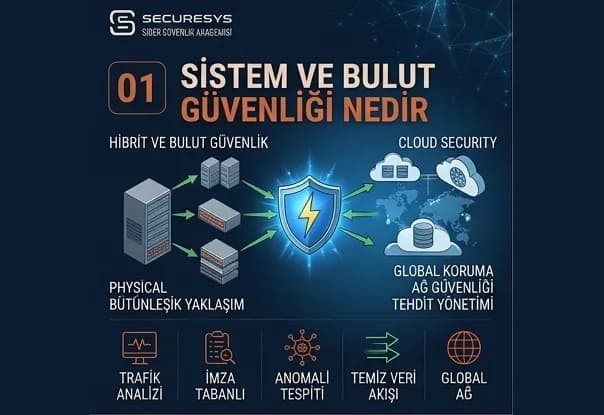
What Is System and Cloud Security? How Is Enterprise Infrastructure Protected?
System and cloud security is not a product but a continuously managed discipline. This chapter covers the shared responsibility model, hardening and baselines, identity security, and the CSPM, CWPP and CNAPP concepts.
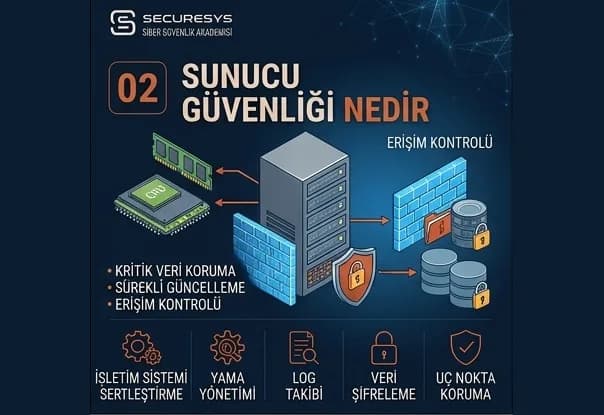
What Is Server Security? How Is Windows and Linux Server Hardening Done?
A secure server is more than a secure build. This chapter covers Windows and Linux hardening, CIS benchmarks and baselines, RDP/SSH security, privileged access and the logging layers.
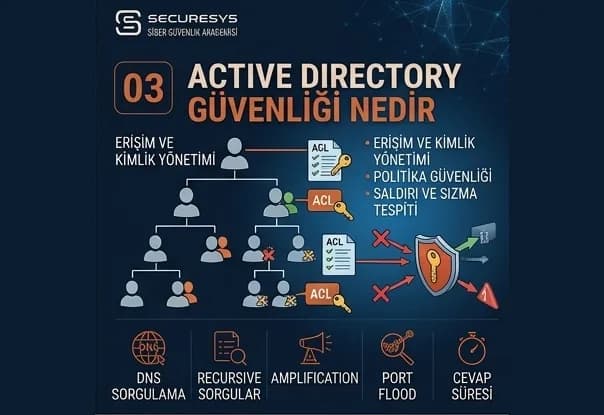
What Is Active Directory Security? Preventing Domain, Privilege and Identity Risks
Active Directory security is about protecting the identity graph. This chapter covers Kerberos and NTLM risks, ACLs and delegation, LAPS/gMSA and tiering, attack path analysis and AD recovery planning.
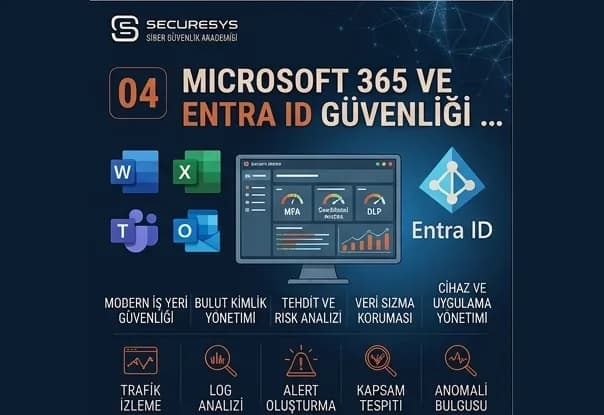
How Is Microsoft 365 and Entra ID Security Achieved?
How is Microsoft 365 and Entra ID security achieved? MFA, conditional access, PIM, OAuth governance, session security and identity incident response together.
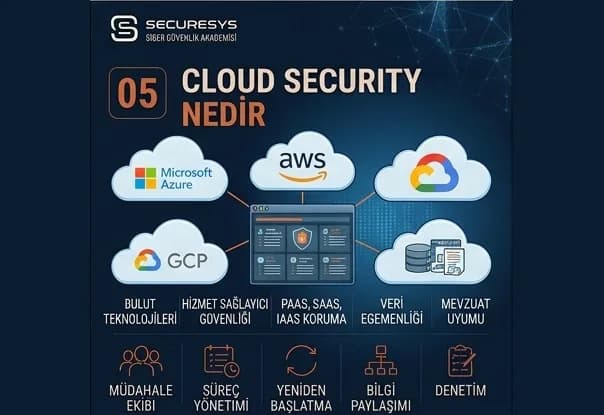
What Is Cloud Security? Securing AWS, Azure and Google Cloud
What is cloud security? How are the IAM, network, storage, logging and CSPM layers secured on AWS, Azure and Google Cloud?
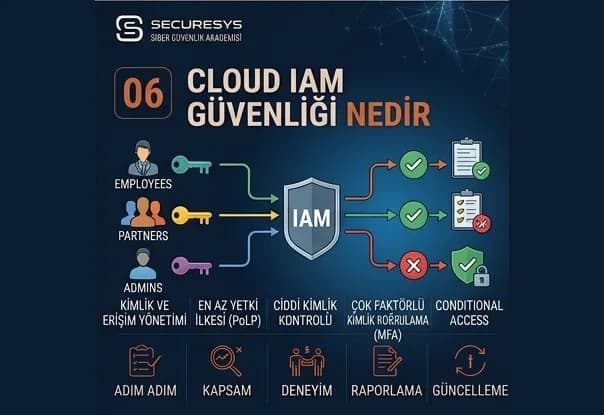
What Is Cloud IAM Security? Managing Permission, Role and Privileged Access Risk
What is cloud IAM security? Overprivilege, privilege escalation, service account risks and the CIEM approach on AWS, Azure and GCP.
Looking for professional support on this topic?
Our expert team will reach out for a free consultation as soon as possible.