What Are CSPM, CWPP and CNAPP? How Do Modern Cloud Security Platforms Work?
What are CSPM, CWPP, CIEM, KSPM, DSPM and CNAPP? How do modern cloud security platforms work and show attack paths?
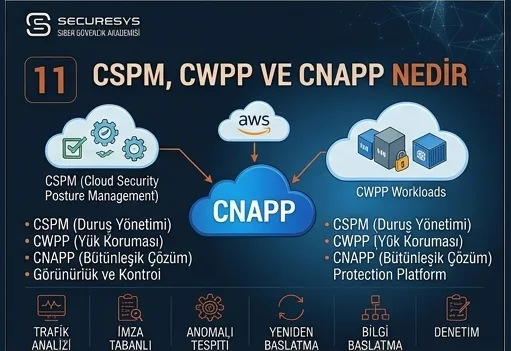
As cloud environments grow, a new problem appears before security teams:
Too many resources, too many services and too many security signals.
On one side AWS accounts.
On another Azure subscriptions.
Somewhere else Google Cloud projects.
On top of them can run;
virtual machines,
containers,
Kubernetes clusters,
serverless applications,
storage services,
IAM roles,
secrets,
databases.
All at the same time.
Every platform produces its own security alert.
Every product creates its own dashboard.
The organisation eventually faces this question:
“Which risk is genuinely critical?”
Modern cloud security concepts such as CSPM, CWPP, CIEM, KSPM, DSPM and CNAPP try to solve exactly this problem.
But these terms are often confused with one another.
What does CSPM do?
What is the difference between CWPP and EDR?
Why is CIEM needed?
Does CNAPP genuinely replace them all?
More importantly:
Do these platforms merely produce thousands of alerts, or can they show the real attack paths?
The real value of the modern cloud security approach emerges here.
What Is CSPM?
Cloud Security Posture Management (CSPM) is the approach and technology category continuously analysing security configurations in a cloud environment.
CSPM basically answers this question:
“Are our cloud resources configured securely?”
CSPM can detect these risks, for instance:
- Public storage
- RDP or SSH open to the internet
- A public database
- Missing encryption
- Audit logging being switched off
- Missing MFA
- Security Group misconfigurations
- IAM policy problems
- Backup or snapshot risks
The basic strength of CSPM is that it assesses the cloud environment continuously.
Because a cloud environment is not static.
A structure that is secure today can change tomorrow.
Why Is CSPM Necessary?
In a traditional data centre environment the infrastructure changes relatively slowly.
In the cloud, a developer can create a new;
VM,
storage,
database,
load balancer
within a few minutes.
A manual security review cannot keep up with that speed.
By analysing cloud APIs, CSPM can make newly formed risks visible faster.
The basic aim of CSPM is therefore to provide:
Continuous Cloud Posture Visibility
as its core function.
Is CSPM Only for Compliance?
No.
CSPM platforms can map to standards such as;
the CIS Benchmark,
ISO 27001,
PCI DSS,
NIST.
But a good CSPM must not say only:
“This control failed.”
It must at the same time try to answer:
“How important is that failure from a real attack perspective?”
Modern CSPM tools have therefore begun adding risk context.
What Is CWPP?
A Cloud Workload Protection Platform (CWPP) is the platform category focusing on the security of workloads running on the cloud.
A workload can be;
a virtual machine,
a container,
a Kubernetes workload,
a serverless function.
CWPP basically answers this question:
“Are the systems running on the cloud secure at runtime?”
CWPP can therefore focus on areas such as;
malware,
runtime attacks,
process behaviour,
vulnerabilities,
file activity,
container activity.
What Is the Difference Between CSPM and CWPP?
Simply:
CSPM → Looks at configuration.
CWPP → Looks at the running workload.
For example:
CSPM:
“This VM's SSH port is open to the internet.”
CWPP:
“A suspicious process is running on this VM.”
The first is a posture problem.
The second is runtime behaviour.
The two technologies are therefore not alternatives to one another.
What Is the Difference Between CWPP and EDR?
These two concepts can overlap in particular areas.
EDR – Endpoint Detection and Response
monitors, particularly on endpoints and servers;
process,
file,
network,
registry,
malware
behaviour.
CWPP
can look at the cloud workload world from a broader angle.
For example;
VMs,
containers,
Kubernetes,
serverless
and other workload types can be covered.
On some platforms EDR and CWPP functions have merged considerably.
The real technical scope must therefore be assessed rather than the product names.
How Does CWPP Work in Container Security?
During container runtime it can monitor behaviour such as;
a shell opening,
a suspicious process,
a network connection,
privilege escalation,
file modification.
If, inside a container that should normally only run a Java process:
bash
or
curl
starts running, that can be an anomaly.
This is valuable for runtime detection.
Can CWPP Protect Serverless Environments?
Some platforms can provide visibility for serverless workloads too.
But installing a classic agent may not be possible in serverless architectures.
Different methods such as;
cloud telemetry,
function behaviour,
API activity,
runtime instrumentation
can therefore be used.
The platform's real technical capability must be assessed separately here.
What Is KSPM?
Kubernetes Security Posture Management (KSPM) is the approach continuously analysing the security configurations of Kubernetes clusters.
KSPM can detect these risks:
a privileged pod,
a root container,
an open API server,
weak RBAC,
a missing Network Policy,
a dangerous hostPath,
an overprivileged service account.
KSPM can be thought of as the extension of CSPM looking at Kubernetes in more detail.
Why Is Kubernetes Security Assessed Separately From CSPM?
Because Kubernetes has its own;
RBAC,
pod,
namespace,
service account,
secret,
network policy
model.
Even if the cloud provider is secure, serious risks can exist inside the cluster.
An AWS account can be completely secure, for instance.
But inside the EKS cluster a developer can be cluster-admin.
CSPM alone may not interpret that in enough detail.
KSPM is therefore necessary.
What Is CIEM?
Cloud Infrastructure Entitlement Management (CIEM) is the security approach focusing on analysing identities and privileges in a cloud environment.
The basic question is this:
“Who holds which privilege and do they genuinely need it?”
CIEM can analyse the relationships of;
human identity,
service accounts,
roles,
workload identity,
permissions.
Why Did CIEM Emerge?
Cloud IAM can be extremely complex.
A user can obtain very different privileges through;
a direct role,
group membership,
inherited permission,
a resource policy,
cross-account trust.
Reading policies one by one is not enough to understand the real privilege level.
CIEM provides effective permission visibility.
How Does CIEM Find Overprivilege?
A service account, for instance:
Holds 400 permissions.
But has used only 20 permissions in the last 90 days.
CIEM:
“This identity may be seriously overprivileged.”
can say.
This approach is used for permission rightsizing.
But automatic reduction must be done carefully because of critical emergency permissions.
What Is DSPM?
Data Security Posture Management (DSPM) focuses on analysing where sensitive data sits, who can reach it and what risk it is under.
DSPM can say, for instance:
There is customer data inside this storage.
This database contains personal data.
There are financial records in this bucket.
That is its contribution.
This information changes cloud risk prioritisation considerably.
The Difference Between CSPM and DSPM
CSPM says:
“This storage is public.”
DSPM says:
“There is sensitive personal data inside this storage.”
Combined:
Public + Sensitive Data
creates a far more critical risk.
Modern cloud security can therefore stay incomplete without data context.
What Is CNAPP?
A Cloud-Native Application Protection Platform (CNAPP) is the modern security approach aiming to unite different cloud security capabilities under a single platform.
Within a CNAPP there can be capabilities such as;
CSPM,
CWPP,
CIEM,
KSPM,
IaC security,
container security,
attack path analysis.
Some platforms can add DSPM or code security features too.
The basic goal is:
Seeing cloud risks as a whole rather than in fragments.
Why Did CNAPP Emerge?
Cloud security was initially managed with different products.
One product CSPM.
Another product container security.
Another product IAM.
Another product runtime.
Security teams had to use dozens of dashboards.
The bigger problem was that the findings could not be connected to one another.
For example;
CSPM → a public VM.
Vulnerability scanner → a critical CVE.
CIEM → a high-privilege role.
DSPM → sensitive data.
These findings appeared in four different places.
Yet from the attacker's perspective it is a single story.
How Does CNAPP Combine These Findings?
For example:
Internet-Facing VM
↓
Critical Vulnerability
↓
Privileged Managed Identity
↓
Secret Vault Access
↓
Production Database
↓
Sensitive Customer Data
This chain can be seen as a single cloud attack path.
The real potential of CNAPP emerges here.
What Is Attack Path Analysis?
Attack path analysis analyses how an attacker can reach a critical resource from a low-privilege or externally exposed starting point.
This approach assesses relationships rather than individual findings.
For example:
A public asset.
A vulnerability.
An identity.
A permission.
Data.
All of them can form an attack route.
Attack path analysis is therefore becoming steadily more important in modern cloud security.
Are an Attack Path and a Vulnerability the Same Thing?
No.
A vulnerability is a single technical weakness.
An attack path is the combination of several weaknesses.
For example:
There is a critical CVE.
But it is on a private network and a low-privilege workload.
The risk can be limited.
On another system there is a medium-level CVE.
But it holds the properties of;
public,
privileged,
sensitive data access.
The real risk can be higher on the second system.
What Is a Toxic Combination?
A toxic combination is several risks that individually look medium or low combining to form a critical attack route.
For example:
Public VM
Weak Application Configuration
High-Privilege Identity
Secret Access
Sensitive Database
This combination can be critical.
Modern CNAPP systems try to make relationships of this kind visible.
What Is the “Public + Vulnerable + Privileged” Model?
It can be a simple but powerful risk model in cloud security.
If a workload is:
Public
open to the internet,
Vulnerable
holding an exploitable security flaw,
Privileged
using a high-privilege cloud identity
then it is very high risk.
If sensitive data context is added, the priority rises further.
Is Exposure Management Part of CNAPP?
Modern cloud security platforms are moving steadily towards the exposure management approach.
The aim is not merely producing findings but understanding;
which asset is reachable by an attacker,
which attack path reaches a critical asset.
Cloud security and attack surface management are therefore converging.
The Difference Between CNAPP and ASM
Attack Surface Management (ASM)
can focus on assets visible from outside.
CNAPP
looks more deeply at the configuration, identity and workload relationships inside the cloud environment.
Used together:
Outside-In + Inside-Out
visibility can be provided.
What Is EASM?
External Attack Surface Management (EASM) tries continuously to discover the organisation's;
domain,
IP,
cloud service,
application
assets visible from the internet.
A forgotten cloud VM can be found by EASM, for instance.
CNAPP can then show that VM's privilege relationships within the cloud.
How Do CNAPP and Vulnerability Management Combine?
CNAPP must not merely show a CVE list.
It must relate the vulnerability to cloud context.
For example:
Critical CVE.
But the workload is not public.
The identity holds low privilege.
There is no sensitive data.
The risk can be medium.
Another CVE is High.
A public workload.
An admin identity.
Critical database access.
The risk can be critical.
This approach is contextual vulnerability management.
What Is Contextual Risk?
A finding's risk is determined not only by its own severity but by the context around it.
The context can be;
internet exposure,
asset criticality,
identity privilege,
data sensitivity,
exploitability.
This approach reduces wrong prioritisation by security teams.
Are EPSS and Exploitability Used in Cloud Risk?
In vulnerability prioritisation, factors such as;
CVSS,
EPSS,
known exploited status,
threat intelligence
can be used.
But cloud context must be added too.
If an actively exploited vulnerability sits on a public workload, for instance, the priority is very high.
What Does IaC Security Do Within CNAPP?
Infrastructure as Code files can be analysed before production.
If Terraform, for instance, will create;
a public database,
open SSH,
unencrypted storage,
wildcard IAM
it can be detected before deployment.
This is the shift left cloud security approach.
Why Is Runtime CSPM Still Necessary?
The IaC can be secure.
But an administrator can make a manual change through the portal.
The real config in production must therefore be monitored separately.
The ideal model is:
IaC Security + Runtime CSPM
working together.
Does CNAPP Combine Shift Left and Shift Right?
The ideal CNAPP approach can cover the whole cloud security lifecycle:
Code
IaC scanning.
↓
Build
Container image security.
↓
Deploy
Admission control.
↓
Cloud Posture
CSPM/KSPM.
↓
Runtime
CWPP.
↓
Identity
CIEM.
↓
Data
DSPM.
CNAPP is therefore not merely a production security product.
How Is CNAPP Used for DevSecOps?
Security findings can be integrated into the developer workflow.
For example;
A pull request is opened.
An IaC risk is detected.
The developer receives remediation at code level.
The problem is fixed before it reaches production.
Security teams thereby become part of the development process rather than merely producing tickets.
Does CNAPP Use an Agent?
It varies by platform.
Some capabilities can be agentless.
Configuration and asset visibility can be obtained through cloud APIs.
For runtime security an agent, sensor or eBPF can be required.
When assessing a CNAPP, therefore:
Is it agentless visibility?
Is there runtime protection?
that distinction matters.
What Is Agentless CNAPP?
It can analyse workloads and configuration through cloud provider APIs and snapshot mechanisms.
Its advantages can be;
fast deployment,
low operational load,
broad asset coverage.
But it can stay limited for real-time runtime behaviour.
Why Is Agent-Based CWPP Necessary?
To see;
process,
network,
file,
memory
behaviour in real time at runtime, a sensor can be required on the host/container.
That provides deeper telemetry.
But agent management can create operational load.
A hybrid approach is therefore widespread.
How Is eBPF Used Within CNAPP?
eBPF can be used to monitor container and Kubernetes runtime activity at kernel level.
For example;
process execution,
network connection,
system call
telemetry can be obtained.
This is valuable particularly for container runtime security.
Can CNAPP Fix Misconfiguration Automatically?
Some platforms can provide auto-remediation.
A public bucket can be made private automatically, for instance.
But automation is not safe in every case.
Faulty remediation can lead to a production interruption.
Automation must therefore be preferred on controls that are;
high confidence,
well tested,
reversible.
What Is a CNAPP Guardrail?
It is the policy preventing risky configuration forming in the first place.
For example:
A public database cannot be created.
Unencrypted storage is forbidden.
Privileged containers are forbidden.
A root access key cannot be created.
This is the preventive security approach.
How Is Policy as Code Used Within CNAPP?
Cloud security policies can be defined as code.
For example:
“A privileged container cannot run in the production namespace.”
“A database can only sit in a private subnet.”
These rules can be enforced through;
CI/CD,
admission control,
cloud policy.
What Is the Difference Between CNAPP and a SIEM?
CNAPP focuses on cloud posture, identity and workload security.
A SIEM collects and correlates broader corporate telemetry centrally.
CNAPP can say, for instance:
“There is a cloud service account privilege escalation risk.”
The SIEM can say:
“The same service account just carried out suspicious API activity.”
The two therefore complete one another.
The Difference Between CNAPP and XDR
XDR correlates threat telemetry such as;
endpoint,
identity,
email,
network.
CNAPP focuses more on cloud-native risk and workload context.
Some vendors are uniting these areas in a single platform.
But the organisation must assess the technical scope independently of the product name.
Why Does CNAPP-SOAR Integration Matter?
When a CNAPP finding forms, an automatic workflow can be started.
For example:
A critical public database was detected.
↓
SOAR opened a ticket.
↓
The cloud owner was informed.
↓
The Security Group was limited temporarily.
↓
The SOC carried out an incident check.
That can reduce remediation time.
How Is the Cloud Security Finding Owner Determined?
One of the biggest operational problems is:
“Who will fix this finding?”
that question.
Using resource metadata and tags;
the application owner,
DevOps,
the platform team,
the database team
can be determined automatically.
CNAPP's operational success must be measured here too.
Can CNAPP Create a Ticket Flood?
Yes.
If a badly configured platform produces thousands of tickets, teams can begin not to use the system.
Risk prioritisation therefore matters.
Creating a ticket for every low severity finding is not a good model.
Why Is Alert Fatigue a Big Problem in Cloud Security?
In an organisation there can be;
20,000 misconfigurations,
5,000 vulnerabilities,
3,000 identity findings.
It is impossible for the security team to fix all of them.
A modern CNAPP must therefore be a:
Finding Management
platform not, but a
Risk Prioritization
platform instead.
How Must Risk Prioritization Be Carried Out?
These factors can be used, for instance:
Public Exposure
Known Exploit
Privilege
Sensitive Data
Asset Criticality
Attack Path
Together these factors can form the real risk score.
Should Business Context Be Added to CNAPP?
Absolutely.
The same misconfiguration can be;
low risk in a test environment,
critical risk on a production payment system.
Therefore;
environment,
business service,
asset owner,
criticality
information must be added to the platform.
Why Is Asset Tagging Critical for CNAPP?
Through tags CNAPP can understand this:
This resource is:
Production.
Finance.
Critical.
Customer-facing.
Without that information, risk prioritisation stays at a technical level.
What Is Crown Jewel Mapping?
It is the marking of the organisation's most critical assets within the platform.
For example;
the customer database,
the payment infrastructure,
the identity system,
ERP
can be crown jewels.
Whether attack paths reach those assets can be analysed separately.
What Is a Cloud Attack Graph?
It is the display, in a graph model, of the;
identity,
resource,
network,
permission,
data
relationships within a cloud environment.
The routes by which an attacker could advance can thereby be visualised.
This approach resembles the logic of an Active Directory attack graph.
What Is Blast Radius?
It is the size of the area that can be affected when an identity or resource is compromised.
If a low-privilege VM reaches only its own bucket, for instance, the blast radius is small.
If the same VM is subscription Owner the blast radius is very large.
CNAPP can show that context.
What Is a Choke Point?
It is the common identity or resource through which many attack paths pass.
A single overprivileged service account can sit on 50 attack paths, for instance.
Fixing that account's privilege provides very large risk reduction.
A choke point remediation strategy is therefore rather valuable.
How Must a CNAPP Remediation Roadmap Be Created?
According to risk reduction, not the finding count.
For example;
Priority 1
Critical attack path.
Priority 2
Public + sensitive data.
Priority 3
Standing admin privilege.
Priority 4
Compliance drift.
This approach optimises the security investment.
What Is a Quick Win in Cloud Security?
It is an action reducing high risk with low effort.
For example;
closing public SSH,
deleting a dormant access key,
switching MFA on,
making a public bucket private.
CNAPP can make quick wins of this kind visible.
What Is a Strategic Cloud Security Improvement?
They are longer-term architectural changes.
For example;
establishing a landing zone,
moving to PIM/JIT,
CNAPP deployment,
multi-account logging,
a workload identity transformation.
Quick wins and strategic actions must be separated in reports.
Can CNAPP Carry Out Security Validation?
Some platforms can offer posture and runtime test capabilities.
But for genuine security verification, work such as;
a cloud pentest,
a Kubernetes assessment,
Red Team,
Purple Team
can still be required.
CNAPP can say:
“There is a risk.”
An authorised test can verify:
“Can this risk genuinely be exploited?”
that question.
Does CNAPP Take the Place of a Penetration Test?
No.
CNAPP provides continuous visibility.
A pentest provides active verification from the attacker's perspective.
The two together are stronger.
CNAPP finds an attack path, for instance.
The pentest tests the path's real impact in a controlled way.
Remediation is then carried out.
CNAPP continuously monitors whether it forms again.
How Are Cloud Red Team and CNAPP Used Together?
The Red Team applies controlled cloud attack techniques.
CNAPP and the SOC try to detect them.
For example;
credential abuse,
privilege escalation,
secret access,
container compromise.
At the end of the exercise the detection gaps are determined.
That can turn into a Purple Team approach.
Why Is Purple Team Valuable for CNAPP?
The platform saying “it detects” in the documentation is not enough.
Whether it produces an alert in a real scenario must be tested.
A controlled privilege escalation is carried out, for instance.
Did CNAPP alert?
Did it reach the SIEM?
Did the SOC give the correct severity?
These can be verified.
How Must a CNAPP Evaluation Be Carried Out?
When choosing a vendor the feature list alone must not be looked at.
These questions can be asked:
How many cloud providers does it support?
How deep is the CSPM?
Does the CIEM calculate real effective permissions?
Is there runtime security?
What is the Kubernetes coverage like?
Does it show attack paths?
Is there DSPM integration?
Is there an IaC scan?
What is the SIEM/SOAR integration like?
What is the false positive rate?
These questions show the product's real value.
Why Does Multi-Cloud CNAPP Matter?
If the organisation uses AWS, Azure and GCP, three separate security portals can make operations harder.
CNAPP can provide a central risk view.
But provider-specific detail must not be lost.
Technical depth must not be given up for the sake of using a single panel.
Native Cloud Security or CNAPP?
The cloud provider's native security services generally know the platform very well.
A third-party CNAPP can provide multi-cloud central visibility.
The organisation must decide according to its;
architecture,
team,
cost,
integration
needs.
In most large structures the two approaches can be used together.
How Is CNAPP Licence Cost Assessed?
The licence model can be based on;
workload,
resource,
host,
cloud account,
data volume.
Not only the licence price but the effect on;
tool consolidation,
operational efficiency,
risk reduction
must be looked at.
But a high cost must not be paid for unused modules.
What Is Tool Consolidation?
It is the uniting in a single platform of separately used;
CSPM,
container scanner,
CIEM,
CWPP
products.
That can provide operational efficiency.
But single vendor dependency and feature depth must also be assessed.
How Is CNAPP Implementation Carried Out?
The general process can be thought of as follows:
1. Cloud Inventory
Accounts and subscriptions are extracted.
2. Read-Only Discovery
The platform connects first with safe read-only privilege.
3. Baseline
The current posture is analysed.
4. Critical Risk Prioritization
Attack paths and exposure are assessed.
5. Workflow Integration
Ticket and SIEM integration is carried out.
6. Runtime Deployment
The necessary workload sensors are installed.
7. Policy Tuning
False positives are reduced.
8. Remediation
Critical risks are fixed.
9. Validation
Controls are tested again.
This is not a one-day product installation.
Which Privileges Must Be Given to CNAPP?
The platform can need cloud API access for visibility.
But it must not itself be overprivileged.
As far as possible the approach of;
read-only,
least privilege,
a separate security account
must be preferred.
If auto-remediation will be used, write permission must be given separately and in a controlled way.
Can the Security Tool Itself Be a Risk?
Yes.
CNAPP can hold powerful integration able to see the whole cloud environment.
Therefore the security of;
the platform admin account,
API credentials,
SSO,
MFA,
audit
carries critical importance.
When a security tool is compromised the blast radius can be large.
How Must CNAPP Administrator Accounts Be Protected?
A separate privileged account.
MFA.
PIM/JIT.
SSO.
Access review.
Audit logging.
Controls of this kind must be applied.
Vendor support access must also be controlled.
Should CNAPP Logs Be Sent to the SIEM?
Yes.
Particularly;
critical findings,
attack paths,
runtime threats,
policy changes,
admin activity
can be transferred to the SIEM.
Cloud risk telemetry is thereby correlated with other security events.
How Is CNAPP Used for the SOC?
The SOC can see two kinds of signal:
Posture Risk
“This workload is open to attack.”
Runtime Threat
“Attack behaviour has begun on this workload.”
Combining these two is extremely valuable for incident response.
Why Does the Exposure + Threat Combination Matter?
CNAPP had previously detected, for instance:
Public VM + Critical CVE
that combination.
Later, at runtime:
a suspicious shell
was seen.
The incident severity must then be far higher.
Because the risk may now be active rather than theoretical.
How Does CNAPP Help Incident Response?
It can show;
which workload the attacker started from,
which identity they used,
which resources they could reach,
which data they could reach.
That speeds up blast radius analysis.
Why Is Blast Radius Analysis Critical in Incident Response?
When an access key is compromised:
“Was only this VM affected?”
that question is insufficient.
The real question must be:
“Which resources could this identity reach?”
CIEM and the attack graph can speed up that answer.
Does CNAPP Take the Place of Forensics?
No.
For cloud forensics, more detailed examination such as;
audit logs,
disk snapshots,
runtime telemetry,
application logs
can be required.
CNAPP helps narrow the incident's scope and provide the starting context.
What Are the Cloud Security Posture KPIs?
Example metrics:
Critical Attack Path Count
Public Critical Asset Count
Overprivileged Identity Count
Critical Vulnerability Exposure
Sensitive Data Exposure
CSPM Coverage
Runtime Coverage
Kubernetes Security Coverage
Mean Time to Remediate
Policy Compliance
These metrics can be more meaningful than the individual finding count.
Why Does Critical Attack Path Count Matter?
There can be 50,000 findings, for instance.
But if only 4 of them form attack paths reaching the genuine crown jewel system, those 4 paths must be the first priority.
This is the foundation of the modern risk-based cloud security approach.
How Is Mean Time to Remediate Used for CNAPP?
A critical risk was found.
It went to the owner.
It was fixed.
How many hours did it take?
Because the cloud environment changes fast, remediation time matters.
The exposure window must be minimised particularly on public exposures.
What Is Cloud Security Debt?
The total of;
misconfigurations,
unused roles,
old images,
unpatched workloads,
policy exceptions
accumulating over time forms a kind of security debt.
As the cloud environment grows, that debt can grow too.
CNAPP can make security debt visible.
Why Does Security Exception Management Matter?
Some policy violations can be necessary for the business.
A particular workload may have to run as root, for instance.
In that case the exception must be recorded with;
an owner,
a business justification,
an expiry date,
a compensating control.
An open-ended exception must not be left in place.
Is CNAPP Used for Compliance?
Yes.
CIS,
ISO,
PCI DSS,
NIST
mapping can be provided.
But a compliance report is not the whole of the cloud security programme.
The real aim is to assess:
Attackability + Business Impact
together.
What Should a CNAPP Report Contain?
A professional cloud security report can include these areas:
Executive Cloud Risk Summary
The management view.
Cloud Inventory
AWS, Azure and GCP scope.
CSPM Findings
Configuration risks.
CIEM Findings
Identity and privilege risks.
CWPP Findings
Workload and runtime risks.
KSPM
Kubernetes posture.
Data Exposure
Sensitive data risks.
Attack Path Analysis
Critical attack routes.
Crown Jewel Exposure
Systems critical to the business.
Remediation Roadmap
Prioritised actions.
This structure turns thousands of technical findings into a manageable risk model.
What Should the CNAPP Output for Management Be?
The statement:
“There are 14,238 CSPM findings.”
is not very meaningful for management.
The more valuable output:
“Four critical attack paths were detected in the cloud environment. Two of them contain privilege chains that could allow production customer data to be reached from internet-facing workloads. In addition, 7 permanent administrators and 18 long-lived access keys were assessed as high risk.”
That provides directly actionable information.
What Is the Biggest Misuse of CNAPP?
Installing the platform and saying:
“Cloud security is done now.”
That is the mistake.
CNAPP is a visibility and control platform.
But it does not on its own solve the problems of;
faulty IAM,
a weak DevOps process,
an application that is not updated,
poor security ownership.
People, process and technology must work together.
What Should the CNAPP Security Operating Model Be?
For example:
Security Team
Policy and risk management.
Platform Team
Cloud baseline and landing zone.
DevOps
IaC and remediation.
SOC
Runtime threat monitoring.
Application Owner
Business risk ownership.
These roles must be defined clearly.
Who Should Fix CNAPP Findings?
The security team can say “there is a problem”.
But the fix is mostly made in the;
DevOps,
cloud platform,
database,
application
teams.
CNAPP's ticket and ownership workflow is therefore as important as its technical features.
What Is Continuous Cloud Security?
It is cloud risks being continuously;
discovered,
prioritised,
remediated,
validated
rather than an annual assessment.
This model suits the cloud's speed better.
How Is Continuous Security Validation Carried Out?
CNAPP creates a finding.
Remediation is carried out.
Then;
the posture is scanned again,
a penetration test can be applied,
a Purple Team scenario can be run.
The aim is to verify that the finding genuinely closed.
Can CNAPP Combine With Threat Intelligence?
Yes.
A new exploit campaign is active, for instance.
CNAPP shows which workloads hold the relevant CVE.
It brings the public and privileged ones forward first.
That provides threat-informed vulnerability management.
What Is Threat-Informed Cloud Security?
It is cloud risks being prioritised not only by compliance but according to current attacker behaviour.
If an actively exploited CVE sits on a public workload, for instance, very high priority is given.
This approach is closer to real attack probability.
Is CNAPP the Final Point of Cloud Security?
No.
Cloud security is developing continuously.
New areas are expanding with concepts such as;
AI workload security,
SaaS security posture management,
DSPM,
application security posture management,
exposure management.
CNAPP is one of the important central parts of this ecosystem but not the only solution.
Conclusion: The Aim of Modern Cloud Security Is Not More Alerts but a Smaller, More Accurate Risk Picture
In cloud environments the problem is mostly not a lack of security data.
Quite the opposite:
There is too much security data.
CSPM can find thousands of misconfigurations.
A vulnerability scanner can show thousands of CVEs.
CIEM can surface hundreds of overprivileged identities.
CWPP can produce runtime alerts.
KSPM can show Kubernetes risks.
DSPM can mark sensitive data.
But what the security team needs is not merely more findings.
The real need is to answer:
Which of these findings, combined, form a genuine attack route?
That is the question.
The modern CNAPP approach therefore moves towards this model:
CSPM
Cloud configuration.
CIEM
Identity and privilege.
CWPP
Workload and runtime.
KSPM
Kubernetes.
DSPM
Data sensitivity.
Attack Path Analysis
The genuine attack route.
The result:
Contextual cloud risk.
And the most valuable output is this:
From the internet, which critical data can be reached and through which attack route?
A cloud security programme able to answer that question has genuinely begun to mature.
But there is one final subject as important as understanding the technology layers one by one:
How will all these security controls be managed at a corporate level?
Server hardening.
Active Directory.
Microsoft 365.
AWS, Azure and Google Cloud.
IAM.
Kubernetes.
Database.
Backup.
CSPM and CNAPP.
Related Articles
System & Cloud Security
What Is System and Cloud Security? How Is Enterprise Infrastructure Protected?
System and cloud security is not a product but a continuously managed discipline. This chapter covers the shared responsibility model, hardening and baselines, identity security, and the CSPM, CWPP and CNAPP concepts.
What Is Server Security? How Is Windows and Linux Server Hardening Done?
A secure server is more than a secure build. This chapter covers Windows and Linux hardening, CIS benchmarks and baselines, RDP/SSH security, privileged access and the logging layers.
What Is Active Directory Security? Preventing Domain, Privilege and Identity Risks
Active Directory security is about protecting the identity graph. This chapter covers Kerberos and NTLM risks, ACLs and delegation, LAPS/gMSA and tiering, attack path analysis and AD recovery planning.
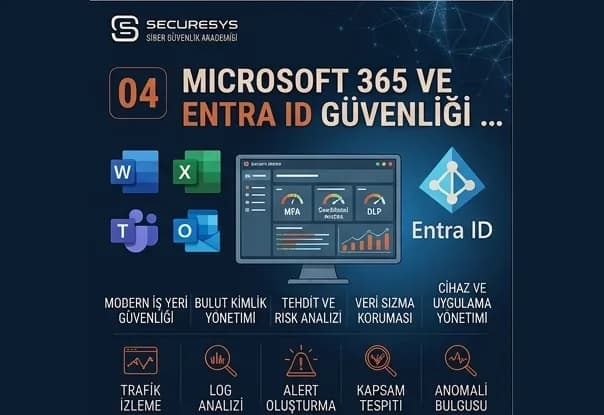
How Is Microsoft 365 and Entra ID Security Achieved?
How is Microsoft 365 and Entra ID security achieved? MFA, conditional access, PIM, OAuth governance, session security and identity incident response together.
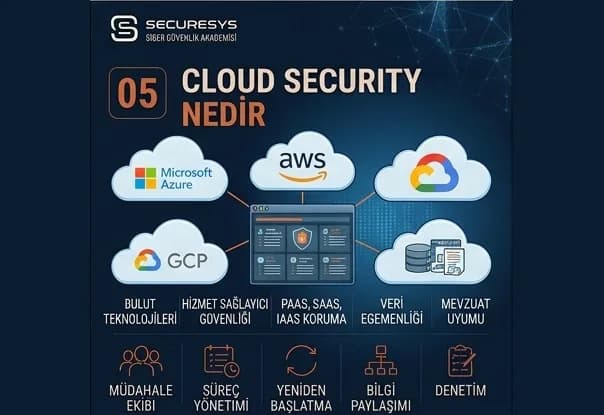
What Is Cloud Security? Securing AWS, Azure and Google Cloud
What is cloud security? How are the IAM, network, storage, logging and CSPM layers secured on AWS, Azure and Google Cloud?
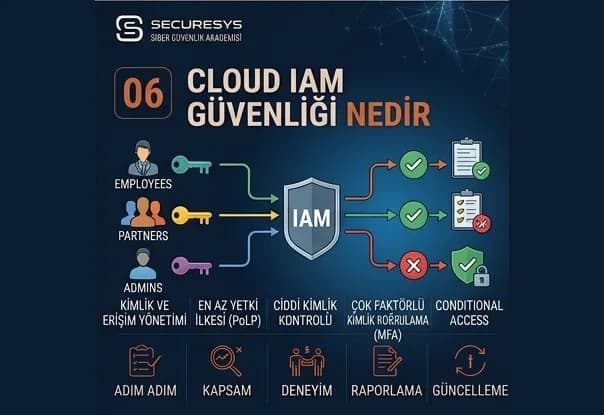
What Is Cloud IAM Security? Managing Permission, Role and Privileged Access Risk
What is cloud IAM security? Overprivilege, privilege escalation, service account risks and the CIEM approach on AWS, Azure and GCP.
Looking for professional support on this topic?
Our expert team will reach out for a free consultation as soon as possible.