What Is Cloud Misconfiguration? How Are Faulty Cloud Configurations Detected?
What is cloud misconfiguration? How are public storage, open ports and disabled logging detected with CSPM?
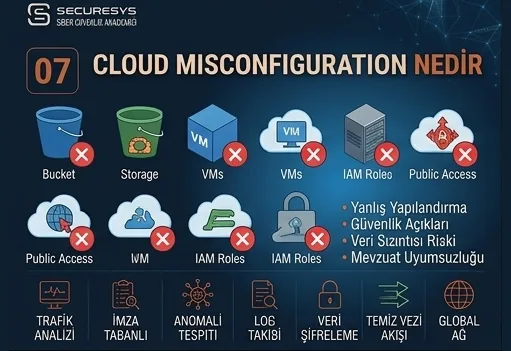
A significant proportion of cloud security incidents does not begin with a complex zero-day.
Something far simpler can be enough:
A Security Group opened wrongly.
A storage bucket left public.
A database open to the internet.
A snapshot open to unauthorised access.
A cloud account with logging switched off.
An excessively broad IAM policy.
A secret forgotten inside the code.
Errors of this kind are generally called cloud misconfiguration.
Because cloud environments change so fast, this risk can become more visible than in classic data centre environments.
A developer can create a new resource within a few minutes.
Hundreds of resources can be deployed with Terraform.
A test environment can be opened briefly.
A firewall rule can be widened “temporarily”.
But those temporary changes can remain in the system for months.
In the modern cloud security approach, therefore, one of the most critical matters is this:
Continuously detecting, prioritising and, as far as possible, automatically fixing the insecure configurations in the cloud environment.
At this point the concepts of cloud misconfiguration, CSPM, CNAPP, cloud security posture management, configuration drift, policy as code, public cloud exposure and cloud compliance gain importance.
What Is Cloud Misconfiguration?
Cloud misconfiguration is a resource on AWS, Microsoft Azure, Google Cloud or another cloud platform being configured insecurely, more openly than it needs to be, or contrary to the organisation's security policy.
Examples can be:
- Public storage
- SSH or RDP open to the internet
- A public database
- An excessively broad Security Group
- Logging being switched off
- Encryption being switched off
- An excessively privileged IAM policy
- A public snapshot
- An exposed secret
- A faulty cross-account trust
- An unused but open cloud resource
A significant part of these errors may not technically be a “vulnerability”.
But they can form a direct access route for an attacker.
Why Is Cloud Misconfiguration So Widespread?
Cloud infrastructures are fast.
That speed provides operational advantage.
But it also accelerates human error.
To run a test, for instance, a developer opens:
SSH → 0.0.0.0/0
The test ends.
The rule is not closed.
After a while that resource is forgotten.
In the same way, storage sharing can be made public temporarily.
But it may not be turned back to private later.
The important problem of cloud security is therefore:
A temporary change turning into permanent risk.
What Is Configuration Drift?
Configuration drift is a system deviating over time from the secure configuration determined at the start.
Secure infrastructure may have been deployed with Terraform, for instance.
Then an administrator manually, through the portal:
Adds a Security Group rule.
That change is not in the IaC code.
The production configuration and the declarative structure now differ from one another.
This situation is configuration drift.
It is a rather critical problem for cloud security.
Why Does Drift Create Security Risk?
Because security teams can think the secure baseline still holds.
But the real environment has changed.
For example;
the database has become public,
encryption has been switched off,
logging has been disabled,
the IAM role has been widened.
These can all have happened.
In a cloud environment, therefore, security must not be checked only at the moment of deployment.
Runtime posture must be monitored continuously.
What Is Cloud Security Posture Management (CSPM)?
CSPM is the approach and technology category continuously analysing the security configurations in a cloud environment.
CSPM can detect risks such as:
public storage,
an open Security Group,
missing MFA,
logging disabled,
encryption disabled,
a public database,
overprivileged access.
The aim is to assess the cloud environment continuously against a security baseline.
How Does CSPM Work?
It generally connects to cloud provider APIs and analyses the configuration of resources.
For example:
AWS account
↓
S3 bucket policy
↓
Public access detected
↓
Finding generated
Rather than a point-in-time scan alone, CSPM can provide periodic or continuous visibility.
It is therefore more sustainable than manual review in large cloud environments.
What Is the Difference Between CSPM and a Vulnerability Scanner?
A vulnerability scanner focuses more on;
CVE,
software version,
patch
risks.
CSPM looks at;
configuration,
identity,
cloud policy,
exposure
risks.
There may be no CVE at all in the database software, for instance.
But if the database is open to the internet through a public IP there is serious security risk.
A vulnerability scanner does not always show that in the right context.
What Is Public Cloud Exposure?
A cloud resource being reachable directly from the internet is assessed as public exposure.
For example;
a VM,
a database,
storage,
a management panel,
an API
can be public.
Public exposure is not always an error.
A website has to be public anyway.
But what is critical are the questions:
Is the right service public?
Is the right port open?
Is the right authentication in place?
These are what matter.
What Is a Public S3 Bucket?
An AWS S3 bucket can be made open to everyone through a faulty access policy.
The attacker can then;
list files,
download them,
in some cases write to them.
Inside the bucket there can be;
backups,
customer data,
documents,
source code,
logs.
Public storage is therefore one of the most critical classic risks in cloud security.
Azure Blob Storage Public Access Risk
If container public access is misconfigured on Azure Blob Storage, data can become reachable without authentication.
That situation creates serious data leakage risk particularly for;
backups,
exports,
logs,
customer files.
Storage Account policy and container-level access must therefore be assessed together.
Google Cloud Storage Public Exposure
On GCP Cloud Storage, objects can be reachable from the internet because of faulty IAM or a public access policy.
For example;
allUsers
or broad external principal access can be critical.
But for public website assets this structure can be legitimate.
Context matters again.
How Is Public Storage Detected?
CSPM tools or cloud-native security services can analyse through;
bucket policy,
ACL,
IAM,
public access settings.
But the logic:
Public = Critical
alone is not enough.
Is there sensitive data inside the resource?
Is it production?
Is being public a business requirement?
These contexts matter.
How Does Data Classification Strengthen Cloud Misconfiguration Analysis?
If a public bucket contains only public marketing images the risk is low.
But if the same bucket contains;
customer information,
a financial file,
personal data
the risk is far higher.
Modern cloud security must therefore assess:
Exposure + Data Sensitivity
together.
What Is DSPM?
Data Security Posture Management (DSPM) focuses on analysing where sensitive data sits in cloud and other environments, who can reach it and how it is protected.
CSPM says:
“This bucket is public.”
DSPM can say:
“There is personal data inside this bucket.”
When the two pieces of information are combined the risk is prioritised far more accurately.
What Is a Public Database?
A cloud database being reachable over the public network can create a serious attack surface.
For example;
PostgreSQL,
MSSQL,
MySQL,
MongoDB
can be reachable over the internet.
Even with authentication in place, the attacker can attempt;
brute force,
credential stuffing,
vulnerability scanning.
Where possible the database must be kept on a private network.
Can a Managed Database Be Public Because It Is Secure?
No.
Being managed only moves particular infrastructure responsibilities to the provider.
Network exposure and access control can still be the customer's responsibility.
It must therefore be thought of as:
Managed ≠ Safe by Default
and treated accordingly.
What Is an Open Security Group?
It is a Security Group or similar cloud firewall rule allowing a very broad source range.
For example:
0.0.0.0/0 → 22
or
0.0.0.0/0 → 3389
can be high risk.
Because everyone on the internet can reach the management service.
Why Must SSH and RDP Not Be Public?
SSH and RDP can provide direct administrator access.
These services being open from the internet raises the risk of;
brute force,
password spraying,
credential attacks,
vulnerability exploitation.
The safer approach is to provide access through;
a VPN,
a bastion,
PAM,
JIT access.
These are the better routes.
How Is a Bastion Host Used in the Cloud?
Administrator access can be provided through a cloud bastion service or a central jump server.
For example:
Admin Laptop
↓
MFA
↓
Bastion
↓
Private VM
The VM's SSH or RDP port then does not have to be opened to the internet.
What Is JIT Network Access?
Just-in-time network access is opening the management port only briefly when required rather than keeping it permanently open.
The SSH port, for instance:
for 30 minutes
to a particular administrator IP
is opened.
At the end of the period it closes automatically.
This approach can reduce public management exposure risk.
What Is a Public Snapshot?
Cloud snapshots can contain a copy of VM or database data.
Because of a faulty sharing policy, a snapshot can be opened to another account or to public access.
The attacker can then obtain the data through the snapshot without entering the production system.
Snapshots must therefore also be assessed as data assets.
Why Is a Snapshot Sensitive?
A snapshot can contain;
a database,
password hashes,
configuration,
application secrets,
customer data.
Snapshot access policy is therefore no less important than the production system.
It is sometimes an easier target from the attacker's perspective.
What Is Backup Misconfiguration?
If a cloud backup service is misconfigured;
the backup can be public,
encryption can be off,
retention can be insufficient,
every administrator can delete it.
That situation raises ransomware and data loss risk.
Backup security must be handled as a separate security domain.
Why Is Encryption Disabled Counted as a Misconfiguration?
Keeping storage or a database containing sensitive data without encryption can create risk.
The cloud provider can offer default encryption on many services.
But on some services the configuration must be checked.
Not only encryption but key access matters too.
What Is KMS Permission Misconfiguration?
Data can be encrypted.
But if the KMS key can be used by everyone, security weakens.
If the attacker can reach both:
encrypted storage
and
the encryption key
the data is not protected.
KMS IAM policy therefore carries critical importance.
Why Is Logging Disabled Critical?
Cloud audit logs being switched off reduces visibility of attacker activity.
The attacker, for instance;
creates a resource,
changes IAM,
downloads data
but there is no audit trail.
That makes incident response seriously harder.
Logging must therefore be one of the core controls of the cloud security baseline.
Is CloudTrail Disabled Risky?
In an AWS environment, the absence of CloudTrail or the relevant audit mechanisms can reduce visibility of administrative activity.
Keeping logs only in the local account is also risky.
When the attacker obtains high privilege they can try to delete the logs.
A central and separate log account architecture can therefore be assessed.
Why Is Central Logging Strong?
The production account can be compromised, for instance.
But if the logs are transferred to a separate security account, the attacker may not be able to delete past logs easily with production privilege.
This approach is valuable for incident response and forensics.
Is Missing MFA Counted as a Cloud Misconfiguration?
Yes, for privileged users in particular.
During a cloud security posture assessment, missing MFA on;
root,
tenant owner,
administrator
accounts can be a critical finding.
But the same severity may not apply to all users.
Role and risk level must be taken into account.
What Happens if the Root Account Is in Daily Use?
If the highest-privilege account is used continuously, the impact of;
phishing,
credential leaks,
session compromise
risks grows.
Root or tenant-level emergency accounts must not be used for daily operations.
What Is IAM Wildcard Permission Misconfiguration?
For example:
Action: *
and
Resource: *
such very broad permissions can create serious risk.
But on some service roles particular wildcards can be needed for technical reasons.
Context-based IAM analysis must therefore be carried out.
What Is Cross-Account Trust Misconfiguration?
One account can grant access to another account.
This can be normal.
But if trust still exists to an old vendor or test account, the attacker can use that route.
The cross-account trust inventory must therefore be reviewed continuously.
External Sharing Cloud Security Risk
A cloud resource or storage may have been shared with another organisation or tenant.
That sharing can be necessary for the business.
But without an end date it can stay open for years.
Third-party access lifecycle is therefore a critical matter.
What Is Anonymous Access?
It is access to a resource being provided without authentication.
A public object link, for instance.
This can be necessary in some use cases.
But in sensitive systems it is a serious exposure risk.
The cloud security system must make anonymous access visible quickly.
What Is Cloud Secret Exposure?
A secret can be;
an API key,
a database password,
a private key,
a token.
Because of misconfiguration it can be exposed inside;
a repository,
VM metadata,
an environment variable,
a log,
storage.
Secret scanning and secret management must therefore be applied together.
Is Keeping a Secret in an Environment Variable Safe?
It is used in some applications.
But the secret can be exposed during process inspection, logging or debugging.
The stronger approach is to use a secret vault and workload identity.
How the secret is given to the runtime must also be assessed.
What Is the Instance Metadata Service?
Cloud VMs can obtain temporary credentials or instance information from their own metadata services.
That service can be abused through faulty network or application configuration.
Metadata access through an SSRF vulnerability, for instance, can create serious consequences in some attack scenarios.
Metadata service security therefore matters.
How Does SSRF Combine With Cloud Misconfiguration?
A web application can hold an SSRF vulnerability.
On its own it is an application vulnerability.
But if the VM runs with a high-privilege identity, the attacker can obtain credentials through the metadata.
The result:
SSRF + Overprivileged Identity = Critical Cloud Attack Path
Findings must therefore be analysed together rather than one by one.
What Is a Toxic Combination?
It is cloud problems that individually appear at different severities combining to form a critical attack route.
For example:
Public Web Application
SSRF
Metadata Access
Privileged IAM Role
Sensitive Storage
together create critical risk.
The aim of modern cloud security is to find combinations of this kind.
Can CSPM See a Toxic Combination?
Advanced CSPM/CNAPP platforms can analyse attack routes by combining the contexts of;
asset,
identity,
network,
vulnerability,
data.
That is more valuable than a classic compliance list.
Because instead of:
1,000 misconfigurations
it becomes possible to prioritise
3 genuinely critical attack paths
and act on them.
What Is Cloud Attack Path Analysis?
It analyses the relationship chains through which an attacker can reach critical data from a low-privilege or internet-facing point.
For example:
Internet
↓
Public VM
↓
Critical CVE
↓
Managed Identity
↓
Key Vault
↓
Database Credential
↓
Production Database
This chain is the real risk story.
The Difference Between Cloud Misconfiguration and a Cloud Vulnerability
Vulnerability
Is a technical security flaw in software or a system.
Misconfiguration
Is a security setting being made wrongly or weakly.
For example:
An Apache CVE → vulnerability.
SSH 0.0.0.0/0 → misconfiguration.
The two risks can exist together.
What Is Cloud Compliance?
It is the assessment of cloud configurations against particular standards such as;
the CIS Benchmark,
ISO 27001,
PCI DSS,
corporate policy.
CSPM tools can do that mapping automatically.
But passing compliance is not a guarantee of genuine security.
What Is the CIS AWS Foundations Benchmark?
It recommends basic security controls for an AWS account.
Controls can be found in areas such as;
IAM,
logging,
monitoring,
network.
In the same way, CIS benchmarks can be used for Azure and Google Cloud.
These structures are valuable for creating a security baseline.
Is 100% Benchmark Compliance Required?
Not always.
Some controls may not suit the organisation's architecture.
What matters is that every exception is managed with justification and risk acceptance.
Therefore:
Blind Compliance
rather than which,
Risk-Based Compliance
can be healthier.
What Is a Security Baseline?
It is the minimum security standard for the organisation's cloud resources.
For example:
Logging mandatory.
Encryption mandatory.
Public storage forbidden.
SSH/RDP from the internet forbidden.
Root MFA mandatory.
Unmanaged admin accounts forbidden.
This baseline is the foundation of cloud governance.
How Does Policy as Code Prevent Misconfiguration?
Security policy is defined as code and checked during deployment.
A Terraform pipeline, for instance:
Detected a public database.
Deployment failed.
The risk is thereby blocked before it reaches production.
This is the shift left cloud security approach.
What Is IaC Security Scanning?
It is the security scanning of Infrastructure as Code files such as Terraform, CloudFormation or Bicep.
For example;
an open port,
unencrypted storage,
wildcard IAM
can be detected before deployment.
That allows cloud misconfigurations to be caught at the earliest stage.
The Difference Between Pre-Deployment and Runtime Security
Pre-Deployment
Is checked at the IaC or pipeline stage.
Runtime
The real configuration in the production environment is monitored.
Both are necessary.
Because even if the IaC is secure, an administrator can make a manual change afterwards.
How Is Drift Detection Carried Out?
The current cloud configuration is compared with the desired state.
According to Terraform, for instance:
RDP closed.
The real Azure NSG:
RDP public.
A drift alert is created.
That situation can be reported to the security team quickly.
What Is Auto-Remediation?
Some misconfigurations can be fixed automatically.
When public storage is detected, for instance, policy can close public access automatically.
But automatic remediation must be used carefully.
It can interrupt a business service.
It must therefore be applied according to severity and resource context.
Should Auto-Remediation Be Applied to Every Finding?
No.
Public 443 access is required for a web application, for instance.
If the system closes it by mistake the service is cut.
Automation is therefore more suitable for controls that are;
high confidence,
well defined,
reversible.
The Difference Between a Preventive Control and a Detective Control
Preventive Control
Prevents the risky configuration forming.
Policy as Code, for instance.
Detective Control
Detects it after the risk has formed.
CSPM, for instance.
The ideal model uses both together.
What Is a Corrective Control?
It is the control making the system secure after a finding is detected.
For example;
a public bucket is made private,
an IAM role is reduced,
logging is switched on.
These three approaches can be thought of together:
Prevent → Detect → Correct
What Is Cloud Misconfiguration Alert Fatigue?
CSPM can produce thousands of findings.
20,000 low-severity findings, for instance.
Security teams cannot deal with all of them.
That situation creates alert fatigue.
Findings must therefore be prioritised on a risk basis.
How Is Risk-Based Prioritization Carried Out?
For a misconfiguration these factors can be assessed together:
Internet Exposure
Is it public?
Asset Criticality
Is it production?
Identity Privilege
Is the workload highly privileged?
Data Sensitivity
Is there sensitive data?
Exploitability
Is there an active attack route?
This information makes the risk score far more meaningful.
The “Public + Privileged + Sensitive” Model
A simple but powerful prioritisation model can be considered for cloud security.
If a resource is at the same time:
Public
open to the internet,
Privileged
holding a high-privilege identity,
Sensitive
able to reach sensitive data
then it is very high risk.
This triad is one of the core logics of modern cloud attack path analysis.
How Does Shadow Cloud Raise Misconfiguration Risk?
A security baseline cannot be applied in an account or subscription the security team does not know about.
There may be no logging.
There may be no MFA.
Public resources may exist.
The cloud organisation inventory must therefore be produced.
How Is Cloud Asset Discovery Carried Out?
Organization/account APIs,
CSPM,
ASM/EASM,
CMDB integration
can be used.
The aim is to answer this question:
“Do we genuinely know all the cloud resources the organisation owns?”
If the answer is no, misconfiguration management stays incomplete.
Why Are Ephemeral Resources Difficult?
A container, serverless function or short-lived VM can be created and deleted within a few minutes.
A traditional monthly vulnerability scan may not see them.
Cloud-native security must therefore be continuous and API based.
Serverless Misconfiguration Examples
A serverless function;
can hold a public trigger,
can use a high-privilege role,
can contain a secret environment variable,
can have logging switched off.
Even when the operating system is not managed, configuration risk continues.
Is Kubernetes Misconfiguration Part of Cloud Security?
Absolutely.
Even when managed Kubernetes is used, risks such as;
a public API server,
overprivileged RBAC,
an open dashboard,
a privileged container,
a missing network policy
can exist.
Kubernetes also requires its own security posture assessment.
Container Misconfiguration Examples
A container;
can run as the root user,
can use privileged mode,
can mount the host filesystem,
can receive unnecessary capabilities.
These misconfigurations can raise the impact of a runtime attack.
Why Are Secrets in Kubernetes Critical?
Kubernetes Secrets can store particular application credentials.
Because of faulty RBAC, a great many pods or users can read the secret.
Even if cloud IAM is secure, sensitive credential access can then form from inside the cluster.
Public API Misconfiguration
An API Gateway or public endpoint can run;
without authentication,
without rate limiting,
with excessively broad CORS.
That situation can create abuse or data exposure.
Cloud misconfiguration does not sit only at the infrastructure layer.
Application edge configurations must also be assessed.
What Is CORS Misconfiguration?
Cross-Origin Resource Sharing (CORS) controls browser-based cross-origin access.
An excessively broad CORS policy can raise data access risk in some applications.
But CORS is not an authentication mechanism on its own.
It must therefore be assessed within the application context.
Cloud Load Balancer Misconfiguration
A load balancer;
can leave the backend public by mistake,
can have a weak TLS policy,
can open a management endpoint,
can have a health endpoint giving away sensitive information.
Edge components must therefore also be brought within CSPM or architecture review.
How Is TLS Misconfiguration Seen in the Cloud?
An old TLS version,
a weak cipher,
a wrong certificate,
an expired certificate
can be found on a cloud load balancer or gateway.
Cloud posture therefore consists of more than IAM and network alone.
Cryptographic configuration matters too.
Does DNS Misconfiguration Affect Cloud Security?
Yes.
A stale DNS record can point to an old cloud resource, for instance.
The resource may have been deleted while the DNS record remained.
That situation can lead to subdomain takeover risk in some scenarios.
The cloud lifecycle and the DNS lifecycle must therefore be managed in sync.
What Is a Dangling DNS Record?
If a DNS record points to a cloud resource that no longer exists, a dangling DNS record can form.
If the attacker can take ownership of the same cloud resource name again, they can take over the subdomain.
The DNS record must therefore be cleaned up when the resource is deleted.
Why Can Subdomain Takeover Be Counted as a Cloud Misconfiguration?
The problem mostly does not arise from a cloud provider flaw.
It arises from an error in resource lifecycle management.
The cloud service is deleted.
The DNS remains.
Configuration and asset lifecycle security must therefore be handled together.
What Is Resource Lifecycle?
It covers the processes of a cloud resource being;
created,
used,
changed,
shut down,
deleted.
Security must be applied across that whole lifecycle.
Removing unused resources in particular reduces the attack surface.
What Is a Zombie Resource?
A cloud resource no longer in use but still running is sometimes called a zombie resource.
An old test VM, for instance.
Nobody owns it.
It receives no patches.
It has a public IP.
Resources of this kind can be an ideal target for an attacker.
What Is an Orphaned Cloud Resource?
It is a cloud resource whose owner or business purpose is unknown.
When a security finding forms, who must fix it is not known.
Tagging and ownership therefore carry critical importance for cloud governance.
How Does Cloud Tagging Strengthen Security?
Resources can be tagged with;
owner,
environment,
criticality,
data classification,
application.
A CSPM finding is thereby assessed together with its risk context.
For example:
Public VM + Production + Payment
can take far higher priority.
What Is a Misconfiguration SLA?
How quickly critical configuration errors must be fixed can be defined.
For example:
Critical → 24 hours
High → 7 days
Medium → 30 days
and similar.
But the periods must be determined according to the organisation's own risk model.
What Is the Exposure Window?
It is the time passing between a security problem forming and being fixed.
For example:
Public bucket opened → 1 August
Detected → 3 August
Fixed → 10 August
The exposure window is 9 days.
That period can be an important KPI in risk terms.
What Is Mean Time to Remediate?
MTTR (mean time to remediate) measures the average fix time of security findings.
Because change is fast in a cloud environment it is particularly valuable.
But rather than average MTTR alone, critical finding MTTR must also be tracked.
Who Should the CSPM Finding Owner Be?
The security team cannot fix every finding itself.
The resource owner can be;
the Cloud Team,
DevOps,
the Application Team,
the Database Team.
Assigning CSPM findings automatically to the correct owner therefore speeds up the remediation process.
How Must Responsibility Be Shared Between Security and DevOps?
Security can determine the policy and risk criteria.
DevOps or platform teams can carry out the technical remediation.
The application owner can verify the business impact of the risk.
This model can be thought of as shared security responsibility.
Does Cloud Misconfiguration Require Incident Response?
Not every misconfiguration is an incident.
But if a critical exposure has stayed open for a long time:
Could an attacker have reached it?
that question must be investigated.
Public storage was detected, for instance.
Making it private alone may not be enough.
Access logs must be examined.
What Must Be Done When a Public Bucket Is Found?
The general process:
The exposure is verified.
The business requirement is checked.
If necessary public access is closed.
Access logs are examined.
Whether there is sensitive data is determined.
Unauthorised downloads are investigated.
Incident response is started if necessary.
Remediation and investigation must therefore be thought of together.
What Happens if There Are No Access Logs?
It then becomes hard to determine whether the exposure was abused.
That shows why a logging misconfiguration is serious.
In cloud security:
Prevention + Detection + Forensics
must be thought of together.
What Is a Cloud Misconfiguration Assessment?
A cloud misconfiguration assessment is the systematic evaluation of cloud resources against security baselines and the genuine risk context.
This work can cover the areas of;
IAM,
network,
storage,
logging,
encryption,
backup,
DNS,
workload.
But it is not merely a compliance checklist.
Attack paths and business impact must also be examined.
How Is a Cloud Configuration Assessment Carried Out?
The general flow can be as follows:
1. Cloud Asset Discovery
Resources are extracted.
2. Baseline Selection
CIS and corporate policy are determined.
3. Configuration Scan
Faulty settings are found.
4. Exposure Analysis
Public resources are detected.
5. Identity Context
The resource's permissions are examined.
6. Data Context
Whether there is sensitive data is determined.
7. Attack Path Analysis
Findings are related to one another.
8. Risk Prioritization
Genuine risk is ranked.
9. Remediation
Fixes are made.
10. Retest
Controls are verified again.
Is Cloud Misconfiguration the Same Thing as a Pentest?
No.
A misconfiguration assessment;
analyses configurations.
A cloud penetration test can check in a controlled way whether those misconfigurations turn into a genuine attack route.
The assessment, for instance:
Found a public VM + a privileged identity.
The pentest:
Can cloud credentials be obtained through this VM and critical storage reached?
can test that question.
What Should a Cloud Misconfiguration Report Contain?
A professional report can include these sections:
Executive Summary
The risk picture for management.
Cloud Inventory
Account, subscription and resource structure.
Critical Misconfigurations
The most important misconfigurations.
Public Exposure
Resources open to the internet.
Identity Context
IAM and privilege connections.
Data Exposure
Sensitive data risk.
Configuration Drift
Deviations from the baseline.
Attack Paths
Combined attack routes.
Compliance Mapping
CIS and corporate policy.
Remediation Roadmap
Prioritised actions.
This structure makes thousands of findings manageable.
What Are the Cloud Misconfiguration KPIs?
For example;
Critical Misconfiguration Count
Public Resource Count
Public Sensitive Resource Count
Configuration Drift Count
Policy Violation Count
Mean Time to Remediate
Critical Exposure Window
Auto-Remediation Rate
CSPM Coverage
metrics of this kind can be used.
But the goal must not be “zeroing the finding count” — it must be reducing genuinely risky exposure.
Can a Cloud Misconfiguration Security Score Be Used?
Yes.
For example:
IAM Configuration – 82/100
Network Exposure – 65/100
Storage Security – 91/100
Logging – 76/100
But a single critical public database can matter more than the whole average score.
The score must therefore always be shown together with the critical findings.
What Is the Biggest Mistake in Cloud Misconfiguration?
The most common mistake:
Carrying out a cloud audit once a year.
A cloud environment can change every day.
An account that is secure today can tomorrow contain;
a new public IP,
a new IAM role,
a new bucket,
a new database.
Cloud configuration security must therefore be continuous.
What Is Continuous Cloud Posture Management?
It is monitoring cloud security posture continuously rather than periodically.
The moment a new resource is created, security policy is checked.
A new public exposure produces an alert instantly.
A new admin role becomes visible.
This model suits the dynamic nature of the cloud better.
The Prevent, Detect, Respond Model
Cloud misconfiguration management can be thought of in three stages:
Prevent
Policy as Code and guardrails.
Detect
CSPM and CNAPP.
Respond
Auto-remediation or ticket workflow.
But one more layer must be added on top of this:
Validate
It must be verified that the fix genuinely closed the risk.
What Is a Cloud Security Guardrail?
It is the central rule preventing a developer from creating an insecure configuration in the first place.
For example:
A production database cannot be public.
Public storage cannot be created.
A root access key cannot be created.
Security logging cannot be switched off.
This approach reduces the impact of human error.
The Relationship Between Cloud Misconfiguration and DevSecOps
A significant proportion of misconfigurations can form during deployment.
Within the DevSecOps pipeline, therefore;
IaC Scan,
Policy as Code,
Secret Scan,
Container Scan
can be run.
The aim must be to see the problem before commit or deployment rather than after it reaches production.
Is Shift Left Enough on Its Own?
No.
The code can be secure.
But a manual change can be made in production.
Therefore:
Shift Left + Runtime CSPM
must be used together.
One prevents the problem forming.
The other monitors the real situation in production.
Conclusion: In Cloud Security the Most Dangerous Flaw Is Sometimes Not a CVE but a Single Wrong Setting
Security problems in cloud environments are not always complex.
Sometimes a single checkbox is enough.
Public Access: Enabled
Sometimes a single rule:
0.0.0.0/0 → SSH
Sometimes a single policy:
Administrator Access
Sometimes a single choice:
Audit Logging: Disabled
Cloud misconfiguration is therefore one of the most critical risk areas of modern cloud security.
But the real problem is not that a misconfiguration forms.
People can make mistakes.
The real problem is:
The error remaining in production unnoticed for a long time.
A strong cloud posture approach must therefore be managed through the cycle of;
Security Baseline
↓
Policy as Code
↓
IaC Security
↓
CSPM
↓
CNAPP
↓
Attack Path Analysis
↓
Risk-Based Remediation
↓
Continuous Validation
working as one loop.
And the most important question must not be only:
“How many misconfigurations are there?”
That is not enough.
The more valuable questions are these:
Which of them is open to the internet?
Which is on a critical production system?
Which runs with a high-privilege identity?
Which reaches sensitive data?
Which of them, combined, form a genuine attack route?
This approach lifts cloud security out of thousands of compliance entries and turns it into genuine risk management.
But a significant proportion of modern cloud infrastructures no longer consists of classic virtual machines.
Applications run on;
Docker containers,
Kubernetes clusters,
managed container services.
That forms the next important area of system and cloud security:
Container and Kubernetes Security.
Related Articles
System & Cloud Security
What Is System and Cloud Security? How Is Enterprise Infrastructure Protected?
System and cloud security is not a product but a continuously managed discipline. This chapter covers the shared responsibility model, hardening and baselines, identity security, and the CSPM, CWPP and CNAPP concepts.
What Is Server Security? How Is Windows and Linux Server Hardening Done?
A secure server is more than a secure build. This chapter covers Windows and Linux hardening, CIS benchmarks and baselines, RDP/SSH security, privileged access and the logging layers.
What Is Active Directory Security? Preventing Domain, Privilege and Identity Risks
Active Directory security is about protecting the identity graph. This chapter covers Kerberos and NTLM risks, ACLs and delegation, LAPS/gMSA and tiering, attack path analysis and AD recovery planning.
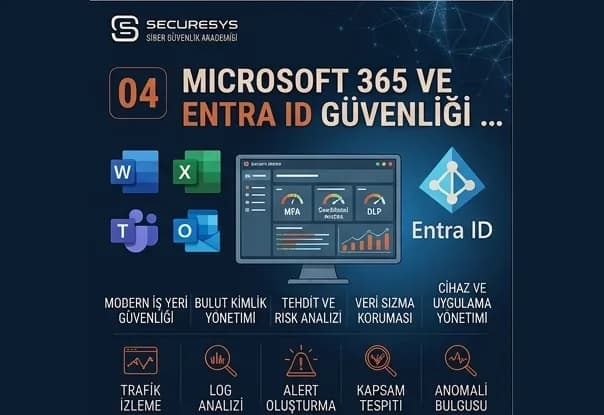
How Is Microsoft 365 and Entra ID Security Achieved?
How is Microsoft 365 and Entra ID security achieved? MFA, conditional access, PIM, OAuth governance, session security and identity incident response together.
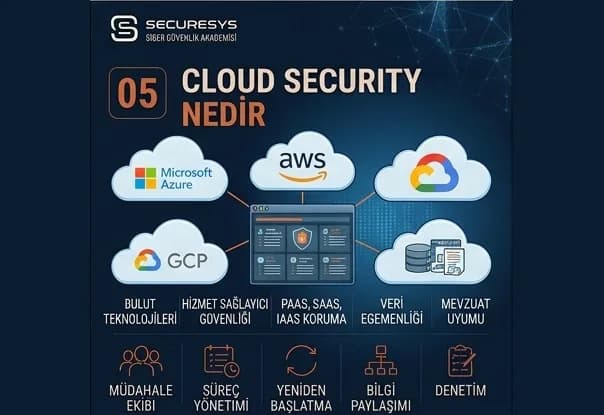
What Is Cloud Security? Securing AWS, Azure and Google Cloud
What is cloud security? How are the IAM, network, storage, logging and CSPM layers secured on AWS, Azure and Google Cloud?
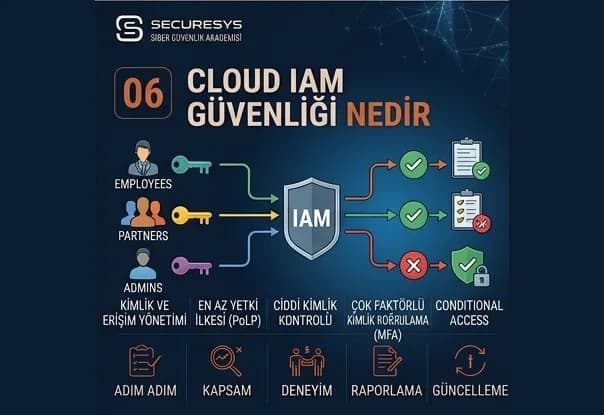
What Is Cloud IAM Security? Managing Permission, Role and Privileged Access Risk
What is cloud IAM security? Overprivilege, privilege escalation, service account risks and the CIEM approach on AWS, Azure and GCP.
Looking for professional support on this topic?
Our expert team will reach out for a free consultation as soon as possible.