What Is Container and Kubernetes Security? K8s Security and Container Hardening
What is container and Kubernetes security? Image, RBAC, network policy, secrets, admission control and runtime security together.
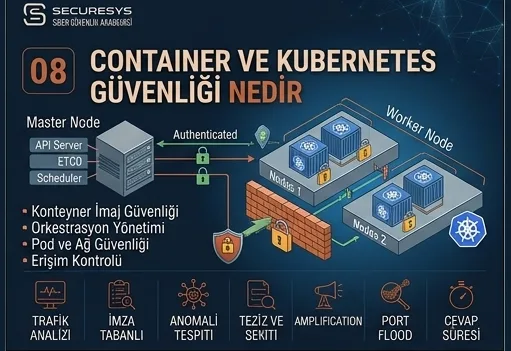
In modern application architectures, each service no longer runs on a separate physical or virtual server.
Applications can run on;
Docker containers,
Kubernetes clusters,
managed container platforms,
microservice architectures.
These are the new foundations.
This approach provides speed, scalability and automation.
But it also brings a new attack surface.
A vulnerable container image.
A pod running as root.
A privileged container.
Faulty Kubernetes RBAC.
An open Kubernetes API Server.
Faulty secret management.
A missing Network Policy.
Excessive cloud IAM privilege.
Even one of these can be an important entry or privilege escalation point for an attacker.
Container security and Kubernetes security are therefore among the most critical areas of modern system and cloud security.
The basic truth here is this:
Using managed Kubernetes does not remove Kubernetes security responsibility.
AWS EKS, Azure AKS or Google GKE can manage some parts of the control plane.
But many areas such as;
workloads,
RBAC,
secrets,
container images,
network policy,
runtime security,
cloud permissions
can still be the organisation's responsibility.
A strong Kubernetes security approach must therefore handle the layers of;
Secure Image + Least Privilege + RBAC + Network Segmentation + Secret Management + Admission Control + Runtime Security + Logging + Continuous Validation
together.
What Is Container Security?
Container security means the secure management of the whole lifecycle from the creation of the container image to production runtime.
This process covers areas such as;
- image security,
- registry security,
- runtime security,
- secret management,
- container privilege,
- network access,
- host interaction,
- vulnerability management.
All of these are in scope.
But container security is not merely scanning a Docker image.
The real question is this:
If this container is compromised, how far can the attacker go?
If the container runs as root, reaches the host filesystem and uses a high-privilege cloud identity, a small application vulnerability can turn into very large impact.
What Is Kubernetes Security?
Kubernetes security (K8s security) is the secure protection of the components within a Kubernetes cluster:
the control plane,
worker nodes,
pods,
services,
RBAC,
secrets,
network,
admission,
runtime.
These are all in scope.
Kubernetes is very powerful because it manages the infrastructure automatically.
But for the same reason a faulty privilege can create impact very fast.
A user holding the wrong role can, for instance;
create a new pod,
read a secret,
run a privileged container,
use a service account token.
Kubernetes security therefore requires a different security model from classic server hardening.
What Is Docker Security?
In Docker or similar container runtimes, security is assessed in a few core areas.
Among them can be;
the image source,
the container user,
Linux capabilities,
the mounted filesystem,
the host network,
runtime permissions.
Container isolation can be strong.
But it must not be thought of as full virtual machine isolation.
The host kernel can be shared by many containers.
Kernel and runtime security therefore matter.
What Is a Container Image?
A container image is the packaged structure containing the;
application code,
libraries,
dependencies,
runtime
components required for the application to run.
The production container is created from that image.
Image security is therefore one of the starting points of supply chain security.
Can There Be a Vulnerability Inside a Container Image?
Yes.
Inside the image there can be;
old OpenSSL,
a vulnerable Java library,
an old Linux package,
a framework with a security flaw.
Even if the application code is completely secure, the base image can be vulnerable.
Container images must therefore be run through vulnerability scanning regularly.
What Is Image Scanning?
Container image scanning is the analysis of the packages and dependencies inside an image against known security flaws.
A scan result can detect, for instance;
a critical CVE,
a high CVE,
an outdated package.
But looking at the CVE count alone is not enough.
The container's production exposure and privilege level must also be assessed.
Is a Critical CVE Always Critical Risk?
No.
There is a critical CVE inside the image, for instance.
But the vulnerable binary may never run.
Another container holds a medium-level CVE but runs as;
internet-facing,
root,
privileged.
The real risk can be higher in the second case.
Risk-based container vulnerability management is therefore required.
What Is a Base Image?
A container image is generally built on another base image.
For example;
Ubuntu,
Alpine,
Debian,
distroless
and similar.
Base image security matters because inherited vulnerabilities can carry directly into the application.
A minimal base image can therefore be preferred.
Why Can a Minimal Image Be More Secure?
The fewer packages inside the image, the smaller the attack surface can be.
Inside a production container, for instance;
a compiler,
a package manager,
a debug tool,
a shell
may not be needed.
Removing these components can reduce the tools an attacker can use after compromise.
What Is a Distroless Image?
A distroless image is the image approach containing only the minimum runtime components required for the application to run.
Tools such as a shell or package manager may not be present.
That can reduce the attack surface.
But it can make operational troubleshooting harder.
It must therefore be assessed alongside the organisation's operating model.
What Happens if a Container Runs as Root?
Many containers can run as the root user by default.
That can mean the attacker holds more privilege when the container is compromised.
Where possible, therefore, the container must be run as a:
non-root user
instead.
But adding a USER directive is not enough on its own.
Runtime privileges must also be checked.
What Is RunAsNonRoot?
It is one of the control mechanisms within the Kubernetes pod security context helping prevent the container running as the root user.
For example:
runAsNonRoot: true
and similar policy can be applied.
This is an important part of a secure container baseline.
What Is a Privileged Container?
A privileged container is a container running with very broad privileges on the host.
Container isolation can then be significantly reduced.
A privileged container can hold broad privilege over;
devices,
kernel capabilities,
host resources.
It must therefore be permitted only in mandatory use cases.
Why Is a Privileged Container a Critical Risk?
Suppose a container is compromised through an application vulnerability.
In a normal container the attacker's room for movement can be limited.
But in a privileged container the risk of host access or container escape can be far higher.
Therefore:
Internet-facing + Privileged Container
this combination must be assessed as particularly critical.
What Is Container Escape?
Container escape is the attack type in which the attacker tries to cross container isolation boundaries and reach the host operating system.
It can relate to factors such as;
a container runtime vulnerability,
a kernel vulnerability,
a dangerous capability,
privileged mode.
If host access is obtained, the other workloads on the same node can also be at risk.
What Are Linux Capabilities?
Linux root privileges can be divided into different capabilities.
For example;
NET_ADMIN,
SYS_ADMIN
and similar.
A container must be given only the capabilities it needs.
SYS_ADMIN in particular must be assessed carefully because it holds very broad privilege.
What Is the Drop All Capabilities Approach?
In a secure container configuration all capabilities can be removed by default and only the necessary ones added back.
This approach is close to:
Default Deny
as a logic.
But application compatibility must be tested.
What Is a Read-Only Root Filesystem?
The container's root filesystem running read-only can make it harder for the attacker to leave persistent files inside the container.
Directories the application must write to can be defined as separate writable volumes.
This suits the immutable infrastructure approach in particular.
Should a Secret Be Stored Inside a Container?
A persistent secret must absolutely not be embedded inside a container image.
For example;
a database password,
an API key,
a private key
can sit inside an image layer.
When the image is pushed to the registry the secret is distributed too.
Even if deleted it can remain inside an old layer.
The secret must therefore be obtained from a secure source at runtime.
Why Is Writing a Secret Inside a Dockerfile Risky?
If an approach such as:
ENV DB_PASSWORD=...
is used during the build, the secret can remain inside the image metadata or layers.
Build secret mechanisms and a secret vault must therefore be used.
What Is a Container Registry?
It is the platform where container images are stored.
For example;
AWS ECR,
Azure Container Registry,
Google Artifact Registry,
Harbor
and similar.
Registry security is an important part of supply chain security.
How Is a Container Registry Protected?
These controls can be assessed:
Authentication.
Least privilege.
A private registry.
Image scanning.
Image signing.
Immutable tags.
Audit logging.
The aim is to make it harder for an attacker to upload a malicious image or change a production image.
Is a Public Container Registry Risky?
Using a public image is not always wrong.
But the source of images used for production must be verified.
An attacker can use;
a malicious image with a similar name,
a typosquatting package,
a compromised upstream image.
A trusted registry and image provenance therefore matter.
What Is Image Signing?
Image signing helps verify cryptographically that a container image was produced by a trusted source.
Running only signed images at deployment can be made mandatory by policy.
That can reduce supply chain attacks.
Why Does Software Supply Chain Security Matter in Containers?
A container image consists of many components.
The base image.
OS packages.
Application dependencies.
Build tools.
The CI/CD pipeline.
Any point in that chain can be compromised.
Container security is therefore not runtime security alone.
It must be thought of as build-to-run security.
What Is an SBOM?
A Software Bill of Materials (SBOM) is the inventory showing which components a piece of software consists of.
For a container image;
packages,
libraries,
dependencies
can be listed.
It helps understand quickly which images are affected when a new security flaw appears.
What Is a Kubernetes Cluster?
A Kubernetes cluster generally consists of;
a control plane,
worker nodes.
The control plane carries out cluster management.
Worker nodes run the application pods.
The security of the two layers differs.
What Is the Kubernetes Control Plane?
The control plane contains critical components such as;
the API Server,
the Scheduler,
the Controller Manager,
etcd.
It is the management brain of the cluster.
If the control plane is compromised, a great many workloads on the cluster can be controlled.
Control plane access must therefore be extremely limited.
Why Is the Kubernetes API Server Critical?
Most management operations on Kubernetes are carried out through the API Server.
A user;
creates a pod,
reads a secret,
changes a deployment,
assigns a role
through the API.
The API Server must therefore not be unnecessarily reachable directly from the internet.
Can the Kubernetes API Server Be Public?
Some managed Kubernetes structures can hold a public endpoint.
But in that case controls such as;
source IP restriction,
strong authentication,
RBAC,
MFA/SSO,
audit logging
matter.
In architectures where it is possible, private control plane access can be assessed.
What Is Anonymous Kubernetes Access?
If the API Server accepts some requests without authentication, anonymous access risk can form.
On a production cluster, anonymous permissions must be extremely limited.
Combined with a public API endpoint in particular it can create critical risk.
What Is Kubernetes RBAC?
Role-Based Access Control (RBAC) determines which operations users and service accounts within Kubernetes can carry out on which resources.
A user can, for instance;
view pods,
but not delete them.
Another user can be a namespace administrator.
RBAC is a core component of Kubernetes security.
The Difference Between a Kubernetes Role and a ClusterRole
Role
Can provide privilege within a particular namespace.
ClusterRole
Can be applied to cluster-wide resources or to multiple namespaces.
ClusterRole permissions must therefore be managed more carefully.
Why Is Cluster-Admin Risky?
cluster-admin provides very broad privilege on Kubernetes.
Giving cluster-admin to developers or application service accounts for convenience creates serious risk.
Minimum privilege must be applied.
Why Is Wildcard RBAC Risky?
Within a role, for instance:
resources: *
verbs: *
such use can grant very broad privilege.
That configuration can turn into privilege escalation risk quickly.
But not every wildcard is automatically critical.
It must be assessed in the context of scope and identity.
What Is a Service Account in Kubernetes?
Pods can use a service account to communicate with the Kubernetes API.
That identity's token can sit inside the pod.
If the application is compromised, the attacker can try to reach the service account token.
Pod service account permissions must therefore be kept to a minimum.
Why Can the Default Service Account Be Risky?
Many workloads can run with the default service account.
If that account receives unnecessary permission, a great many pods hold the same privilege.
Creating a dedicated service account for critical workloads and applying minimum RBAC can therefore be preferred.
What Is a Service Account Token?
A Kubernetes service account token can help a pod authenticate to the API Server.
The security of that token matters.
If the pod does not need API access, not mounting the token can be considered.
What Is automountServiceAccountToken?
It controls whether the service account token is mounted into the pod automatically.
If the application does not use the Kubernetes API it may not need the token.
The token sitting unnecessarily inside the container can create credential exposure for an attacker.
What Are Kubernetes Secrets?
Kubernetes Secrets can be used to store sensitive data such as;
passwords,
API keys,
certificates,
tokens.
But because the name is “Secret” it must not automatically be regarded as high security.
Access control and encryption configuration matter separately.
Are Kubernetes Secrets Safe With Base64?
Base64 encoding is not encryption.
The secret value may only be encoded.
A user with RBAC privilege can read the secret.
For Secrets, therefore;
encryption at rest,
RBAC,
an external secret manager
can be assessed.
What Is an External Secret Manager?
It is the approach of obtaining Kubernetes secrets at runtime from systems such as;
AWS Secrets Manager,
Azure Key Vault,
Google Secret Manager,
HashiCorp Vault
rather than keeping them directly inside the cluster.
This model can be stronger in terms of secret lifecycle and rotation.
What Is etcd?
etcd is the distributed key-value store holding the critical state data of a Kubernetes cluster.
Secret and configuration information can be stored there.
etcd is therefore an extremely critical asset.
Its access and encryption must be protected strongly.
Can etcd Be Open to the Internet?
Direct public exposure in a production environment can create serious risk.
etcd must be reachable only by control plane components.
Network and authentication controls must be applied.
What Is a Kubernetes Network Policy?
A network policy helps limit which pods or network resources pods can communicate with.
By default, in many clusters pods can communicate broadly with one another.
That can raise lateral movement risk.
What Is a Default Deny Network Policy?
All pod traffic is closed by default.
Only the necessary communication routes are opened explicitly.
This approach is closer to:
Zero Trust Networking
as a logic.
But application dependencies must be known correctly.
How Is Micro-Segmentation Carried Out in Kubernetes?
Workload communication can be limited through mechanisms such as;
namespaces,
labels,
Network Policy,
a service mesh.
For example:
Frontend only to the API.
API only to the database.
Developer pods cannot reach the production database.
This model reduces lateral movement.
What Is HostNetwork?
It is the configuration allowing a pod to use the host network namespace.
The pod can then gain access closer to the node network directly.
It must not be used unless necessary.
What Is HostPath?
hostPath allows a filesystem directory on the host to be mounted inside the container.
This is a powerful but risky feature.
If critical host paths such as:
/
or
/var/run/docker.sock
are mounted into the container, container compromise can turn into host compromise.
Why Is Mounting the Docker Socket Critical?
If /var/run/docker.sock is mounted into a container, the container can obtain broad control over the Docker daemon.
That situation can create serious risks such as creating new privileged containers on the host.
It must therefore be used extremely carefully in production workloads.
What Is the Kubernetes Security Context?
It defines the security properties of a pod or container such as;
user,
group,
capability,
privilege,
filesystem.
A secure security context is the foundation of container hardening.
What Is allowPrivilegeEscalation?
It is the security setting helping prevent a container process gaining higher privilege than it currently holds.
Unless necessary, the approach:
allowPrivilegeEscalation: false
can be preferred.
What Is Seccomp?
seccomp is the security mechanism helping limit Linux system calls.
System calls the container does not need to use can be blocked.
This is a defence-in-depth control reducing the impact of container escape and exploits.
Are AppArmor and SELinux Used in Container Security?
Yes.
Mandatory Access Control mechanisms such as AppArmor and SELinux can help limit container workloads' access on the host.
But creating the correct policy requires operational expertise.
What Are Pod Security Standards?
Kubernetes uses the Pod Security Standards approach to define the security levels of workloads.
Broadly, profiles such as;
Privileged,
Baseline,
Restricted
can be considered.
For production workloads a stricter profile can be preferred as far as possible.
What Is Pod Security Admission?
Pod Security Admission ensures that particular Pod Security Standards rules are applied when a pod is created.
Deployment of a privileged pod or a root container can be blocked, for instance.
This is a preventive security control.
What Is an Admission Controller?
It is the mechanism applying policy before a Kubernetes API request is accepted.
Controls such as;
unsigned images forbidden,
privileged pods forbidden,
resource limits mandatory,
images outside a particular registry forbidden
can be applied.
Security is thereby enforced before it reaches production.
What Is OPA Gatekeeper?
Open Policy Agent (OPA) and Gatekeeper can be used to apply admission policy on Kubernetes with a policy-as-code approach.
For example:
“A root container cannot run in the production namespace.”
such policy can be created.
This is valuable for cloud-native DevSecOps security.
What Is Kyverno?
Kyverno is one of the tools used as a policy engine for Kubernetes.
Policies can be defined in a form close to the Kubernetes native manifest structure.
Security teams can create;
validate,
mutate,
generate
policies.
But more important than the tool is correct policy design.
The Difference Between Admission Policy and CSPM
Admission Policy:
Blocks the risky workload before it even forms.
CSPM/KSPM:
Detects the risks in the existing cluster configuration.
The ideal model:
Prevent + Detect
uses the two together.
What Is KSPM?
Kubernetes Security Posture Management (KSPM) means the approach continuously assessing the security configurations of Kubernetes clusters.
For example;
a privileged pod,
an open API server,
weak RBAC,
a missing Network Policy,
hostPath usage
can be detected.
KSPM can be thought of as the Kubernetes-focused extension of CSPM.
What Is the CIS Kubernetes Benchmark?
The CIS Kubernetes Benchmark offers security recommendations for cluster and node configurations.
For example;
API Server,
Scheduler,
Controller Manager,
etcd,
worker node
configurations are assessed.
In managed Kubernetes services some controls can be the provider's responsibility.
The benchmark must therefore be interpreted according to the platform.
What Is EKS Security?
On Amazon Elastic Kubernetes Service (EKS), AWS manages particular parts of the control plane.
But the customer can be responsible for;
IAM integration,
RBAC,
node,
pod,
network,
secret,
image
security.
A “managed cluster” therefore does not remove security responsibility.
What Is AKS Security?
Azure Kubernetes Service (AKS) is Microsoft Azure's managed Kubernetes service.
In AKS security, areas such as;
Entra integration,
Azure RBAC,
Network Policy,
Key Vault,
the container registry,
Defender/runtime security
matter.
Identity and Kubernetes RBAC must be designed correctly together.
What Is GKE Security?
Google Kubernetes Engine (GKE) is a managed Kubernetes platform.
In a GKE environment, controls such as;
IAM,
Workload Identity,
a private cluster,
network policy,
binary authorization,
secret management
can be assessed.
The basic security principles are similar to other managed Kubernetes services.
Is Using Managed Kubernetes Secure?
Managed Kubernetes provides an important advantage in areas such as control plane patching and availability.
But these errors can still arise from the customer:
too many cluster-admin users,
a public API endpoint,
privileged pods,
an open network,
weak secret management,
vulnerable images.
The Shared Responsibility Model therefore holds here too.
What Is Kubernetes Node Security?
Worker nodes run the container workloads.
If a node is compromised, many pods on that node can be affected.
On nodes, therefore;
OS patching,
minimal packages,
an EDR/runtime sensor,
network restriction,
SSH control
must be applied.
Is SSH Access to the Node Necessary?
In managed clusters, manual management of nodes can be reduced as far as possible.
If SSH is required it must be controlled with;
a private network,
a bastion,
JIT,
MFA/PAM.
The node being open directly to the internet can create unnecessary risk.
What Is an Immutable Node?
It is the approach of creating a node from a new secure image and removing the old one rather than making manual changes on the node.
This is the immutable infrastructure model.
It can reduce configuration drift.
How Is Kubernetes Patch Management Carried Out?
Kubernetes security contains several different patch layers:
The cluster version.
The node operating system.
The container image.
Application dependencies.
All of these layers have separate lifecycles.
Patch management therefore requires central visibility.
Must the Kubernetes Version Be Kept Current?
Yes.
Old Kubernetes versions can create risk in terms of;
security fixes,
support,
compatibility.
The version calendar supported by the managed provider must be followed.
But application compatibility must be tested before the upgrade.
What Is Container Runtime Security?
Runtime security monitors the behaviour forming while the container runs in production.
For example;
an unexpected shell opening,
a new process,
sensitive file access,
a network connection,
privilege escalation
can be detected.
Image scanning and runtime security therefore complete one another.
Why Is Runtime Detection Necessary?
The image can be completely clean.
But the attacker can run commands at runtime through an application vulnerability.
An image scan cannot see that.
Runtime detection monitors the real running behaviour.
How Is eBPF Used in Container Security?
eBPF is the technology usable for obtaining low-level telemetry at the Linux kernel level.
Cloud-native security platforms can use eBPF to observe;
process,
network,
system call
behaviour.
It can provide powerful visibility for container runtime detection.
Is There Kubernetes EDR?
Traditional EDR agents can be used on some nodes.
But in the container world, cloud-native security solutions can be required for workload and runtime behaviour.
Therefore:
EDR + CWPP + Kubernetes Runtime Security
can be assessed together.
What Does CWPP Do in Kubernetes?
A Cloud Workload Protection Platform (CWPP) can monitor;
vulnerability,
runtime behaviour,
malware,
configuration
risks in container and Kubernetes workloads.
While CSPM looks at cloud config, CWPP focuses on workload behaviour.
How Does CNAPP Cover Kubernetes Security?
Modern CNAPP platforms can bring together the features of;
CSPM,
KSPM,
CWPP,
CIEM,
container image security,
IaC scanning.
For example:
Public Kubernetes Service
Vulnerable Pod
Privileged Container
High-Privilege Cloud Identity
can be shown as a single attack path.
How Do Kubernetes and Cloud IAM Combine?
In managed Kubernetes environments, pods can reach cloud services.
A pod can use, for instance;
S3,
Key Vault,
Cloud Storage.
There is therefore a relationship between Kubernetes service identity and cloud IAM.
In a faulty design, pod compromise can turn into cloud account compromise.
Why Does Workload Identity Matter?
Rather than putting a static cloud access key inside the pod, a workload identity mechanism can be used.
Thereby;
short-lived credentials,
identity binding,
minimum permission
can be provided.
That reduces secret exposure risk.
What Is a Kubernetes Attack Path?
It is the chain along which an attacker advances from a low-privilege pod or user to critical cluster/cloud privilege.
For example:
Internet-facing Application
↓
RCE
↓
Pod
↓
Service Account Token
↓
Kubernetes Secret Access
↓
Cloud Credential
↓
Production Database
This chain is far more valuable than individual findings.
How Does Kubernetes Lateral Movement Happen?
After compromising a pod the attacker can look for access to;
other pods,
services,
the node,
the API Server,
cloud metadata.
Network Policy and least privilege limit that movement.
Is a Namespace a Security Boundary?
A namespace provides organisation and some access control operations.
But it must not be thought of as a strong security boundary on its own.
Additional controls are required particularly because of cluster-level RBAC and shared node structures.
Why Is Multi-Tenant Kubernetes Risky?
If different teams or customers use the same cluster, isolation becomes critical.
RBAC,
Network Policy,
Pod Security,
Resource Quota
must be designed carefully.
In high-risk multi-tenant structures the use of separate clusters can be assessed.
Is Resource Quota Related to Security?
Yes.
If a namespace or workload consumes all CPU and memory resources it can affect other services.
ResourceQuota and limits contribute to availability security.
They can reduce DoS impact.
Why Do CPU and Memory Limits Matter?
Leaving a container with unlimited resources can affect cluster capacity in a noisy neighbour situation or an application bug.
Requests and limits must therefore be defined.
But too low a limit can also break application availability.
Kubernetes DoS Risk
An attacker or a badly configured workload can create;
a great many pods,
high CPU,
high memory.
Quota and admission policy therefore matter for availability security.
Why Are Kubernetes Audit Logs Necessary?
Critical operations carried out through the API Server can be seen in the audit logs.
For example;
a secret read,
a role assignment,
pod creation,
an exec command,
a config change
can be monitored.
They are a critical data source for incident response.
Why Must kubectl exec Be Monitored?
kubectl exec can allow commands to be run inside a running pod.
This is used for legitimate troubleshooting.
But it can be abused by an attacker or an insider.
In a production environment exec activity must be logged and limited if necessary.
Should a Kubernetes Secret Read Produce an Alert?
Not every secret read is an attack.
Applications can use secrets normally.
But a human admin reading a great many secrets, or unexpected service account activity, can be an anomaly.
Behaviour-based monitoring is valuable.
How Is Kubernetes SIEM Integration Carried Out?
To the SIEM;
Kubernetes Audit Logs,
node logs,
container runtime logs,
cloud IAM logs,
WAF/API logs
can be sent.
For example:
WAF → exploit attempt.
Runtime → shell opened.
Kubernetes → secret read.
Cloud IAM → storage access.
These events can be correlated as a single attack chain.
What Is Kubernetes Threat Hunting?
It is searching cluster telemetry for past attack behaviour.
A hypothesis, for instance:
“A service account token may have been used through a compromised pod.”
In the audit logs;
token activity,
secret access,
unexpected API calls
can be searched for.
How Is Kubernetes Incident Response Carried Out?
When a pod is compromised, deleting the pod alone may not be enough.
What must be checked:
Which service account was the pod using?
Which secrets did it reach?
On which node did it run?
Did it hold cloud IAM permission?
Did it communicate with other pods?
Was the image trustworthy?
Containment and investigation must therefore be carried out together.
Should a Compromised Pod Be Deleted?
It may be necessary.
But forensic evidence can be lost.
Collecting;
logs,
container state,
network connections,
node telemetry
first can be assessed.
The incident response plan must be prepared in advance.
Why Is Ephemeral Container Forensics Difficult?
Containers are short lived.
When a pod is deleted, filesystem and runtime evidence can be lost.
Central logging and runtime telemetry are therefore extremely important.
Cloud-native forensics differs from classic disk imaging.
Kubernetes Backup Security
Cluster configuration and persistent data must be backed up.
But inside the backup there can be;
secrets,
application configuration,
sensitive data.
Backup access must therefore be protected separately.
Why Is an etcd Backup Critical?
In self-managed clusters an etcd backup can be important for cluster state recovery.
But an etcd backup can contain sensitive credentials and secrets.
Encryption and access control must be applied.
How Is Disaster Recovery Planned in Kubernetes?
A Kubernetes cluster can be recreated.
But how application data, secrets and configuration will come back must be planned.
Infrastructure as Code and GitOps can speed up the recovery process.
What Is GitOps?
GitOps is managing Kubernetes configuration through a Git repository as the source of truth.
Cluster config changes can be made with code review and version control.
That can reduce configuration drift.
But the Git repository and the CI/CD pipeline themselves become high-value security targets.
GitOps Supply Chain Risk
If an attacker compromises the Git repository they can change the production manifest.
They can add a malicious image or a privileged pod, for instance.
Therefore;
branch protection,
signed commits,
code review,
CI/CD security
matter.
Why Is the CI/CD Pipeline Critical in Kubernetes Security?
The pipeline generally holds deployment privilege to the production cluster.
If that credential is obtained, the attacker can deploy workloads directly.
The CI/CD identity must therefore hold minimum privilege and secrets must be protected tightly.
Can a Kubernetes Secret Leak Into CI/CD Logs?
Yes.
A faulty pipeline configuration can write the secret value to the console log.
Log masking and secret scanning therefore matter.
A long-lived cluster admin token must also not be kept inside the pipeline.
Is Using “latest” as an Image Tag Risky?
latest can be a mutable tag.
The same tag can point to a different image today.
That can reduce deployment reproducibility and supply chain security.
Using a digest or an immutable version tag can be more controlled.
What Is an Image Digest?
It is the cryptographic hash value of the image.
If the deployment is tied to a particular digest, it can be verified more securely that the same image is being run.
This is valuable for supply chain integrity.
How Is Image Policy Applied With Admission Control?
A policy, for instance:
Only the corporate registry.
Only signed images.
An image containing a critical CVE cannot be deployed.
The latest tag is forbidden.
Image security is thereby enforced at the production deployment point.
Can an Image Be Deployed if There Is No Vulnerability Fix?
There can be a risk-based exception process.
For example;
the CVE is not in the application path,
a compensating control exists,
the vendor has not released a fix.
An exception can then be granted with risk owner approval.
But it must be time limited and trackable.
What Is Exception Management?
It is the process of granting a temporary exception to security policy.
An application may require a privileged container, for instance.
For the exception;
a business justification,
an owner,
an expiry date,
a compensating control
must be defined.
An open-ended exception can turn into a security flaw.
What Is a Kubernetes Security Assessment?
A Kubernetes security assessment is the systematic evaluation of the cluster's security level across;
architecture,
RBAC,
network,
secrets,
workloads,
nodes,
logging,
runtime.
This work is not merely a CVE scan.
Configuration and privilege relationships matter more.
How Is a Kubernetes Security Assessment Carried Out?
The general flow can be as follows:
1. Cluster Architecture Review
Managed/self-managed structure.
2. API Exposure
Control plane access.
3. RBAC Analysis
User and service account permissions.
4. Workload Security
Root, privileged, capabilities.
5. Network Policy
Pod communication.
6. Secret Management
Credential security.
7. Image Security
Vulnerability and registry controls.
8. Runtime Security
Detection coverage.
9. Logging
Audit and SIEM integration.
10. Attack Path Analysis
Routes from pod to cluster/cloud.
This approach provides a genuine risk picture.
The Difference Between a Kubernetes Pentest and a Security Assessment
Security Assessment
Analyses configuration and posture.
Kubernetes Penetration Test
Tests how exploitable those errors are through authorised attack techniques.
The assessment, for instance:
finds an overprivileged service account.
The pentest:
is secret or cloud resource access possible through that account?
verifies that question.
What Is a Container Security Assessment?
It is the security evaluation of the areas of;
image,
Dockerfile,
registry,
runtime,
privilege,
secrets.
It can be applied on container platforms not using Kubernetes as well.
What Is the CIS Docker Benchmark?
It provides security recommendations for Docker host and container configuration.
For example;
the daemon,
the filesystem,
logging,
container privilege
can be covered.
But in modern managed container environments not every item can be applied literally.
What Are the Kubernetes Security KPIs?
Example metrics:
Privileged Container Count
Root Container Percentage
Cluster-Admin User Count
Overprivileged Service Account Count
Critical Image Vulnerability Count
Public API Endpoint Count
Network Policy Coverage
Unsigned Image Count
Runtime Detection Coverage
Audit Logging Coverage
These metrics can help monitor security posture over time.
How Is Network Policy Coverage Measured?
How many of the production namespaces hold a default-deny policy can be measured, for instance.
But the number alone is not enough.
If the policy is written wrongly, application communication can still be broader than needed.
Security validation is therefore required.
Can a Kubernetes Security Score Be Used?
For management visibility, the areas of;
RBAC,
workload,
network,
image,
runtime,
logging
can be scored.
But a single privileged internet-facing pod can matter more than the whole average score.
The score and the critical attack paths must therefore be presented together.
What Should a Kubernetes Report Contain?
A professional report can include these areas:
Executive Summary
The business and technical risk summary.
Cluster Architecture
EKS, AKS, GKE or a self-managed structure.
Control Plane Security
API and etcd risks.
RBAC & Identity
User and service account privileges.
Workload Hardening
Root, privileged and capability findings.
Network Security
Network Policy and exposure.
Secrets
Credential security.
Image & Supply Chain
Registry and vulnerability risks.
Runtime Detection
CWPP/SOC visibility.
Attack Path Analysis
Pod → Cluster → Cloud routes.
Remediation Roadmap
Priority improvements.
What Is the Biggest Mistake in Kubernetes Security?
The most common mistake:
“We use managed Kubernetes, security is the provider's responsibility.”
is that assumption.
The provider can protect some layers of the control plane.
But the application and workload configuration still belongs to the organisation.
If a pod runs with;
root,
privileged,
a cluster-admin service account
the provider cannot know whether that is a business need or an error.
Kubernetes security must therefore be assessed within the Shared Responsibility Model.
Core Security Controls for Containers and Kubernetes
A strong approach can include these layers:
Trusted Images
A trusted registry and image signing.
Image Scanning
CVE and dependency analysis.
Non-Root Containers
Minimum runtime privilege.
Pod Security
Control of privileged and dangerous configuration.
RBAC
Least privilege.
Network Policies
Workload segmentation.
Secret Management
Vault and short-lived credentials.
Admission Control
Policy as Code.
Runtime Security
CWPP/eBPF-based detection.
Audit & SIEM
Central visibility.
Continuous Validation
KSPM and security assessment.
These layers must work together.
What Should the Container Security Lifecycle Be?
Container security must not begin only at production runtime.
The better model:
Code
↓
Dependency Scan
↓
Dockerfile Security
↓
Image Build
↓
Image Scan
↓
Image Sign
↓
Registry
↓
Admission Policy
↓
Runtime Security
↓
Monitoring
↓
Incident Response
This structure supports the secure software supply chain approach.
The Relationship Between Kubernetes Security and DevSecOps
Kubernetes config is mostly kept in source control as YAML or a Helm chart.
Security controls can therefore be brought into CI/CD.
For example;
manifest scanning,
RBAC review,
secret scanning,
policy validation
can be carried out before deployment.
This is the shift left Kubernetes security approach.
Why Is Runtime Validation Still Necessary?
The pipeline can be secure.
But an administrator can make a manual change in production.
Or an attacker can create a new pod through the API at runtime.
Therefore:
Shift Left + Runtime Security + KSPM
must be used together.
Why Is Kubernetes Attack Path Analysis One of the Main Subjects of the Future?
Because in modern cloud-native architectures risk does not stay within a single platform.
The attack chain can be as follows:
Internet
↓
Web Application Vulnerability
↓
Container
↓
Kubernetes Service Account
↓
Secret
↓
Cloud IAM
↓
Managed Database
This chain contains the areas of;
application security,
container security,
Kubernetes security,
cloud IAM,
data security
at the same time.
From the attacker's perspective these are not separate departments.
It is a single attack route.
Modern security must therefore be assessed with the same wholeness.
Conclusion: Kubernetes Security Is More Than Pod Security
Kubernetes is a powerful orchestration platform.
But its security cannot be measured only by:
“Is there a CVE in the image?”
The better questions are these:
Is the pod running as root?
Is it privileged?
Which service account does it use?
Which secrets can that service account read?
Which services can it talk to over the network?
Does it hold cloud IAM privilege?
Is a suspicious process detected at runtime?
Are API Server activities seen by the SOC?
Genuine container and Kubernetes security is formed with the approach of;
Secure Build + Least Privilege + RBAC + Network Isolation + Secret Security + Admission Control + Runtime Detection + Cloud IAM Security + Continuous Validation
working together.
And behind the critical applications in the container world there is often another high-value system:
The database.
Your application can be secure.
Your Kubernetes cluster can be hardened.
Cloud IAM can be correct.
But if the database is misconfigured;
customer data,
financial records,
identity information,
trade secrets
can still be at risk.
The next critical subject therefore goes straight to the data itself.
Related Articles
System & Cloud Security
What Is System and Cloud Security? How Is Enterprise Infrastructure Protected?
System and cloud security is not a product but a continuously managed discipline. This chapter covers the shared responsibility model, hardening and baselines, identity security, and the CSPM, CWPP and CNAPP concepts.
What Is Server Security? How Is Windows and Linux Server Hardening Done?
A secure server is more than a secure build. This chapter covers Windows and Linux hardening, CIS benchmarks and baselines, RDP/SSH security, privileged access and the logging layers.
What Is Active Directory Security? Preventing Domain, Privilege and Identity Risks
Active Directory security is about protecting the identity graph. This chapter covers Kerberos and NTLM risks, ACLs and delegation, LAPS/gMSA and tiering, attack path analysis and AD recovery planning.
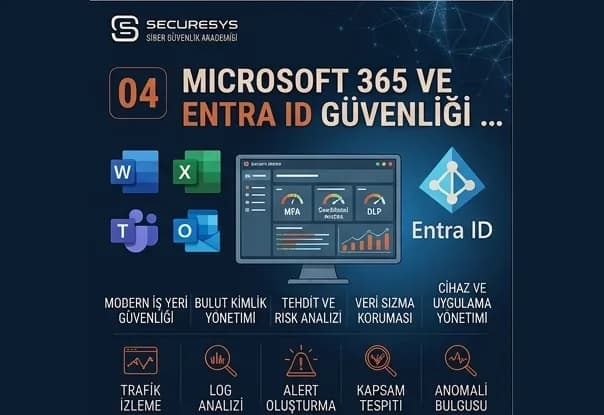
How Is Microsoft 365 and Entra ID Security Achieved?
How is Microsoft 365 and Entra ID security achieved? MFA, conditional access, PIM, OAuth governance, session security and identity incident response together.
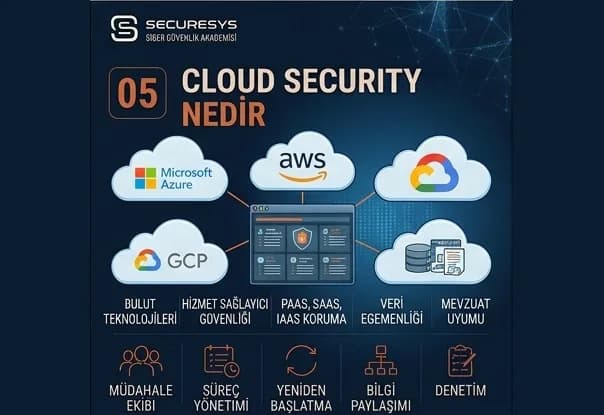
What Is Cloud Security? Securing AWS, Azure and Google Cloud
What is cloud security? How are the IAM, network, storage, logging and CSPM layers secured on AWS, Azure and Google Cloud?
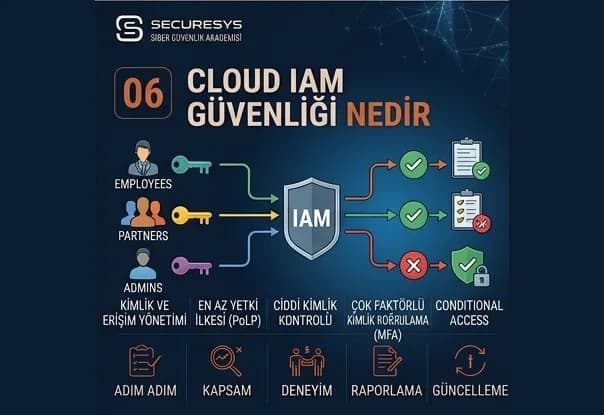
What Is Cloud IAM Security? Managing Permission, Role and Privileged Access Risk
What is cloud IAM security? Overprivilege, privilege escalation, service account risks and the CIEM approach on AWS, Azure and GCP.
Looking for professional support on this topic?
Our expert team will reach out for a free consultation as soon as possible.