Enterprise Cyber Hygiene Checklist: 25 Critical Security Controls and Implementation Guide
Enterprise cyber hygiene checklist: a guide to implementing 25 critical controls, from MFA, patch management and EDR to backup and access security.
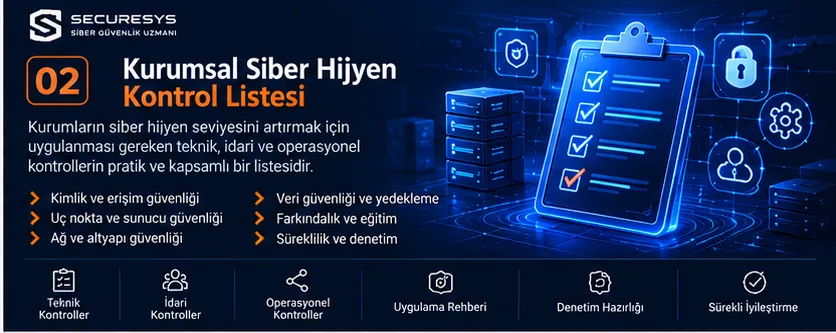
What Is an Enterprise Cyber Hygiene Checklist?
An enterprise cyber hygiene checklist is a control framework used to systematically assess the baseline security measures that should be in place across an organisation's information systems, identify gaps and prioritise remediation work.
This checklist does not merely ask whether technical security products exist.
It also assesses whether security controls are configured correctly, and what their coverage, effectiveness and continuity look like.
For example, having EDR in the organisation is not enough on its own.
EDR agents need to run on all critical systems, be monitored centrally, and have their security events reviewed.
Similarly, the fact that MFA has been deployed does not mean that all privileged accounts are protected.
A cyber hygiene assessment aims to make gaps of this kind visible.
Short answer: An enterprise cyber hygiene checklist is a practical assessment tool that ensures baseline controls are implemented and verified across asset management, identity security, system security, network security, data protection, security monitoring and incident response.
1. Why Should Enterprise Cyber Hygiene Be Managed with a Checklist?
Cyber security involves a large number of technical and administrative controls.
These controls may be managed by different teams.
System administrators are responsible for server updates.
Network teams manage firewall and VPN configurations.
Information security teams carry out risk assessments.
SOC teams monitor security events.
Human resources supports user lifecycle processes.
In such a distributed structure, it is possible for some controls to be overlooked.
A standard checklist clarifies responsibilities and assessment criteria.
Key benefits
- Standardisation of security controls.
- Systematic identification of gaps.
- Assignment of responsibilities.
- Prioritisation of risks.
- Creation of audit evidence.
- Tracking of remediation activities.
- Measurement of security maturity.
However, completing the checklist does not by itself mean that security has been achieved.
Controls need to be verified on real systems.
2. How Should Cyber Hygiene Controls Be Prioritised?
Every organisation has a different infrastructure and risk profile.
For this reason, not all controls may be implemented with the same priority.
For example, securing critical internet-facing systems may require a higher priority than low-impact systems in an isolated test environment.
Recommended assessment criteria
Asset criticality level: How important is the system to business processes?
Threat exposure: Is the system exposed to the internet or to untrusted networks?
Vulnerability status: Are there known and exploitable security weaknesses?
Data sensitivity: Does the system process personal or commercially sensitive data?
Existing controls: Are there security mechanisms in place that reduce the risks?
Business impact: What could the operational consequences be if a security breach occurred?
These criteria should be assessed together to prepare a risk-based implementation plan.
A. ASSET AND INVENTORY SECURITY
3. Control 1: Hardware and Digital Asset Inventory
Security objective
To identify the digital assets that the organisation owns or manages, and to keep that information up to date.
Risks
Unknown servers.
Uncontrolled client devices.
Unauthorised network devices.
Virtual machines outside the inventory.
Systems to which security controls are not applied.
Implementation method
Servers, clients, network devices, virtual machines and cloud resources should be included in the inventory.
A technical owner should be assigned to each asset.
A criticality level should be defined.
New assets should be added to the inventory automatically or through a controlled process.
Technical verification
Inventory records can be compared against network discovery and system management data.
Devices that are not in the inventory can be investigated.
Example KPI
Inventory coverage = Number of verified assets included in the inventory / Total number of detected assets × 100
Recommended owner: IT Operations / System Administration
Priority: Critical
4. Control 2: Software Inventory and Unauthorised Application Management
Security objective
To keep the software used on enterprise systems, and its versions, under control.
Risks
Software that has reached end of support.
Applications with security vulnerabilities.
Unauthorised remote access tools.
Uncontrolled browser extensions.
Packages containing malware.
Implementation method
An approved software list should be created.
Installed software should be monitored centrally.
Unused applications should be removed.
Products that have reached end of support should be identified.
Application allowlisting can be applied in suitable environments.
Technical verification
Records from endpoint management and software inventory tools can be compared.
Example KPI
Number of critical assets running unsupported software.
Recommended owner: IT Operations / Endpoint Management
Priority: High
B. IDENTITY AND ACCESS SECURITY
5. Control 3: Multi-Factor Authentication (MFA)
Security objective
To reduce the risk of user accounts being compromised with nothing more than password knowledge.
Risks
Password compromise.
Credential stuffing.
Phishing.
Unauthorised VPN access.
Misuse of cloud accounts.
Implementation method
MFA should be applied first to administrator accounts, remote access systems and critical applications.
Phishing-resistant MFA methods should be considered for high-risk access.
MFA enrolment and recovery processes must also be managed securely.
Technical verification
Identity provider reports can be reviewed.
MFA exceptions can be identified.
Access tests can be carried out for critical accounts.
Example KPI
MFA coverage rate for critical accounts.
Recommended owner: IAM / Information Security
Priority: Critical
6. Control 4: Privileged Account Management (PAM)
Security objective
To reduce the risk of highly privileged accounts being misused.
Risks
Compromise of Domain Admin accounts.
Uncontrolled administrator access.
Shared administrator accounts.
Unauthorised configuration changes.
Implementation method
Administrator accounts should be separated from standard user accounts.
The principle of least privilege should be applied.
MFA should be used.
Administrator sessions should be monitored appropriately.
Temporary privilege elevation should be applied where necessary.
Technical verification
Privileged group memberships can be reviewed.
Administrator session logs can be assessed.
The authorisation matrix can be verified.
Example KPI
Number of privileged accounts that have not been reviewed.
Recommended owner: IAM / System Administration
Priority: Critical
7. Control 5: User Lifecycle and Access Management
Security objective
To manage the access of employees and external users in line with their duties.
Risks
Accounts of departed users remaining active.
Old privileges being retained after a change of role.
Accumulation of unnecessary access.
Uncontrolled external user accounts.
Implementation method
Joiner, mover and leaver processes should be defined.
Human resources and IT processes should be linked.
Privileges should be reviewed regularly.
Service accounts should be assessed separately.
Technical verification
Active account lists can be compared with personnel records.
Privilege approvals and deactivation records can be reviewed.
Example KPI
Proportion of accounts disabled within the target time after an employee leaves.
Recommended owner: Human Resources / IAM
Priority: Critical
8. Control 6: Password and Credential Security
Security objective
To ensure that passwords and other credentials are created, stored and used securely.
Risks
Weak passwords.
Password reuse.
Shared accounts.
Storage of passwords in clear text.
Access keys embedded in source code.
Implementation method
Long and unique passwords should be used.
Password managers can be considered.
Known compromised passwords should be blocked.
Service accounts and API keys should be managed with secure secret management solutions.
Technical verification
Password policies can be reviewed.
Authorised and controlled security assessments can be carried out.
Secret scanning can be applied to code repositories.
Example KPI
Number of credentials that fall outside policy or outside the scope of secure storage.
Recommended owner: IAM / Information Security / DevOps
Priority: High
C. SYSTEM AND ENDPOINT SECURITY
9. Control 7: Patch Management
Security objective
To reduce the risk of known security vulnerabilities being exploited.
Risks
Outdated operating systems.
Applications with security vulnerabilities.
Actively exploited vulnerabilities.
Systems that have reached end of support.
Implementation method
A patch management policy should be established.
Critical assets should be prioritised.
Updates should be tested in suitable environments.
Deployment results should be verified.
A separate process should be defined for emergency security updates.
Technical verification
Patch management reports can be reviewed.
Results can be verified with vulnerability scans.
Example KPI
Proportion of critical missing patches remediated within the defined target time.
Recommended owner: System Administration / IT Operations
Priority: Critical
10. Control 8: Vulnerability Management
Security objective
To continuously identify security weaknesses in enterprise systems and manage them on a risk basis.
Risks
Unknown security weaknesses.
Misconfigurations.
Vulnerable services exposed to the internet.
Delayed remediation.
Implementation method
Regular vulnerability scans should be carried out.
Findings should be validated.
Risks should be prioritised according to asset criticality.
Remediation owners should be assigned.
Fixes should be re-verified.
Technical verification
Vulnerability scan results and remediation records can be compared.
The closure status of critical weaknesses can be reviewed.
Example KPI
Number of critical vulnerabilities that have exceeded their target remediation time.
Recommended owner: Information Security / System Administration
Priority: Critical
11. Control 9: EDR and Endpoint Protection
Security objective
To support the prevention, detection and investigation of malicious activity on endpoints.
Risks
Malware.
Ransomware.
Unauthorised process execution.
Credential theft.
Suspicious command execution.
Implementation method
A suitable endpoint protection solution should be used.
Agent coverage should be monitored.
Protection policies should be kept up to date.
Critical alerts should be reviewed.
Systems outside protection should be identified.
Technical verification
Device records in the EDR management console can be compared with the asset inventory.
Agent health and policy status can be checked.
Example KPI
Proportion of eligible devices with an active and healthy EDR agent.
Recommended owner: Endpoint Management / SOC
Priority: Critical
12. Control 10: Secure System Configuration (Hardening)
Security objective
To reduce unnecessary services and risky configurations on systems.
Risks
Default accounts.
Unnecessary services.
Exposed management ports.
Weak security policies.
Insecure protocols.
Implementation method
Secure configuration standards should be established per operating system and application.
Guidance such as the CIS Benchmarks can be used.
Unnecessary services should be disabled.
Configuration changes should be made in a controlled manner.
Technical verification
Configuration audits can be carried out.
Secure configuration checklists can be used.
Example KPI
Proportion of critical systems that comply with the secure configuration standard.
Recommended owner: System Administration / Information Security
Priority: High
D. NETWORK AND COMMUNICATIONS SECURITY
13. Control 11: Firewall Rule Management
Security objective
To restrict network access to only the necessary sources and services.
Risks
Overly broad access rules.
Unused firewall policies.
Uncontrolled management access.
Incorrect NAT configurations.
Implementation method
Firewall rules should be reviewed regularly.
Rule owners should be assigned.
Unnecessary access should be removed.
Critical changes should be approved.
Technical verification
The rule base can be reviewed.
Traffic logs can be assessed.
Unused rules can be identified.
Example KPI
Number of active firewall rules that have no owner or justification.
Recommended owner: Network Security
Priority: High
14. Control 12: Network Segmentation
Security objective
To control access between systems that sit at different security levels.
Risks
An attacker moving laterally inside the network.
Access from the user network to critical servers.
Uncontrolled use of management networks.
Implementation method
Critical systems should be placed in separate security zones.
VLAN and firewall policies should be applied.
Management networks should be separated.
Unnecessary access between systems should be blocked.
Technical verification
Network access tests can be performed.
Segmentation rules can be reviewed.
Example KPI
Proportion of critical system groups that have an approved segmentation policy.
Recommended owner: Network Management / Network Security
Priority: High
15. Control 13: VPN and Remote Access Security
Security objective
To manage access from outside the organisation securely.
Risks
Compromised VPN accounts.
Lack of MFA.
Overly broad network access.
Stale user accounts.
Outdated VPN appliances.
Implementation method
MFA should be applied to VPN access.
Access privileges should be restricted.
User accounts should be reviewed regularly.
The VPN infrastructure should be kept up to date.
Access logs should be monitored.
Technical verification
VPN user lists can be reviewed.
MFA coverage can be verified.
Authorisation and connection logs can be assessed.
Example KPI
Number of active remote access accounts without MFA protection.
Recommended owner: Network Security / IAM
Priority: Critical
E. EMAIL AND USER SECURITY
16. Control 14: Email Security and DMARC
Security objective
To reduce the risks of email-borne impersonation and malicious content.
Risks
Phishing.
Business Email Compromise.
Malicious attachments.
Use of spoofed domain names.
Implementation method
Email security filters should be applied.
SPF, DKIM and DMARC configurations should be assessed.
Suspicious link and attachment checks should be used.
MFA should be applied.
Technical verification
DNS records can be reviewed.
DMARC reports can be assessed.
Email security policies can be verified.
Example KPI
Proportion of corporate domains with an appropriately configured DMARC policy and reporting mechanism.
Recommended owner: Email Administration / Information Security
Priority: High
17. Control 15: Security Awareness and Phishing Training
Security objective
To increase employees' ability to recognise cyber threats and develop secure behaviour.
Risks
Fake login pages.
Suspicious links.
Social engineering.
Accidental data sharing.
Implementation method
Regular awareness training should be delivered.
Realistic and ethical phishing simulations can be run.
Incident reporting channels should be defined.
Employees should be encouraged to report suspicious messages.
Technical verification
Training attendance records can be reviewed.
Simulation results can be assessed.
Suspicious message reporting processes can be measured.
Example KPI
Training completion rate and verified phishing report rate.
Recommended owner: Information Security / Human Resources
Priority: High
F. DATA SECURITY AND BACKUP
18. Control 16: Data Classification and DLP
Security objective
To protect enterprise data according to its sensitivity level.
Risks
Personal data leakage.
Disclosure of trade secrets.
Uncontrolled file sharing.
Unauthorised data transfer.
Implementation method
A data classification policy should be established.
Sensitive data types should be identified.
Sharing rules should be defined.
DLP controls should be applied in the environments where they are needed.
Technical verification
File sharing permissions can be reviewed.
DLP policies can be verified with controlled test data.
Example KPI
Proportion of critical data sources that have been classified.
Recommended owner: Information Security / Data Owners
Priority: High
19. Control 17: Backup Security
Security objective
To preserve recovery capability in the event of data loss and service outages.
Risks
Ransomware.
Data deletion.
Storage failure.
Corrupted backups.
Implementation method
A backup policy should be established.
Backup frequency should be defined for critical systems.
Access to backups should be restricted.
Offline or immutable backup options should be considered.
Technical verification
Backup success records can be reviewed.
Restore tests can be performed.
Example KPI
Backup success rate and restore test success rate.
Recommended owner: System Administration / Backup Team
Priority: Critical
20. Control 18: Data Encryption
Security objective
To reduce the readability of data in the event of unauthorised access.
Risks
Device loss.
Unauthorised storage access.
Network traffic interception.
Disclosure of sensitive data.
Implementation method
Disk encryption should be used on suitable systems.
Secure protocols should be preferred for data transfer.
Encryption keys should be managed securely.
Backup data should be protected appropriately.
Technical verification
Disk encryption status can be reviewed.
TLS configurations can be assessed.
Key management processes can be checked.
Example KPI
Proportion of critical devices and data stores that comply with the encryption policy.
Recommended owner: IT Operations / Information Security
Priority: High
G. CLOUD AND APPLICATION SECURITY
21. Control 19: Cloud and SaaS Security
Security objective
To reduce the misconfiguration and access risks in cloud services and SaaS applications.
Risks
Publicly accessible storage.
Overly broad IAM privileges.
Uncontrolled file sharing.
Unauthorised OAuth applications.
Implementation method
Cloud assets should be included in the inventory.
IAM policies should be reviewed.
MFA should be applied.
Storage access should be controlled.
Security logs should be enabled.
Technical verification
Cloud configurations can be reviewed.
SaaS access reports can be assessed.
Example KPI
Number of critical cloud configuration findings.
Recommended owner: Cloud Operations / Information Security
Priority: High
22. Control 20: Web Application and API Security
Security objective
To reduce the security weaknesses in enterprise applications.
Risks
Broken Access Control.
Injection.
Authentication problems.
Insecure API access.
Disclosure of sensitive data.
Implementation method
Secure Coding principles should be applied.
Code reviews should be carried out.
Testing methods such as SAST and DAST can be considered.
API authorisation controls should be applied.
Risk-based penetration tests should be performed.
Technical verification
Application security tests and source code reviews can be carried out.
The remediation of findings can be verified with a retest.
Example KPI
Number of high-risk application security findings that have exceeded their target remediation time.
Recommended owner: Software Development / AppSec
Priority: High
H. SECURITY MONITORING AND INCIDENT RESPONSE
23. Control 21: Centralised Logging and SIEM
Security objective
To support the detection and analysis of security events.
Risks
Security events going unnoticed.
Inadequate audit records.
Difficulty investigating incidents.
Implementation method
Critical log sources should be identified.
Centralised log collection should be applied.
Time synchronisation should be ensured.
Correlation rules should be created for security events.
Technical verification
Log sources can be compared against the inventory.
It can be verified that event records arrive on time.
Example KPI
Proportion of critical systems covered by centralised logging.
Recommended owner: SOC / Information Security
Priority: High
24. Control 22: SOC and Continuous Security Monitoring
Security objective
To monitor suspicious activity and assess security events.
Risks
Attacks detected late.
Misconfigured alerts.
Security events that are never investigated.
Implementation method
Critical security scenarios should be defined.
Log and EDR data should be correlated.
Alert priorities should be defined.
Incident investigation and notification processes should be established.
Technical verification
Detection and notification flows can be verified by generating controlled test events.
Example KPI
MTTD: Mean Time to Detect.
MTTR: Mean Time to Respond, or Mean Time to Resolve depending on the organisation's definition.
Metric definitions should be stated explicitly in reporting.
Recommended owner: SOC
Priority: High
25. Control 23: Cyber Incident Response Plan
Security objective
To ensure that cyber security incidents are responded to in a coordinated and effective manner.
Risks
Delayed response.
Wrong decisions.
Loss of evidence.
Prolonged service outages.
Implementation method
An incident response plan should be prepared.
Roles and responsibilities should be defined.
Communication channels should be defined.
Critical incident scenarios should be developed.
Tabletop exercises should be conducted.
Technical verification
Incident response exercises can be carried out.
Response records can be assessed.
Example KPI
Completion rate of planned incident response exercises.
Recommended owner: Information Security / SOC / Crisis Management
Priority: Critical
I. GOVERNANCE AND CONTINUOUS IMPROVEMENT
26. Control 24: Supplier and Third-Party Security
Security objective
To manage the risks posed by third parties that access enterprise systems or process data.
Risks
Uncontrolled supplier access.
Contracts without security requirements.
Stale external user accounts.
Supplier-originated data breaches.
Implementation method
Critical suppliers should be identified.
Security requirements should be included in contracts.
Supplier access should be restricted.
Periodic risk assessments should be carried out.
Technical verification
Supplier accounts and access logs can be reviewed.
Contractual security obligations can be assessed.
Example KPI
Proportion of critical suppliers with a current security assessment.
Recommended owner: Procurement / Information Security / Legal
Priority: High
27. Control 25: Periodic Security Audit and Improvement
Security objective
To regularly verify the effectiveness of baseline security controls and to close gaps.
Risks
Recurring security weaknesses.
Audit findings that are never closed.
Policies that become outdated.
Declining control effectiveness.
Implementation method
Periodic security audits should be planned.
Control owners should be assigned.
Findings should be prioritised by risk level.
Improvement plans should be prepared.
Corrections should be verified.
Technical verification
Audit reports and action records can be reviewed.
Closed findings can be verified with a retest.
Example KPI
Proportion of security audit findings closed within the target time.
Recommended owner: Information Security / Internal Audit
Priority: High
28. Priority Matrix for Cyber Hygiene Controls
The table below provides an example for the initial prioritisation of the 25 controls.
| Control | Priority | Core objective |
|---|---|---|
| Asset inventory | Critical | Visibility |
| Software inventory | High | Reducing uncontrolled software risk |
| MFA | Critical | Account security |
| PAM | Critical | Privileged access security |
| User lifecycle | Critical | Reducing unauthorised access |
| Password and secret management | High | Credential security |
| Patch management | Critical | Remediating known vulnerabilities |
| Vulnerability management | Critical | Identifying risks |
| EDR | Critical | Endpoint protection |
| Hardening | High | Reducing the attack surface |
| Firewall management | High | Network access control |
| Network segmentation | High | Limiting lateral movement |
| VPN security | Critical | Remote access |
| Email security | High | Reducing phishing risk |
| Awareness | High | User security |
| Data classification and DLP | High | Data protection |
| Backup | Critical | Data recovery |
| Encryption | High | Data confidentiality |
| Cloud security | High | Cloud configuration security |
| Web and API security | High | Application security |
| SIEM | High | Event visibility |
| SOC | High | Security monitoring |
| Incident response | Critical | Response readiness |
| Supplier security | High | Third-party risks |
| Periodic audit | High | Continuous improvement |
These priorities are illustrative.
The actual implementation order should be determined according to the organisation's risk assessment.
29. Cyber Hygiene Maturity Assessment Model
Organisations can use a simple maturity model to measure the current state of their controls.
Level 0: Not implemented
The control does not exist, or there is no verifiable evidence of its implementation.
Level 1: Partial
The control is implemented on some systems.
However, its scope and process consistency are insufficient.
Level 2: Defined
A policy or procedure exists for the control.
The scope of implementation has been defined.
Level 3: Managed
The control is implemented regularly and tracked by its owners.
Level 4: Measured
The effectiveness of the control is monitored through performance indicators and verification activities.
Level 5: Optimised
Control results are fed into continuous improvement processes.
This model is an example for internal assessment.
It is not an official ISO or CIS certification level.
30. How Is a Cyber Hygiene Score Calculated?
In a simple assessment approach, each control can be scored on a scale of 0–5.
If all 25 controls are weighted equally, the maximum score is:
25 × 5 = 125
As an example, suppose the organisation's total score is 85.
The maturity rate is:
85 / 125 × 100 = 68%
This result shows that the organisation has achieved a score of 68% in the example assessment model.
However, a score of 68% does not mean that the organisation is 68% secure.
This is because a critical gap in MFA or backup may represent a significant risk that the total score conceals.
For this reason, scoring must always be reported together with critical findings.
31. Risk-Based Weighted Scoring
In more advanced assessments, controls can be evaluated with different weights.
For example:
Critical control: weight of 4 points.
High control: weight of 3 points.
Medium control: weight of 2 points.
Low control: weight of 1 point.
Calculation approach
The maturity score of each control is multiplied by its weight.
The total weighted score is divided by the maximum achievable weighted score.
This approach increases the influence of critical controls on the overall assessment.
However, the weights need to be set according to the organisation's actual risk profile.
32. Evidence Management in a Cyber Hygiene Audit
Assessing controls solely on verbal statements may not be sufficient.
Appropriate evidence needs to be collected.
Example evidence
Asset inventory.
MFA reports.
Patch management records.
EDR coverage reports.
Firewall rule lists.
Backup results.
Restore test records.
Vulnerability scan reports.
SOC incident records.
Incident response exercise reports.
Evidence security
Evidence may contain sensitive information.
For this reason, the principles of access control, retention period and data minimisation should be applied.
33. First 30-Day Implementation Plan
Days 1–7
Identifying critical assets.
Reviewing administrator accounts.
Assessing MFA coverage.
Identifying internet-facing systems.
Days 8–14
Assessing critical vulnerabilities.
Identifying missing patches.
Checking EDR coverage.
Days 15–21
Reviewing backup policies.
Planning restore tests.
Assessing firewall access.
Days 22–30
Reviewing log sources.
Assessing incident response readiness.
Drawing up the remediation plan.
This plan is an example roadmap at an introductory level.
34. First 90-Day Cyber Hygiene Improvement Programme
Phase 1: Current State
Assessing the 25 controls.
Identifying gaps.
Risk scoring.
Phase 2: Critical Controls
MFA.
Patch management.
EDR.
Backup.
Privileged access.
Phase 3: Operational Security
Vulnerability management.
Centralised logging.
SOC monitoring.
Incident response.
Phase 4: Continuous Improvement
Establishing KPIs.
Periodic audits.
Retesting.
Management reporting.
This approach supports turning cyber hygiene into a sustainable programme.
35. How Should SMEs Implement the 25 Controls?
Small and medium-sized enterprises may have limited budget and staff resources.
For this reason, controls should be implemented in stages.
Initial priorities
MFA.
Backup.
Up-to-date systems.
Endpoint protection.
Administrator account security.
Email security.
User awareness.
Second stage
Vulnerability management.
Centralised logging.
Firewall rule management.
Cloud security.
Periodic security audits.
This approach helps reduce the fundamental risks first.
However, SMEs that carry out high-risk activities may need more comprehensive controls.
36. Cyber Hygiene Automation for Large Organisations
Large organisations may have thousands of assets.
For this reason, manual control processes may prove insufficient.
Automation areas
Asset discovery.
Software inventory.
Patch compliance checks.
Vulnerability scanning.
EDR coverage monitoring.
Identity lifecycle.
Configuration compliance.
Log collection.
Key point
Automation should not be used solely for data collection.
The gaps that are detected need to be assigned to owners, and remediation processes need to be tracked.
37. The Relationship Between Cyber Hygiene and ISO/IEC 27001
ISO/IEC 27001 defines the requirements for an information security management system.
Cyber hygiene controls can support the technical and operational implementation of this management system.
Example mapping
Asset management.
Access control.
Vulnerability management.
Secure configuration.
Backup.
Logging.
Incident management.
However, completing all 25 controls does not automatically mean ISO/IEC 27001 compliance has been achieved.
The management system requirements must be assessed separately.
38. The Relationship Between Cyber Hygiene and NIST CSF 2.0
NIST CSF 2.0 contains six functions that support the management of cyber security risks.
GOVERN.
IDENTIFY.
PROTECT.
DETECT.
RESPOND.
RECOVER.
The 25 cyber hygiene controls can be mapped to these functions.
For example, asset inventory can be assessed under IDENTIFY, MFA under PROTECT, SIEM under DETECT and incident response under RESPOND.
This mapping helps the enterprise security programme to be managed more systematically.
39. The Relationship Between Cyber Hygiene and CIS Controls
CIS Controls provides guidance for prioritising baseline security measures.
The 25-control checklist can be assessed by drawing on the CIS Controls approach.
However, the 25 controls in this article are not a one-to-one copy of the official CIS Controls list.
They are a practical assessment framework created for enterprise use.
This distinction is important.
This is because, in standards compliance assessments, the official control definitions and versions must be taken as the basis.
40. How Should a Cyber Hygiene Report Be Prepared?
A professional cyber hygiene assessment report should not merely show control statuses.
Recommended report structure
Executive summary.
Scope.
Methodology.
Asset inventory assessment.
Results for the 25 controls.
Critical findings.
Risk rating.
Remediation recommendations.
Responsibility matrix.
Implementation roadmap.
KPI recommendations.
From a management perspective
The report should clearly show the business impact of technical gaps.
For example, instead of a statement such as “MFA is missing”, it should explain which critical access paths are at risk.
41. SECURESYS Cyber Hygiene Audit and Consulting
SECURESYS bases its enterprise cyber security work on technical verification and a risk-based approach to remediation.
Cyber hygiene assessments can be planned according to the organisation's existing infrastructure and needs.
Service scope
Cyber Hygiene Current State Analysis
Assessment of baseline security controls.
Assessment of the 25 Critical Controls
Review of control coverage and effectiveness.
Vulnerability Management
Identification and prioritisation of security weaknesses.
System and Network Security Audit
Assessment of servers, networks and security devices.
Identity and Access Security
Review of MFA, PAM and access policies.
Backup and Resilience
Assessment of data protection and restore readiness.
SOC and Continuous Security Monitoring
Monitoring of security events and support for response processes.
ISO/IEC 27001 Compliance Consulting
Assessment of the processes related to information security management system requirements.
Core approach
In cyber hygiene assessments, SECURESYS aims not just to list the gaps but to produce an actionable remediation plan.
This is because the value of a security assessment is tied not to the number of findings, but to the extent to which risks can be reduced.
42. A Practical 25-Item Cyber Hygiene Checklist
- 1. Is the hardware and digital asset inventory up to date?
- 2. Is there a software inventory and an approved application list?
- 3. Is MFA applied to critical accounts?
- 4. Are privileged accounts managed securely?
- 5. Are user lifecycle processes being implemented?
- 6. Are passwords and credentials managed securely?
- 7. Are critical security patches being applied?
- 8. Is vulnerability management carried out regularly?
- 9. Is endpoint protection and EDR coverage sufficient?
- 10. Are secure system configurations being applied?
- 11. Are firewall rules reviewed regularly?
- 12. Have critical networks been segmented appropriately?
- 13. Has VPN and remote access security been ensured?
- 14. Are email security and DMARC controls in place?
- 15. Is user security awareness training being delivered?
- 16. Have data classification and DLP controls been assessed?
- 17. Are backup and restore tests being carried out?
- 18. Is critical data encrypted appropriately?
- 19. Are cloud and SaaS security being checked?
- 20. Are web applications and APIs subjected to security testing?
- 21. Are centralised logging and SIEM in place?
- 22. Are security events monitored regularly?
- 23. Is a cyber incident response plan in place and has it been tested?
- 24. Are supplier security risks being managed?
- 25. Are periodic security audits and improvements being carried out?
This checklist can be extended according to the organisation's risk profile.
Frequently Asked Questions
What is a cyber hygiene checklist?
It is a systematic checklist used to assess an organisation's baseline cyber security controls and identify gaps.
How many items does a cyber hygiene control set contain?
There is no single universal number. This guide presents 25 critical controls for enterprise use.
How is a cyber hygiene assessment carried out?
The asset inventory, technical controls, policies and procedures, evidence and security risks are assessed together.
How often should a cyber hygiene assessment be performed?
It should be determined according to the organisation's risk level. Critical controls should be monitored continuously, and comprehensive assessments should be carried out at planned intervals.
Is cyber hygiene the same thing as ISO/IEC 27001?
No. Cyber hygiene focuses on baseline security controls, whereas ISO/IEC 27001 defines the requirements for an information security management system.
What is the relationship between cyber hygiene and CIS Controls?
CIS Controls is a guide that can be used to prioritise cyber security controls. Cyber hygiene assessments can draw on this guide.
Why is MFA a critical control?
It helps reduce the risk of unauthorised access if a password is compromised.
Does EDR prevent all cyber attacks?
No. EDR is an important security layer, but it does not guarantee that all attacks will be prevented.
Why is vulnerability management important?
It ensures that known security weaknesses are detected and remediated on a risk basis.
Is backup part of cyber hygiene?
Yes. Backup and restore tests are among the baseline cyber hygiene controls.
Does a SOC replace cyber hygiene?
No. A SOC monitors security events, whereas cyber hygiene focuses on reducing baseline security weaknesses.
How is a cyber hygiene score calculated?
A total or weighted assessment can be made by scoring the maturity levels of the controls.
Does a high cyber hygiene score mean security is guaranteed?
No. A critical security gap can pose a significant risk despite a high total score.
Which controls are the priority for SMEs?
MFA, patch management, backup, endpoint protection, identity security and email security are generally important starting areas.
What does cyber hygiene consulting provide?
It supports the assessment of the current security posture, the identification of gaps and the creation of an actionable remediation plan.
What evidence is used in a cyber hygiene audit?
Evidence such as the asset inventory, MFA reports, patch records, EDR coverage, firewall rules, backup tests and security event records can be used.
Conclusion: The 25 Critical Controls Form the Foundation of Sustainable Cyber Security
Enterprise cyber security cannot be achieved merely by owning advanced products.
Baseline security controls must be applied correctly and continuously.
The asset inventory must be kept up to date.
Critical accounts must be protected with MFA.
Privileged access must be restricted.
Security patches must be applied.
Vulnerabilities must be assessed regularly.
Endpoints must be protected.
Network access must be controlled.
Sensitive data must be protected.
Backup and restore processes must be verified.
Security events must be monitored.
And all of these controls must be assessed periodically.
The 25 critical cyber hygiene controls covered in this article provide a practical starting framework for organisations to measure their current security level and build a remediation plan.
However, completing the checklist is not sufficient on its own.
Controls must be verified on real systems, owners must be assigned and results must be measured.
What matters in cyber security is not only which controls you have, but knowing how effectively those controls work.
Related Articles
Cyber Security Compliance & Advisory Centre
What Is Cyber Hygiene? Essential Cyber Security Controls and Implementation Guide for Organisations
What is cyber hygiene and why does it matter? A guide to MFA, patch management, asset inventory, backup and access control for organisations.
What Is ISO/IEC 27001? ISMS, 93 Controls and Certification Guide
What is ISO/IEC 27001? Learn the 2022 standard, its 93 controls, ISMS setup, risk analysis, SoA, TÜRKAK accreditation and the certification process.
How to Perform an ISO/IEC 27001 Risk Analysis: Risk Assessment, Risk Treatment and SoA Preparation Guide
How is an ISO 27001 risk analysis done? 5×5 risk matrix, risk register, risk treatment plan, residual risk, SoA examples and an ISMS audit guide.
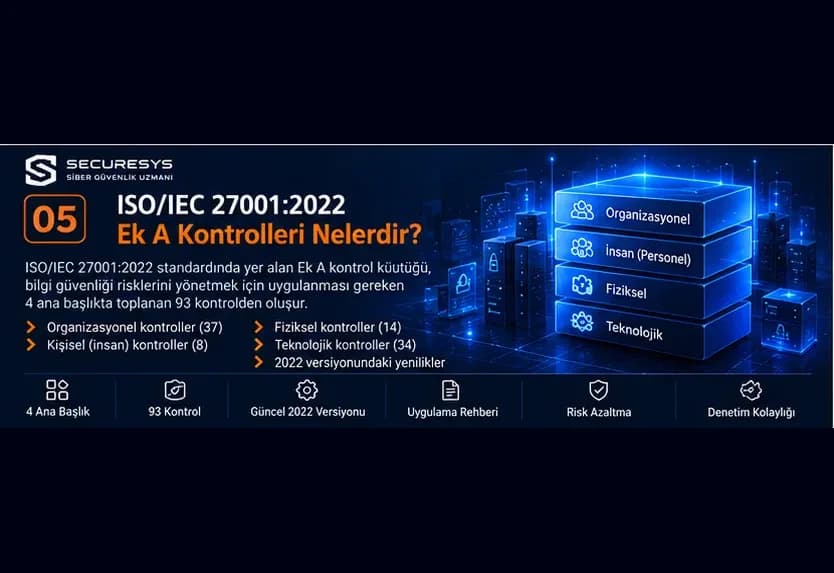
ISO/IEC 27001:2022 Annex A Controls: 93 Information Security Controls and Implementation Guide
Explore the 93 security controls in ISO 27001:2022 Annex A. Learn the organisational, people, physical and technological controls with implementation examples.
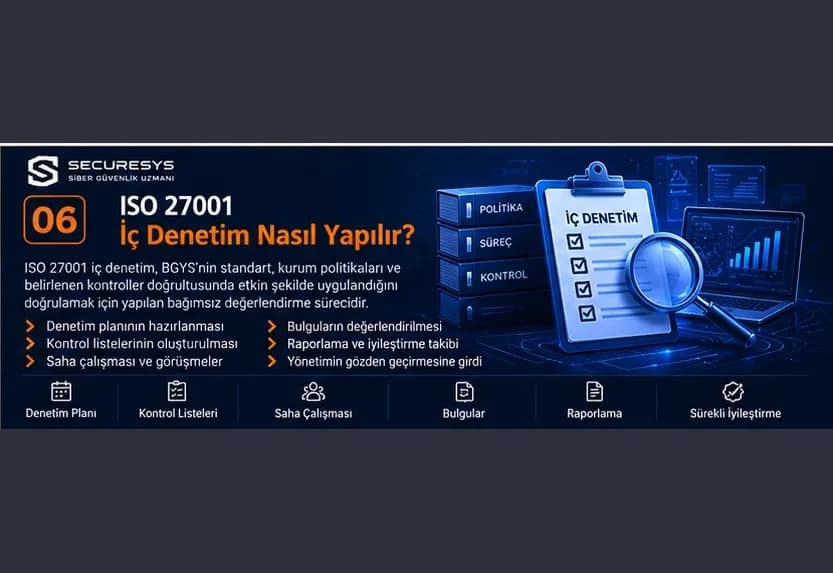
How to Conduct an ISO 27001 Internal Audit: Audit Plan, Nonconformity Management and Certification Readiness
How is an ISO 27001 internal audit done? Learn the audit plan, checklist, major and minor nonconformities, corrective actions and certification readiness.
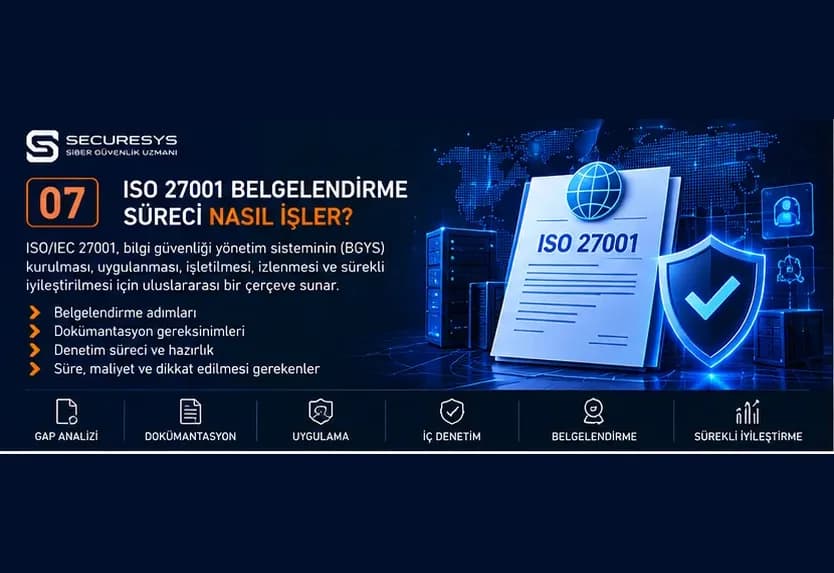
How Does the ISO 27001 Certification Process Work? A Guide to TÜRKAK, Stage 1, Stage 2 and Surveillance Audits
How do you get ISO 27001 certified? TÜRKAK accreditation, Stage 1 and Stage 2 audits, major and minor nonconformities, surveillance and certification costs.
Looking for professional support on this topic?
Our expert team will reach out for a free consultation as soon as possible.