What Is PAM? Privileged Access Management and Privileged Account Security
What is PAM? A guide to privileged account security, credential vaults, session recording, JIT/JEA, PEDM and Zero Standing Privilege.
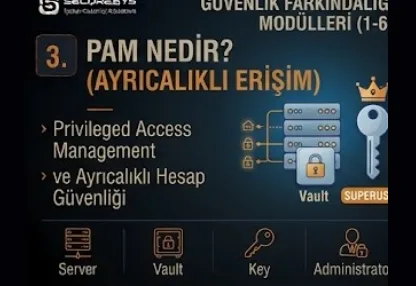
In corporate cyber security not all user accounts have the same risk level. A standard employee's account being obtained can create a serious security event; however, a high-privilege account such as Domain Admin, root, database administrator, cloud administrator or one that manages the security systems being obtained can create much larger opportunities from the attacker's point of view. Because a privileged identity does not only log in to the system; it can change configurations, create new users, disable security controls, access critical data and move towards other systems.
For this reason in a modern Identity Security architecture normal user access and privileged access should not be managed in the same way. While IAM manages users' identity verification, Single Sign-On, MFA and the general access lifecycle, PAM – Privileged Access Management enables accounts with high authority, their credentials and privileged sessions to be used under much stricter security controls.
However, the PAM concept has also changed significantly in recent years. In the traditional approach when PAM was mentioned what was understood was mostly administrator passwords being stored inside a central Password Vault and changed regularly. In the modern PAM approach, on the other hand, the target is not only to protect the password. The aim is as far as possible for the user never to know the administrator password, for high authority not to be continuously present on the account, for access to be given only at the moment of need, for the privileged session to be monitored and for the authority to be removed automatically when the operation is completed.
This transformation has taken PAM out of being a simple password vault and made it one of the fundamental components of the Privileged Identity Security architecture.
What Is PAM and Why Is It Necessary?
PAM, that is, Privileged Access Management, is the body of technology, policy and operational processes that enables high-privilege users, administrator accounts, service accounts, privileged credentials and critical system access inside the organization to be managed safely.
In an organization a privileged identity does not mean only the administrator in the IT department. Many different privileged identities can exist such as Windows Domain Admin, Linux root, database administrator, firewall administrator, network administrator, cloud Global Administrator, backup administrator, hypervisor administrator and security platform administrator. Alongside these the service accounts, API credentials and automation identities used by applications can also have high authority.
For this reason the first duty of PAM is not only to store passwords but to make the organization's privileged attack surface area visible.
If an organization does not know how many privileged accounts it has it is not possible for it to protect these accounts effectively.
A modern PAM programme should therefore be able to answer these questions:
Which privileged identities exist?
Who are the owners of these accounts?
Which systems can they access?
Are their authorities really necessary?
Who knows the administrator passwords?
Which operations are carried out with these accounts?
Is privileged access continuously open, or is it given at the moment of need?
The answers to these questions form the foundation of a PAM programme.
What Is a Privileged Account?
A Privileged Account is an account that has a higher level of authority on the system compared to a normal user account. This authority can be on the operating system, a network device, a database, a cloud platform or a business application.
For example a Domain Admin account can make broad changes on Active Directory. A Linux root account can manage the whole of the operating system. A database administrator can access sensitive data or change the database configuration. A cloud administrator can create new resources, change IAM permissions or give high authority to other users.
For this reason privileged accounts are one of the most valuable targets of attackers.
An attacker may at the beginning have obtained a standard employee account. However, their real aim is most of the time not to stay with this account for a long time. The attacker tries to obtain higher privilege.
This attack chain can generally proceed as:
Initial Access → Credential Access → Privilege Escalation → Lateral Movement → Privileged Access
in this way.
When a privileged account is compromised the attacker can start to behave no longer like a normal user but like a system administrator.
For this reason PAM is not only a tool that organizes IT operations but at the same time an important defense layer against ransomware, lateral movement, credential theft and privilege escalation risks.
What Is Privileged Identity Security?
Privileged Identity Security is the broader security perspective of PAM. The aim is not only to protect the password of the administrator account but to control the whole lifecycle of the privileged identity.
This lifecycle can start with an access request. The user states why they want privileged access. If necessary the manager or system owner gives approval. The user verifies their identity with strong MFA. The PAM system creates temporary privileged access. The session is monitored or recorded. When the operation is completed the authority is taken back and the necessary audit records are stored.
What is important in this approach is:
"Who is the administrator?"
rather than this question:
"Who used administrator authority, on which system, for which reason, for how long and what did they do with this authority?"
being able to answer this question.
The real value of modern PAM emerges here.
What Is the Difference Between IAM and PAM?
IAM and PAM are frequently confused with each other but they solve different security problems.
IAM works on the identities and access lifecycle across the organization. The employee joining the organization, an account being created, using SSO, carrying out authentication with MFA, receiving application permissions and their accesses being removed when they leave the organization are within the scope of IAM.
PAM, on the other hand, manages high-risk privileged access.
For example a system administrator can first carry out authentication with a normal corporate identity over Microsoft Entra ID or another Identity Provider. Afterwards they can request temporary privileged access from the PAM platform in order to carry out maintenance on a production server.
In this case IAM:
"Who really is this user?"
answers this question.
PAM, on the other hand:
"Should administrator access be given to this user, for how long should it be given and should what they do during this access be monitored?"
manages these questions.
Therefore IAM and PAM are not alternatives to each other. Inside a modern Identity Security Architecture they are two separate security layers that complement each other.
Why Should Administrator Accounts Be Separated from Normal User Accounts?
One of the risks frequently seen in corporate environments is employees carrying out their daily work with accounts that have administrator privileges. The user can with the same account read e-mail, browse the internet and carry out an administrator operation on a critical server.
This situation seriously enlarges the attack surface.
For example if the administrator opens a phishing e-mail or goes to a malicious website the attacker can find the opportunity to access not only a normal employee session but an identity with high privilege.
For this reason different identities can be used for privileged users.
For example while the administrator's daily account is:
ahmet.yilmaz
the privileged account:
adm-ahmet.yilmaz
can be separated in this way.
However, the modern PAM approach goes beyond this too. Instead of keeping a permanent administrator account the privilege can be created at the moment of need or assigned temporarily.
This takes us to the Just-in-Time Access approach, one of the most important concepts of modern PAM.
Just-in-Time Access, JEA and Zero Standing Privilege
In the traditional access model the administrator's privileged access can be continuously open. Even at times when the user is not carrying out an administrator operation the account has high authority.
This can be evaluated as Standing Privilege.
The problem is this: even if the attacker compromises the account at a moment when the administrator is not working they can obtain ready privileged access.
Just-in-Time Access – JIT aims to reduce this problem. The user has privileged access only when they really need it.
For example if a database administrator is going to carry out maintenance on the production database they can request two hours of temporary privileged access. After approval the authority is activated and at the end of two hours it is removed automatically.
This model:
Request → Verify → Approve → Grant → Monitor → Expire
can work in this way.
The other concept that completes the JIT approach is Just-Enough-Access – JEA.
While JIT:
For how long will the authority be given?
handles this question, JEA:
How much authority will be given to the user?
focuses on this question.
If an administrator needs to restart a particular service it may not be necessary to give root access on the whole operating system. Privilege can be provided only for the necessary command or task.
When these two approaches are combined:
Minimum Privilege + Minimum Time
this model emerges.
One of the most advanced approaches of modern PAM, on the other hand, is the Zero Standing Privilege – ZSP model.
Zero Standing Privilege aims as far as possible not to leave continuous privileged permission on identities. The authority is created at the moment of need, used in a controlled way and removed when the operation is completed.
In this way even if the attacker obtains an account they may not find a ready administrator privilege on it.
Are Credential Vault and Password Rotation Still Important in Modern PAM?
Yes. Modern PAM is not only a Vault but the Credential Vault is still an important security component.
Inside traditional environments administrator passwords, database credentials, network device passwords or service account credentials continue to be used. This information being kept in Excel files, inside shared documents, in ticket systems or as common passwords known by team members creates a serious security risk.
The Credential Vault used on PAM platforms enables privileged credentials to be kept inside an encrypted and controlled repository.
Instead of seeing the password directly the user can connect to the target system over PAM.
In this model:
User → PAM → Target System
this flow arises.
PAM uses the necessary credential in the background but may not show the administrator password to the user.
This is an important principle:
A privileged credential should as far as possible not be known by the user.
Password rotation also comes into play here. The administrator password can be changed automatically at particular periods or after every use. In this way the credential staying the same for a long time can be prevented.
However, modern security architecture is increasingly moving towards the model:
Long-Lived Password → Short-Lived Credential
and even in some use cases:
Password-Based Privilege → Identity-Based Temporary Access
this model.
What Is Privileged Session Management?
In privileged access security only the credential being protected is not sufficient. After the user carries out authentication correctly the operations they carry out can also need to be controlled.
Privileged Session Management – PSM enables the privileged session between the administrator and the target system to be managed over the PAM platform.
For example instead of connecting to the server directly with SSH or RDP the administrator can establish the connection over PAM.
The flow:
Administrator → PAM Session Gateway → Critical Server
can take place in this way.
The PAM platform can monitor this session, log it or under particular conditions record it.
This approach provides important visibility in terms of audit and incident investigation.
After an event not only the information:
"Ahmet connected to the server at 14:32."
but the answer to the question,
"Which administrative operations did Ahmet carry out inside this session?"
can also be investigated.
Session Recording and Command Control
Privileged Session Recording enables high-privilege sessions to be recorded. An RDP session can be recorded in a video-like format, and an SSH session over commands and terminal activity.
These recordings provide accountability especially on critical infrastructure.
However, Session Recording should not be used in an unlimited way for the purpose of monitoring employees. Privacy, data retention, access authorization and audit requirements must be taken into account.
Modern PAM platforms may not only carry out recording. Some solutions can apply control over the commands or behaviors inside the session.
For example a particular dangerous command:
can be blocked,
can require approval,
can create an alert
or the session can be terminated.
This is the Privileged Session Control approach.
Privilege Elevation and Delegation Management – PEDM
One of the important areas of modern PAM is Privilege Elevation and Delegation Management – PEDM technology.
In the traditional endpoint model local administrator rights can be given to the user. However, when the user is an administrator they can carry out not only the necessary application but many security-sensitive operations on the device.
PEDM instead provides privilege elevation for a particular application or process.
For example the employee works as a normal user.
If a business application requires administrator privilege only that application can be run elevated.
The user themselves does not become a full local administrator.
This is:
Remove Local Admin + Elevate Application
this approach.
Endpoint privilege management can be an important security control especially in terms of ransomware, malware installation and unauthorized software risks.
What Is a Break-Glass Account?
When identity systems or PAM infrastructure become inaccessible emergency administrator access can be necessary.
For this purpose a Break-Glass Account or Emergency Access Account can be used.
However, this account should not be used during normal operations.
For a break-glass account:
very strong authentication,
secure credential storage,
a limited number of authorized people,
detailed monitoring,
usage alerting
should be applied.
When the account is used it is preferred for the security team to be informed instantly.
Because the attacker can also target emergency access mechanisms.
Why Are Shared Administrator Accounts Risky?
Inside many legacy environments more than one administrator can use the same root or administrator account.
For example five people use the same:
Administrator
account.
In this case during an audit it may not be possible to understand which operation which person carried out.
Accountability is lost.
A modern PAM architecture can enable the user to carry out authentication to PAM with their own personal identity and to use the shared privileged account in a controlled way.
In this way even if the target system sees the same administrator account the real user can be determined over the PAM audit trail.
In the long term where possible named privileged identities and temporary privilege models should be preferred.
Is Service Account Security Part of PAM?
Yes. Service accounts are one of the hardest areas of PAM programmes.
A service account can be used by an application, a scheduled task, a Windows service, a database integration or an automation process.
The problem is that these accounts are most of the time not changed for years.
If the password is changed the application can stop working.
For this reason IT teams:
"Let us not touch it, the system will break."
can leave service account credentials the same for years with this approach.
This situation can create a valuable persistence opportunity for the attacker.
Modern PAM and Secrets Management platforms can support the inventory, ownership, dependency discovery and automated rotation processes of service account credentials.
However, what is important here is not only to change the password.
First of all these questions should be answered:
Is this service account still necessary?
Who is the owner?
Which systems use it?
Which privilege does it have?
Can it carry out interactive login?
Does password rotation affect the application?
For this reason service account security merges directly with the Non-Human Identity Security area.
PAM, Secrets Management and Non-Human Identity
Traditional PAM was mostly built on human administrators. Inside a modern enterprise architecture the privileged credentials used by applications and machines are at least as important as human accounts.
Secrets such as API keys, database passwords, certificates, service account passwords and access tokens can be located inside application environments.
At this point an intersection arises between PAM and Secrets Management.
Secrets management platforms such as HashiCorp Vault or cloud-native secret services can manage the secrets lifecycle for applications. Some enterprise PAM platforms can also offer application credentials and secrets management capabilities.
The modern target is to reduce static secrets.
Where possible the transformation:
Hardcoded Secret → Vaulted Secret → Rotated Secret → Dynamic/Short-Lived Credential
should be applied.
This approach is especially important for cloud-native, DevOps and machine identity environments.
PAM and Cloud Privileged Access
Cloud environments have changed the understanding of PAM.
While inside a traditional datacenter privileged access was mostly thought of over the accounts:
Administrator
Root
Domain Admin
inside cloud environments new privileged identities can be found such as:
Global Administrator,
Subscription Owner,
Cloud IAM Role,
Service Principal,
Workload Identity
these.
Moreover cloud permissions can be extremely granular and dynamic.
For this reason modern privileged access security cannot rest only on a password vault.
For cloud privileged access:
JIT Role Activation,
MFA,
Conditional Access,
Short-Lived Credentials,
Entitlement Governance,
Session Monitoring
controls such as these can be used together.
At this point the PAM, IAM, IGA and CIEM technologies are approaching each other.
Are Microsoft Entra PIM and PAM the Same Thing?
PIM – Privileged Identity Management capabilities such as Microsoft Entra Privileged Identity Management can support use cases such as privileged cloud roles being made eligible instead of being kept continuously active and being activated at the moment of need.
This makes an important contribution to the JIT privilege model.
However, PIM and enterprise PAM are not completely the same concept.
Enterprise PAM more broadly:
Credential Vaulting,
Password Rotation,
Privileged Session Management,
RDP/SSH Proxy,
Session Recording,
Service Account Management,
Secrets Management,
Endpoint Privilege Management
can contain capabilities such as these.
For this reason PIM and PAM intersect in some areas but should not be evaluated as the same technology category.
In Which Areas Do Modern PAM Products Differ?
In the PAM market there are CyberArk, BeyondTrust, Delinea, One Identity Safeguard, WALLIX, ManageEngine PAM360 and different enterprise PAM platforms. Local or regional solutions can also be evaluated in particular use cases.
Comparing these products only with the question:
"Which one provides a password vault?"
is not sufficient.
Because modern PAM products can specialize in different areas.
For one organization strong Session Management can be critical while for another organization Endpoint Privilege Management can be more important. A DevOps-heavy organization can give more importance to Secrets Management and API integration. A hybrid enterprise environment, on the other hand, can want Windows, Linux, databases, network devices, cloud platforms and legacy systems to be taken into the same PAM architecture.
Therefore during PAM product evaluation:
Credential Vaulting,
Password Rotation,
Privileged Session Management,
Session Recording,
JIT Access,
PEDM,
Secrets Management,
Service Account Management,
Cloud Integration,
API Capabilities,
SIEM/SOC Integration,
High Availability,
Disaster Recovery
areas such as these should be evaluated together.
The product choice should be made after the architecture; the architecture should not be shaped according to the product's features.
How Should CyberArk, BeyondTrust, Delinea and Other PAM Platforms Be Positioned?
CyberArk is one of the widely known platforms in the enterprise privileged access security area and is associated with privileged credential, session and identity security use cases.
BeyondTrust has strong use cases especially in areas such as privileged access, remote privileged access and endpoint privilege management.
Delinea is positioned in the privileged access, vaulting and modern privilege management area.
One Identity Safeguard and WALLIX are also among the enterprise solutions evaluated in privileged password and session management scenarios. ManageEngine PAM360, on the other hand, is one of the platforms used for PAM requirements at different scales.
However, no product name on its own means:
"PAM security has been provided in this organization."
this.
For example the organization may have bought CyberArk or another PAM product but if Domain Admin users continue to connect directly to servers, if local administrator rights have not been removed, if service accounts have not been onboarded or if emergency accounts outside PAM are not controlled the privileged attack surface continues.
PAM success should be measured not with the number of licenses but with:
PAM Coverage
this.
What Is PAM Coverage?
PAM Coverage is one of the important maturity metrics that shows how much of the privileged identities and critical systems inside the organization are under PAM controls.
For example if there are 500 privileged accounts but only 100 accounts are managed over PAM, the technology having been installed does not mean that the large part of the privileged access risk is managed.
Similarly the passwords can be inside the Vault but if administrators can connect directly to target systems without using the PAM Session Gateway the Session Management coverage can remain incomplete.
For this reason separately:
Credential Coverage,
Privileged Account Coverage,
Session Coverage,
Service Account Coverage,
Cloud Privilege Coverage
can be measured.
These metrics show the real maturity of a PAM programme.
Why Is Privileged Account Discovery the First Step of a PAM Project?
One of the most important stages in a PAM implementation is the Privileged Account Discovery process.
If the organization focuses only on known Domain Admin accounts important privileged identities can be missed.
For example:
Local Administrators,
Database Accounts,
Network Device Accounts,
Backup Administrators,
Service Accounts,
Cloud Admin Roles,
Application Admin Accounts
should be included in the inventory.
After discovery accounts can be classified according to risk level.
For example:
Tier 0 / Critical
High Privilege
Operational Privilege
Application Privilege
categories such as these can be created.
This provides a risk-based onboarding strategy.
Active Directory and Tier 0 Privileged Access
Inside Active Directory environments Domain Admin and similar high-impact identities must be especially protected.
In the tiering approach critical identity infrastructure can be handled as a separate security tier.
The administrator using the same privileged identity for:
a Domain Controller,
a normal workstation,
e-mail,
the internet
can create a serious risk.
For this reason approaches such as dedicated administrative workstations or a Privileged Access Workstation – PAW can be used for privileged administration.
The fundamental principle here is this:
A credential at a high security level should not be used on a device at a lower security level.
PAM is an important part of this architecture but endpoint isolation and administrative tiering are also necessary.
How Does PAM Provide Protection Against Ransomware?
Ransomware attacks do not start only with file encryption.
The attacker can first obtain initial access.
Afterwards they carry out credential theft.
They carry out privilege escalation.
With lateral movement they reach critical systems.
At the final stage the backup infrastructure or domain-level privileges can be targeted.
PAM can make it harder for the attacker to obtain high privilege in this chain.
For example if the Domain Admin password is not known by the user the credential theft risk decreases. If JIT is applied there is no continuous administrator privilege on the compromised account. Session monitoring can help to detect unusual privileged activity. If the backup administrator credentials are protected separately it can become harder for ransomware to reach the backup infrastructure.
However, PAM on its own is not ransomware protection.
PAM;
EDR + Identity Security + Network Segmentation + Backup Security + SOC
must work together with these.
The Relationship Between PAM and Zero Trust
In the Zero Trust approach being inside the internal network is not sufficient for privileged access.
Even an administrator must pass through appropriate controls during every access request.
The modern privileged Zero Trust model can be thought of as follows:
Identity Verified
Strong MFA
Device Trusted
Access Approved
Minimum Privilege
Limited Duration
Session Monitored
↓
Privileged Access
This approach is the exact opposite of the "they can access everywhere at any time because they are an administrator" model.
PAM and SOC/SIEM Integration
PAM platforms produce important security telemetry.
For example:
Privileged Login
Failed PAM Login
Vault Access
Password Checkout
New Privileged Account
JIT Activation
Break-Glass Usage
Suspicious Session
Blocked Command
events such as these can be monitored by the SOC.
When these events are correlated on the SIEM with endpoint, network and identity telemetry stronger detection can be created.
For example:
EDR Credential Theft Alert + PAM Privileged Session Request
if these are seen on the same user a high severity incident can be created.
For this reason modern PAM is not only a preventive control but at the same time a part of the Detection & Response architecture.
AI Agents and PAM: The New Generation Privileged Access Problem
The development of Agentic AI systems creates a new problem in terms of PAM.
When an AI Agent stops being only a chatbot that produces information and starts to take action on real systems it needs permissions.
For example an AI Agent:
can change a server configuration,
can create a cloud resource,
can query a database,
can open a user account over a ticket,
can give an automated response to a security incident.
In this case the agent can become a privileged actor.
Giving an AI Agent a continuous administrator credential is a serious security risk.
The safer approach is the PAM principles we use for human administrators being applied to AI Agents too:
Unique Agent Identity + Least Privilege + JIT Access + Short-Lived Credentials + Approval + Full Audit Trail
For example if an agent is going to carry out a restart operation on a server it can receive temporary privilege only for this action.
After the operation the permission expires.
In this way the PAM architecture of the future will have to manage not only:
Human Privileged Access
but,
Human + Machine + AI Agent Privileged Access
this.
How Should a PAM Project Be Started?
The first step of a successful PAM project should not be a product installation.
First the privileged access landscape should be understood.
In the first stage:
Privileged Account Discovery,
Critical System Inventory,
Service Account Discovery,
Access Flow Mapping,
Risk Classification
should be carried out.
Afterwards which identities will be taken under which PAM controls should be determined.
For example the first phase:
Domain Admin
Cloud Global Admin
Backup Admin
Firewall Admin
can be critical identities such as these.
The second phase:
Database Administrators
Network Administrators
Application Administrators
can be these.
In the following stages:
Service Accounts
DevOps Secrets
Endpoint Privileges
Non-Human Identities
can be taken into scope.
This phased approach reduces the operational disruption risk.
Important KPIs and KRIs for PAM
The success of a PAM programme should not be measured only by how many accounts have been taken into the Vault.
Among the more meaningful indicators:
Privileged Account Coverage
PAM Session Coverage
Standing Privilege Count
JIT Access Adoption
Shared Account Reduction
Local Admin Reduction
Service Account Coverage
Credential Rotation Success Rate
Break-Glass Usage
Unmanaged Privileged Account Count
can be found.
The Standing Privilege Count in particular is important in terms of modern PAM maturity.
The target is not only to protect credentials but to reduce the number of identities that have continuous high authority.
The Most Frequently Made Mistakes in PAM
The problems frequently seen in organizations are these:
- Seeing PAM only as a Password Vault
- Putting the product into service without carrying out Privileged Account Discovery
- Taking only Domain Admin accounts into PAM
- Leaving Local Administrator accounts outside the scope
- Keeping Service Accounts outside PAM
- Continuing to use shared Administrator accounts
- Permitting users to see the privileged password
- Not applying Password Rotation
- Not using Session Management
- Permitting direct RDP/SSH access outside PAM
- Not applying JIT Access
- Not reducing Standing Privileges
- Not removing Local Admin Rights
- Not monitoring Break-Glass Accounts
- Leaving cloud privileged roles outside the PAM programme
- Not sending PAM logs to the SIEM
- Not protecting the PAM infrastructure itself sufficiently
- Not planning High Availability and Disaster Recovery
- Not applying strong segregation for PAM administrators
- Thinking the product deployment is the whole of the PAM programme
PAM Security Checklist
While evaluating their privileged access security maturity organizations can examine these controls:
- Is a Privileged Account Inventory present?
- Is Privileged Account Discovery carried out regularly?
- Have Domain Admin accounts been separated?
- Are root accounts under control?
- Are database administrator accounts within the scope of PAM?
- Are network administrator accounts within the scope of PAM?
- Are cloud administrator roles being controlled?
- Are shared administrator accounts being reduced?
- Are privileged credentials inside the Vault?
- Can users see administrator passwords directly?
- Is Automatic Password Rotation being applied?
- Do Privileged Sessions pass over PAM?
- Is Session Recording being applied?
- Has direct RDP/SSH access been limited?
- Is Strong MFA being applied?
- Do privileged users use phishing-resistant MFA?
- Is JIT Access being applied?
- Is JEA being applied?
- Is there a Zero Standing Privilege roadmap?
- Are Local Administrator Rights being reduced?
- Is PEDM being applied?
- Are Service Accounts in the inventory?
- Are the Service Account owners known?
- Are secrets managed centrally?
- Are Break-Glass Accounts protected separately?
- Does Break-Glass usage produce an instant alert?
- Are PAM logs being sent to the SIEM?
- Is a privileged access playbook present for the SOC?
- Is HA present for the PAM infrastructure?
- Is PAM Disaster Recovery being tested?
- Are AI Agents and automation identities being included in the privileged inventory?
PAM Maturity Model
Level 1 – Manual Privileged Access: Administrator passwords are known by team members. Shared accounts are widespread. There is limited visibility over privileged activity.
Level 2 – Credential Vaulting: Privileged credentials are taken into a central Vault and password rotation starts to be applied. However, standing privileges and direct access can largely continue.
Level 3 – Controlled Privileged Sessions: Privileged sessions are passed over PAM, MFA is applied, session recording and approval workflows are put into service. Service accounts start to be managed more in a controlled way.
Level 4 – JIT and Least Privilege: Permanent admin access is reduced. Just-in-Time Access, Just-Enough-Access and Endpoint Privilege Management are made widespread. PAM works integrated with the SIEM and SOC.
Level 5 – Zero Standing Privilege: For Human, Machine and AI Agent privileged identities temporary, policy-driven and short-lived access is used. Static credentials are brought down to the minimum level. Privileged access is subjected to continuous risk assessment.
At this level PAM:
Vault-Centric
from this approach:
Identity-Centric + Risk-Based + Just-in-Time
turns into this approach.
Frequently Asked Questions
What is PAM?
PAM, Privileged Access Management, is the cyber security approach that aims to manage safely the credentials, permissions and sessions of administrator, root, database admin, cloud admin and other high-privilege identities.
What is the difference between IAM and PAM?
While IAM manages the identity and access lifecycle across the organization, PAM focuses especially on the control of high-privilege privileged access. In a modern Identity Security architecture the two technologies work together.
Is PAM only a Password Vault?
No. Modern PAM can contain capabilities such as Password Rotation, Privileged Session Management, Session Recording, JIT Access, PEDM, Service Account Management, Secrets Management and Zero Standing Privilege alongside Credential Vaulting.
What is a Privileged Account?
It is an account that has higher system or application authority than a normal user account. Domain Admin, root, database administrator and cloud administrator can be given as examples.
What is JIT Access?
Just-in-Time Access is privileged permission being given temporarily only for the period needed instead of being kept continuously open.
What is JEA?
Just-Enough-Access aims for the minimum privilege necessary for the task the user will carry out to be given to them.
What is Zero Standing Privilege?
It is the approach of the authority being created at the moment of need and removed after the operation instead of leaving continuous high privilege on identities.
What is PEDM?
Privilege Elevation and Delegation Management aims to provide privilege elevation for a particular application, process or task without giving the user full administrator authority.
What is Session Recording?
It is privileged administrator sessions being recorded for audit and forensic purposes.
Should Service Accounts be included in PAM?
Service accounts that have high privilege or sensitive systems access should be taken into the scope of privileged identity governance. Modern PAM and Non-Human Identity Security can handle this area together.
Does PAM block ransomware?
PAM on its own does not block ransomware but it can make it harder for the attacker to obtain high privilege at the credential theft, privilege escalation and lateral movement stages.
Are Microsoft Entra PIM and PAM the same thing?
Not exactly. While PIM can focus on the activation and governance of privileged cloud roles, enterprise PAM can provide broader capabilities such as Credential Vaulting, Session Management, Password Rotation, PEDM and Service Account Management.
What kind of products are CyberArk, BeyondTrust and Delinea?
These platforms are enterprise security products that offer different Privileged Access Management and Privileged Identity Security use cases. Which platform is suitable should be evaluated according to the organization's architecture, privileged account structure, cloud use and operational requirements.
Does buying a PAM product complete the PAM project?
No. For PAM to be successful the discovery, privileged account classification, policy, onboarding, access workflow, operational ownership, monitoring, incident response and continuous improvement processes need to be designed together.
Conclusion: The Target of Modern PAM Is Not to Store the Password but to Remove Permanent Authority
Privileged Access Management was for many years identified with administrator passwords being kept inside a secure Vault.
This approach is still valuable but it is not sufficient for modern privileged access security.
Because from the attacker's point of view the real value is not the password itself but the level of:
Privilege
this.
The administrator password can be extremely strong.
It can be kept inside the Vault.
It can be rotated every day.
However, if there is continuous administrator privilege on the compromised user the risk continues.
For this reason the real transformation of modern PAM is:
Password Security
from this approach to:
Privilege Security
the transition to this approach.
The PAM architecture of the future is moving towards this model:
Identity Verification
↓
Phishing-Resistant MFA
↓
Access Request
↓
Risk / Policy Evaluation
↓
Approval
↓
Just-in-Time + Just-Enough Privilege
↓
Monitored Session
↓
Automatic Privilege Revocation
In this model the administrator password may not be known by the user.
Indeed in some modern scenarios the need for a permanent administrator password or a standing privileged account can be reduced as far as possible.
As cloud, DevOps, Machine Identity and Agentic AI adoption increases this approach will become even more important.
Because a privileged identity is now not only:
Domain Admin
this.
The privileged actor:
an employee,
an administrator,
a service account,
an application,
a workload,
an automation bot
or an AI Agent
can be these.
For this reason the scope of modern PAM is broadening as:
Human Privilege + Machine Privilege + AI Agent Privilege
in this way.
The fundamental formula of a corporate PAM strategy can be summarized as follows:
Discover → Vault → Verify → Limit → Elevate → Monitor → Rotate → Revoke
However, the more important principle than this is this:
Instead of giving the user an administrator account, try to give the minimum authority that will carry out the operation they need for the minimum period.
And the most important sentence of this chapter:
The success of modern PAM should be measured not by how many administrator passwords are kept in the vault but by how little permanent privileged access is left in the organization.
Related Articles
Identity & Access Management (PAM - IAM)
What Is Identity and Access Management? IAM, PAM, IGA and Modern Identity Security
What is identity and access management? IAM, PAM, IGA, ITDR, CIEM, non-human identity and a Zero Trust based modern identity security architecture.
What Is IAM? Identity and Access Management, SSO, MFA and the User Lifecycle
What is IAM? A guide to the Identity Provider, SSO, MFA, passkeys, SAML/OIDC, SCIM and the joiner-mover-leaver user lifecycle.
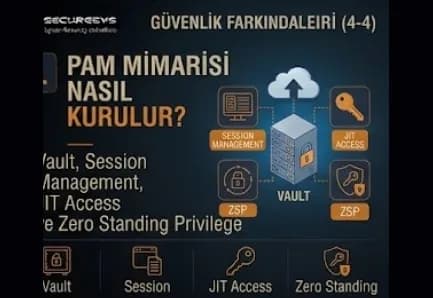
How Is a PAM Architecture Built? Vault, Session Management, JIT Access and Zero Standing Privilege
How is a PAM architecture built? Credential vault, session proxy, password rotation, JIT/JEA, Zero Standing Privilege, HA/DR and SIEM integration.
What Is IGA? Identity Governance and Administration, Access Review and Entitlement Management
What is IGA? A guide to entitlement management, access review, access certification, SoD, role mining and fighting permission creep.
What Are Passwordless Authentication and Passkeys? FIDO2, WebAuthn and Phishing-Resistant MFA
What are passwordless authentication and passkeys? FIDO2, WebAuthn, phishing-resistant MFA and protection against MFA fatigue and AiTM attacks.
What Is ITDR? Detecting Identity Attacks With Identity Threat Detection and Response
What is ITDR? Detecting identity attacks: account takeover, MFA fatigue, token theft, session hijacking and privilege escalation.
Looking for professional support on this topic?
Our expert team will reach out for a free consultation as soon as possible.