Black Box, Gray Box and White Box Penetration Testing
Three different starting points, three different perspectives. Which approach suits which system, and what each one reveals — with real-world scenarios.
Not every penetration test begins from the same starting point.
In some engagements the tester is given no information whatsoever about the organisation. In others, limited user credentials are shared. In some projects the entire system architecture, the user accounts and even the source code are handed to the testing team.
These different approaches have a direct bearing on the scope of the test, the methodology applied and the results obtained.
Under international standards, penetration tests are generally carried out using one of three approaches:
- Black Box
- Gray Box
- White Box
Each has a different purpose, and each delivers real security gains when applied to the right scenario.
Black Box Penetration Testing
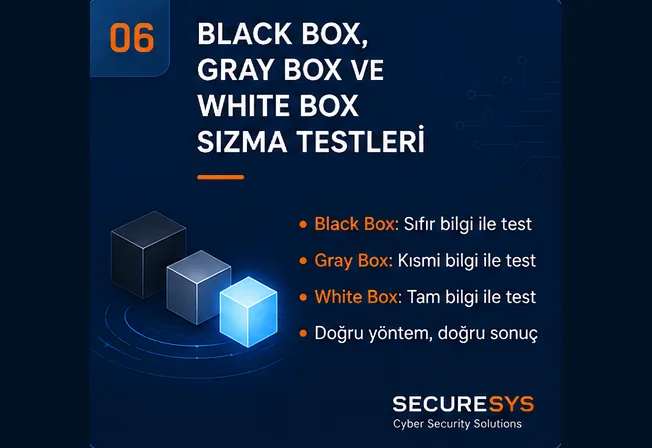
In the Black Box approach the tester is given no technical information about the system in advance.
The tester:
- Does not know the system architecture.
- Has no user account.
- Does not know the network topology.
- Has no access to source code.
- Cannot see server details.
The test begins entirely from the perspective of a genuine external attacker.
The first stage is reconnaissance. Open-source intelligence (OSINT), DNS records, subdomains, internet-facing services and other visible components are analysed. Attack scenarios are then applied on the basis of what that work turns up.
This method is highly effective for assessing the organisation's externally visible attack surface.
Advantages of Black Box Testing
- It simulates genuine attacker behaviour.
- It measures the security of internet-facing systems.
- It surfaces information leakage.
- It shows how prepared the organisation is for external threats.
Points to Bear in Mind
Reconnaissance in a Black Box test takes time. And because there is no access to certain internal systems, only the risks visible from outside can be assessed.
A Real-World Example
An attacker knows nothing about your company.
All they can see is your website.
They research the company on Google.
They look through the employees on LinkedIn.
They discover your subdomains.
They find your VPN login screen.
They notice that an old application is still exposed to the internet.
That is where they gain their first access.
A Black Box test simulates precisely that scenario.
Gray Box Penetration Testing
The Gray Box approach sits between Black Box and White Box.
The testing team is given limited information.
For example:
- A standard user account
- Test users
- Limited documentation
- Specific IP details
This method simulates the attacks a real attacker who has already got into the system — or a malicious insider — could carry out.
Gray Box testing is particularly well suited to:
- Customer portals
- Intranet applications
- ERP systems
- HR applications
- Dealer portals
Advantages of Gray Box Testing
- Authorisation controls can be examined in detail.
- Business logic vulnerabilities are easier to find.
- The testing window is used more efficiently.
- Internal user risk can be assessed.
- Genuine user scenarios can be applied.
A Real-World Example
Imagine an employee's username and password have fallen into an attacker's hands.
The attacker can now log into the system.
So what happens next?
Will they be able to see other users' data?
Will they be able to escalate their privileges?
Will they reach the administrative screens?
Will they get to other departments' records?
Gray Box testing sets out to answer exactly those questions.
White Box Penetration Testing
In the White Box approach the testing team is given comprehensive information about the system.
For example:
- Network architecture
- User accounts
- Administrator accounts
- Source code
- API documentation
- System architecture
- Server details
- Security policies
The aim is to examine the system in as much detail as possible and to identify vulnerabilities that might otherwise be missed.
This method is preferred in particular for:
- Critical public sector systems
- Financial institutions
- Software development processes
- Projects run alongside source code analysis
Advantages of White Box Testing
- Deeper technical analysis is possible.
- Hidden vulnerabilities can be identified.
- Risk can be assessed at code level.
- The testing window is used more efficiently.
- A higher coverage rate can be achieved.
A Real-World Example
Consider a newly developed internet banking application.
Before release:
- The software architecture is examined.
- The API documentation is shared.
- Test users are created.
- The source code is analysed.
- The administration panel is tested.
The aim is not to perform reconnaissance like an attacker but to assess the entire system for security down to the finest detail.
That is what the White Box approach is for.
Which Method Is Better?
There is no single correct answer to that question.
The best method is the one that matches the organisation's needs and the purpose of the test.
| Test Approach | When Is It Preferred? |
|---|---|
| Black Box | To measure how resilient internet-facing systems are to external attack |
| Gray Box | To assess authorisation and business logic controls in systems reachable by authenticated users |
| White Box | For critical systems, development processes, or projects requiring in-depth security analysis |
Many mature organisations do not settle for a single method. They use all three approaches together, in different periods or across different systems, to arrive at a more comprehensive security assessment.
The SecureSys Approach
At SecureSys we begin every project by analysing the organisation's needs, its system architecture and the objectives set for the test. We then recommend whichever of the Black Box, Gray Box or White Box methodologies fits best — or a combination of them where that is the right answer.
Our aim is not simply to list vulnerabilities. It is to simulate genuine attack scenarios, set out the risks the organisation actually faces in concrete terms, and offer improvements that can be put into practice.
The success of a penetration test is not determined by methodology alone. The knowledge, the experience and the internationally recognised competencies of the team carrying out the work matter just as much as the method used.
← Previous chapter: Social Engineering: A Chain of Attacks That Starts With One Click
Next chapter → What Should a Penetration Tester Know? Competencies and Certifications
Related Articles
Penetration Testing

Why Is Penetration Testing Necessary?
Why does the attack surface keep growing in a digital organisation, and why are security products not enough on their own? The case for verifying from an attacker's perspective.
What Is Penetration Testing?
The definition, the purpose, and how it differs from a vulnerability scan — what it delivers to the organisation and what it means for decision-makers and engineers.
Types of Penetration Testing
Web, API, mobile, internal and external network, Active Directory, wireless, cloud, OT/ICS, social engineering, DDoS, VoIP and continuous assessment — the scope, methodology and deliverables of each.
How Is the Scope of a Penetration Test Determined?
Which systems are in, which are out, and why that decision drives budget, duration and the quality of the findings — plus the five mistakes made most often.
Social Engineering: A Chain of Attacks That Starts With One Click
A real attack chain that began with a single email, the role of the human factor, and the measurable value of awareness work.

What Should a Penetration Tester Know? Competencies and Certifications
Two specialists using the same tool can reach entirely different results. The technical competencies, the internationally recognised certifications, and why a certificate alone is not enough.
Looking for professional support on this topic?
Our expert team will reach out for a free consultation as soon as possible.