Choosing the Right Penetration Testing Partner
The questions to ask before you buy: methodology, the manual-to-automated ratio, team experience, report quality and re-test. Plus why security is a process, not a product.
Why Does Choosing the Right Penetration Testing Partner Matter So Much?

Cyber security investment takes on meaning not through the technology purchased but through the specialists who assess that technology properly. In the same way, penetration testing is not a technical service consisting of automated tools being run. A genuine penetration test is a comprehensive security assessment that brings together the attacker's perspective, technical expertise, sector experience and international methodology.
When buying penetration testing services, organisations should therefore consider not only price but the knowledge of the team delivering the work, the methodologies they apply, the quality of their reporting and their project experience.
Choosing the right partner affects not just whether today's vulnerabilities are found, but how the organisation's cyber security maturity develops over the long term.
What Should You Expect From a Professional Penetration Testing Service?
The answers to the following questions should always be weighed before buying.
Does the methodology used meet international standards?
Professional work should be carried out in line with internationally recognised methodologies such as:
- OWASP Web Security Testing Guide
- OWASP API Security Top 10
- PTES
- NIST SP 800-115
- OSSTMM
Is the testing carried out with automated tools alone?
Automated security scanners provide valuable support.
But:
- Business logic vulnerabilities
- Authorisation errors
- Chained attacks
- Business logic weaknesses
- Complex API vulnerabilities
can usually be uncovered only through manual analysis.
A professional penetration test must combine automated analysis with expert assessment.
Does the team have enough experience?
Technical certifications matter.
But real project experience is worth at least as much.
Teams that have worked on projects across sectors such as:
- Finance
- Public sector
- Defence industry
- Energy
- Healthcare
- Manufacturing
- Telecommunications
can deliver a more comprehensive assessment against a wider range of attack scenarios.
Can the report be acted on?
A good report does not simply list vulnerabilities.
It also:
- Explains the risk levels.
- Provides technical evidence.
- Includes remediation recommendations.
- Sets priorities.
- Offers a summary assessment for management.
Technical teams and executives can then both work from the same document.
Is a re-test service offered?
Verification testing carried out after the vulnerabilities have been closed shows whether the remediation really worked.
The re-test process is therefore an important indicator of quality in a professional service.
The SecureSys Approach
At SecureSys we regard penetration testing not as a security check but as a strategic process that strengthens an organisation's digital resilience.
We bring to every project:
- Scope analysis,
- Risk assessment,
- A test plan aligned with international methodologies,
- Manual and automated security analysis,
- Verified findings,
- Executive and technical reports,
- Remediation advice,
- Re-test service.
Our aim is not simply to point out vulnerabilities but to help organisations manage the risks they represent.
Why SecureSys?
We have delivered a great many security assessment projects across sectors ranging from public bodies to financial institutions, from the defence industry to manufacturing plants, and from energy companies to e-commerce platforms.
Our team holds international technical certifications including:
- OSCP
- OSWE
- OSEP
- OSCE
- eWPTX
- LPT
- OSWP
- CEH
Our projects are grounded in international standards; we verify every finding and offer our clients recommendations they can put into practice.
As an organisation authorised by TSE, we also deliver security assessment services using methodologies aligned with national and international standards.
Cyber Security Is a Process, Not a Product
No security product protects an organisation on its own.
Firewalls…
EDR solutions…
WAF systems…
SIEM platforms…
Cloud security services…
All of these are important parts of a security architecture.
But the only way to know how secure they really are is to test them against genuine attack scenarios.
That is precisely why penetration testing is not merely an audit activity but one of the cornerstones of a security culture that keeps developing.
The purpose of security is not only to block attacks, but to discover the weak points before an attacker does and take the necessary measures in time.
In Closing
Throughout this guide we have looked at penetration testing not as a technical service but as an important part of risk management, business continuity and corporate security.
With properly planned, regularly repeated penetration testing, organisations can:
- Protect their digital assets more effectively,
- Verify the effectiveness of their security investment,
- Support their regulatory compliance work,
- Prevent potential data breaches,
- Improve their cyber resilience.
Cyber threats keep evolving.
Vulnerabilities change every day.
But one thing does not change:
A vulnerability discovered by an attacker is a risk. A vulnerability discovered by you strengthens your security.
📞 Get in Touch With SecureSys
To find out more about penetration testing, Red Team engagements, source code analysis, API security, mobile application security and our other cyber security services tailored to your organisation, please contact our team.
"Let's discover your vulnerabilities together, before a real attacker does."
← Previous chapter: Penetration Testing Regulations and Standards
Service page → Penetration Testing Service
Related Articles
Penetration Testing
Why Is Penetration Testing Necessary?
Why does the attack surface keep growing in a digital organisation, and why are security products not enough on their own? The case for verifying from an attacker's perspective.
What Is Penetration Testing?
The definition, the purpose, and how it differs from a vulnerability scan — what it delivers to the organisation and what it means for decision-makers and engineers.
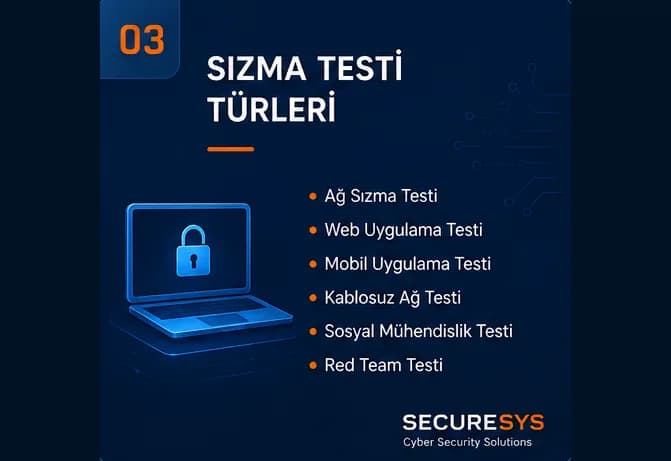
Types of Penetration Testing
Web, API, mobile, internal and external network, Active Directory, wireless, cloud, OT/ICS, social engineering, DDoS, VoIP and continuous assessment — the scope, methodology and deliverables of each.
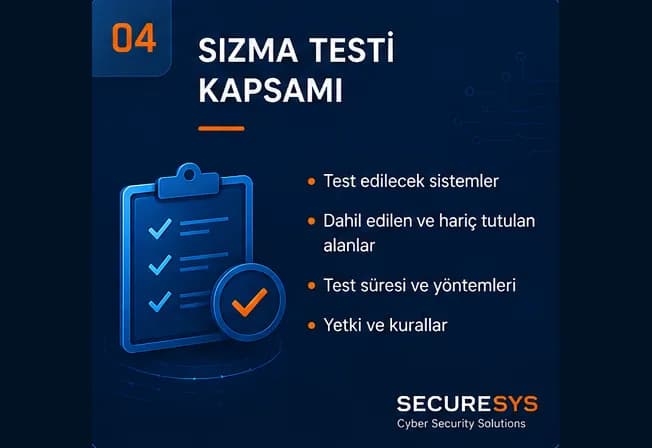
How Is the Scope of a Penetration Test Determined?
Which systems are in, which are out, and why that decision drives budget, duration and the quality of the findings — plus the five mistakes made most often.
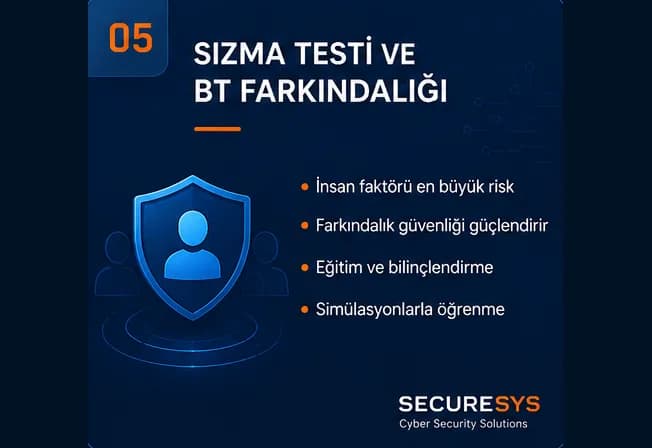
Social Engineering: A Chain of Attacks That Starts With One Click
A real attack chain that began with a single email, the role of the human factor, and the measurable value of awareness work.
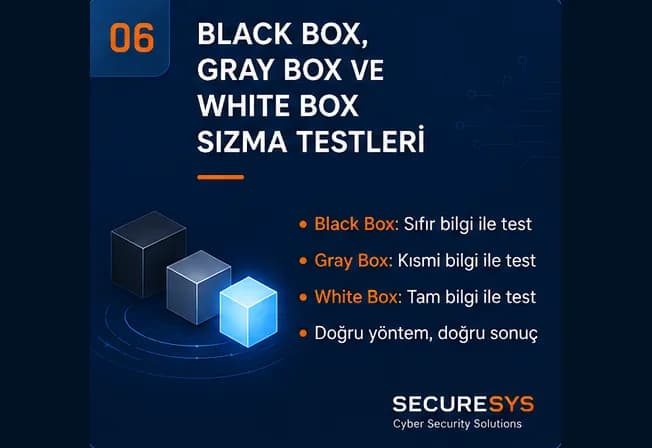
Black Box, Gray Box and White Box Penetration Testing
Three different starting points, three different perspectives. Which approach suits which system, and what each one reveals — with real-world scenarios.
Looking for professional support on this topic?
Our expert team will reach out for a free consultation as soon as possible.