What Is Lateral Movement? How Does an Attacker Move Through a Corporate Network?
The real risk of an attack emerges not at initial access but in how far the attacker can move inside the network. This chapter covers RDP, SMB, WinRM, pass-the-hash, network segmentation, PAM and Zero Trust.
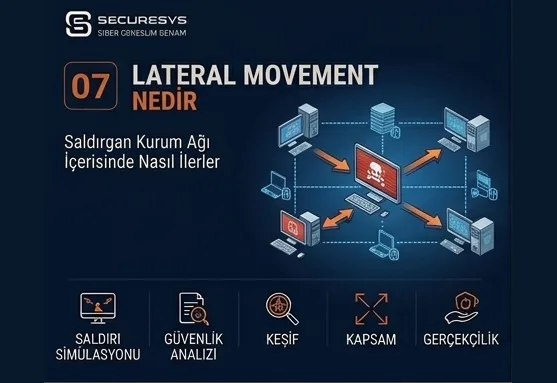
An attacker gaining their first access to a corporate network rarely means they have reached the final objective.
The first system compromised is usually an ordinary employee computer, a user account with limited privileges or a particular application. Critical data, administrator accounts, databases, file servers and business-critical systems sit elsewhere on the network.
The attacker therefore has to progress from one system to another.
In cyber security literature this behaviour is called lateral movement.
Lateral movement is the process by which a threat actor uses the first system or user account they compromised to move towards other systems, accounts or service resources within the corporate network.
This movement can be achieved by taking advantage of factors such as;
valid user accounts,
faulty permissions,
remote management services,
shared administrator accounts,
weak network segmentation,
service accounts,
credential exposure.
Any of these can open a route.
Lateral movement is one of the most critical stages of the attack chain in Red Team operations.
Because the real question is this:
Once an attacker compromises the first system, how far can they progress inside the corporate network?
The answer concerns not only endpoint security, but Active Directory, identity security, network segmentation, PAM, EDR/XDR and SOC visibility as well.
What Is Lateral Movement?
Lateral movement describes the attacker widening their reach by moving from the system they first accessed to other systems.
The attacker may, for example, have first compromised a standard user computer.
At that point they may have no direct access to the critical ERP server or the domain controller.
But the compromised user may hold;
access to other servers,
shared folder permissions,
remote desktop rights,
local administrator privileges,
service account connections.
Every one of those is a potential step.
The attacker evaluates these relationships and tries to move to other systems on the network.
A simple attack route might look like this:
User Computer
↓
File Server
↓
Application Server
↓
Service Account
↓
Management Server
↓
Critical System
This entire chain can be part of the lateral movement process.
Why Is Lateral Movement So Dangerous?
Initial access is usually limited.
Lateral movement grows the attacker's sphere of influence.
If the attacker remains on a single user computer, the risk may be limited.
But if the same attacker can reach;
file servers,
databases,
backup systems,
the domain management infrastructure,
ERP servers,
cloud management platforms,
the impact of the incident grows dramatically.
The real risk of an attack therefore usually emerges not at initial access, but in how far the attacker can move sideways.
What Is the Difference Between Lateral Movement and Privilege Escalation?
These two concepts are frequently confused.
Privilege escalation is the attacker's attempt to obtain higher privileges than their current account provides.
Lateral movement is the attacker moving to other systems or accounts.
For example;
going from a standard user to a local administrator may be privilege escalation.
Using that same account to move to another server may be lateral movement.
In real attacks these two processes usually feed one another.
The attacker moves to a new system.
On that system they obtain higher privileges.
With those privileges they move to another system.
Then they collect new credentials.
And so the attack chain grows.
What Does an Attacker Look for Before Lateral Movement?
An attacker generally does not connect to systems at random.
They first try to understand the environment.
This stage is called discovery.
The attacker may look for answers to questions such as:
Which domain am I in?
Which systems are on the network?
Which user account do I hold?
Which resources can this user reach?
Which servers are critical?
On which systems do I have administrator rights?
Which users hold high privileges?
Which remote management services are available?
This information forms a route for lateral movement.
Discovery activity can therefore be an early warning signal for the SOC.
Why Are Valid Accounts Critical for Lateral Movement?
Within MITRE ATT&CK, the abuse of valid accounts plays an important role in many attack chains.
When the attacker holds a genuine user account, connections made to other systems can look legitimate at first glance.
The user may, for instance, be able to access;
a file server,
an application server,
a remote management system.
The attacker can use the same identity.
The difficulty here is this:
Technically the authentication succeeds.
But the person making the access may not be the real user.
Controls such as identity security, behavioural analysis and conditional access therefore matter not only at initial access but during lateral movement too.
Why Do Remote Services Matter?
Corporate environments use many remote services for management and access.
For example;
Remote Desktop Protocol (RDP),
Windows Remote Management (WinRM),
SMB,
SSH,
remote management tools
are all part of legitimate IT operations.
But when misconfigured or opened up to overly broad access, these services can become lateral movement tools for an attacker.
From a security perspective the core question is therefore not:
“Is this service open?”
The more important question is:
“Who can reach where, from which system, through which service?”
RDP Lateral Movement Risk
Remote Desktop Protocol (RDP) is a protocol widely used for remote access to Windows systems.
Administrators or support teams may use RDP in corporate environments.
But;
granting RDP rights to very broad user groups,
not using MFA,
a lack of network segmentation,
using highly privileged accounts on standard systems
can all increase the risk.
Once an attacker obtains a valid user account they may try to reach other systems over RDP.
RDP access should therefore be restricted as far as possible and monitored.
Why Does SMB Matter for Lateral Movement?
Server Message Block (SMB) is one of the protocols widely used for file and resource sharing in Windows environments.
SMB may be necessary for corporate operations.
But faulty permissions can create unexpected access to;
shared folders,
administrative shares,
remote system resources.
None of it intended.
From the attacker's perspective SMB is not merely a file access protocol.
It can also be a component that reveals information about the systems and access relationships on the network.
Restricting SMB access on a segment and user basis is therefore important.
What Is WinRM?
Windows Remote Management (WinRM) is a technology that allows Windows systems to be managed remotely.
IT teams may use it for legitimate administrative purposes.
But if an attacker holds a valid user or administrator privilege, services like WinRM can be considered for moving through the network.
The security of remote management services is therefore not limited to a firewall rule.
Identity management,
authorisation,
PAM,
logging,
SOC monitoring
must be considered together.
Pass-the-Hash and Lateral Movement
One of the historically important attack techniques in Windows networks is the pass-the-hash method.
In this approach the attacker may try to abuse authentication material without always needing the plaintext password.
The reason such techniques matter for lateral movement is that they let the attacker use the same identity on different systems.
Using the same local administrator password across multiple systems in particular can raise the risk severely.
Solutions such as Windows LAPS (Local Administrator Password Solution) are therefore important in modern Windows environments.
Using a different local administrator password for each endpoint can reduce the attacker's ability to progress to dozens of systems with a single credential.
Why Are Shared Local Administrator Accounts Dangerous?
One of the critical legacy mistakes in many organisations is using the same local administrator account across multiple computers.
Hundreds of computers may carry the same:
localadmin
account and the same password.
If an attacker obtains that credential on a single computer they can try it on the others.
In that case the compromise of one system can put a great many endpoints at risk.
For this reason;
unique local administrator passwords,
LAPS,
least privilege,
restricting local admin access
are critically important in reducing lateral movement risk.
Why Is Credential Dumping Linked to Lateral Movement?
On a system they have compromised, an attacker may try to find new user identities.
This process falls under credential access.
The aim is to reach authentication material such as;
passwords,
hashes,
tokens,
tickets,
session information.
Anything that proves identity.
If the attacker obtains a credential belonging to another user, an opportunity to access new systems arises.
Credential access and lateral movement are therefore linked in most attack chains.
From the defensive side, reducing credential exposure on endpoints is extremely important.
Why Should High-Privilege Users Not Sign In on Standard Computers?
If a Domain Admin or highly privileged system administrator signs in on an everyday user computer, the compromise of that device can create serious risk.
Highly privileged accounts should therefore not be used for;
email,
web browsing,
standard office tasks.
Those belong to ordinary accounts.
Highly privileged administrative work should where possible be carried out through;
Privileged Access Workstations (PAW)
or dedicated management systems.
This approach can significantly reduce lateral movement risk.
Does Network Segmentation Stop Lateral Movement?
Network segmentation is one of the most important security controls for reducing lateral movement risk.
The aim is to stop the corporate network being a single flat structure.
For example;
user VLANs,
server networks,
management networks,
database segments,
OT/ICS networks,
backup systems
can all be separated from one another.
Only necessary traffic should be permitted between these segments.
When an attacker compromises a user computer they should not be able to reach the whole network directly.
What Is a Flat Network and Why Is It Risky?
A flat network describes a network structure in which different systems can reach one another with very little segmentation.
In structures like this the attacker can see a very wide group of systems after initial access.
From a user computer, for instance;
servers,
databases,
backup infrastructure,
management services
may all be directly reachable.
This makes lateral movement easy.
Approaches such as microsegmentation and Zero Trust Network Access have therefore gained importance in modern security architectures.
Is Network Segmentation Enough on Its Own?
No.
This is an important point.
An organisation may have excellent network segmentation.
But if the same highly privileged user account can reach systems in different segments, the attacker can progress through the identity instead.
Not only network segmentation but also identity segmentation is therefore required.
For example;
user accounts,
server management accounts,
Domain Admin accounts,
backup administrator accounts
must be separated from one another.
This approach makes it far harder for an attacker to move widely on a single credential.
How Does PAM Reduce Lateral Movement Risk?
Privileged access management (PAM) is a security approach that allows highly privileged accounts to be managed under control.
Through PAM;
administrator passwords can be protected centrally,
access can be made time-bound,
sessions can be recorded,
high privileges need not sit permanently with a user,
privileged activity can be monitored.
Each of these narrows the attacker's options.
PAM matters greatly for lateral movement.
Because one of the assets attackers hunt for most is highly privileged credentials.
PAM can reduce the unnecessary circulation of those credentials on endpoints and in users' daily activity.
What Is Just-in-Time Access?
Just-in-time (JIT) access is the approach of granting users high privileges only for the period they are needed, rather than permanently.
Instead of a system administrator being a Domain Admin 24/7, for example, they can hold the privilege for 30 minutes for a particular task.
This approach reduces the attack surface.
Because the attacker will not find standing high privileges on the account they compromise.
JIT access and PAM are therefore important parts of modern privileged access architecture.
How Does Zero Trust Affect Lateral Movement?
The core principle of the Zero Trust approach is:
Never trust, always verify.
In other words, a user or device is not automatically considered trustworthy simply because it sits inside the network.
Every access is evaluated against factors such as;
identity,
device state,
location,
risk level,
resource sensitivity.
Nothing is assumed.
This approach matters particularly for reducing lateral movement risk.
Because the attacker having entered the internal network does not mean they can reach every resource.
The Relationship Between Lateral Movement and Active Directory
In Microsoft-based environments, lateral movement is usually shaped by Active Directory relationships.
The attacker can look for access routes to different systems by analysing;
group memberships,
local admin relationships,
service accounts,
delegations,
ACLs,
session relationships.
The map is already there to read.
Attack path analysis is therefore important not only for privilege escalation but for lateral movement too.
Knowing in theory which system an attacker could move to from which other system is a major advantage for the defence.
How Is BloodHound Used in Lateral Movement Analysis?
Graph-based Active Directory analysis tools such as BloodHound can make the connections between users, computers and permission relationships visible.
For example;
User A
may be a local admin on one computer.
On that same computer;
User B
may have signed in with high privileges.
And User B may be an administrator on another server.
This relationship can be difficult to spot manually.
Graph-based analysis makes the attack route far easier to see.
Tools of this kind should therefore be used not only by Red Teams but also by defensive teams for attack path management.
How Does a SOC Detect Lateral Movement?
Detecting lateral movement behaviour is not easy.
Because the attacker usually uses legitimate protocols already in use within the organisation.
RDP is normal.
SMB is normal.
WinRM is normal.
PowerShell is normal.
The problem is not the presence of the protocol, but its unusual use.
The following signals can be valuable for a SOC:
a user accessing a server they do not normally connect to,
authentication to many systems in a short period,
an ordinary employee using management protocols,
a direct connection from a workstation to a critical server,
unusual administrative share access,
a highly privileged account appearing on an unexpected endpoint.
Lateral movement detection therefore mostly requires behavioural analysis.
How Do EDR/XDR See Lateral Movement?
Modern EDR and XDR solutions can analyse endpoint;
process behaviour,
network connections,
authentication activity,
script usage,
credential access.
All of it as telemetry.
But having an EDR installed does not on its own guarantee the attack will be stopped.
Policy configuration,
telemetry quality,
SOC integration,
detection engineering
must be evaluated together.
In Red Team operations the question asked is therefore not just “is there an EDR?”.
“Did the EDR see this attacker behaviour?”
is the question that matters.
Why Are SIEM and Correlation Critical?
In lateral movement attacks a single event is not always meaningful.
For example;
an RDP connection may be normal.
An SMB connection may be normal.
An authentication event may be normal.
But if the same user;
connects to ten different servers within five minutes,
then reaches a critical management system,
then performs unexpected privileged activity,
these events become far more meaningful together.
This is where the core strength of a SIEM appears:
Correlation.
Relating security data from different sources makes the attack chain visible.
Detection Engineering and Lateral Movement
Detection engineering teams can develop detection scenarios for specific lateral movement techniques.
For example;
RDP usage patterns,
SMB connections,
remote service activity,
authentication behaviour,
movements of highly privileged accounts
can all be analysed.
Using MITRE ATT&CK mapping, it becomes possible to measure which lateral movement techniques the organisation can detect.
This approach helps build detection coverage.
What Does a Red Team Measure in Lateral Movement Testing?
In a professional Red Team operation the aim is not merely to move to another server.
These questions should also be measured:
Did network segmentation prevent the movement?
Did PAM protect the highly privileged account?
Did the EDR see the behaviour?
Did the SIEM raise a meaningful alert?
Did the SOC notice the attack?
Did identity security detect the anomalous authentication?
At which point was the attack stopped?
Which systems could the attacker reach?
These questions turn lateral movement testing into genuine security validation.
What Should Be Done to Reduce Lateral Movement Risk?
Organisations should not rely on a single product to reduce lateral movement risk.
A layered approach is required.
In particular;
Network Segmentation
User, server and critical system networks must be separated.
Identity Segmentation
Standard and highly privileged accounts must be kept apart.
Least Privilege
Users should hold only the privileges they need.
PAM
Highly privileged accounts must be managed centrally and under control.
LAPS
Local administrator passwords must be unique per system.
MFA
Critical administrative access must be protected with strong authentication.
EDR/XDR
Endpoint behaviour must be monitored.
SIEM
Authentication and network activity must be correlated.
Active Directory Hardening
Attack paths and privilege relationships must be analysed regularly.
Red Team / Purple Team
Whether the controls work against real attack techniques must be tested.
What Is Microsegmentation?
Traditional network segmentation is usually implemented through VLANs and firewall rules.
Microsegmentation takes segmentation to a far more granular level.
Two systems on the same server network may not need to reach one another directly, for example.
The microsegmentation approach permits only the traffic actually required between systems.
This model can make it much harder for an attacker to move freely to other servers after compromising one.
It is an important security approach in large data centre and cloud environments in particular.
Lateral Movement and Ransomware
Lateral movement is a particularly critical stage in ransomware attacks.
An attacker encrypting only a single user computer may have limited impact.
But if the attacker can reach;
the domain environment,
file servers,
backup systems,
critical applications,
the impact of the attack can be far greater.
In many advanced ransomware operations attackers therefore spend a long period performing reconnaissance and lateral movement inside the environment before the encryption stage.
This makes lateral movement testing important in ransomware readiness assessments and Red Team work.
Why Are Backup Systems a Lateral Movement Target?
One of the most critical targets for attackers can be the backup infrastructure.
Because an organisation's ability to carry out a successful incident response usually depends on clean backups.
If the attacker can reach backup management systems they can;
delete the backups,
render them inaccessible,
break the recovery capability.
Any of these turns an incident into a crisis.
The backup management network and backup administrator accounts should therefore be separated as far as possible from other systems.
Backup security is no longer merely a data protection topic; it is directly a cyber resilience topic.
Lateral Movement and Cyber Resilience
Lateral movement is not only about the attacker's freedom of movement.
It also shows the organisation's level of cyber resilience.
In an ideal security architecture, even if the attacker gains initial access, controls such as;
network segmentation,
identity separation,
EDR,
PAM,
MFA,
the SOC
should make their progress difficult.
This approach limits the impact in cases where the attack cannot be prevented entirely.
It is often called blast radius reduction.
How Should Lateral Movement Be Presented in a Red Team Report?
Lateral movement findings should not be reported through technical commands or the tools used alone.
What really matters for management is the attack route.
The report can show a visual attack path such as;
First User
↓
Workstation
↓
Local Admin Rights
↓
Application Server
↓
Service Account
↓
Backup Management System
with each hop clearly marked.
For every step the report should explain;
which security control was missing,
at which point an alert fired,
at which point the SOC detected it,
which improvement could break the attack chain.
This approach makes the report understandable to management as well as to technical teams.
Conclusion: Can You Stop the Attacker Inside?
For many years the corporate cyber security approach focused largely on perimeter security.
Separating outside from inside with a firewall was the basic defence model.
Today, because of cloud, remote work and identity-based access, that boundary has become increasingly blurred.
The critical question is therefore no longer only:
“Can the attacker get in?”
The more important question is:
“If they get in, how far can they go?”
Lateral movement answers that question.
Even if an attacker compromises the first endpoint, if they;
cannot see other systems,
cannot find highly privileged credentials,
cannot reach management services,
are stopped by network segmentation,
are detected early by the SOC,
the organisation's blast radius is significantly reduced.
The purpose of a strong corporate defence is therefore not only to prevent initial access.
It is to make it hard for the attacker to reach critical systems even after that first foothold.
Red Team, Purple Team and lateral movement tests are used to measure whether this defence actually works.
But reaching new systems is not enough for the attacker.
The next step is usually to obtain a stronger identity.
Going from standard user to local administrator, from local administrator to a privileged account or to critical administrative rights can multiply the impact of the attack.
The name of that process is:
Privilege escalation.
Related Articles
Red Teaming & Threat Intelligence
What Is Red Teaming? Simulating a Real Cyber Attack
Red Teaming measures an organisation's resilience across people, process and technology by simulating a real attacker's tactics and techniques under control. In this chapter we walk through the stages of a Red Team operation using a real-world scenario.
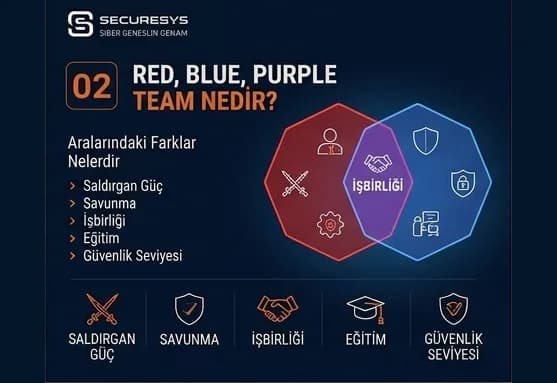
What Are Red Team, Blue Team and Purple Team? How Do They Differ?
The Red Team simulates the attack, the Blue Team runs the defence, and the Purple Team combines both to improve detection capability. This chapter covers the three roles, detection engineering and MITRE ATT&CK coverage analysis.
How Is a Red Team Operation Planned? Scope, Objectives and Rules of Engagement
A Red Team operation begins with correct planning, not with attack tools. This chapter covers objective setting, crown jewels, scope, rules of engagement, the White Team and stop conditions.
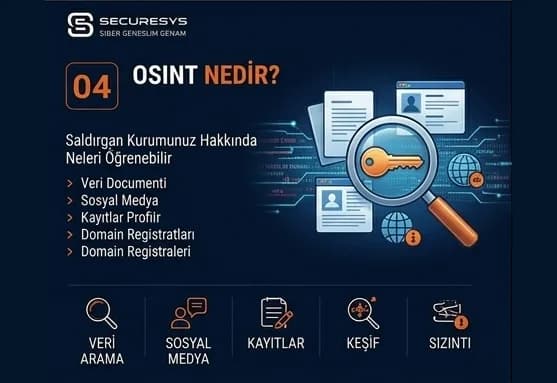
What Is OSINT? What Can an Attacker Learn About Your Organisation?
Attackers get to know an organisation before touching a single system. This chapter examines how open source intelligence — from domains and certificate transparency to LinkedIn and leaked credentials — builds a corporate attack surface.
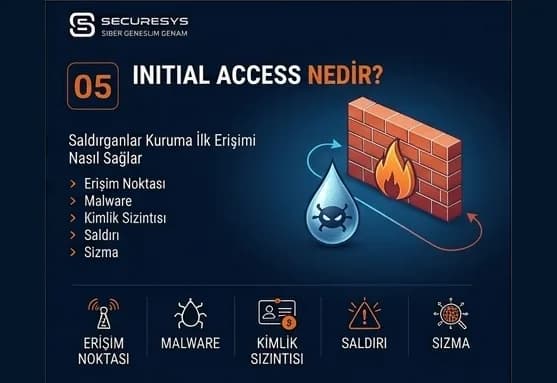
What Is Initial Access? How Do Attackers Gain Their First Foothold?
Initial access is the door to the attack, not its end. This chapter examines initial access methods — from phishing and valid accounts to internet-facing applications and the supply chain — along with the initial access broker ecosystem.
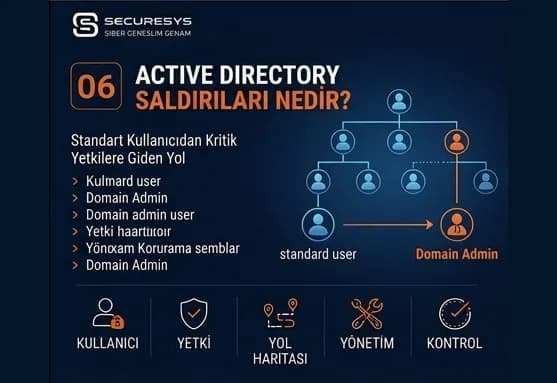
What Are Active Directory Attacks? The Path from Standard User to Critical Privileges
In Active Directory the real danger is not a single vulnerability but the route between them. This chapter covers Kerberos attacks, service accounts, ACL and delegation risks, and attack path analysis.
Looking for professional support on this topic?
Our expert team will reach out for a free consultation as soon as possible.