What Is Cyber Threat Intelligence (CTI)? Who Is Targeting Your Organisation?
Not every threat matters equally to you. This chapter covers the four levels of threat intelligence, the difference between IOCs and TTPs, the intelligence lifecycle and the threat-informed defense approach.
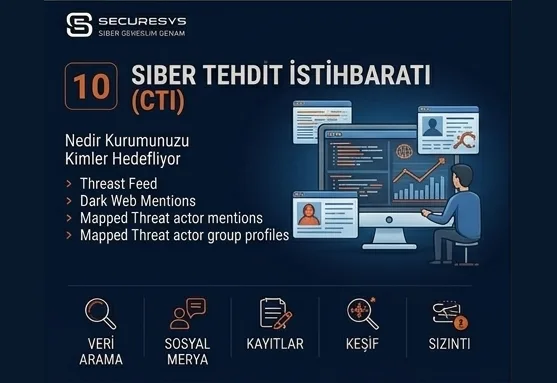
However strong an organisation's cyber security infrastructure is, the defence usually remains incomplete if the answers to these questions are unknown:
Who is targeting us?
Why are they targeting us?
Which techniques do they use?
Which of our systems do they consider most valuable?
Which IPs, domains, malware or infrastructure do the attackers use?
Which threat actors are most active in our sector?
The field that tries to produce answers to these questions systematically is cyber threat intelligence (CTI).
Cyber threat intelligence does not consist merely of malicious IP addresses or IOC lists.
A genuine CTI approach aims to produce actionable intelligence for the organisation's security teams by analysing;
- threat actors,
- attacker motivations,
- attack campaigns,
- the TTPs in use,
- targeted sectors,
- malware families,
- command & control infrastructure,
- data leaks,
- dark web activity,
- current attack trends.
All of it interpreted in context.
The core purpose of threat intelligence is therefore not to collect more data, but to understand which threat genuinely matters to the organisation.
What Is Cyber Threat Intelligence?
Cyber threat intelligence (CTI) is the process of collecting, verifying, analysing and turning data about existing or potential cyber threats into information on which decisions can be made.
The critical word here is intelligence.
Not every piece of data is intelligence.
For example:
The information that the address 185.x.x.x is malicious is a data point.
The information that this IP is used in the command & control infrastructure of a particular malware family is more meaningful.
Associating that same infrastructure with a threat actor recently targeting the finance sector approaches the level of intelligence.
The real question for the organisation is this:
“What does this information mean for us?”
That is precisely where the value of threat intelligence appears.
The Difference Between Threat Data and Threat Intelligence
This distinction is very important.
A security system can produce millions of data points.
Firewall logs,
EDR telemetry,
DNS records,
IOC feeds,
dark web data,
malware analysis,
phishing domains
can all be collected continuously.
But none of this data is intelligence on its own.
Take a simple example:
Data
An IP address has been flagged as malicious.
Information
This IP belongs to a particular C2 server.
Intelligence
This C2 infrastructure is being used in a threat campaign recently targeting the finance sector and is also showing activity in your organisation's region.
The third piece lets the security team make a decision.
For example;
the IOC can be blocked,
historical logs can be searched in the SIEM,
hunting can be carried out in the EDR,
a detection rule can be developed for the relevant TTP.
At this point the data becomes actionable intelligence.
What Is a Threat Actor?
A threat actor is the person, group or organisation carrying out or supporting a cyber attack.
Threat actors can have very different motivations.
They may attack for reasons such as;
financial gain,
espionage,
political objectives,
hacktivism,
sabotage,
data theft,
competitive advantage.
The motive shapes the behaviour.
Treating every attacker as a single category is therefore wrong.
The behaviour model of a ransomware group may not be the same as that of a state-sponsored APT group.
That difference changes the defensive strategy too.
What Is an APT?
Advanced persistent threat (APT) is a term used to describe threat actors that generally possess high capability and carry out long-term, targeted attacks.
APT operations often include stages such as;
prolonged reconnaissance,
targeted phishing,
custom malware,
credential theft,
persistence,
lateral movement,
data exfiltration.
Each stage is deliberate and patient.
But the term “APT” should not be used loosely for every advanced attack.
It is generally reserved for a particular organisation, state-sponsored group or long-running threat operation.
Threat intelligence teams can track APT groups';
TTPs,
the infrastructure they use,
the sectors they target,
their geographic targets,
their malware families.
What Is Threat Actor Profiling?
Threat actor profiling is the systematic analysis of a threat actor's behaviour.
When building a profile, these questions can be assessed:
What is their motivation?
Which sectors do they target?
In which countries are they active?
Which methods do they use for initial access?
Which malware families are they associated with?
Which MITRE ATT&CK techniques do they use?
Which C2 infrastructure are they associated with?
From which targets do they steal data?
This information is extremely valuable for both Red Team and Blue Team.
Because the defence can be shaped around a real threat profile rather than theoretical threats.
What Are the Types of Threat Intelligence?
Cyber threat intelligence is generally handled at four main levels:
Strategic Threat Intelligence
Operational Threat Intelligence
Tactical Threat Intelligence
Technical Threat Intelligence
Each level serves a different audience and a different decision process.
What Is Strategic Threat Intelligence?
Strategic threat intelligence is broader-perspective intelligence aimed at senior management and decision makers.
At this level the focus is less on technical detail and more on;
sector threats,
geopolitical developments,
ransomware trends,
supply chain risks,
new attack models,
regulatory impacts.
The picture is deliberately wide.
For a board of directors, for example, this information is valuable:
“Identity-based attacks targeting the finance sector have risen markedly in recent months.”
On the strength of that information the organisation can prioritise investment in;
MFA,
ITDR,
PAM,
identity security.
Strategic intelligence guides decision makers rather than technical teams.
What Is Operational Threat Intelligence?
Operational threat intelligence provides information about specific attack campaigns and threat operations.
For example;
an active attack campaign,
the targeted sector,
the timing of the attack,
the infrastructure used,
the malware family,
the phishing theme
can all be assessed at this level.
Operational intelligence is particularly valuable for SOC, incident response and threat hunting teams.
The aim is to understand active or imminent threats.
What Is Tactical Threat Intelligence?
Tactical threat intelligence focuses on attacker behaviour, that is on the level of tactics, techniques and procedures (TTP).
If it is known that a threat actor;
uses phishing,
performs PowerShell-based execution,
carries out credential dumping,
uses RDP for lateral movement,
employs particular persistence methods,
that information falls within tactical intelligence.
One of the most important uses of tactical intelligence is detection engineering.
Because defensive teams can develop detections around the attacker's behavioural patterns.
What Is Technical Threat Intelligence?
Technical threat intelligence consists mostly of technical indicators.
For example;
IP addresses,
domains,
URLs,
file hashes,
malware signatures,
certificate fingerprints
can fall into this category.
These indicators are generally called indicators of compromise (IOC).
Technical intelligence can be used in systems such as;
firewalls,
SIEM,
EDR,
NDR,
DNS security.
But the useful life of technical indicators can sometimes be short.
An attacker can change an IP address or a domain.
IOCs alone are therefore not enough.
What Is an IOC?
An indicator of compromise (IOC) is a technical sign that may indicate the possibility of compromise on a system or network.
Examples of IOCs include;
a malicious IP,
a domain,
a URL,
a file hash,
an email address,
a certificate,
a registry artefact.
Each is observable and concrete.
IOCs are very valuable for rapid defensive action.
When a new IOC arrives, for example;
it can be checked on the firewall,
searched in proxy logs,
queried retrospectively in the SIEM,
hunted for on endpoints through the EDR.
This can help identify traces of past attacks.
What Is the Biggest Problem with IOCs?
IOCs can be changed easily.
An attacker can change the IP address they use today tomorrow.
They can buy a new domain.
They can recompile the malware file.
The hash changes entirely.
Defence based solely on IOCs is therefore a reactive security approach.
A stronger defence tries to understand the attacker's behaviour.
And that is where the concept of TTPs becomes important.
What Are TTPs?
Tactics, techniques and procedures (TTP) describe how threat actors carry out their attacks.
An attacker;
using targeted phishing,
running commands with PowerShell,
performing credential access,
carrying out lateral movement over RDP,
using DNS-based communication
forms a TTP profile.
TTPs can be longer-lived than IOCs.
Because an attacker can change an IP address easily, but changing operational habits is harder.
Modern threat intelligence is therefore increasingly moving towards a TTP-based detection approach.
Why Does MITRE ATT&CK Matter for Threat Intelligence?
MITRE ATT&CK is one of the important frameworks used to classify the attack techniques used by threat actors under a common language.
The techniques a threat actor uses at the;
initial access,
execution,
persistence,
privilege escalation,
credential access,
lateral movement,
command & control
stages can all be expressed through ATT&CK.
This allows the threat intelligence team and the SOC to speak the same language.
The CTI team can say:
“This threat actor uses these techniques.”
That is their contribution.
The SOC can then ask:
“Which of these techniques can we detect?”
And the Red Team can say:
“Let us simulate these techniques under control.”
This cycle is the foundation of the threat-informed defense approach.
What Is Threat-Informed Defense?
Threat-informed defense is the shaping of security strategy around the behaviour of real threat actors.
In the traditional approach an organisation may try to implement hundreds of different security controls.
Threat-informed defense asks a different question:
“Which techniques do the threat actors most likely to target us actually use?”
Priority then goes to those techniques.
If the most commonly used techniques in the organisation's sector are;
phishing,
valid accounts,
credential dumping,
PowerShell,
RDP,
C2 over HTTPS,
then detection and Red Team work can prioritise those areas.
This approach makes limited security resources go further.
How Do Threat Intelligence and Red Teaming Work Together?
Threat intelligence and Red Teaming are two important fields that complement one another.
The CTI team analyses real threats.
The Red Team simulates those threat behaviours under control.
The threat intelligence team may, for instance, identify the following behaviours in an attacker group targeting a particular sector:
Initial access: spear phishing
Execution: PowerShell
Credential access: credential dumping
Lateral movement: RDP
Persistence: scheduled task
C2: HTTPS
Using this TTP profile the Red Team can design a realistic adversary simulation for the organisation.
This approach can be called threat-led Red Teaming or threat-informed Red Teaming.
What Is Threat-Led Red Teaming?
Threat-led Red Teaming is the construction of attack scenarios in line with intelligence obtained about real threat actors.
The aim is not to try random attack techniques.
The aim is to test attacker behaviour that could genuinely target the organisation.
The threat profile of a financial institution may not be the same as that of an energy company.
The Red Team scenario must therefore vary by sector.
This makes the Red Team engagement more realistic and more meaningful for the business.
How Do Threat Intelligence and the SOC Work Together?
CTI should not be used merely to prepare a separate report and send it to the SOC.
A good threat intelligence programme must be integrated directly into SOC operations.
Suppose the CTI team receives information about a new threat actor.
That actor is known to use particular TTPs.
On the strength of that information the SOC can create;
SIEM queries,
EDR hunts,
detection rules,
network monitoring,
IOC searches.
Threat intelligence then turns directly into detection capability.
The Relationship Between Threat Hunting and Threat Intelligence
Threat hunting is the process of proactively searching an environment for attacker behaviour that has not yet raised an alert.
Threat intelligence is one of the most important inputs to that hunting work.
If the CTI team knows that a particular threat group uses;
certain PowerShell behaviour,
certain registry patterns,
certain DNS patterns,
certain authentication behaviour,
the threat hunting team can search historical telemetry for those behaviours.
This approach asks the question:
“No alert came in — but could the attacker already be inside?”
What Is a Threat Intelligence Platform (TIP)?
Large organisations may have many threat intelligence sources.
Threat intelligence platform (TIP) solutions can be used to manage that data centrally.
TIP platforms can provide functions such as;
IOC collection,
feed management,
deduplication,
enrichment,
confidence scoring,
indicator lifecycle,
integration with SIEM and other security systems.
All of it as a single pipeline.
But buying a TIP does not mean establishing a threat intelligence programme.
Technology is only the infrastructure.
The real value comes from analysts turning data into corporate context.
What Is a Threat Intelligence Feed?
A threat intelligence feed is a data stream through which threat indicators are shared regularly.
A feed may contain indicators such as;
malicious IPs,
domains,
URLs,
file hashes.
These arrive continuously.
Organisations can obtain feeds from different sources such as;
commercial feeds,
open sources,
sector sharing platforms,
their own SOC data.
But more feeds do not always mean more security.
Because low-quality or context-free IOCs can generate a great many false positives.
Feed quality, relevance and confidence therefore matter.
What Is a Confidence Score?
A confidence score can be used in threat intelligence systems to express the reliability of an indicator.
An IP reported by a single uncertain source does not carry the same weight as an IP that several reliable sources associate with the same threat actor.
IOCs can therefore be assessed against factors such as;
source reliability,
recency,
level of attribution,
number of observations.
This approach helps security teams prioritise more accurately.
Why Are False Positives a Problem for Threat Intelligence?
An IP address having been seen once in malicious activity does not always mean it is permanently bad.
Because of cloud services and shared hosting infrastructure, IPs can be used by different customers.
Domain reputation can likewise change over time.
Threat intelligence should therefore not be managed with straight automatic blocking logic.
Otherwise legitimate services can end up blocked.
The right approach is to take action by assessing;
confidence,
context,
asset criticality,
threat relevance
together.
What Is the Threat Intelligence Lifecycle?
Professional CTI programmes are usually managed through a threat intelligence lifecycle.
That cycle generally consists of the following stages:
1. Direction
The intelligence requirement is defined.
↓
2. Collection
The necessary data is gathered.
↓
3. Processing
The data is processed and normalised.
↓
4. Analysis
The data is analysed and interpreted.
↓
5. Dissemination
The intelligence is delivered to the relevant teams.
↓
6. Feedback
The usefulness of the intelligence is assessed and new requirements identified.
This cycle shows how threat intelligence differs from random data collection.
What Are Intelligence Requirements?
One of the most important steps in a threat intelligence programme is defining intelligence requirements.
The organisation can define these questions in advance:
Which threat actors target our sector?
Are our executive accounts being sold on the dark web?
Are there phishing domains imitating our brand?
Are there credential leaks belonging to our organisation?
Which ransomware groups are active in our sector?
Are the technologies we use being actively exploited?
These questions determine which data the threat intelligence team needs to collect.
What Are Priority Intelligence Requirements (PIR)?
Priority intelligence requirements (PIR) express the intelligence questions most important to the organisation.
One of a financial institution's PIRs might be:
“What are the current TTPs of ransomware groups targeting the finance sector and operating in Türkiye?”
For a defence company, meanwhile:
“What are the recent phishing and espionage techniques of APT groups targeting the defence industry?”
may matter more.
A threat intelligence programme should therefore not be designed identically for every organisation.
Where Does Dark Web Monitoring Sit in Threat Intelligence?
Dark web monitoring can be an important component of CTI programmes.
The aim is to track content such as;
corporate credential leaks,
data sale listings,
unauthorised access being sold,
forum discussions mentioning the organisation,
ransomware leak site posts.
All of it happening outside the perimeter.
But dark web monitoring is not threat intelligence on its own.
What is found must be verified and analysed in terms of corporate risk.
For example:
“Your company name appeared on a forum.”
is not meaningful in isolation.
These questions must be asked:
Who posted it?
What is being sold?
Is the data current?
Is it genuine?
Which system does it relate to?
Is action required?
What Is Credential Leak Monitoring?
Credential leak monitoring is the tracking of whether credentials belonging to employees or corporate accounts have appeared in data leaks.
This work can be carried out against;
email addresses,
usernames,
domain information.
Those are the search keys.
When a leaked credential is identified;
the account can be verified,
the password can be reset,
active sessions can be terminated,
MFA can be checked,
past logins can be examined in the SIEM.
Threat intelligence then turns directly into incident response action.
Brand Monitoring and Phishing Detection
Attackers can target not only corporate systems but the brand itself.
For example;
a domain resembling the company name,
a fake login page,
an imitation social media account,
a fake mobile application
can be created.
Brand protection and digital risk protection activities can therefore also be carried out within threat intelligence.
Phishing domain monitoring is an important security area for finance, e-commerce and large consumer brands in particular.
What Is Vulnerability Intelligence?
Threat intelligence does not consist of threat actor analysis alone.
Vulnerability intelligence helps assess whether the vulnerabilities in the technologies an organisation uses are being exploited by real attackers.
An organisation may have thousands of CVEs.
Closing them all at once may not be possible.
In that situation this question is more valuable:
“Is this vulnerability being actively used in attacks?”
This approach also forms the basis of risk-based vulnerability management (RBVM) processes.
When exploit activity, asset criticality and exposure are assessed together, patch prioritisation becomes far more accurate.
How Do Threat Intelligence and Vulnerability Management Come Together?
Classic vulnerability management mostly looks at CVSS scores.
But a high CVSS score does not always mean the highest real risk.
There may be a vulnerability with a CVSS of 9.8 that is not internet-facing and not being exploited.
Another CVE may carry a lower score yet be in active use in attacks.
Threat intelligence adds this information at that point:
“This vulnerability is being actively exploited by real threat actors.”
The organisation can then build a more accurate patch priority.
The Most Critical Link Between CTI and Red Teaming
If a Red Team thinks only in terms of “what attack could we perform?”, the result may be technically strong but not specific to the organisation.
CTI changes that approach.
The question asked becomes:
“What are the attackers who could genuinely target our organisation doing?”
That information is fed into the Red Team scenario.
If the threat actor uses;
phishing,
OAuth abuse,
credential theft,
RDP lateral movement,
HTTPS C2,
the Red Team can simulate those behaviours in a controlled way.
This gives the security team a far more realistic test.
How Do CTI and the Purple Team Work Together?
Threat intelligence surfaces particular TTPs.
The Red Team simulates those TTPs.
The Blue Team tries to detect them.
The Purple Team then improves what is missing.
The cycle runs as follows:
Threat Intelligence
↓
Threat Actor TTP
↓
Red Team Simulation
↓
Blue Team Detection
↓
Detection Gap
↓
Purple Team Improvement
↓
Retest
This structure is one of the strongest implementation models of threat-informed defense.
What Should a Threat Intelligence Report Contain?
A professional CTI report should be more than a table of IOCs.
Depending on the audience, it may contain the following areas:
Executive Threat Summary
A current risk summary for management.
Threat Actor Analysis
The actors targeting the organisation or its sector.
Campaign Analysis
Active attack campaigns.
TTP Analysis
Attacker behaviour mapped through MITRE ATT&CK.
IOC Analysis
Technical indicators.
Vulnerability Intelligence
Vulnerabilities under active exploitation.
Dark Web & Credential Exposure
Digital exposure belonging to the organisation.
Detection Recommendations
Recommendations for the SOC and detection engineering.
Red Team Recommendations
Attack scenarios that should be simulated.
This structure turns intelligence directly into operational security output.
How Is the Success of Cyber Threat Intelligence Measured?
The success of threat intelligence should not be measured by the number of IOCs collected.
“We received 500,000 IOCs this month.”
is not a meaningful success metric on its own.
More meaningful measurements might be:
How many critical threats were detected early?
How many detection rules were developed thanks to CTI?
How many risky credentials were identified?
How many active attack campaigns were spotted in advance?
How many threat hunting exercises were started from CTI?
How many critical CVEs were prioritised thanks to intelligence?
These metrics show the real security value of threat intelligence.
Why Does CTI Matter for Management?
Threat intelligence may look like a technical SOC function, but it is in fact of strategic importance to management.
Because CTI can answer these questions:
Is the threat level in our sector rising?
Which attack types are on the increase?
Which threat actors' target profile does our organisation match?
Which security investments should we prioritise?
Which critical business systems are at greater risk?
A good CTI programme should therefore build a bridge between technical teams and management.
Conclusion: Not Every Threat Matters Equally to You
Thousands of new IOCs, vulnerabilities, attack campaigns and malware samples appear in the cyber security world every day.
It is not possible for an organisation to give all of them the same priority.
The core question is therefore not:
“Which threats exist in the world?”
The better question is:
“Which threats genuinely matter to us?”
Cyber threat intelligence tries to answer that question.
The real value lies not in collecting more data, but in;
selecting the right data,
putting it in context,
relating it to the organisation's attack surface,
and turning it into action.
Each of those steps is deliberate.
A good threat intelligence programme does not merely send IOCs to the SOC.
It produces realistic attack scenarios for the Red Team.
It provides hypotheses for threat hunting teams.
It brings prioritisation to vulnerability management processes.
And it gives management the strategic visibility to understand future cyber risk.
In the modern security approach, Red Teaming and cyber threat intelligence are therefore not two separate functions but two capabilities that strengthen one another.
But one of the most striking areas of threat intelligence remains the invisible risks in the outside world.
Leaked corporate accounts.
Stolen passwords.
Company access put up for sale.
Ransomware groups' leak sites.
Company names appearing in dark web forums.
And digital traces the organisation is not yet aware of.
Related Articles
Red Teaming & Threat Intelligence
What Is Red Teaming? Simulating a Real Cyber Attack
Red Teaming measures an organisation's resilience across people, process and technology by simulating a real attacker's tactics and techniques under control. In this chapter we walk through the stages of a Red Team operation using a real-world scenario.
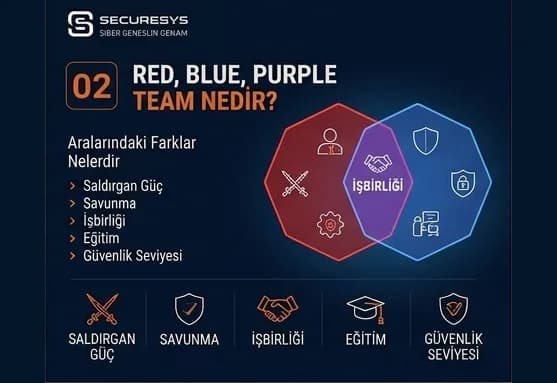
What Are Red Team, Blue Team and Purple Team? How Do They Differ?
The Red Team simulates the attack, the Blue Team runs the defence, and the Purple Team combines both to improve detection capability. This chapter covers the three roles, detection engineering and MITRE ATT&CK coverage analysis.
How Is a Red Team Operation Planned? Scope, Objectives and Rules of Engagement
A Red Team operation begins with correct planning, not with attack tools. This chapter covers objective setting, crown jewels, scope, rules of engagement, the White Team and stop conditions.
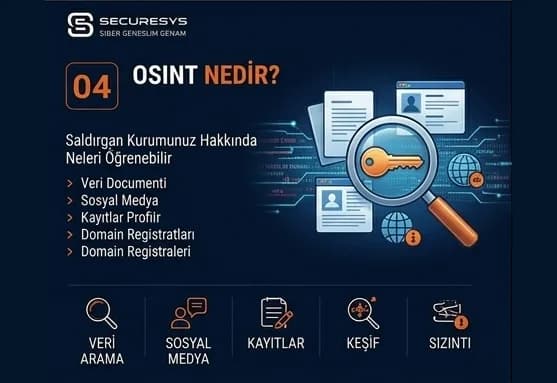
What Is OSINT? What Can an Attacker Learn About Your Organisation?
Attackers get to know an organisation before touching a single system. This chapter examines how open source intelligence — from domains and certificate transparency to LinkedIn and leaked credentials — builds a corporate attack surface.
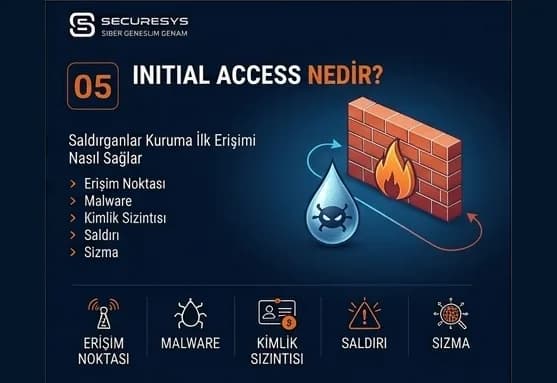
What Is Initial Access? How Do Attackers Gain Their First Foothold?
Initial access is the door to the attack, not its end. This chapter examines initial access methods — from phishing and valid accounts to internet-facing applications and the supply chain — along with the initial access broker ecosystem.
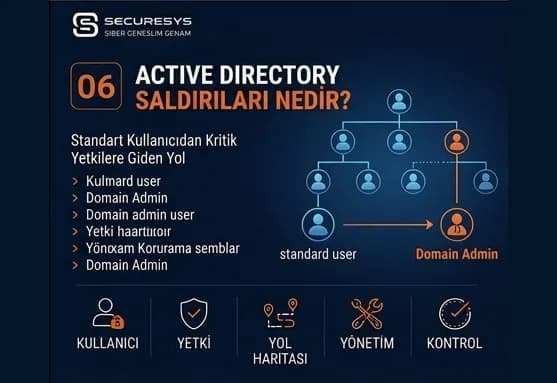
What Are Active Directory Attacks? The Path from Standard User to Critical Privileges
In Active Directory the real danger is not a single vulnerability but the route between them. This chapter covers Kerberos attacks, service accounts, ACL and delegation risks, and attack path analysis.
Looking for professional support on this topic?
Our expert team will reach out for a free consultation as soon as possible.