What Is Dark Web Monitoring? Tracking Leaked Credentials and Corporate Data
You must see what the attacker already holds. This chapter covers leaked credentials, stealer logs, initial access broker listings, ransomware leak sites and brand impersonation.
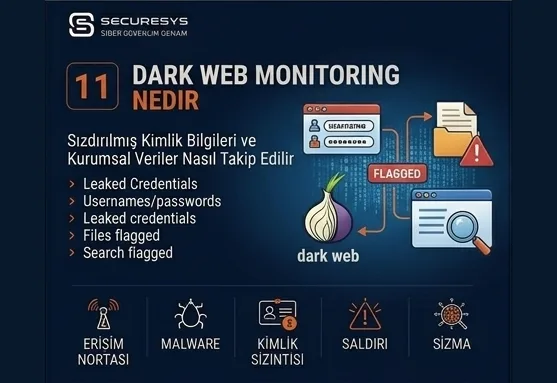
An organisation's data does not always leak from its own systems.
A third-party platform an employee uses may suffer a data breach.
A user may be exposed to malware on a personal device.
A supplier account may be compromised.
An employee may use the same password in several places.
An attacker who has gained access to the corporate network may put the user credentials they obtained up for sale on various platforms.
As a result, the company's email addresses, user accounts, session information, access data or sensitive documents can begin circulating around the internet without the organisation's own security teams noticing.
In modern cyber security, therefore, monitoring the organisation's internal systems alone is not enough.
The organisation's digital exposure in the outside world must be tracked too.
One of the important parts of this approach is called dark web monitoring.
Dark web monitoring is a cyber threat intelligence activity aimed at tracking indicators such as the organisation's name, domain, employee email addresses, user accounts, leaked credentials, accesses being sold and sensitive data across the dark web, underground forums, leak sites and other risky sources.
But dark web monitoring is not merely a check for “has our company name appeared?”.
The real value emerges in this question:
Is the information found genuine, is it current, and how risky is it for the organisation?
What Is the Dark Web?
The dark web refers to the parts of the internet that are not indexed by standard search engines and require special access methods.
Not all of the dark web is used for cyber crime.
It also has legitimate uses such as privacy, avoiding censorship, journalism and anonymous communication.
But from a cyber threat intelligence perspective the dark web is an important source, because some threat actors share or sell;
- stolen user accounts,
- database leaks,
- access to company networks,
- malware logs,
- payment card data,
- ransomware leaks,
- attack tools
on platforms of this kind.
Dark web monitoring is therefore an important component of cyber threat intelligence (CTI) processes.
Are the Deep Web and the Dark Web the Same Thing?
No.
These two concepts are frequently confused.
The deep web is the general name for internet content not indexed by search engines.
For example;
a corporate intranet,
a private email account,
internet banking,
subscription-only content
can all be considered part of the deep web.
The dark web, meanwhile, refers to the more restricted, anonymity-focused parts of the internet reached through special networks or tools.
So:
All dark web content is deep web, but not all deep web content is dark web.
From a security perspective, what really matters is less the naming and more understanding which channels the organisation's sensitive data is circulating through.
What Is Dark Web Monitoring?
Dark web monitoring is the systematic search for particular key indicators relating to the organisation across risky sources.
For example;
the company domain,
employee email addresses,
the brand name,
executive names,
corporate IP ranges,
product names,
critical system names
can be tracked.
In relation to these, content such as;
credential leaks,
stealer logs,
combo lists,
database dumps,
initial access sale listings,
ransomware leaks
can be investigated.
But it is not enough for a professional dark web monitoring service merely to collect data.
What is found must be;
verified,
dated,
analysed for its source,
checked for whether the affected account is still active,
related to corporate risk.
Only then does it become useful.
What Is a Credential Leak?
A credential leak is the unauthorised exposure of usernames, email addresses, passwords or authentication information.
This information can leak for various reasons.
Credential exposure can result from;
a third-party data breach,
a phishing attack,
infostealer malware,
a misconfigured system,
the compromise of an employee device.
Any of these routes leads to the same place.
One of the most critical risks for an organisation is this:
Is the leaked password still active?
If it is, the attacker can try to sign in as a legitimate user using the valid accounts technique.
What Is a Stealer Log?
A stealer log refers to records of data captured by information-stealing malware.
These logs may contain;
usernames and passwords saved in the browser,
cookies,
session information,
form data,
certain application tokens,
device information.
Everything the browser held.
The critical difference here is this:
A stealer log may not be a classic data breach from years ago.
It can indicate a far more recent device compromise.
If an employee signed in to their corporate Microsoft 365 account from a personal computer and that device was infected with an infostealer, those account details can fall into attackers' hands.
Stealer log detection should therefore be treated as high priority.
What Is Infostealer Malware?
An information stealer (infostealer) is a category of malware developed to capture sensitive information from a device.
The data targeted includes;
browser credentials,
cookies,
session tokens,
saved passwords,
application data.
All of it quietly harvested.
The corporate risk problem is this:
The attack does not have to take place on a company device.
The employee's personal device may have been compromised.
But if the user accesses corporate services from that same device, corporate credentials or session information can fall into the attacker's hands.
This shows why BYOD security and identity security must be considered together.
What Is a Combo List?
One of the concepts encountered in the cyber crime ecosystem is the combo list.
Combo lists are usually lists gathered from various sources containing combinations such as;
email:username
or
email:password
pairs.
Not all of the data in these lists is current.
Some may come from data breaches years old.
But because of password reuse, even old credentials can pose a risk.
If a user is still using the password they set five years ago on their corporate account, an old leak can turn into a current attack vector.
Why Is Password Reuse a Critical Risk?
Password reuse is the use of the same or a similar password across multiple systems.
This behaviour lets attackers make use of old data leaks.
If an employee uses a similar password on;
a personal shopping site,
a social media account,
their corporate email account,
a third-party data breach can affect company security too.
To reduce this risk, controls such as;
MFA,
phishing-resistant authentication,
a password manager,
breached password detection,
conditional access
should be used together.
What Is an Initial Access Broker?
One of the important actors in the dark web and cyber crime economy is the initial access broker (IAB).
Initial access brokers obtain initial access to organisations and sell that access on to other attacker groups.
The access put up for sale may be;
a VPN account,
RDP access,
a Citrix or remote access account,
a cloud account,
a web shell,
a corporate user account.
All of it tradeable.
This model specialises the attack ecosystem.
One group obtains the initial access.
Another group buys it.
A third actor runs the ransomware operation.
Seeing an “access for sale” listing relating to an organisation on the dark web can therefore be extremely critical.
What Does “Access for Sale” Mean?
Underground forums sometimes offer access to particular companies or sectors for sale.
A listing may include information such as;
the company's sector,
the country,
the revenue range,
the type of access,
the privilege level.
Enough to identify a target without naming it.
Not every listing should be assumed genuine.
Fraud is common on cyber crime forums too.
But if a sale listing matching the organisation's characteristics strongly is identified, the incident must be treated as high-priority threat intelligence.
Incident response and threat hunting processes should be started if necessary.
What Is a Ransomware Leak Site?
Many ransomware groups do not merely encrypt systems.
They may try to exfiltrate data before the attack and pressure the company with the threat of publishing it.
This approach is known as double extortion.
Some groups publish their victims on their own leak sites.
These platforms may share information such as;
the company name,
data samples,
a countdown,
the claimed volume of stolen data.
All of it designed to apply pressure.
Tracking these leak sites within dark web monitoring is particularly important for large organisations.
What Is Double Extortion?
In a traditional ransomware attack the attacker encrypts files and demands payment.
In the double extortion model the attacker first tries to capture the data.
They may then encrypt the systems.
Even if the company restores from backups, the attacker can use the threat:
“If you don't pay, we publish the data.”
Ransomware security is therefore not only backup security.
Data exfiltration detection is critically important too.
What Is Triple Extortion?
In some attacks the extortion widens further.
This can be called triple extortion.
In addition to encryption and data leakage, the attacker may;
contact customers,
threaten business partners,
launch a DDoS attack,
or use other pressure methods.
This shows that ransomware attacks are not merely a technical incident but a corporate crisis management problem.
Is a Company Name Appearing on the Dark Web Always Critical?
No.
This is an important distinction.
It is not enough for a dark web monitoring platform to raise an alert saying;
“Your company name was found.”
The company name may appear;
in a general sector discussion,
in an old data dump,
in content relating to another company.
Every finding must therefore be analysed.
In a professional threat intelligence approach these questions are asked:
Is the source reliable?
How current is the data?
Are there genuine employee accounts involved?
Could the credential still be active?
Is it related to corporate systems?
What is the threat actor's capability?
Is urgent action required?
Without context, data turns into noise.
Why Do False Positives Matter in Dark Web Monitoring?
Dark web sources are not clean, standardised databases.
The same data can be shared repeatedly across different platforms.
Old leaks can be republished as though new.
Fake data packages can be sold.
Several companies may share similar names.
Validation is therefore critically important in a professional dark web monitoring service.
Otherwise security teams can end up dealing with hundreds of low-value alerts.
That in turn creates alert fatigue.
What Should Be Done When Credential Exposure Is Found?
When a leaked credential belonging to an employee is found, a structured response process should be followed rather than automatic panic.
First, it must be checked;
which source the credential came from,
which date it belongs to,
whether the account is active,
whether the password is still valid.
Those four facts set the priority.
If the risk is confirmed;
a password reset,
termination of active sessions,
an MFA check,
a conditional access review,
analysis of historical authentication logs,
an EDR endpoint check
can all be carried out.
Threat hunting should be started if necessary.
Why Can a Session Cookie Leak Be More Critical Than a Password?
In modern authentication systems the user is issued a session token or cookie after a successful sign-in.
Under certain conditions this information represents the user's session.
The attacker therefore does not always need the password.
Captured active session information can pose a serious risk.
In an infostealer incident, saying only:
“We changed the password.”
may therefore not always be enough.
Terminating active sessions and invalidating tokens may also be necessary.
This shows that modern identity security consists of far more than password management.
If MFA Is in Place, Is a Credential Leak Unimportant?
No.
MFA can significantly reduce credential theft risk.
But a leaked credential is still a security incident.
Because the attacker can consider various routes such as;
MFA fatigue,
social engineering,
session hijacking,
legacy authentication,
a weak recovery process.
Each bypasses the second factor differently.
It is therefore important for organisations to use phishing-resistant MFA and strong conditional access policies wherever possible.
The Relationship Between Dark Web Monitoring and Brand Protection
Dark web monitoring does not track leaked user accounts alone.
Corporate brand abuse can be monitored as well.
For example;
a domain resembling the company name,
a fake customer portal,
a phishing site,
an imitation social media account,
a fake mobile application
can be identified.
These activities can be assessed under digital risk protection (DRP) or external threat monitoring.
This area matters particularly for banks, e-commerce companies, holding groups and brands with large customer bases.
What Is Typosquatting?
Typosquatting is the registration of domain names closely resembling a genuine domain for attack purposes.
If the company domain is:
securecompany.com
the attacker may use a visually similar variant.
The aim is for the user to reach a phishing page without noticing the address.
Identifying brand-lookalike domains is important in dark web monitoring and digital risk protection work.
Monitoring newly registered domains in particular can provide early warning.
Why Does Domain Monitoring Matter?
New domains resembling the company brand can be detected before the attack has even begun.
Domain monitoring is therefore a proactive security approach.
A domain may;
not yet have been used in a phishing email,
not yet be hosting malicious content.
But its brand similarity and registration behaviour can constitute a risk.
In that case the security team can examine the domain in advance and, where needed, begin blocking or takedown processes.
What Is Digital Risk Protection?
Digital risk protection (DRP) describes the approach of monitoring digital risks in internet sources outside the organisation's own control.
Its scope can include areas such as;
dark web monitoring,
credential leak monitoring,
brand impersonation,
phishing domain detection,
social media impersonation,
data leak monitoring.
All of it outside the perimeter.
The purpose of DRP is to detect digital risks outside the organisation as early as possible.
In that sense DRP can be considered alongside external attack surface management.
The Difference Between Dark Web Monitoring and External Attack Surface Management
These two concepts are close but focus on different areas.
External attack surface management (EASM) focuses on discovering the organisation's technical assets visible on the internet.
For example;
domains,
subdomains,
IPs,
cloud assets,
internet services.
Things the organisation owns.
Dark web monitoring, by contrast, tracks stolen, leaked or criminally traded information relating to the organisation.
The strongest approach is to use both together.
EASM answers:
“Which of our systems can the attacker see?”
Dark web monitoring answers:
“Which of our information may the attacker already hold?”
The two questions are complementary.
The Difference Between Threat Intelligence and Dark Web Monitoring
Dark web monitoring can be a component of cyber threat intelligence.
But the two are not the same thing.
Threat intelligence is far broader.
CTI can cover areas such as;
threat actors,
APTs,
malware,
TTPs,
IOCs,
vulnerability intelligence,
campaign intelligence,
dark web intelligence.
Dark web monitoring covers only part of that.
A platform providing only dark web data should therefore not be assumed to meet the whole CTI requirement.
What Is Dark Web Intelligence?
Dark web intelligence is the verification and analysis of information obtained from the dark web and similar underground sources so that it becomes threat intelligence.
For example;
Data: 25 email addresses belonging to the company domain were found.
That on its own is monitoring output.
But:
Intelligence: Eight of the accounts belong to active employees, the data comes from a recent infostealer log, and two users show credential traces relating to the organisation's remote access services.
That is now actionable intelligence.
The difference is context and analysis.
How Should Dark Web Monitoring Be Integrated with the SOC?
Sending dark web findings as a PDF report by email and leaving it there is not the ideal approach.
Critical findings must feed directly into SOC and incident response processes.
When a risky credential is identified, for example;
the user's history can be searched in the SIEM,
identity provider records can be examined,
the user's endpoint can be checked in the EDR,
suspicious IPs and domains can be searched for,
active sessions can be assessed.
External threat intelligence is then verified against internal telemetry.
This approach is extremely valuable in terms of external-to-internal correlation.
How Is Threat Hunting Used?
Suppose a credential belonging to an active employee is found inside a stealer log.
The user's password is changed immediately.
But the process should not end there.
By looking at historical data the threat hunting team can investigate;
whether there were suspicious logins,
whether there were unusual locations,
whether a new device was used,
whether an unexpected mailbox rule was created,
whether unusual cloud access took place,
whether there are malware traces on the endpoint.
Because a credential leak is sometimes not only a future risk but an indicator of a compromise that has already happened.
What Is IOC Enrichment?
Technical indicators obtained from dark web or threat intelligence sources can be enriched with additional information.
This process is called IOC enrichment.
For an IP address, for example, information such as;
reputation,
ASN,
geographic location,
first seen date,
last seen date,
associated malware,
associated threat actor
can be added.
This allows the SOC analyst to assess the alert far more quickly.
Dark Web Monitoring and SIEM Integration
Some threat intelligence indicators can be fed into the SIEM.
For example;
malicious domains,
IPs,
URLs,
hashes
can be compared against the organisation's telemetry.
But loading all dark web data into the SIEM automatically may not be right.
Too many low-quality IOCs can create performance and false positive problems.
Criteria such as;
confidence score,
relevance,
freshness,
context
should therefore be used.
How Is Priority Determined in Credential Leak Monitoring?
Not every credential leak carries the same risk level.
The following criteria can be used, for example:
Is the account active?
Active accounts carry higher priority.
Is the user privileged?
Administrator and critical role accounts carry higher risk.
How recent is the data?
A new stealer log generally carries higher priority than an old breach.
What is the source?
Whether it is an infostealer, a phishing kit or an IAB matters.
Is MFA in place?
The level of protection is assessed.
Is there access to critical systems?
Finance, VPN, cloud or administrator access creates greater impact.
This approach enables risk-based response.
What Are VIP and Executive Monitoring?
Senior executives, board members and users in critical positions can be more valuable to attackers.
Some organisations therefore run VIP monitoring or executive protection programmes.
Within these programmes;
corporate email,
brand impersonation,
leaked accounts,
fake social media profiles,
phishing attempts
can be tracked more closely.
This approach matters particularly for CEO fraud and business email compromise attacks.
What Is Business Email Compromise (BEC)?
Business email compromise (BEC) is an attack type in which attackers attempt financial fraud by compromising or impersonating corporate email accounts.
The attacker may send a fraudulent payment request while posing as;
the CEO,
the CFO,
a finance manager,
a supplier.
The request looks routine.
Credential leaks and mailbox compromise therefore carry serious risk for finance departments.
Dark web monitoring, identity security and email security must be handled together to reduce BEC risk.
Why Does Third-Party Credential Exposure Matter?
An organisation's own security level may be very strong.
But a supplier's user account may have been compromised.
If that supplier has access to the organisation through;
VPN,
remote support,
a B2B portal,
file sharing,
the attacker can exploit the trusted relationship.
Within dark web monitoring, therefore, the risks of critical third parties can also be assessed.
This approach matters for third-party cyber risk management.
What Should Be Done if a Ransomware Group Adds Your Company to a Leak Site?
In such a situation the reality of the incident must be verified quickly.
The first step is not to make a public statement or to contact the attacker.
First;
incident response,
DFIR,
legal,
senior management,
the relevant regulatory and privacy teams
must be coordinated.
Technically;
the scope of compromise,
data exfiltration,
persistence,
lateral movement,
credential exposure
must be investigated.
Dark web monitoring serves as the alarm here.
The real process is incident response and crisis management.
Does Dark Web Monitoring End with Buying a Security Product?
No.
A platform may be tracking;
thousands of forums,
leak sites,
credential sources.
But the real value lies in what is done after the alert.
A security team must;
verify the data,
score the risk,
identify the affected user,
pass it to the SOC,
start incident response,
carry out remediation.
Dark web monitoring should therefore be an operational process, not a dashboard.
What Should a Dark Web Monitoring Report Contain?
A professional dark web monitoring or digital risk protection report may contain the following areas:
Executive Summary
The critical external threat picture for management.
Credential Exposure
Analysis of leaked accounts and credentials.
Stealer Log Findings
Risks originating from information stealers.
Access Broker Findings
Access sales that may relate to the organisation.
Ransomware Exposure
Findings relating to leak sites and ransomware.
Brand Impersonation
Fake domains and brand imitation.
Threat Actor Context
The actor or campaign the finding relates to.
Risk Score
The finding's priority by recency, accuracy and impact.
Recommended Actions
Recommendations for the SOC, IAM, incident response and management.
This format turns monitoring data directly into manageable cyber risk.
How Is the Success of Dark Web Monitoring Measured?
Success should not be measured as;
“We found 10,000 records this month.”
More meaningful metrics are these:
How many genuine credential exposures were identified?
How many active user accounts were protected?
How many phishing domains were detected early?
How many critical findings turned into incident response?
How many fake brand uses were blocked?
What was the average time from detection to response?
How many false positives were filtered out?
These metrics show the service's real security value.
Why Does Dark Web Monitoring Matter for Organisations?
Organisations can control their own networks.
But they cannot control the whole internet.
A compromise on an employee's personal device,
a third-party data breach,
a supplier leak,
an infostealer campaign
can all lie outside the organisation's direct control.
External threat visibility is therefore necessary.
A modern security strategy should not ask only:
“Are we protecting our own systems?”
It should also ask:
“Which sensitive information about our organisation is circulating in the outside world?”
Conclusion: You Must See What the Attacker Already Holds
A username.
An old password.
An active session.
A VPN account.
A leaked company document.
A corporate access sale listing.
A fake domain.
Each of these can surface from a different source.
But correlated correctly, they can be the early indicator of a critical attack against the organisation.
The real value of dark web monitoring emerges here.
The aim is not to collect as much data as possible from the dark corners of the internet.
The aim is to notice the information in the attacker's hands that could affect the organisation's security before the attack happens or grows.
Dark web monitoring must therefore work alongside;
cyber threat intelligence,
the SOC,
threat hunting,
identity security,
incident response,
digital risk protection.
The strongest security model is the one that can look from the inside out and from the outside in at the same time.
Inside, the EDR may see a user behaviour.
Outside, threat intelligence may see that same user's credential inside a stealer log.
When those two pieces are combined, an ordinary-looking event can become critical.
And that is the real power of modern threat intelligence:
Turning scattered signals into an attack story.
The next step is to turn that intelligence into a genuine test of the defence.
In other words, to use the threat actors facing the organisation and their TTPs in Red Team scenarios.
Related Articles
Red Teaming & Threat Intelligence
What Is Red Teaming? Simulating a Real Cyber Attack
Red Teaming measures an organisation's resilience across people, process and technology by simulating a real attacker's tactics and techniques under control. In this chapter we walk through the stages of a Red Team operation using a real-world scenario.
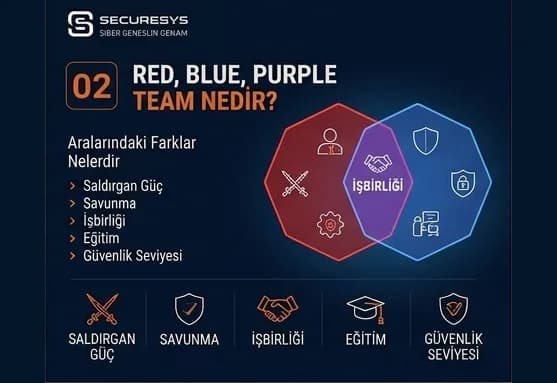
What Are Red Team, Blue Team and Purple Team? How Do They Differ?
The Red Team simulates the attack, the Blue Team runs the defence, and the Purple Team combines both to improve detection capability. This chapter covers the three roles, detection engineering and MITRE ATT&CK coverage analysis.
How Is a Red Team Operation Planned? Scope, Objectives and Rules of Engagement
A Red Team operation begins with correct planning, not with attack tools. This chapter covers objective setting, crown jewels, scope, rules of engagement, the White Team and stop conditions.
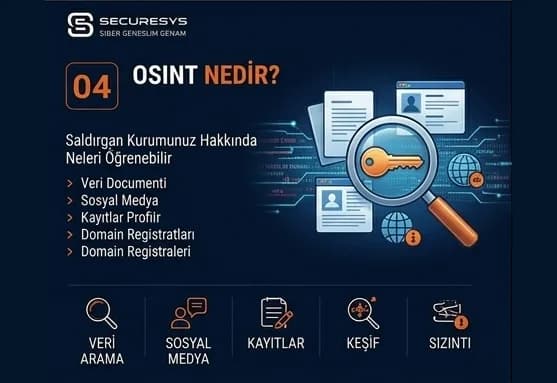
What Is OSINT? What Can an Attacker Learn About Your Organisation?
Attackers get to know an organisation before touching a single system. This chapter examines how open source intelligence — from domains and certificate transparency to LinkedIn and leaked credentials — builds a corporate attack surface.
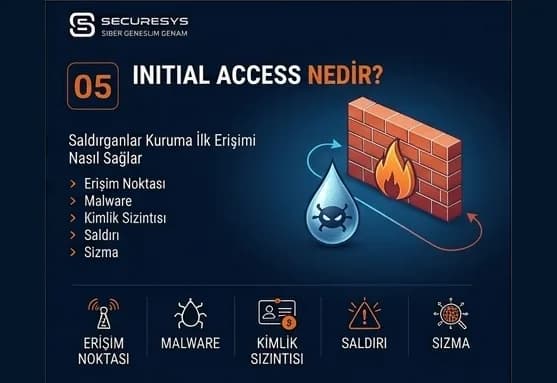
What Is Initial Access? How Do Attackers Gain Their First Foothold?
Initial access is the door to the attack, not its end. This chapter examines initial access methods — from phishing and valid accounts to internet-facing applications and the supply chain — along with the initial access broker ecosystem.
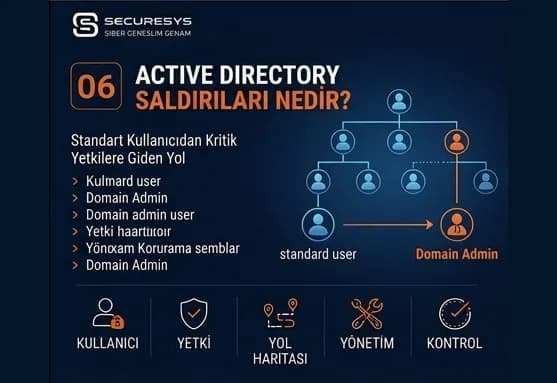
What Are Active Directory Attacks? The Path from Standard User to Critical Privileges
In Active Directory the real danger is not a single vulnerability but the route between them. This chapter covers Kerberos attacks, service accounts, ACL and delegation risks, and attack path analysis.
Looking for professional support on this topic?
Our expert team will reach out for a free consultation as soon as possible.