What Is Privilege Escalation? How Does an Attacker Reach Critical Privileges?
The attacker's target is not your password but the privileges that account can reach. This chapter covers local and domain privilege escalation, privilege creep, service accounts, and the PAM, JIT, JEA and PAW approaches.
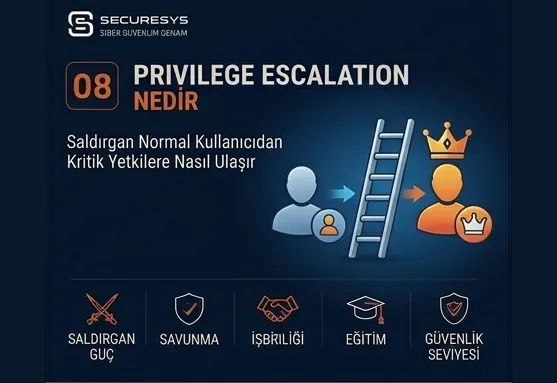
An attacker gaining access to a corporate system does not always mean they hold critical privileges.
Most attacks start through a low-privileged user account, a standard employee computer or a service with limited access.
At this point one of the attacker's most important objectives is:
To turn their current access into stronger privileges.
In cyber security literature this process is called privilege escalation.
Privilege escalation is the attempt by a threat actor to reach an access level higher than the user or system privileges they currently hold.
That escalation may run;
from standard user to local administrator,
from local administrator to system administrator,
from a low-privileged domain user to a privileged account,
and under certain conditions on to critical Active Directory privileges.
Each step widens the impact.
But privilege escalation does not always stem from a single software vulnerability.
In real corporate environments the most serious privilege escalation routes usually emerge from the combination of many small problems, such as;
faulty permissions,
excessive group memberships,
weak service accounts,
incorrect ACL configurations,
legacy administrative rights,
shared administrator accounts,
faulty delegations.
None of them critical on their own.
Privilege escalation, Active Directory security, Red Teaming, privileged access management and least privilege should therefore not be thought of separately.
The real question is this:
If a standard user account is compromised, how far up the privilege ladder can the attacker reach?
What Is Privilege Escalation?
Privilege escalation is the attempt by a user or attacker to obtain access to higher-level privileges than they held at the start.
Within the MITRE ATT&CK framework, privilege escalation is treated as a distinct tactic.
The aim at this stage is usually;
- to gain control over more systems,
- to bypass security controls,
- to access critical files,
- to reach other users' credentials,
- to manage services,
- to create new accounts or access routes,
- to reach critical business systems.
Any of these can be the motive.
Privilege escalation matters greatly in Red Team operations.
Because the attacker's initial access level is usually limited.
If a route can be found from a low-privileged user to critical privileges, the organisation's real attack surface may be far wider than assumed.
What Is Local Privilege Escalation?
Privilege escalation can be assessed at different levels.
The first of these is the local privilege escalation approach.
The attacker may have signed in on a computer as a standard user.
But they do not hold administrator or SYSTEM level privileges on that system.
In that case the attacker may try to obtain higher local privileges by exploiting security problems such as;
incorrect file permissions,
faulty service configurations,
weak application privileges,
out-of-date software,
incorrect operating system configurations.
Each is a familiar weakness.
For example:
Standard User
↓
Local Administrator
This transition can be considered local privilege escalation.
Local administrator level matters to the attacker.
Because that privilege provides more control over the endpoint and makes the later stages of the attack easier.
What Is Domain Privilege Escalation?
Domain privilege escalation is the attacker's attempt to reach more privileged domain accounts or critical domain rights in an Active Directory environment.
This process can have a far broader impact than local privilege escalation.
The attacker may pass through various stages such as;
standard domain user,
service account,
server administrator,
privileged group member.
Each is a rung on the ladder.
A theoretical attack route might look like this:
Domain User
↓
Local Admin
↓
Server Access
↓
Service Account
↓
Privileged Group
↓
Critical Domain Privilege
This entire chain is not a single vulnerability.
It is an attack path.
In Active Directory security, therefore, privilege relationships must be analysed together rather than as isolated findings.
The Difference Between Vertical and Horizontal Privilege Escalation
The concept of privilege escalation can also be explained in two ways.
Vertical privilege escalation is a user moving up to a higher privilege level.
For example:
Standard user → Administrator.
Horizontal privilege escalation is a user being able to access another user's resources at the same privilege level.
For example, a standard user being able to reach another standard user's private data.
In web application security, horizontal privilege escalation is particularly associated with risks such as broken access control and IDOR/BOLA.
In corporate systems the same logic applies to identity and access control.
Privilege security is therefore not merely a matter of “can they become admin?”.
Which resources that do not belong to them can the user reach?
That question matters too.
Why Is Privilege Escalation Critical for the Attacker?
A low-privileged user account limits many of the attacker's options.
But once high privileges are obtained, their room to manoeuvre grows.
For example, they can;
reach more files,
change security settings,
see other users' processes,
access service configurations,
affect certain security controls,
progress to other systems.
From the attacker's point of view, privilege escalation therefore usually opens the way to the lateral movement and credential access stages.
The attack chain can progress like this:
Initial Access
↓
Discovery
↓
Privilege Escalation
↓
Credential Access
↓
Lateral Movement
↓
Critical Asset
But in real attacks this ordering is not fixed.
The attacker may move back and forth between stages repeatedly.
Misconfiguration Is One of the Biggest Sources of Privilege Escalation
Privilege escalation usually brings software vulnerabilities to mind.
But in corporate environments a significant proportion of serious risks emerge from security misconfiguration.
For example;
granting a user unnecessary administrator rights,
sharing critical folders with incorrect permissions,
services being modifiable by a standard user,
old group memberships never being removed,
an incorrect ACL configuration
can each create a privilege escalation route.
The important characteristic of risks like this is that;
the system may be technically up to date.
There may be no CVE at all.
And yet the attacker can still escalate their privileges.
Patch management alone therefore does not eliminate privilege escalation risk.
What Is Privilege Creep?
One of the important problems in corporate identity security is privilege creep.
An employee holds certain privileges when they join the company.
Later they change project.
They take on a new role.
They move to another department.
They are given access to new applications.
The old privileges are not always removed.
Over the years the user can end up with access far beyond their normal job function.
This situation is called privilege creep.
Privilege creep is extremely valuable to an attacker.
Because an ordinary-looking compromised user account can reach far more systems than expected.
Identity governance and administration (IGA) processes therefore matter for security.
What Is Least Privilege?
The principle of least privilege states that users and services should hold only the minimum privileges they need to perform their work.
If a user only needs to read a particular folder, they may not need write access.
If a system administrator needs to manage a particular server, they may not need to be an administrator across the entire domain.
If a service only needs to reach one database, it should not hold high privileges on every server.
Although this approach sounds simple, it can be difficult to apply in large organisations.
Because privileges accumulate over the years.
Projects change.
Organisational structures change.
Old accounts are forgotten.
Least privilege is therefore not merely a policy, but a process that must be managed continuously.
Why Do Service Accounts Matter for Privilege Escalation?
Service accounts are necessary for many corporate systems to run.
But these accounts can pose a high risk.
Because service accounts frequently;
use long-lived passwords,
are tracked less closely than interactive user accounts,
can reach multiple servers,
may hold more privileges than they need.
All four traits work in the attacker's favour.
If an attacker who reached a system from a low-privileged user account discovers a weakness in a service account, they can reach higher privileges.
Service account security is therefore an important part of privilege escalation risk.
Organisations should use approaches such as;
gMSA,
managed identities,
secret rotation,
PAM,
least privilege
wherever possible.
What Is gMSA?
A group managed service account (gMSA) is one of the mechanisms that helps make service account password management more secure in Microsoft Active Directory environments.
With traditional service accounts, passwords can be set manually and left unchanged for long periods.
In the gMSA approach, password management can be automated by Active Directory.
This helps reduce;
password reuse,
the risk of long-lived static credentials,
manual password management.
All three shrink at once.
But using gMSA does not solve every risk on its own.
Which systems the account can be used on and which privileges it holds must still be controlled.
Active Directory ACLs and Privilege Escalation
There are many different permission relationships between Active Directory objects.
These relationships are managed through access control list (ACL) structures.
Misconfigured ACLs can allow low-privileged users to modify critical objects unexpectedly.
A user may, for instance;
be able to change another user's properties,
be able to manage a particular group,
hold write access over a critical object.
Situations like this can create a privilege escalation route without any Domain Admin membership.
ACL review is therefore critically important in AD pentest and attack path analysis work.
Group Membership Risks
Active Directory groups make privilege management easier.
But nested group structures can become complex over time.
For example:
User A → Group A → Group B → Group C → Privileged Resource
A long permission chain like this can exist.
A user not appearing directly in a critical group does not mean they are safe.
Through nested group membership they can hold indirect privileges.
In privileged access analysis, therefore, not only direct group memberships but also nested group relationships must be assessed.
How Do Local Administrator Rights Turn into Privilege Escalation?
In many organisations employees or IT teams can be seen holding more local administrator rights than necessary.
This provides operational convenience at first.
But it creates serious risk from an attack perspective.
A user who is a local administrator can;
change system configurations,
perform highly privileged operations,
attempt to access certain credentials.
More importantly, if other highly privileged users use the same device, the attacker can take advantage of that to advance the privilege escalation chain.
Local administrator rights must therefore be reviewed regularly.
Why Are Shared Admin Accounts Risky?
Using the same administrator account across multiple systems increases both privilege escalation and lateral movement risk.
The same administrator account might be in use on;
50 workstations,
10 servers,
several management systems.
One credential covering all of it.
If that account is compromised, the attacker can gain very broad access.
Controls such as;
separate administrative accounts,
unique local admin passwords,
LAPS,
PAM
should therefore be used.
The fewer systems a highly privileged credential is used on, the better for security.
Sudo and Linux Privilege Escalation
Privilege escalation is not a topic for Windows or Active Directory environments alone.
Similar risks exist on Linux systems.
For example;
incorrect sudo configurations,
overly broad file permissions,
highly privileged scripts,
incorrect service permissions,
out-of-date kernels or applications
can each create privilege escalation routes.
In Red Team operations, therefore, the privileged access structure of Linux servers must be assessed alongside Windows endpoints.
What Is Cloud Privilege Escalation?
As corporate infrastructure has moved to the cloud, cloud privilege escalation has become increasingly important.
In environments such as Azure, AWS and Google Cloud, the attacker's target may be IAM permissions rather than operating system administrator rights.
A low-privileged cloud identity that;
can create roles,
can add permissions to an existing role,
can use a service account,
can read secrets,
can act on another workload,
may be able to climb to a higher cloud privilege level.
IAM misconfiguration is therefore one of the most critical risks in cloud security.
Permission graph and role relationship analysis is gaining ever more importance in cloud pentest and Red Team work.
Microsoft Entra ID and Privilege Escalation
In modern hybrid environments, Active Directory and Microsoft Entra ID may be used together.
Privilege escalation may therefore not take place solely in the on-premises domain environment.
The attacker may also look for privilege escalation routes through;
cloud users,
service principals,
application permissions,
admin roles,
conditional access configurations.
Each is a separate surface.
This makes the concept of hybrid identity security important.
An organisation's on-premises AD may be strong, but if the cloud identity configuration is weak the attacker can take a different route.
What Is PAM and How Does It Reduce Privilege Escalation?
Privileged access management (PAM) is a security approach that allows highly privileged accounts to be managed securely.
PAM solutions can provide controls such as;
holding administrator passwords centrally,
credential rotation,
recording privileged sessions,
approving access requests,
granting time-bound privileges.
Each removes standing risk.
From a privilege escalation perspective, PAM's core purpose is this:
To prevent highly privileged accounts sitting permanently and uncontrolled in users' hands.
This approach makes it harder for an attacker to move from a compromised ordinary user account straight to a highly privileged credential.
What Is Just-in-Time Privilege?
Just-in-time (JIT) privilege is the granting of high privileges only at the moment they are needed and for a limited period.
A system administrator does not normally hold high privileges.
When they need to perform a critical operation, they request approval.
They use the high privilege for 30 minutes.
When the time expires the privilege is removed automatically.
This approach reduces the problem of standing privileges.
Because when the attacker compromises the account they will not find permanent administrator rights.
What Is Just Enough Administration?
Just enough administration (JEA) is an approach that lets administrators perform only the management operations they need.
Instead of a user being an administrator across an entire server, for example, they can be permitted only to restart a particular service.
This approach reduces privilege escalation risk and potential attack impact.
When least privilege, JIT and JEA are used together, the privileged access structure can be strengthened significantly.
What Is a Privileged Access Workstation (PAW)?
Using highly privileged accounts on everyday user computers creates serious risk.
Specially hardened devices can therefore be used for critical administrative activity.
These devices are called privileged access workstations (PAW).
On PAW systems;
internet access can be restricted,
email may not be used,
only administrative operations may be permitted,
high security policies can be applied.
Every restriction is deliberate.
The aim is to isolate critical identities such as Domain Admin from everyday user activity.
The Relationship Between Privilege Escalation and Credential Access
Privilege escalation and credential access feed one another in most attacks.
When an attacker obtains higher privileges they can reach more credentials.
Those new credentials can in turn take them to other, more privileged accounts.
For example:
Standard User
↓
Local Admin
↓
Credential Access
↓
Server Admin
↓
New Credential
↓
Privileged Domain Account
Endpoint credential protection is therefore especially important.
Controls such as;
Credential Guard,
PAM,
LAPS,
admin tiering,
session separation
can break the privilege escalation chain.
Can EDR Detect Privilege Escalation?
EDR and XDR platforms can detect some of the behaviour that appears during privilege escalation.
For example;
unexpected process behaviour,
security setting changes,
highly privileged processes,
credential access attempts,
suspicious service activity
can all be analysed.
But having an EDR installed is not enough on its own.
Detection rules,
policy configurations,
telemetry,
SOC analysis
must work together.
In Red Team operations, privilege escalation scenarios can therefore also be used for EDR security validation.
How Does a SOC Detect Privilege Escalation?
SOC teams can assess signs of privilege escalation across different data sources.
For example;
new administrator group memberships,
unusual privileged logins,
account privilege changes,
critical GPO changes,
service account activity,
unexpected privileged process behaviour
can all be important signals.
The key point here is the context of the behaviour.
An IT administrator making a planned change may be entirely normal.
A standard finance user suddenly being added to an administrator group is highly suspicious.
Behavioural analysis approaches such as user and entity behaviour analytics (UEBA) are therefore important.
How Does ITDR See Privilege Escalation Attacks?
Identity threat detection and response (ITDR) is becoming increasingly important for detecting identity-based attacks.
ITDR can analyse areas such as;
highly privileged account activity,
Active Directory changes,
anomalous authentication,
identity attack paths,
privilege relationships.
All of it identity-centric.
This approach matters particularly in scenarios where attackers move using valid user accounts without any malware.
Because traditional antivirus may never see a malicious file.
The problem is not malware; it is the abuse of identity.
Privilege Escalation and Living off the Land
Modern attackers do not always use custom malware.
They can take advantage of legitimate tools already present in the operating system.
This approach is called living off the land (LotL).
PowerShell,
Windows management tools,
script engines,
remote management services
are all part of normal operations.
When an attacker uses these tools, a traditional signature-based security approach can therefore fall short.
The defence has to be behaviour-focused.
What Does a Red Team Measure in Privilege Escalation Testing?
In a professional Red Team engagement, privilege escalation should not be reported merely as “we became administrator”.
These questions need answering:
What was the starting privilege?
Which misconfiguration created the attack route?
In how many steps were high privileges reached?
Did the EDR see the behaviour?
Did the SOC raise an alert?
Did PAM block the attack chain?
Was least privilege being applied?
Which other systems were affected by that privilege?
At which earliest point could the attack chain have been broken?
These questions turn a Red Team report from a technical exploit list into a genuine risk analysis.
Why Does Attack Path Management Matter?
Corporate Active Directory and hybrid identity environments can hold thousands of permission relationships.
Checking users one by one manually is therefore not enough.
Attack path management aims at the continuous analysis of the access routes leading from low-privileged identities to critical assets.
A route like this may emerge:
Normal User
↓
Group Membership
↓
Local Admin
↓
Service Account
↓
Privileged Server
↓
Critical Identity
Removing a single point inside this attack path can break the whole chain.
Remediation work therefore does not always require changing every system.
Sometimes cutting the most critical link is enough.
What Should Be Done to Reduce Privilege Escalation Risk?
Privilege escalation is not a problem that can be solved with a single security product.
Organisations particularly need to;
Least Privilege
reduce unnecessary access,
PAM
manage highly privileged accounts centrally,
JIT Access
reduce standing admin privileges,
JEA
limit administrative functions,
LAPS
separate local administrator accounts,
gMSA
strengthen service account password management,
PAW
isolate critical admin accounts,
Active Directory Hardening
review ACL and delegation relationships regularly,
EDR/XDR
monitor endpoint behaviour,
ITDR
monitor identity attacks,
SIEM/SOC
build correlation around privileged activity.
All of it belongs in the same programme.
Alongside these, regular AD pentest, Red Team and Purple Team work should verify that the controls genuinely function.
What Should a Privilege Escalation Report Contain?
A professional privilege escalation or Red Team report should not merely list the techniques used.
The report should contain areas such as;
Initial Access Level
The privilege level at the start.
Privilege Escalation Path
The attack route leading to higher privileges.
Identity Relationships
User, group, system and service account relationships.
Business Impact
The business impact the obtained privileges could create.
Detection Analysis
Which activity was seen by EDR, ITDR and the SOC.
Root Cause
The underlying configuration problem that made the attack route possible.
Remediation Priority
The fixes that would break the attack chain fastest.
Retest
Re-verification of the attack route after the fixes.
Together these complete the picture.
This approach turns a privilege escalation assessment from a technical finding into a security validation process.
Why Does Privilege Escalation Matter at Management Level?
Privilege escalation may look like a technical topic at first glance.
But its business impact is very large.
When an attacker reaches critical privileges they can gain access to;
financial data,
customer information,
trade secrets,
backup systems,
the ERP infrastructure,
corporate email,
cloud services.
The reach becomes organisation-wide.
The privilege escalation problem is therefore not only the IT security team's problem.
It is a corporate risk and business continuity problem.
Privileged access risk is therefore one of the metrics that should be tracked at senior management level.
Conclusion: The Attacker's Target Is Not Your Password, but Your Privileges
From an attacker's perspective, not every compromised user account has the same value.
The real value lies in where that account can reach.
A standard user may appear to have access only to their own computer.
But;
they may be a local administrator on another system,
a route to a critical service account may exist,
through a faulty ACL they may control another user,
through a nested group relationship they may hold unexpected privileges.
None of it visible on the surface.
In modern cyber security, therefore, the question:
“Could a user account be compromised?”
is not enough on its own.
The real question should be:
“If this user is compromised, what privileges can that turn into?”
Privilege escalation analysis answers that question.
A strong organisation tries to prevent the attacker compromising the first account.
A stronger organisation acts on this assumption:
Even if the first account is compromised, we must prevent high privileges being reached.
Least privilege, PAM, JIT, PAW, Active Directory hardening, ITDR and attack path management are therefore core components of modern cyber security architecture.
But once the attacker reaches high privileges, another problem appears in front of them.
Staying inside the organisation without losing that access.
Being able to return even if security teams close accounts or restart systems.
And hiding the communication channel they have built from the defensive systems.
These stages bring two critical concepts into view:
Persistence and command & control (C2).
Related Articles
Red Teaming & Threat Intelligence
What Is Red Teaming? Simulating a Real Cyber Attack
Red Teaming measures an organisation's resilience across people, process and technology by simulating a real attacker's tactics and techniques under control. In this chapter we walk through the stages of a Red Team operation using a real-world scenario.
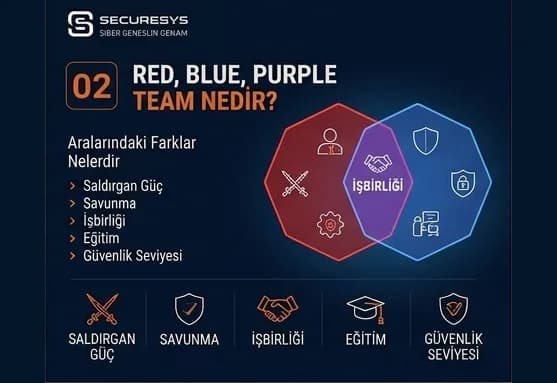
What Are Red Team, Blue Team and Purple Team? How Do They Differ?
The Red Team simulates the attack, the Blue Team runs the defence, and the Purple Team combines both to improve detection capability. This chapter covers the three roles, detection engineering and MITRE ATT&CK coverage analysis.
How Is a Red Team Operation Planned? Scope, Objectives and Rules of Engagement
A Red Team operation begins with correct planning, not with attack tools. This chapter covers objective setting, crown jewels, scope, rules of engagement, the White Team and stop conditions.
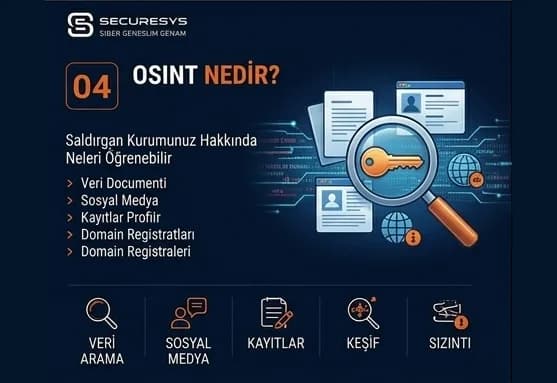
What Is OSINT? What Can an Attacker Learn About Your Organisation?
Attackers get to know an organisation before touching a single system. This chapter examines how open source intelligence — from domains and certificate transparency to LinkedIn and leaked credentials — builds a corporate attack surface.
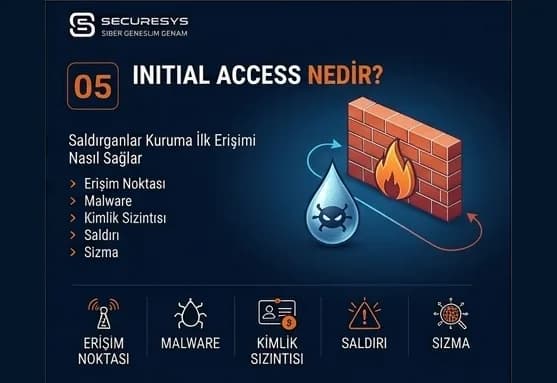
What Is Initial Access? How Do Attackers Gain Their First Foothold?
Initial access is the door to the attack, not its end. This chapter examines initial access methods — from phishing and valid accounts to internet-facing applications and the supply chain — along with the initial access broker ecosystem.
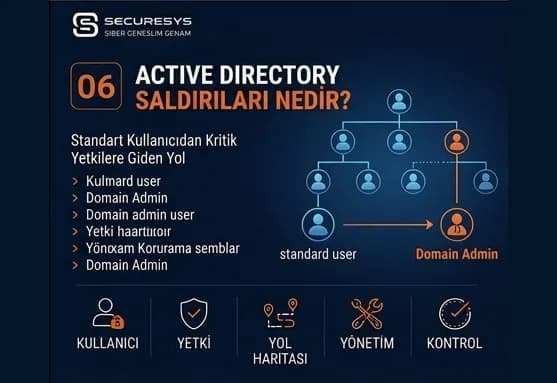
What Are Active Directory Attacks? The Path from Standard User to Critical Privileges
In Active Directory the real danger is not a single vulnerability but the route between them. This chapter covers Kerberos attacks, service accounts, ACL and delegation risks, and attack path analysis.
Looking for professional support on this topic?
Our expert team will reach out for a free consultation as soon as possible.