Security Risks of AI-Assisted Software Development: AI Code Assistants and Secure Code
Explore the security risks of AI-assisted software development: AI code assistants, insecure code generation, data leakage, SAST and a Secure Coding guide.
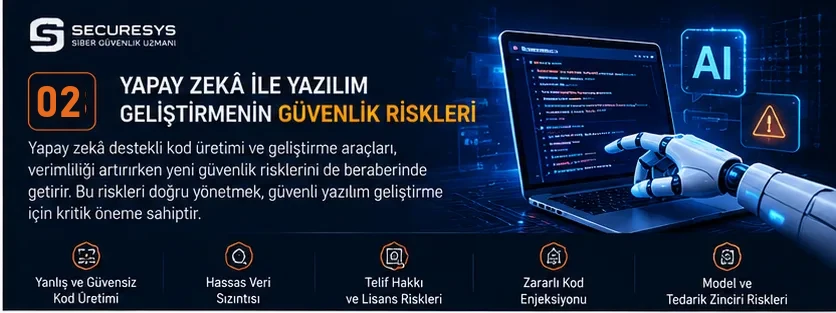
Introduction: Software Development Has Accelerated, but Has Security Kept the Same Pace?
Imagine a software developer preparing a new application.
In the traditional development approach, the developer first designs the architecture, decides which technologies to use, researches the required libraries and only then starts writing source code.
As the code grows, tests are prepared.
Bugs are fixed.
Code review is carried out.
Afterwards the application is moved to the test environment.
Today, the same developer can give an AI code assistant the following instruction:
“Develop a REST API that uses JWT authentication, connects to a PostgreSQL database and provides user management.”
Within a few minutes, the AI can generate the project structure, controller files, data models, database connections and sample authentication code.
Some tools can even prepare test files, add dependencies and make changes to the code.
This development is an important transformation for software development.
However, a critical question arises here:
Does AI producing working code mean it produces secure code?
The answer is no.
AI code assistants can speed up the development process, but the security of the code they produce is not automatically guaranteed.
A piece of code may compile.
It may pass all functional tests.
It may perform the operation the user requested.
Yet it may also contain weaknesses such as SQL Injection, Broken Access Control, sensitive data leakage or insecure cryptography.
More importantly, the technical expertise required to assess whether AI-generated code is secure does not go away.
On the contrary, fast code generation can increase the importance of security review.
Because code that a developer used to write in a few days can now be created in a much shorter time.
This presents security teams with a new problem:
How will security control capacity be maintained while code generation speed increases?
In this article, we will examine in detail the security risks of AI-assisted software development, the vulnerabilities AI code assistants can introduce, corporate source code leakage problems and how secure development processes should be designed.
1. What Is AI-Assisted Software Development?
AI-assisted software development is the use of AI models in software production processes.
This approach does not mean automatic code completion alone.
Modern AI code assistants can support many different development activities.
For example:
- Creating new functions.
- Explaining existing code.
- Offering refactoring suggestions.
- Preparing unit tests.
- Debugging.
- Generating documentation.
- Developing API integrations.
- Preparing database queries.
- Performing code conversion.
- Suggesting security improvements.
Some systems only complete the code the developer is writing.
Others can examine multiple files within a repository, propose changes or carry out operations with the tools they are permitted to use.
This second approach adds new security responsibilities to the AI-assisted development process.
Because the tool no longer merely produces text.
It can access files, run commands and make changes in the development environment.
Therefore, the security assessment should not be limited to the generated code.
Which data the AI code assistant can access and which operations it can perform must also be assessed.
2. How Do AI Code Assistants Work?
AI code assistants mostly rely on large language models.
These models generate new code or suggestions using natural-language instructions, source code examples and the context provided to them.
For example, a developer may give the following instruction:
“Make this function more performant.”
The model can analyse the relevant code and propose an alternative implementation.
However, the result the model produces is not a solution whose security has been mathematically proven in the traditional sense.
The model generates a probable answer based on the context presented to it and the patterns it has learned.
For this reason, the suitability of the proposed code must be verified separately with respect to:
- business requirements,
- security policies,
- application architecture,
- the framework version in use,
- the authorisation model
in each case.
The difference in responsibility between the code assistant and the developer
An AI code assistant can propose a solution.
However, in an enterprise software development process, responsibilities must be defined for accepting, testing and deploying the code to production.
The fact that code was generated by AI should not exempt it from security review.
Likewise, the fact that code was written by a human does not guarantee that it is secure.
Therefore, the right approach is to apply common security standards regardless of the source of the code.
3. Is AI-Generated Code Secure?
Code generated by AI can be secure.
However, being secure is not guaranteed.
This distinction is important.
AI models can produce examples of secure programming.
For example, they can use parameters in SQL queries, validate user input or suggest secure password storage methods.
At the same time, in some cases they may also suggest insecure methods.
There are different reasons for this.
The model may not have understood the security requirements clearly enough.
The example code given to it may already be insecure.
The current security features of the framework in use may not be present in the context.
Performance or ease of development may have taken priority over security requirements.
Most importantly, the model may not know all of the application's business rules and trust boundaries.
For example, when creating an API endpoint, the model may add an authentication check.
However, it may fail to notice that a user should only be able to view their own records.
In this case, the application verifies the user's identity.
But object-level authorisation is missing.
The resulting problem may be Broken Object Level Authorization, or BOLA.
This example shows us an important fact:
Secure code generation requires not just correct syntax, but the correct security context.
4. SQL Injection Risk in AI-Generated Code
SQL Injection is a security weakness that can arise when user-controlled data is included in SQL queries in an insecure manner.
When preparing a database query, an AI code assistant may suggest an insecure string concatenation method.
For example, let us examine the following Python code:
def get_user(connection, username):
query = (
"SELECT * FROM users WHERE username = '"
+ username
+ "'"
)
return connection.execute(query)
In this example, user input is added directly to the SQL query.
This approach is not secure.
A more secure method is to use the parameterised query mechanism supported by the database driver in use.
For example, for Python sqlite3:
def get_user(connection, username):
query = "SELECT * FROM users WHERE username = ?"
return connection.execute(query, (username,))
Here, user input is processed as a parameter, separate from the SQL command structure.
However, security is not complete simply by preventing SQL Injection.
Which users can call the function, and the access permissions for the records it returns, must also be checked.
Why can AI code assistants make this mistake?
Whether the model produces a secure query may depend on the technology in use, the content of the prompt and the context.
When a developer gives only an instruction such as “write the shortest SQL query”, the security requirements may not have been stated explicitly.
For this reason, secure database access should be defined as an explicit requirement in corporate AI code development policies.
5. Broken Access Control: One of the Most Critical Risks of AI Code
Broken Access Control refers to security weaknesses that allow users to access data or operations beyond their permissions.
This risk is especially significant in CRUD applications generated by AI.
Imagine a code assistant is asked to create an API that displays customer records.
The model may develop the following endpoint:
@app.get("/customers/{customer_id}")
def get_customer(customer_id: int):
return database.get_customer(customer_id)
In this example, the customer record is retrieved from a functional standpoint.
However, from a security standpoint, important questions remain unanswered.
Who is the user making the request?
Can this user access the record of the relevant customer?
Does the customer belong to a different tenant?
Is the operation written to the audit log?
Without these checks, the endpoint cannot be called secure.
Secure approach
The application should obtain the user identity from a trusted authentication mechanism.
It should then check authorisation for the relevant object on the server side.
For example, conceptually:
@app.get("/customers/{customer_id}")
def get_customer(customer_id: int, current_user=Depends(authenticate)):
customer = database.get_customer(customer_id)
if customer is None:
raise HTTPException(status_code=404)
if not authorization.can_read_customer(current_user, customer):
raise HTTPException(status_code=403)
return customer
This example illustrates the secure architecture principle. In a real application, authentication, tenant isolation and object-level access policies must also be implemented correctly.
Such checks are critically important, especially in finance, healthcare and multi-customer SaaS applications.
6. Insecure Cryptography Risk in AI Code Assistants
Cryptography is one of the areas that must be assessed carefully in AI-generated code.
A developer may give the model the following instruction:
“Write a simple function that encrypts user passwords.”
However, password storage and reversible encryption do not meet the same security requirement.
User passwords should generally be stored with suitable password hashing algorithms, using a unique salt and secure parameters.
For example, Argon2id is one of the password hashing methods that can be preferred with appropriate configurations.
By contrast, using general-purpose fast hash algorithms directly to store passwords is not appropriate.
Which mistakes can AI suggest?
Insecure or outdated algorithms may be used.
A fixed encryption key may be suggested.
The IV or nonce may be handled incorrectly.
The cryptographic key may be written into the source code.
Unsuitable methods may be used instead of secure random number generation.
For this reason, cryptographic operations should not be left to the suggestions of an AI code assistant.
Libraries approved by the organisation and secure usage standards should be applied.
7. The Hard-Coded Secret Problem
One of the major risks in AI-assisted software development is the inclusion of sensitive access credentials in source code.
For example, when a developer requests an API integration, the model may generate sample code such as the following:
API_KEY = "replace-with-your-api-key"
This example alone is not a real secret leak.
However, the risk arises if the developer writes a real key into the placeholder and pushes the code to the repository.
In more serious cases, a real API key, connection password or token may already be present in the context given to the model.
For this reason, the repository content used by AI code assistants must be managed carefully.
Secure approach
Secrets should not be kept in source code.
Instead, centralised secrets management solutions, secure runtime environment configurations or suitable workload identity mechanisms can be used.
For example:
import os
api_key = os.environ["SERVICE_API_KEY"]
This approach prevents the secret from being hard-coded in source code.
However, how the environment variable is provisioned, who can access it and whether it is written to logs must also be assessed separately.
8. Is It Safe to Send Source Code to AI?
There is no single universal answer to this question.
The security assessment depends on the AI service used, the contractual terms, the data processing policy, the sensitivity of the application and the corporate configuration.
For example, a developer may send a function to an AI service for debugging.
However, the code concerned may contain:
- customer information,
- commercial algorithms,
- internal company API endpoints,
- access keys,
- security configurations
among other things.
Transferring this information to an external service should be assessed in terms of data security and privacy.
Questions to ask in a corporate risk assessment
To which provider is the code being sent?
Is the service used under an enterprise agreement?
Is the data used for model training?
How long is the data retained?
In which countries is it processed?
Who are the sub-processors?
Are administrator controls and audit logs available?
Can the developer see which files are included in the context?
The answers to these questions may vary depending on the service and the plan used.
Therefore, it is not correct to assess all AI code assistants as having the same level of data security.
9. What Is Shadow AI Coding?
Shadow AI Coding is the use by software development teams of AI coding tools that have not been approved by the organisation or are not adequately managed.
This situation can arise especially with services used through personal accounts.
A developer may use an AI code assistant with a personal account on a company computer.
The tool may analyse the repository content.
Code fragments may be sent to an external service.
Yet the security team may be unaware of this usage.
The risk here is not only data leakage.
The organisation not knowing which tools are used, which code is generated by AI and which security controls are applied is also a governance problem.
How can Shadow AI Coding be reduced?
The organisation should define approved AI development tools.
It should give developers clear data-sharing rules.
It should apply additional policies to sensitive repositories.
It should use corporate accounts and access controls.
When necessary, it should audit data transfers and tool usage.
However, the goal should not be prohibition alone.
Secure alternatives that meet developers' productivity needs should be provided.
10. How Does AI Hallucination Affect Code Security?
Hallucination is a concept relating to an AI model producing content that does not match reality or the available context.
In code development processes, this can appear in different forms.
The model may suggest an API function that does not exist.
It may recommend the use of an outdated framework.
It may call a security library with incorrect parameters.
It may invent a dependency name that does not exist.
Such errors do not create only functional problems.
In some cases they can also create security risks.
For example, a developer may try to install a library suggested by the model through the package manager without verifying it.
This is linked to the dependency and package security risks we will examine in the next section.
Secure verification approach
The existence and trustworthiness of packages suggested by AI should be verified.
Official documentation should be checked.
Version compatibility should be assessed.
Dependencies should be put through SCA checks.
The technical explanation produced by the model should not be accepted as a reliable source on its own.
11. Dependency Hallucination and Package Risk
AI code assistants may sometimes suggest packages that do not actually exist or are misnamed.
For example, a developer may ask the model for a library recommendation for a security function.
The model may produce a package name that does not exist.
The developer may add this name to the dependency list without verifying it.
In such cases, a malicious actor publishing a package under the same name can lead to a supply chain risk when the right conditions arise.
This risk is not specific to AI tools.
However, quickly applying AI-generated suggestions can magnify the problem.
Protection methods
Organisations should standardise their dependency-addition processes.
Source verification should be carried out for new packages.
The package's publisher, history and maintenance status should be examined.
SCA checks should be applied.
Where possible, approved package repositories should be used.
In addition, lockfile and version-pinning policies should be considered.
12. What Is Vibe Coding and Why Can It Create Security Risks?
Vibe Coding is an approach in which AI is made to produce code to a large extent through natural-language instructions, and most of the development activity is carried out by directing the model.
This method can deliver fast results for prototype development.
However, accepting code without sufficiently understanding what it does can create security risks.
For example, a user with limited technical experience can build a working customer portal through AI.
The portal can register users.
It can connect to a database.
It can upload files.
However, if the developer lacks sufficient knowledge of authentication, authorisation, session management and secure data handling, serious vulnerabilities may go unnoticed.
The core security problem of Vibe Coding
The problem is not writing code with AI.
The problem is putting generated code into production without understanding its security properties.
Therefore, especially in applications that process real customer data, it is important for the code to be assessed by experts.
A prototype and a production application do not have the same security requirements.
13. Can AI Code Assistants Remove Security Controls?
In some development scenarios, an AI assistant may propose changing an existing security control in order to solve a functional problem.
For example, the developer may type:
“This endpoint keeps returning a 403 error, fix it.”
as an instruction to the assistant.
The model may suggest removing the authorisation check without analysing the problem sufficiently.
In this case, the functional error may disappear.
But a security vulnerability may arise.
Similar risks can occur in areas such as:
- CORS configurations,
- TLS verification,
- authentication middleware,
- input validation,
- security logging
and so on.
Secure development principle
Removing or weakening a security control should not be treated like a normal refactoring operation.
Such changes should be reviewed separately for their security impact.
Expert review and automated tests are especially important for changes to security controls suggested by AI.
14. Are AI-Generated Tests Sufficient?
AI code assistants can help with preparing unit tests and integration tests.
However, generating tests is not the same as security verification.
For example, the model might test the following scenario for a user API:
“Is customer information returned when a valid user ID is submitted?”
This is a functional test.
However, additional scenarios are needed from a security standpoint.
Is access to another user's record blocked?
Is tenant isolation correct?
Is an unauthorised user's request rejected?
Are untrusted parameters handled securely?
Therefore, an AI-generated test suite does not automatically guarantee security test coverage.
Negative security tests
In secure software development, not only the expected successful behaviours but also unauthorised and faulty behaviours must be tested.
For example:
Unauthorised user access must be rejected.
An invalid token must not be accepted.
A record belonging to another tenant must not be returned.
Sensitive information must not be disclosed in error messages.
These tests are especially important in AI-assisted development processes.
15. Is AI Code Review Reliable?
AI code review tools can help identify potential security problems.
For example:
Insecure SQL queries.
Missing input validation.
Hard-coded secrets.
Risky API usage.
Some authentication problems.
However, AI Code Review results can also include false positives and false negatives.
Furthermore, it may not be possible for the model to know all of the business logic or the application's actual authorisation policy.
For this reason, AI Code Review should be used as a control that supports the assessment of security experts and developers.
AI Code Review is not an automatic substitute for independent security verification.
Especially in critical applications, it should be assessed together with controls such as SAST, manual code analysis and pentesting.
16. The Role of SAST in AI Code Security
SAST plays an important role in assessing the security of AI-generated code.
Because SAST does not have to behave differently depending on whether the code was written by a human or by AI.
The key element being analysed is the source code itself.
For example, if user input in an AI-generated function is passed to an insecure SQL query, SAST can detect this data flow.
However, SAST cannot find every problem.
Complex business logic and application-specific authorisation errors in particular may require manual assessment.
Recommended control approach for AI-generated code
Code generated by AI:
- Must go through the normal Pull Request process.
- Must be included in SAST analysis.
- Must be put through SCA checks.
- Must have Secret Scanning applied.
- Must be verified with functional and security tests.
- Must undergo manual Security Code Review for critical changes.
This approach makes it possible to benefit from development speed without lowering the security standard of AI code.
17. AI Code Assistants and Secret Scanning
In AI-supported development processes, Secret Scanning can be used against two different risks.
The first is the presence of sensitive information in AI-generated code.
The second is the developer sending real secrets from the existing repository to the model as context.
For the first risk, repository and pipeline controls are important.
For the second risk, data transfer policies and the access scope of the AI tool should be assessed.
For example, a developer may ask an AI code assistant to solve a connection problem in a .env file.
If this file contains real production credentials, sensitive information may be transferred to an external service.
For this reason, a secure AI development policy should clearly define how sensitive configuration files are handled.
18. Agentic Coding and New Security Risks
Agentic Coding refers to AI systems carrying out development tasks in multiple steps instead of merely suggesting code.
For example, a coding agent:
Can examine the repository.
Can modify files.
Can run tests.
Can install packages.
Can run terminal commands.
Can prepare Pull Requests.
These capabilities can increase development productivity.
However, the access and operation permissions of the tool are critically important.
Core security questions in Agentic Coding
Which directories can the agent access?
Which commands can it run?
Does it have internet access?
Which credentials can it use?
Can it access production systems?
Do file deletion or modification operations require approval?
Are the changes made by the agent audited?
Using a fully privileged coding agent without answering these questions can create unnecessary risk.
19. Prompt Injection from Within the Repository
One of the risks to watch for in Agentic Coding systems is untrusted content inside the repository influencing the AI assistant.
For example, while working on a project, a coding agent may read the README file, code comments or other documents.
If one of these files can be modified by an attacker, it may contain malicious instructions.
The model may interpret the file content not merely as data to be analysed but as instructions that direct its behaviour.
This is an indirect Prompt Injection risk.
Example scenario
A developer gives a coding agent the following task:
“Fix the test failures in this project.”
The agent starts reading the repository files.
However, an untrusted document contains an instruction unrelated to fixing the tests.
This instruction may aim to make the agent modify other files or run unnecessary commands.
For this reason, the trust boundary between repository content and authorised user instructions must be maintained in the coding agent architecture.
20. Least Privilege for AI Coding Agents
The principle of least privilege states that a system should have only the permissions it needs to perform its task.
This principle is especially important in AI Coding Agent systems.
For example, an agent that only prepares unit tests does not need access to the production database.
An agent that generates documentation does not need permission to modify cloud infrastructure.
An agent that reviews code may not need write access to all repositories.
For this reason, coding agent permissions should be defined on a per-task basis.
Secure working environment
In suitable scenarios, agents can be run in isolated development environments.
File access can be restricted.
Network access can be controlled.
Sensitive credentials can be kept away from the working environment.
User approval can be required for critical commands.
However, using a sandbox alone does not eliminate all risks.
Sandbox configuration and access permissions should also be included in the security assessment.
21. Supply Chain Security in AI Code Assistants
AI-assisted development is not limited to source code generation.
Tools frequently suggest new packages and development components.
For example, the model may suggest an authentication library.
It may select a container image.
It may add a CI/CD plugin.
It may recommend using a GitHub Action.
Each of these suggestions should be assessed from a supply chain security perspective.
Trusted source verification
The source of the package or component should be verified.
Version control
The known vulnerabilities of the version in use should be examined.
Integrity verification
Where appropriate, package integrity and signature verification can be used.
Update policy
Security updates for dependencies should be tracked.
SBOM
An inventory of the components that make up the software can be maintained.
These controls should also apply to components suggested by AI.
22. Licensing and Intellectual Property Risks in AI-Generated Code
AI-assisted software development creates not only technical security risks.
Licensing and intellectual property matters must also be assessed.
For example, if code suggested by an AI code assistant resembles a third-party project, licence obligations may come into play.
Assessing this issue depends on the contractual terms of the service used, the nature of the code and the applicable law.
For this reason, organisations should establish not only security but also licensing and intellectual property policies for AI-generated code.
The origin of the code and licence compliance are especially important for organisations developing commercial products.
SCA solutions can provide licence visibility for some third-party components.
However, they do not automatically resolve all intellectual property problems.
23. How to Prepare a Corporate AI Coding Policy
An AI Coding Policy is a corporate policy that determines the conditions under which developers may use AI tools.
This policy should not be merely a list of prohibitions.
It should support development teams in working securely and productively.
Example policy headings may be as follows:
Approved tools
The AI code assistants permitted for use by the organisation are determined.
Data sharing
Which source code and data may be sent to external services is defined.
Secret security
Transferring information such as API keys, passwords and tokens to the model is prevented or strictly limited.
Code review
AI-generated code goes through the normal code review processes.
Security testing
Controls such as SAST, SCA and Secret Scanning can be made mandatory.
Agent permissions
Terminal, repository, network and production access are restricted on a per-task basis.
Audit and traceability
Where necessary, the changes made by the AI tool and critical operations are recorded.
Training
Regular awareness of AI code security is provided to developers.
24. Security Quality Gate for AI-Generated Code
A Security Quality Gate refers to the security criteria that code must meet in order to proceed to the next development or deployment stage.
A separate, lower security standard should not be applied to code generated by AI.
For example, an organisation may use the following policy:
New Critical SAST finding: The release is blocked.
Active production secret: The commit or pipeline is blocked.
Critical and exploitable dependency vulnerability: Blocked based on risk assessment.
Authorisation change: Requires additional code review.
Authentication mechanism change: Security tests are made mandatory.
These rules should be adapted to the organisation's risk appetite and the criticality level of the application.
The aim is not to stop development at every security warning.
The aim is to prevent unacceptable risks from being carried into the production environment.
25. Human-in-the-Loop in AI Code Security
The Human-in-the-Loop approach involves including human assessment in certain development operations.
AI code assistants can propose a large number of changes.
However, it is not right to accept all changes automatically.
Human review is particularly important in the following areas:
- Authentication.
- Authorization.
- Cryptography.
- Payment.
- Secret Management.
- Security Configuration.
- Infrastructure as Code.
- CI/CD permissions.
- Production access.
For example, when an AI Coding Agent wants to change a security configuration, this operation may require expert approval.
This approach helps control critical risks without completely eliminating development speed.
26. Security Metrics in AI-Assisted Software Development
The success of a corporate AI Coding programme should be measurable.
However, the number of lines of code generated or the number of tasks completed is not sufficient from a security perspective.
More meaningful metrics can be used.
AI-generated code security findings
Security weaknesses detected in AI-assisted development processes can be tracked.
Critical finding rate
The proportion of Critical and High severity findings in the generated code can be assessed.
Remediation time
The time taken to close security findings can be tracked.
Security Gate failures
Critical risks blocked in the pipeline can be analysed.
Secret Exposure incidents
Leaks of sensitive information occurring through code or development tools can be tracked.
Code review coverage
The proportion of critical changes that go through manual review can be measured.
These metrics should be used not to penalise developers but to improve process quality.
27. Sample CI/CD Process for AI Coding Security
The secure pipeline structure of an organisation doing AI-assisted development may look as follows:
1. Developer / AI Coding Assistant
The code is developed.
2. Pull Request
The changes enter the review process.
3. Secret Scanning
A sensitive information check is performed.
4. SAST
Source code security analysis is carried out.
5. SCA
Third-party dependencies are assessed.
6. Unit and Integration Tests
Functional verification is performed.
7. Security Test
Negative security tests are applied to critical flows.
8. Security Quality Gate
A risk-based decision is made.
9. Manual Review
Critical changes are reviewed by an expert.
10. Deployment
The approved code is deployed to the appropriate environment.
This structure helps ensure that AI-generated code is assessed at the same security level as traditional development standards.
28. Example Scenario: A Customer Portal Developed with AI
Imagine a software team developing a customer portal using an AI code assistant.
The portal includes user login, customer information and document download features.
The AI assistant produces a working application in a short time.
The functional tests are successful.
However, different problems may emerge in the security review.
First problem: Missing authorisation
A user can access another customer's file by changing the document ID value in the URL.
This problem can be classified as BOLA or IDOR.
Second problem: Hard-coded credential
The database connection password is kept in plain text in the configuration file.
Third problem: Insecure dependency
A package suggested by AI may be outdated and have known vulnerabilities.
Fourth problem: Faulty file upload
File type and access controls may not have been implemented adequately.
Fifth problem: Missing audit logging
Critical customer operations may not be recorded.
This example shows that an application developed with AI can remain deficient from a security standpoint even if it is functionally successful.
Correct approach
Before the application goes into production:
SAST is performed.
SCA is applied.
Secret Scanning is carried out.
Critical authorisation flows are reviewed manually.
Web and API pentests are performed.
Findings are fixed.
A retest is carried out.
This process does not eliminate the speed of AI development.
But it helps prevent speed from turning into uncontrolled security risk.
29. The SECURESYS Approach to AI Code Security
At SECURESYS, we believe that in AI-assisted software development processes, security should not be left solely to the AI tool the developer uses.
AI code assistants can increase development productivity.
However, corporate security standards must be maintained.
For this reason, AI-generated code must be subject to the same security controls as traditional source code.
Depending on the project scope, the following components can be assessed together:
Source Code Analysis
Reviewing AI-generated code through SAST and manual analysis methods.
Secure Coding
Establishing secure coding standards for developers and AI-assisted development processes.
Software Composition Analysis
Assessing the security of dependencies and third-party components suggested by AI.
Secret Scanning
Detecting sensitive information in source code, repositories and pipeline processes.
DevSecOps
Integrating security controls into CI/CD processes.
Web and API Security Testing
Assessing applications developed with AI support in their running environment.
AI Coding Governance
Establishing policy, permission and data security controls for the use of AI code assistants.
AI Gateway and Data Protection
Architectural controls for managing communication with corporate AI services under appropriate security policies.
The main goal of this approach is not to prevent software development with AI.
On the contrary, it is to be able to use the speed advantage AI offers without compromising security.
Because in enterprise software development, success is not merely producing more code in less time.
It is producing more secure and sustainable software in less time.
30. AI Code Security Checklist for Organisations
Organisations using AI-assisted software development can treat the following checklist as a starting point.
Tool management
- Have the AI code assistants in use been inventoried?
- Has an approved tool policy been created?
- Are corporate accounts being used?
- Have data retention and usage terms been assessed?
Data security
- Is the sharing of sensitive source code controlled?
- Are secrets protected from being sent to the model?
- Are there appropriate rules for customer and personal data?
- Has data transfer to external AI services been assessed?
Code security
- Does AI-generated code go through SAST analysis?
- Are SCA checks applied?
- Is Secret Scanning active?
- Are critical code changes reviewed manually?
- Are there authentication and authorisation tests?
Agent security
- Have coding agent permissions been restricted?
- Are terminal commands controlled?
- Is production access restricted?
- Is there an approval mechanism for critical operations?
- Can agent activities be traced?
Process management
- Is there an AI Coding Policy?
- Have developers received security training?
- Has a Security Quality Gate been defined?
- Are security findings tracked?
- Are retest and remediation processes applied?
This checklist can be extended according to the size of the organisation, the tools it uses and the criticality level of its applications.
Frequently Asked Questions
Is writing code with AI secure?
Writing code with AI is not insecure in itself. However, the security of the generated code is not guaranteed. It must be verified through SAST, code review and security testing.
Can AI code assistants introduce security vulnerabilities?
Yes. In some cases, AI code assistants may suggest code containing problems such as SQL Injection, Broken Access Control, insecure cryptography or missing input validation.
Is SAST necessary for AI-generated code?
Yes. It is recommended that code generated by AI also be put through automated security analysis like normal source code.
Is it safe to send company source code to AI?
This depends on the AI service used, the data processing terms and corporate security policies. A risk assessment should be carried out before sharing sensitive code.
Is Vibe Coding secure?
Vibe Coding can enable rapid prototype development. However, if the generated code is put into production without being sufficiently understood and tested, serious security risks can arise.
What is an AI Coding Agent?
An AI Coding Agent is an AI system that can perform repository inspection, code modification, test execution and certain development tasks in a multi-step manner.
What is the most important security control for an AI Coding Agent?
No single control is sufficient. Least privilege, an isolated working environment, approval of critical operations, source code security and audit logs should be assessed together.
Does AI Code Review replace manual code analysis?
No. AI Code Review can support security review, but it cannot fully replace expert assessment, especially for complex business logic and authorisation problems.
Can AI code assistants suggest libraries that do not exist?
Yes. In some cases, models may suggest packages that do not exist or are misnamed. Dependencies should be verified before they are used.
What is an AI Coding Policy?
It is the policy that governs an organisation's use of AI-assisted software development tools, data sharing, security controls and permission boundaries.
Should a pentest be performed for AI-generated code?
A pentest should be performed according to the application's criticality level and risks. The fact that it was generated by AI does not remove the need for a pentest.
Can AI replace software security experts?
AI can support some security analyses and increase automation. However, human expertise remains important for corporate risk assessment, complex business logic analysis and security decisions.
Conclusion: AI Can Write Code, but Security Responsibility Remains with the Organisation
AI-assisted software development is one of the major transformations of modern software engineering.
Developers can create prototypes faster.
They can automate repetitive coding tasks.
They can speed up test preparation and debugging processes.
However, a new development discipline is needed to use these advantages securely.
Because AI code assistants can produce secure code.
But they can also produce insecure code.
They can suggest the right dependency.
But they can also invent a wrong or non-existent package name.
They can fix a security problem.
But in some cases they can weaken an existing security control.
For this reason, the core approach in AI-assisted software development processes must be clear:
Code generated by AI must be subject to the same security standards as code written by humans.
For secure AI Coding, writing better prompts for the model is not enough.
The organisation must have Secure Coding standards.
SAST and SCA checks must be applied.
Secret Scanning must be used.
Critical code changes must be reviewed.
Coding agent permissions must be restricted.
Sensitive data sharing must be controlled.
And all of these processes must be managed within a Secure SDLC approach.
The speed that AI brings to software development must not be a reason to remove security controls.
On the contrary, the faster code is generated, the more important automated security controls become.
Because in modern software security, the core goal is not merely to develop quickly.
It is to make secure development scalable.
AI can write code.
It can create tests.
It can fix bugs.
It can develop new functions.
However, corporate security responsibility still belongs to the organisation that develops and operates the software.
AI can speed up the development process; it cannot replace security assurance.
Related Articles
Software & AI Security
What Is Software and AI Security? New-Generation Cyber Threats in Modern Applications
What is software and AI security? Explore LLM, AI Agent, Prompt Injection, data leakage, model security and Secure AI SDLC risks for modern applications.
What Is LLM Security? Cyber Attacks on Large Language Models and How to Defend Against Them
What is LLM security? Prompt injection, data leakage, insecure output handling, model abuse and the enterprise security controls for large language models.
Prompt Injection and Jailbreak Attacks: How AI Systems Are Manipulated
What are Prompt Injection and Jailbreak? Explore direct and indirect attacks, RAG and AI Agent risks, realistic examples and LLM security controls.
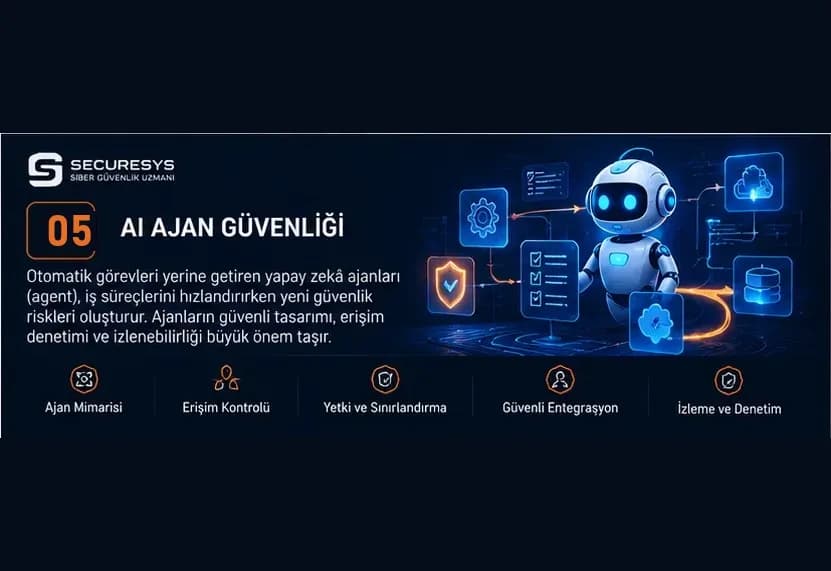
AI Agent Security: Autonomous AI, Tool Calling and MCP Risks
What is AI Agent security? Explore MCP, Tool Calling, Prompt Injection, privilege escalation, data leakage and secure architecture for autonomous AI agents.
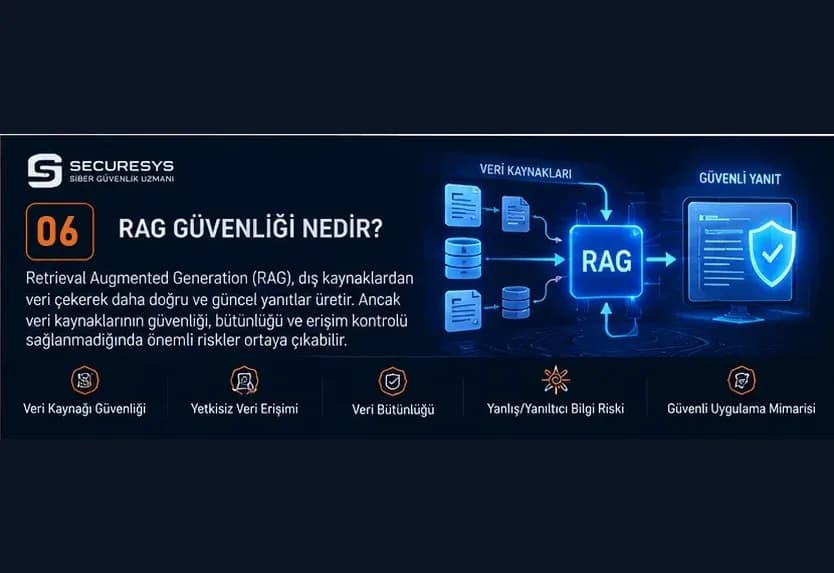
What Is RAG Security? Vector Database, Document Poisoning and Enterprise Data Leakage Risks
What is RAG security? Understand vector database, embedding, document poisoning, prompt injection and enterprise data leakage risks in RAG systems.
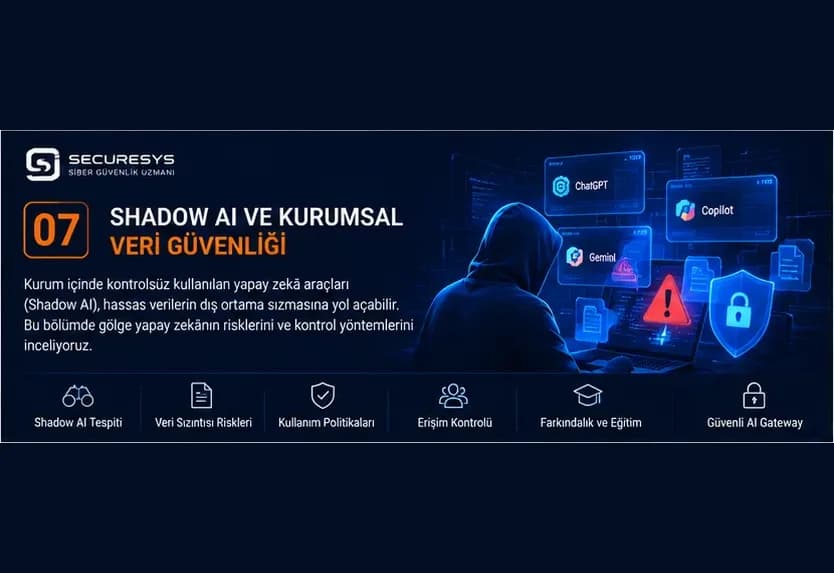
Shadow AI and Corporate Data Security: KVKK, GDPR and Protecting Sensitive Data in AI
What is Shadow AI? Uncontrolled employee AI use, corporate data leakage, KVKK, GDPR, AI DLP, data masking and AI Gateway methods to protect sensitive data.
Looking for professional support on this topic?
Our expert team will reach out for a free consultation as soon as possible.