AI Agent Security: Autonomous AI, Tool Calling and MCP Risks
What is AI Agent security? Explore MCP, Tool Calling, Prompt Injection, privilege escalation, data leakage and secure architecture for autonomous AI agents.
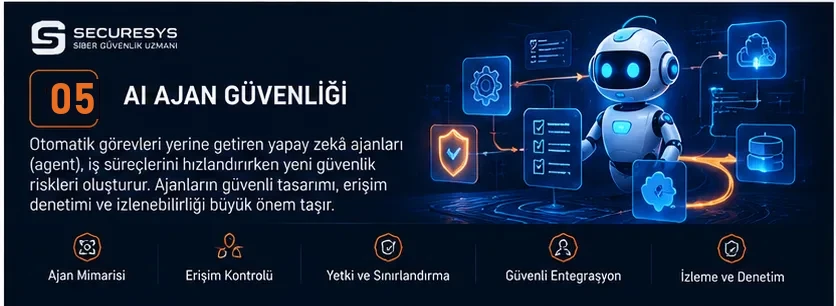
Introduction: AI No Longer Just Answers, It Also Takes Action
A new era has begun in AI applications.
The core task of the first generation of enterprise AI applications was to produce information.
A user asked a question and the model answered.
A document was uploaded and the model prepared a summary.
A text was submitted and the model translated it.
Security risks mattered in these systems, but the actions the model could carry out directly were mostly limited.
Today, AI systems are increasingly connected to enterprise tools.
They can access email systems.
They can create calendar entries.
They can query customer information from CRM applications.
They can start workflows in ERP systems.
They can generate reports from databases.
They can modify files in software development environments.
They can perform certain administrative operations in cloud infrastructure.
At the centre of this transformation are AI Agents, that is, AI agents.
The fundamental difference between an AI Agent and a classic chatbot is that, instead of merely producing answers, it can use tools to reach specific goals and manage multiple steps of an operation.
For example, a user can give an AI agent the following instruction:
“Prepare this month's sales report, compare it with last month and create an email draft for my manager.”
To fulfil this task, the agent can carry out different operations.
First, it accesses the sales data.
Then it creates the report.
It compares the results with the previous period.
It summarises the findings.
Finally, it prepares the email draft.
When this process is designed correctly, it can deliver significant efficiency.
However, the same architecture creates new security responsibilities.
What happens if the agent accesses the wrong data?
What happens if it follows the instructions in a malicious document?
What happens if it runs with more privileges than it needs?
What happens if it starts an operation the user did not want?
What happens if one of the tools it is connected to is compromised?
These questions are no longer only about the behaviour of the AI model.
They are directly about the security of enterprise information systems.
In AI Agent security, the core objective is less about controlling what the AI thinks and more about securing which operations it can perform and with which privileges.
1. What Is an AI Agent?
An AI Agent is an AI-based system that can gather information from its environment, evaluate the current context, use appropriate tools and carry out one or more operational steps in order to reach a specific goal.
Not every AI Agent is equally autonomous.
Some agents only produce recommendations.
Some carry out operations with user approval.
Others can run automatically within predefined boundaries.
For this reason, it would be wrong to limit the concept of an AI Agent to fully independent systems.
Core components of an AI Agent
An AI agent can generally consist of the following components:
Model: Interprets the user request, produces information and generates recommendations for the next operation.
Instructions: Define the agent's task, its behavioural boundaries and its operating rules.
Tools: Allow it to interact with external systems.
Context: Includes user messages, documents, past operations and other relevant information.
Orchestration layer: Manages model calls, tool usage and workflows.
Security controls: Apply authentication, authorisation, approval, data protection and audit functions.
All of these components must be assessed from a security perspective.
This is because a security problem may not stem solely from the text the model produces.
An API the agent is connected to, or a misconfigured service account, can also create serious risk.
2. The Difference Between an AI Agent and a Traditional Chatbot
Traditional chatbot systems are mostly used to present information to the user.
AI Agent systems, by contrast, can perform operations beyond generating information.
| Feature | Traditional Chatbot | AI Agent |
|---|---|---|
| Core function | Answering questions | Goal-oriented task execution |
| Tool usage | May be absent or limited | Can be one of its core capabilities |
| Multi-step operations | Usually limited | Can manage multiple steps |
| Data access | Information sources | Information sources and transactional services |
| Autonomy | Low or limited | Varies by design |
| Security impact | Mostly information and output | Information, data modification and operations |
| Critical control | Data access and output security | In addition to these, operation authorisation |
This distinction is important.
This is because a chatbot giving a wrong answer and an AI Agent performing a wrong operation do not have the same impact.
For example, a customer support chatbot giving incorrect product information may affect customer satisfaction.
However, a customer support agent modifying the wrong customer record can directly create a data integrity problem.
For this reason, AI Agent security requires a broader operational security approach than traditional LLM security.
3. What Is Agentic AI?
Agentic AI refers to AI systems operating with agent-like capabilities such as planning, tool usage and multi-step task execution in order to reach specific goals.
In this approach, the model may not be limited to answering a single question.
For example, a user can assign the following task:
“Analyse last month's open support tickets, identify the most frequent problems and prepare a report for management.”
The agent can break this task down into sub-steps.
It queries the support tickets.
It classifies the data.
It generates statistics.
It prepares the report.
It presents the results to the user.
However, each new step may require a new security assessment.
For example, the privilege needed to read support tickets is different from the privilege to modify customer records.
For this reason, in Agentic AI architectures, task planning and operation authorisation must be separated from each other.
A model may plan a workflow; however, it must not have the authority to change security policies.
4. What Is AI Agent Security?
AI Agent security is the protection of the data sources, tools, operational privileges and workflows used by AI agents against security risks.
In this scope, both traditional cybersecurity risks and AI-specific threats are assessed.
For example:
- Unauthorised data access.
- Excessive authorisation.
- Prompt Injection.
- Insecure tool calls.
- MCP integration risks.
- Sensitive data leakage.
- Uncontrolled operation chains.
- Manipulation of tool outputs.
- Credential security.
- Lack of auditing and traceability.
Three questions lie at the foundation of AI Agent security:
What can the agent access?
What can the agent do?
How are the operations the agent performs controlled?
The answers to these questions must be enforced through reliable application and infrastructure controls.
5. What Is Tool Calling?
Tool Calling is the mechanism that allows an AI model to propose structured calls in order to use functions defined by the application.
For example, an organisation may have an AI Agent integrated with its customer management system.
The user asks the following question:
“Get the last three orders of customer ABC.”
The model can generate a defined tool call to retrieve the relevant customer information.
For example, conceptually:
{
"tool": "get_customer_orders",
"arguments": {
"customer_id": "ABC"
}
}
In this example, the model is proposing that the get_customer_orders tool be used.
However, there is an important distinction.
The model generating a tool call does not mean the tool must necessarily be executed.
The application layer must evaluate the request.
It must verify the user's identity.
It must check the access privilege for the relevant customer record.
It must validate the parameters.
Then it must make a decision according to the operation policy.
In Tool Calling security, the model's proposal and the application's permission to perform the operation must be kept separate.
6. Tool Calling Security Risks
Tool Calling mechanisms can create different security risks.
Unauthorised tool use
The model can be targeted to call a tool that the user does not have access privileges for.
For example, a standard user may attempt to have an administrator function executed.
Incorrect parameter use
The model may send incorrect or unexpected parameters to a tool call.
This can lead to data integrity or business logic problems.
Excessive authorisation
A tool may have broader access privileges than necessary.
Insecure output handling
Data returned from a tool may be processed insecurely by the model or the application.
Lack of auditing
If tool calls are not logged, investigating incidents can become difficult.
These risks cannot be resolved at the model level alone.
Application, API and infrastructure controls must be applied together.
7. Excessive Agency: Over-Privileged AI Agents
Excessive Agency is the security risk associated with granting an AI agent more operational privileges than it needs to perform its task.
For example, an AI Agent's task may be only to view customer orders.
However, if the agent also has the privilege to cancel orders and modify customer information, unnecessary risk arises.
Example scenario
Let us imagine a reporting assistant used in a financial institution.
The assistant's task is to query financial data and prepare reports.
However, the database connection is configured with a broadly privileged account.
In addition to reading data, this account can also perform data modification operations.
In this case, the model proposing an incorrect tool call can lead to more serious consequences.
Protection approach
Read and write privileges must be separated.
Service accounts specific to the agent's task must be used.
Separate authorisation must be applied for critical operations.
Unnecessary tools must be removed from the agent environment.
Agent privileges must be reviewed regularly.
This approach is the application of the principle of least privilege to AI Agent architectures.
8. AI Agents and Least Privilege
Least Privilege aims to ensure that users and systems hold only the privileges required for their tasks.
This principle is particularly important in AI Agent systems.
This is because agents can access multiple tools.
For example, an agent can:
Connect to the CRM system.
Use the email service.
Retrieve information from the document management system.
Call the reporting API.
Granting broad privileges to all of these tools creates unnecessary risk.
Task-based authorisation
A reporting agent can be given read-only privileges.
A support agent can be granted only the privilege to create support tickets.
A calendar agent can be permitted to operate only on specific calendars.
This approach can limit the potential impact in the event of an attack or a model error.
9. What Is MCP?
MCP is the abbreviation of Model Context Protocol.
Model Context Protocol is an open protocol that makes it easier for AI applications to interact with external data sources and tools in a standardised way.
MCP can make the integration of different AI applications with various systems more orderly.
For example, through MCP an AI application can:
Access the file system.
Query enterprise knowledge sources.
Use database tools.
Connect to development tools.
Interact with business applications.
However, ease of integration does not remove security requirements.
On the contrary, as more tools and data sources are used, security boundaries must be defined clearly.
10. How Does the MCP Architecture Work?
The MCP architecture contains different components.
In general:
MCP Host: The application that delivers the AI experience.
MCP Client: The component that carries out protocol communication with the MCP server.
MCP Server: The component that exposes tools, resources or other supported capabilities.
For example, a desktop AI application can obtain information, through an MCP client, from an MCP server connected to the enterprise document system.
In this architecture, the following questions are important from a security standpoint:
Is the MCP server trustworthy?
With which identity does the client connect?
Which tools can be used?
How is data access restricted?
How are tool outputs processed?
How are credentials protected?
Without answers to these questions, the mere presence of MCP support does not mean a secure integration.
11. What Is MCP Security?
MCP security is the secure management of the tools, data sources, authentication mechanisms and operational privileges exposed through MCP.
MCP is an integration protocol.
It does not, on its own, solve all application security problems.
For example, an MCP server may expose a database query tool.
However, which user can use this tool on which records must be controlled separately.
Similarly, an MCP server being trustworthy does not mean that all the tools it exposes can be used with unlimited privileges.
Core areas of MCP security
Server trustworthiness.
Authentication.
Authorisation.
Tool access control.
Data security.
Operation auditing.
Secure communication.
Supply chain security.
These controls must be assessed together.
12. The Malicious MCP Server Risk
An AI application can connect to different MCP servers.
Not all of these servers may have the same level of trustworthiness.
For example, an organisation may want to use an externally sourced MCP integration.
However, the source, code and access privileges of the integration may not have been sufficiently reviewed.
In this case, a security risk arises.
Possible risks
The MCP server may request more data than expected.
Tool descriptions may contain manipulative content.
Tool outputs may contain untrusted instructions.
The server may forward sensitive information to inappropriate destinations.
Protection approach
MCP servers must be obtained from trusted sources.
Integrations must undergo a security assessment.
Unnecessary tools must not be enabled.
Network access must be restricted.
Credentials must be managed securely.
The data the MCP server can access must be explicitly defined.
13. Tool Description Poisoning
Tool Description Poisoning is an attack approach that aims to influence model behaviour by manipulating the tool descriptions presented to an AI agent.
An AI Agent can rely on tool descriptions to understand which tool does what.
For example, a tool description might read:
“This tool queries customer orders.”
and nothing more.
However, a tool description controlled by an attacker may contain additional instructions aimed at changing the model's behaviour.
In this case, the tool description stops being merely technical metadata and becomes a Prompt Injection surface.
Security principle
Tool descriptions must be obtained from trusted sources.
Tool privileges must be determined by application policies, not by the description text.
New or modified tools must be subject to a security assessment.
This risk is particularly important in AI Agent systems that use dynamic tool discovery.
14. Tool Output Poisoning
Tool Output Poisoning is an attack approach that aims to influence model behaviour by manipulating the data a tool returns.
For example, an AI Agent can use a tool to read a web page.
The tool returns the page content to the model.
However, the content may be controlled by an attacker.
If the model interprets this content as an instruction rather than merely as information, a security problem can arise.
Example scenario
An agent collects data from external sources to compare product prices.
A data source controlled by an attacker includes, along with the price information, instructions aimed at changing the model's evaluation method.
In this case, the comparison result produced by the model can be manipulated.
Protection approach
Tool outputs must be treated as untrusted data.
Critical decisions should, wherever possible, be verified with structured data and independent rules.
Tool outputs must not be allowed to create new operational privileges.
15. Prompt Injection in AI Agent Systems
Prompt Injection is one of the key threats to AI Agent security.
This is because content controlled by an attacker can influence the model's behaviour.
For example:
A customer support message.
A PDF document.
A web page.
An email.
A repository file.
An MCP tool output.
All of this content can be a potential attack surface.
Why can it create higher risk for an AI Agent?
A classic chatbot can only produce an incorrect answer.
An AI Agent, however, can perform operations through the tools it is connected to.
For this reason, manipulating the model's behaviour can turn into a real system impact.
Core defence
Untrusted content gaining the authority of an instruction must be restricted.
Tool calls must be verified independently.
Agent privileges must be limited on a task basis.
Approval mechanisms must be applied for critical operations.
16. AI Agents and Unauthorised Data Access
AI Agent systems can access different data sources.
However, not all users may be authorised to access all data.
For example, an organisation's AI assistant may be connected to the CRM system.
Sales staff can view their own customer records.
Regional managers can access the records of specific teams.
Senior management can reach broader reports.
In this case, the AI Agent's data access must be aligned with the user's actual privileges.
The security problem
The agent may be able to query all customer records with a broadly privileged service account.
If the application does not apply user-based authorisation, a data leakage risk can arise.
Secure approach
The user's identity must be verified.
Data access must be restricted according to user privileges.
Tenant isolation must be applied.
The service account used by the agent must comply with the principle of least privilege.
Critical data accesses must be logged.
17. The Confused Deputy Problem and AI Agents
Confused Deputy is a security problem in which the privileges held by a system are used inappropriately at the direction of another party.
This risk is important in AI Agent systems.
This is because the agent can interpret requests coming from the user or from external content and perform operations with its own tool privileges.
For example, an agent may have a broadly privileged enterprise account.
An attacker, on the other hand, may not be able to access this account directly.
However, by manipulating the agent, they may aim to have the account's privileges used inappropriately.
Protection approach
The agent's technical privileges and the user's business privileges must be assessed separately.
The actual user context must be verified before the operation.
Tool access must be restricted on a task basis.
Critical operations must pass through independent policy checks.
This approach helps reduce privilege misuse in AI Agent systems.
18. What Is Human-in-the-Loop?
Human-in-the-Loop is the inclusion of human review or approval in the process for certain AI operations.
It is an important control in AI Agent systems, particularly for high-impact operations.
For example:
Generating a report.
Preparing an email draft.
Offering a calendar suggestion.
Operations such as these may be low risk.
However:
Transferring money.
Deleting customer data.
Changing a user's privileges.
Sending bulk email.
Changing configuration in a production system.
Operations such as these carry higher risk.
For this reason, human approval may be required for critical operations.
How should human approval be implemented?
What the operation will do must be shown to the user clearly.
The data and systems the operation will affect must be specified.
Critical parameters must be verified.
The approval must be logged.
However, human approval alone is also not sufficient.
The operation performed after approval must match the approved scope.
19. Security in AI Agent Operation Chains
AI Agent systems can use multiple tools sequentially.
For example:
Customer information is retrieved from the CRM.
Payment status is queried from the finance system.
Open tickets are fetched from the support system.
A report is generated.
An email draft is prepared.
In this process, each step may have different data and privilege requirements.
Security risk
Untrusted content obtained in one step can influence subsequent steps.
For example, the description field in a customer record may aim to manipulate the model's subsequent tool selection.
Protection approach
Each tool call must be evaluated separately.
The total privilege scope of the operation chain must be checked.
Untrusted content must not be used as instructions in subsequent steps.
Additional verification must be applied for critical operations.
This approach is important in multi-step agent systems.
20. Security in Multi-Agent Systems
In Multi-Agent architectures, multiple AI agents can work together.
For example:
One agent collects data.
Another agent performs analysis.
A third agent generates the report.
A fourth agent transfers the results to the relevant system.
This structure can enable the separation of tasks.
However, it creates new questions from a security standpoint.
What information can agents pass to one another?
How trustworthy is an instruction produced by one agent for another agent?
Are the agents using the same service account?
Which agent is responsible for which operation?
Security approach
Explicit trust boundaries must be defined between agents.
Each agent must access only the tools it needs.
Messages between agents must be assessed from a security perspective.
Responsibility for critical operations and audit logs must be determined.
Content produced by one agent must not be automatically accepted as highly trusted by another agent.
21. AI Agent Credential Security
AI Agent systems can use credentials to connect to various services.
For example:
API key.
OAuth token.
Service account.
Database connection information.
Cloud access identity.
The security of this information is critically important.
Risks
Storing credentials in source code.
Writing tokens to logs.
The agent operating with unnecessarily broad access privileges.
Passing credentials into the external model context.
Uncontrolled use of long-lived access keys.
Protection approach
Centralised secrets management must be used.
Short-lived credentials should be preferred wherever possible.
Service accounts must be configured according to the principle of least privilege.
Credential access must be monitored.
Credentials must not be included in the model prompt unnecessarily.
22. Data Leakage in AI Agent Systems
AI Agent systems can access different enterprise data sources.
For this reason, the risk of data leakage does not arise only in the model's responses.
For example, an agent can send a document to an external service.
It can forward a report to the wrong recipient.
It can pull more data than necessary through an API.
Or it can write sensitive information to logs.
Methods to reduce data leakage
Data minimisation must be applied.
The data sources the agent can access must be restricted.
External data transfer must be controlled.
Sensitive information must be masked where appropriate.
Critical data operations must be logged.
These controls are core components of AI Agent security.
23. AI Agents and Audit Logs
In AI Agent systems, audit logging is important for security and accountability.
This is because an agent can perform a large number of operations.
For example, it can query a customer record.
It can create a file.
It can prepare an email draft.
It can start a workflow.
It must be known on behalf of which user and with which privilege these operations were performed.
Information that can be included in an audit log
The user who initiated the operation.
The agent identity.
The tool used.
The time of the operation.
The result of the operation.
The approval status.
The security policy decision.
However, care must be taken during logging not to store sensitive data unnecessarily.
Secure logging must strike an appropriate balance between traceability and data minimisation.
24. Rate Limiting and Operation Limits in AI Agent Security
AI Agent systems can make a large number of tool calls.
This can create risk in terms of resource consumption and cost.
For example, a misconfigured agent can call the same API repeatedly.
An operation loop can take longer than expected.
External model usage costs can increase.
Protection methods
The number of tool calls must be limited.
Operation timeouts must be defined.
User-based and agent-based quotas must be applied.
Cost limits must be set.
Unexpected operation loops must be monitored.
These controls are important for both security and operational sustainability.
25. Using a Sandbox in AI Agent Security
A sandbox is an isolated environment in which applications or operations are run within defined boundaries.
In AI Coding Agents and similar systems, using a sandbox can be an important security control.
For example, a coding agent can use terminal commands to run tests.
Running these commands directly on a production server creates unnecessary risk.
Instead, the agent can be run in an isolated development environment.
Sandbox security controls
File system access must be restricted.
Network access must be controlled.
Sensitive credentials must be kept out of the environment.
Resource consumption must be limited.
The runtime environment must be refreshed regularly.
However, using a sandbox does not mean that all risks have been eliminated.
The sandbox configuration itself also needs a security assessment.
26. What Is AI Agent Security Testing?
AI Agent Security Testing is the assessment of AI agents in terms of data access, tool usage, authorisation and operational security.
These tests are broader in scope than merely examining the answers the model gives.
Test areas
Prompt Injection.
Tool Calling security.
MCP integrations.
Excessive authorisation.
Unauthorised data access.
Credential security.
Insecure output handling.
Operation chain manipulation.
Audit logs.
Test methodology
First, the agent architecture must be understood.
Then the data sources and tools must be identified.
Trust boundaries must be defined.
Risk-based attack scenarios must be prepared.
The real system impact of the findings must be verified.
Finally, remediation and retesting must be carried out.
27. MCP Security Testing
Special security assessments can be carried out on AI Agent systems that use MCP integrations.
For example:
The trustworthiness of the MCP server.
The authentication mechanism.
Tool authorisation.
The security of tool descriptions.
The processing of tool outputs.
The data access scope.
Credential management.
Network security.
Each of these controls must be assessed according to the architecture of the integration.
For example, the risks of an MCP server that accesses the local file system may differ from those of an MCP server that connects to an external SaaS API.
For this reason, MCP security should not be limited to a single checklist.
28. Example Scenario: An Enterprise CRM AI Agent
Let us imagine an organisation develops an AI agent that works on top of its CRM system.
The agent's tasks are as follows:
Querying customer records.
Listing open opportunities.
Preparing a sales report.
Summarising meeting notes.
In the first phase, the agent has read-only privileges.
Later, new features are added.
Updating customer records.
Changing the opportunity stage.
Creating email drafts.
At this point, the security risks increase.
Risk 1: Unauthorised customer access
The agent may be able to view customer records belonging to another sales representative.
Risk 2: Prompt Injection
Malicious content in the CRM description field can influence the agent's behaviour.
Risk 3: Excessive authorisation
The agent may unnecessarily hold the privilege to delete customer records.
Risk 4: Incorrect operation
The model may propose updating the wrong opportunity record.
Risk 5: Lack of auditing
It may not be possible to trace which customer record the agent modified.
Secure architecture
User-based authorisation must be applied.
Tool privileges must be restricted.
An approval mechanism should be considered for critical data changes.
Tool calls must be logged.
Prompt Injection and authorisation tests must be performed.
This example shows that AI Agent security is not only about model behaviour, but about enterprise operational security.
29. SECURESYS Approach to AI Agent Security
At SECURESYS, we believe that AI Agent security requires traditional application security, API security and AI security controls to be applied together.
This is because AI Agent systems do not merely produce information.
They can connect to enterprise systems.
They can read data.
They can start operations.
And with certain privileges, they can affect operational processes.
For this reason, the security assessment must go beyond model behaviour.
Depending on the project scope, the following areas can be addressed together:
AI Agent Security Assessment
Assessment of the agent architecture, data access and operational privileges.
Tool Calling Security Testing
Examination of tool calls in terms of authorisation, parameter validation and operational security.
MCP Security Assessment
Assessment of MCP servers, tool descriptions and integration security.
Prompt Injection Testing
Testing the effect of untrusted content on agent behaviour.
API Security Testing
Assessment of the authentication and authorisation controls of the services the agent is connected to.
Data Leakage Assessment
Examination of sensitive data access and transfer risks.
AI Gateway Architecture
Design of centralised policy, data protection and tool usage controls.
AI Red Teaming
Assessment of the agent system's security resilience with realistic attack scenarios.
In this approach, the core objective is not only to prevent the model from making incorrect decisions.
It is to ensure that the system's security boundaries are preserved even when the model makes an incorrect decision.
Particularly in enterprise AI Agent applications:
What the agent can do must be explicitly restricted by user and system policies.
30. AI Agent Security Checklist
Architecture security
- Has the agent architecture been documented?
- Have the models and tools in use been inventoried?
- Have the data sources been identified?
- Have trust boundaries been defined?
Authorisation
- Is the user's identity verified?
- Has tool access been restricted on a task basis?
- Is the principle of least privilege applied?
- Do critical operations pass through independent authorisation?
MCP security
- Do the MCP servers come from trusted sources?
- Have MCP tool privileges been assessed?
- Have tool descriptions and outputs been reviewed from a security perspective?
- Are credentials managed securely?
Data security
- Has sensitive data been classified?
- Is unnecessary data access prevented?
- Is external data transfer controlled?
- Is tenant isolation ensured?
Operational security
- Is there an approval mechanism for critical operations?
- Are tool calls logged?
- Have operation limits been defined?
- Are faulty operation chains monitored?
Security testing
- Has Prompt Injection been tested?
- Has Tool Calling security been assessed?
- Has MCP Security Testing been performed?
- Has unauthorised data access been tested?
- Has a retest been carried out for critical findings?
This checklist can be extended according to the organisation's AI Agent use case.
Frequently Asked Questions
What is an AI Agent?
An AI Agent is an AI-based system that can gather information, use tools and carry out multi-step tasks in order to reach specific goals.
What is AI Agent security?
AI Agent security is the secure management of AI agents' data access, tool usage, operational privileges and workflows.
What is Agentic AI?
Agentic AI refers to AI systems operating with agent-like capabilities such as planning, tool usage and multi-step task execution.
What is Tool Calling?
Tool Calling is the mechanism that allows a model to propose structured calls in order to use functions defined by the application.
What is MCP?
MCP is the abbreviation of Model Context Protocol. It makes it easier for AI applications to interact with external data sources and tools in a standardised way.
Why is MCP security important?
MCP integrations can give AI systems new data and operation access. For this reason, authentication, authorisation and tool security are important.
What is Excessive Agency?
Excessive Agency is the security risk associated with granting an AI agent broader operational privileges than it needs to perform its task.
What is Tool Description Poisoning?
It is an attack approach that aims to influence the model's tool selection or behaviour by manipulating tool descriptions.
What is Tool Output Poisoning?
It is an attack approach that aims to influence model behaviour by manipulating the data returned from tools.
Why is Prompt Injection dangerous in AI Agent systems?
AI Agent systems can perform operations with real tools. For this reason, manipulating the model's behaviour can turn into an operational security impact.
What is Human-in-the-Loop?
It is the inclusion of human review or approval in the process for certain AI operations.
What is the most important security control for an AI Agent?
A single control is not enough. Least privilege, independent authorisation, data security, operation approval and continuous security testing must be applied together.
What is an AI Agent Pentest?
An AI Agent Pentest is the assessment of AI agents' data access, tool usage, authorisation and operational security through controlled attack scenarios.
Are MCP servers secure?
The security of MCP servers depends on their source, configuration, privileges and the controls applied. Using MCP does not, on its own, provide a security guarantee.
Can an AI Gateway be used in AI Agent security?
Yes. Depending on product features, it can support centralised policy, data protection, model access and certain tool usage controls.
Conclusion: Granting AI Agents Capabilities Requires Limiting Their Privileges
AI Agent systems represent an important stage in the integration of AI technologies into enterprise business processes.
AI no longer just answers questions.
It connects to data sources.
It prepares reports.
It starts workflows.
It uses tools.
And in some cases, it performs real system operations.
These developments offer significant opportunities in terms of efficiency.
But they also increase security responsibility.
This is because a model producing a wrong answer and a model performing a wrong operation are not the same thing.
For an AI Agent to be secure, controlling the model's behaviour alone is not enough.
Data access must be restricted.
Tool privileges must be defined.
MCP integrations must be assessed.
Credentials must be protected.
Critical operations must pass through independent authorisation.
Human approval must be applied where necessary.
And all operations must be monitored appropriately.
In the face of threats such as Prompt Injection in particular, the core security principle must be clear:
A document or tool output that the model reads must not be able to change the agent's privileges.
A secure AI Agent architecture is not built on the assumption that the model will always make the right decision.
On the contrary, it accepts that the model can make mistakes or be manipulated.
The system is designed to preserve its security boundaries regardless.
For this reason, the core goal of AI Agent security is not to remove AI's capabilities.
It is to make those capabilities controlled and auditable.
An AI agent may be intelligent; but reliable security policies must decide which operations it can perform.
Related Articles
Software & AI Security
What Is Software and AI Security? New-Generation Cyber Threats in Modern Applications
What is software and AI security? Explore LLM, AI Agent, Prompt Injection, data leakage, model security and Secure AI SDLC risks for modern applications.
Security Risks of AI-Assisted Software Development: AI Code Assistants and Secure Code
Explore the security risks of AI-assisted software development: AI code assistants, insecure code generation, data leakage, SAST and a Secure Coding guide.
What Is LLM Security? Cyber Attacks on Large Language Models and How to Defend Against Them
What is LLM security? Prompt injection, data leakage, insecure output handling, model abuse and the enterprise security controls for large language models.
Prompt Injection and Jailbreak Attacks: How AI Systems Are Manipulated
What are Prompt Injection and Jailbreak? Explore direct and indirect attacks, RAG and AI Agent risks, realistic examples and LLM security controls.
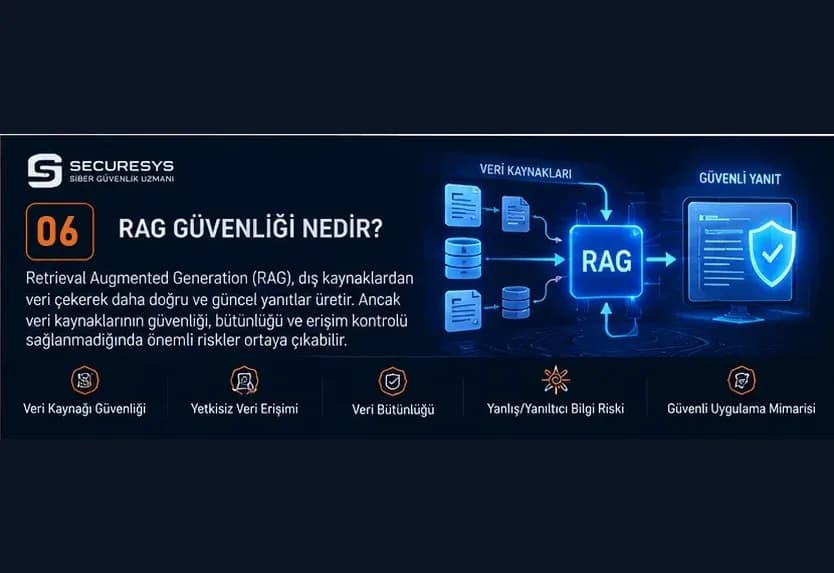
What Is RAG Security? Vector Database, Document Poisoning and Enterprise Data Leakage Risks
What is RAG security? Understand vector database, embedding, document poisoning, prompt injection and enterprise data leakage risks in RAG systems.
Shadow AI and Corporate Data Security: KVKK, GDPR and Protecting Sensitive Data in AI
What is Shadow AI? Uncontrolled employee AI use, corporate data leakage, KVKK, GDPR, AI DLP, data masking and AI Gateway methods to protect sensitive data.
Looking for professional support on this topic?
Our expert team will reach out for a free consultation as soon as possible.