What Is the NIS2 Directive? EU Cybersecurity Obligations, Risk Management and Compliance Guide
What is the NIS2 Directive? Scope, 24 and 72-hour incident reporting, risk management, management accountability, fines and NIS2 compliance advisory.
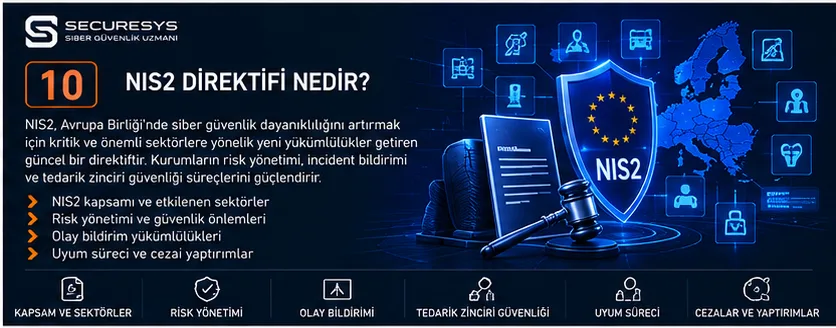
What Is the NIS2 Directive?
The NIS2 Directive is European Union legislation that aims to raise the cybersecurity level of organisations operating in critical and important sectors across the EU, and that regulates risk management, incident reporting, management accountability and supervision obligations.
Officially titled Directive (EU) 2022/2555, NIS2 widens the scope of the original NIS Directive and brings more sectors and types of organisation within cybersecurity obligations.
The core objective of NIS2 is to achieve a high, common level of cybersecurity for network and information systems across the European Union.
The Directive does not target the use of security technologies alone; it aims to ensure that organisations manage their cybersecurity risks, report security incidents on time, assess supplier risks and establish accountability at senior management level.
Quick facts about NIS2
| Topic | Description |
|---|---|
| Official instrument | Directive (EU) 2022/2555 |
| Core objective | Strengthening cybersecurity resilience across the EU |
| Scope | Certain organisations in critical and important sectors |
| Risk management | Article 21 |
| Incident reporting | Article 23 |
| Management accountability | Article 20 |
| Entity classification | Essential and Important Entities |
| Deadline for transposition into national law | 17 October 2024 |
| Supervision and penalties | National implementation by the relevant Member State |
Short answer: NIS2 compliance means that an organisation determines which obligations apply to it under the Directive and the applicable national legislation, and runs its cybersecurity risk management, incident reporting, supplier security and management oversight through demonstrable processes.
1. Why Was the NIS2 Directive Created?
As digital services and critical infrastructures become more interdependent, the impact of cybersecurity incidents grows wider.
A cyber incident at an energy distribution company can affect not only that company but also the businesses and individuals it serves.
Similarly, an outage at a cloud service provider can bring the operations of many organisations to a halt at the same time.
Although the original NIS Directive helped establish a common European approach to cybersecurity, there were areas to improve in terms of sector coverage, differences in implementation and supervision mechanisms.
NIS2 was prepared in response to these needs.
Core problems NIS2 focuses on
- Different levels of security maturity across critical sectors
- Cybersecurity risks originating in the supply chain
- Late or inadequate reporting of security incidents
- Insufficient cybersecurity oversight at management level
- Divergent practices between countries
- Growing dependence on cloud and managed service providers
- Ransomware and service disruption risks
NIS2 adopts a risk-based approach that recognises these problems cannot be solved simply by purchasing technology.
2. When Did NIS2 Enter into Force?
The NIS2 Directive entered into force in January 2023.
The deadline set for EU Member States to transpose the Directive into their national legislation was 17 October 2024.
As of 18 October 2024, NIS2 replaced the previous NIS framework.
However, how an EU directive applies in practice must be assessed together with the national legislation and competent authorities of the Member State concerned.
Points to watch as of 2026
Organisations should review the current legislation in the EU country in which they operate.
Registration and notification obligations may be handled through different administrative mechanisms depending on the country.
Supervisory powers and enforcement procedures are made concrete through national legislation.
In January 2026, the European Commission proposed certain targeted amendments to NIS2. Amendments that are only proposals must not be confused with the binding provisions currently in force until they are adopted and enter into force.
Important: An organisation's compliance assessment should be based not only on the text of the Directive but on the national legislation in force in the relevant country.
3. Which Sectors Does NIS2 Cover?
NIS2 addresses different sectors under Annex I and Annex II.
Annex I: Sectors of high criticality
Energy.
Transport.
Banking.
Financial market infrastructures.
Health.
Drinking water.
Waste water.
Digital infrastructure.
ICT service management (business-to-business).
Public administration.
Space.
Annex II: Other critical sectors
Postal and courier services.
Waste management.
Manufacture, production and distribution of chemicals.
Production, processing and distribution of food.
Certain manufacturing activities.
Digital providers.
Research organisations.
From a manufacturing perspective
It should not be assumed that all manufacturing companies automatically have the same status under NIS2.
The relevant manufacturing sub-sector, the size of the organisation, the services it provides and the national legislation must all be assessed.
4. What Are Essential Entities and Important Entities?
Under NIS2, organisations are classified, according to certain conditions, as Essential Entities and Important Entities.
This distinction matters particularly for the supervisory approach and the enforcement mechanisms.
| Criterion | Essential Entities | Important Entities |
|---|---|---|
| General approach | Organisations of higher criticality | Other important organisations within scope |
| Supervision | Proactive (ex ante) and reactive (ex post) supervisory powers | Generally a reactive (ex post) supervisory approach |
| Risk management | Article 21 obligations | Article 21 obligations |
| Incident reporting | Article 23 obligations | Article 23 obligations |
| Penalties | Maximum limits specific to the relevant category | Maximum limits specific to the relevant category |
An important distinction
Essential or Important status is not determined by looking at the sector name alone.
The size of the organisation, its activities and the specific classification provisions set out in the Directive are taken into account.
For some types of organisation there are special rules that apply regardless of size.
5. How Is Company Size Assessed under NIS2?
NIS2 generally focuses on medium-sized and large organisations operating in the sectors concerned.
However, size criteria alone are not sufficient.
The assessment considers
Number of employees.
Annual turnover.
Balance sheet total.
Relationships with partner and linked enterprises.
Sector of activity.
Criticality of the service provided.
Specific determinations made by the Member State.
Example
When assessing whether a company providing managed security services in the EU falls within the scope of NIS2, not only the number of employees but also the nature of the service and any applicable special provisions must be examined.
Critical point
It cannot be said that all small organisations are automatically out of scope.
The Directive contains cases in which it applies regardless of size.
6. Are Companies in Türkiye Affected by NIS2?
Türkiye is not a member of the European Union.
For this reason, it cannot be said that the NIS2 Directive applies directly and generally to all companies in Türkiye.
That said, companies in Türkiye may encounter NIS2-related obligations for various reasons.
First scenario: Operating in the EU
The services an organisation provides in the EU and its operating structure may be assessed under the NIS2 implementation of the country concerned.
Second scenario: A subsidiary in the EU
The EU subsidiary of a group headquartered in Türkiye may fall within scope.
Third scenario: Supplier relationships
A customer in the EU that is within the scope of NIS2 may require its supplier to meet contractual security obligations.
Fourth scenario: Managed services
Organisations that qualify as an MSP or MSSP and operate in the EU market may require a specific assessment.
Example
A company that develops software in Türkiye provides services to a critical infrastructure operator in the EU.
The customer may set requirements in the contract covering security testing, incident reporting, access control and supply chain security.
This does not mean that the supplier in Türkiye is automatically an Essential Entity under NIS2.
Conclusion: For organisations in Türkiye, direct legal scope and contractual security requirements arising from customers should be assessed separately.
7. NIS2 Article 20: Accountability of Senior Management
One of the notable aspects of NIS2 is that it ties cybersecurity risk management to the accountability of senior management.
Under Article 20, the management bodies of the organisations concerned must approve cybersecurity risk-management measures and oversee their implementation.
There are also provisions requiring members of management bodies to receive appropriate training.
Topics that can be addressed at management level
Cybersecurity strategy.
Risk appetite.
Acceptance of critical risks.
Security investments.
Incident response readiness.
Supplier risks.
Business continuity.
Audit results.
Example
The information security team identified a critical gap in access control.
Remediating the risk requires investment.
Management must assess the risk and the recommended measures and make the necessary decisions.
Critical point
NIS2 compliance is not a responsibility that can be completed by handing it over to the IT department alone.
8. NIS2 Article 21: Cybersecurity Risk Management
NIS2 Article 21 requires organisations within scope to take appropriate and proportionate technical, operational and organisational cybersecurity risk-management measures.
The measures must be assessed according to the risks the organisation is exposed to, its size, the likely impact of incidents and other applicable conditions.
Core measure areas under Article 21
| Area | Implementation example |
|---|---|
| Risk analysis and security policies | Enterprise risk methodology |
| Incident handling | SOC, response procedures |
| Business continuity and crisis management | Backup, disaster recovery |
| Supply chain security | Supplier risk assessment |
| Secure system development and maintenance | Secure SDLC, vulnerability management |
| Assessing the effectiveness of measures | Control testing and audits |
| Cyber hygiene and training | Awareness, baseline security controls |
| Cryptography | Encryption and key management |
| Human resources and access security | IAM, asset management |
| MFA and secure communications | Appropriate authentication and communication controls |
Key point
Article 21 is not a product list that mandates the use of a single brand or technology.
Security measures must be implemented on a risk basis and in a demonstrable way.
9. How Is a NIS2 Risk Analysis Carried Out?
Risk analysis starts with the organisation understanding its critical services and the systems that support them.
Step 1: Identifying critical services
Which services are important to customers or to society?
Which services, if disrupted, could cause serious impact?
Step 2: Asset inventory
Servers.
Applications.
Databases.
Cloud systems.
Network devices.
OT systems.
Third-party connections.
Step 3: Threat analysis
Ransomware.
Credential theft.
Supplier breach.
DDoS.
Insider threats.
Misconfigurations.
Step 4: Impact assessment
Service disruption.
Financial loss.
Customer impact.
Legal consequences.
Operational damage.
Step 5: Risk treatment
Risk reduction.
Risk avoidance.
Risk sharing.
Justified risk acceptance.
Example risk record
| Field | Example |
|---|---|
| Critical service | Cloud-based customer application |
| Threat | Compromise of an administrator account |
| Vulnerability | Lack of MFA |
| Impact | Service disruption and data access |
| Control | Phishing-resistant MFA, PAM, monitoring |
| Owner | IT and information security |
| Verification | Access testing and log review |
10. Incident Management under NIS2
NIS2 requires organisations not only to detect cybersecurity incidents but also to respond to them appropriately.
Stages of incident management
Preparation.
Detection.
Analysis.
Classification.
Response.
Recovery.
Notification.
Post-incident review.
Example
Ransomware activity is detected in an organisation's critical application.
The SOC team verifies the alert.
The response team identifies the affected systems.
The business continuity team assesses the impact on the service.
The legal and compliance teams review the NIS2 notification requirements.
Senior management is informed.
Critical point
Not every security alert is a significant incident subject to notification under NIS2.
The incident must be assessed against the significance criteria in the relevant legislation.
11. What Are the NIS2 Incident Reporting Deadlines?
NIS2 Article 23 provides for a staged reporting approach for significant incidents.
Reporting timeline
| Stage | General deadline | Purpose |
|---|---|---|
| Early warning | Within 24 hours of becoming aware at the latest | To make the competent authority aware of the incident |
| Incident notification | Within 72 hours of becoming aware at the latest | Initial assessment of impact and severity |
| Intermediate report | Upon request by the competent authority | Sharing the current status |
| Final report | Within one month of the 72-hour incident notification at the latest | Detailed assessment of the incident |
Special cases
Different reporting conditions may apply to certain trust service providers.
If the incident is still ongoing at the final report stage, a progress report and a later final report may be required.
Critical point
The 24-hour and 72-hour deadlines do not mean that all cybersecurity incidents must be reported automatically.
The definition of a significant incident and the implementation in the relevant country must be taken into account.
12. How Is a Significant Incident Determined under NIS2?
Under NIS2 Article 23, criteria such as severe operational disruption of services, financial loss, or considerable damage to other natural or legal persons are assessed in deciding whether an incident is significant.
Example indicators
Unavailability of a critical service.
A significant number of customers affected.
Severe operational disruption.
High financial impact.
Cross-border impact.
Considerable material or non-material damage.
Example
A short-lived security alert with limited impact may fall outside the scope of reporting after the necessary review.
By contrast, an attack that seriously disrupts a critical service may require notification.
Key point
For certain digital service providers, Implementing Regulation 2024/2690 sets out the criteria for significant incidents in more detail.
13. How Is a 24-Hour Early Warning Prepared?
The purpose of the early warning is to inform the competent authority about a significant incident without waiting for all technical details to be completed.
Information that can be considered in preparation
Time the incident was detected.
Affected service.
Initial incident classification.
Suspected malicious activity.
Possible cross-border impact.
Status of the initial response.
Example
Unauthorised access is detected on the critical management platform of a managed service provider.
Initial analysis suggests that some customer services may have been affected.
The organisation quickly assesses whether the incident meets the significant-incident criteria and starts the applicable notification process.
Critical point
The early warning is not designed to wait for the final forensic report to be prepared.
14. How Is a 72-Hour Incident Notification Prepared?
The incident notification updates the information obtained after the early warning.
Content examples
Initial technical assessment of the incident.
Affected systems.
Impact on the service.
Severity of the incident.
Indicators of compromise, if known.
Initial measures taken.
Technical evidence
Security logs.
SIEM alerts.
EDR records.
Network traffic.
System timeline.
Key point
Evidence integrity must be preserved while preparing the notification, and unverified information must not be presented as a definitive finding.
15. Is a SOC Service Mandatory for NIS2?
NIS2 does not explicitly require all organisations to purchase a specific commercial SOC service.
However, appropriate capabilities must be established for detecting, analysing and responding to security incidents.
Contributions a SOC can make
Centralised security monitoring.
Event correlation.
Threat detection.
Alert prioritisation.
Incident escalation.
Response coordination.
Reporting.
When can 24/7 monitoring be considered?
If critical services run without interruption.
If the impact of an incident is high.
If rapid response to attacks is required.
If there are contractual or sectoral requirements.
Conclusion
A SOC is one of the important operational capabilities that support NIS2 risk management; however, it does not by itself deliver regulatory compliance.
16. How Does a SIEM Support NIS2 Compliance?
SIEM systems can centrally evaluate event logs collected from different security sources.
Log sources
Firewall.
VPN.
Active Directory.
Servers.
Cloud infrastructures.
EDR.
Databases.
Critical applications.
Example correlation
An administrator account logs in from an unusual country.
Privileged access is then performed.
Shortly afterwards, a high-volume data transfer is observed.
If suitable use cases have been defined, the SIEM can correlate these activities.
Key point
Collecting logs alone is not sufficient.
Log integrity, time synchronisation, alert quality and incident response processes must also be assessed.
17. NIS2 and Supply Chain Security
Supply chain security is one of the core risk-management areas under NIS2 Article 21.
Organisations are expected to assess the security risks in their relationships with their direct suppliers and service providers.
Example suppliers
Cloud providers.
Software developers.
MSP and MSSP organisations.
Data centre service providers.
Network service providers.
Industrial automation suppliers.
Assessment topics
The supplier's security maturity.
Data access.
Remote access methods.
Subcontractors.
Reporting of security incidents.
Business continuity.
Service termination.
Example
The remote maintenance provider of an energy company has access to OT systems.
This access must be assessed in terms of authentication, session recording, authorisation and access duration.
18. What Should NIS2 Supplier Contracts Contain?
Contractual security provisions help manage supplier risks.
Example headings
Security responsibilities.
Access control.
Confidentiality.
Incident reporting obligations.
Subcontractor management.
Security testing.
Audit rights.
Data return and destruction.
Service continuity.
Example approach
A contractual process can be created requiring a critical service provider to inform its customer without delay when it detects a security incident.
Critical point
The notification deadline in a supplier contract and the organisation's own NIS2 notification to the competent authority are separate obligations.
The processes should be designed so that they support each other.
19. NIS2 and Vulnerability Management
Vulnerability management covers identifying, prioritising and remediating security weaknesses in systems.
Process
Asset discovery.
Vulnerability detection.
Risk assessment.
Prioritisation.
Remediation.
Re-verification.
Prioritisation criteria
Technical severity of the vulnerability.
Information on active exploitation.
Whether the system is exposed to the internet.
Impact on critical services.
Existing compensating controls.
Example
An internet-facing VPN appliance has a critical vulnerability that is being actively exploited.
This risk must be assessed not only by its CVSS score but together with its accessibility and business impact.
20. Penetration Tests under NIS2
Penetration tests can support the assessment of the effectiveness of security controls.
Example test areas
External network.
Internal network.
Web applications.
Mobile applications.
API.
Active Directory.
Cloud infrastructure.
Wireless network.
OT systems.
Example
An authorisation vulnerability is found in a critical customer portal.
The finding is fed into the risk management process.
The fix is applied.
A retest is performed.
Critical point
NIS2 does not contain a general schedule prescribing the same scope and frequency of penetration testing for all organisations.
Tests should be planned according to risks and any applicable specific requirements.
21. NIS2 and Secure Software Development
NIS2 covers security measures relating to the acquisition, development and maintenance of network and information systems.
Secure development practices
Security requirements.
Threat modelling.
Secure coding.
Source code analysis.
Dependency security.
Security testing.
Change management.
Example
An organisation develops in-house the software that delivers its critical service.
Requirements for authentication, access control and secure data handling must be addressed during the development phase.
Key point
SAST, DAST and SCA tools can support secure development processes.
However, using these tools alone does not satisfy all NIS2 obligations.
22. NIS2 and Business Continuity
NIS2 treats business continuity and crisis management as part of its risk-management measures.
Core components
Business impact analysis.
Identifying critical services.
Recovery priorities.
Backup.
Disaster recovery.
Crisis communication.
Exercises.
RTO and RPO
RTO: The target recovery time of the service.
RPO: The acceptable data loss target.
Example
A critical application of a healthcare organisation becomes unavailable.
The business continuity plan must already define an alternative way of working and recovery priorities.
Critical point
Taking a backup is not the same as being able to recover successfully from it.
Restore tests must be carried out.
23. The NIS2 Approach to Ransomware
Ransomware attacks can cause service disruption, data loss and operational damage.
Defence layers
MFA.
EDR/XDR.
Network segmentation.
Patch management.
Privileged access management.
Secure backup.
Incident monitoring.
Response exercises.
Example
An attacker uses a compromised administrator account to try to reach the backup systems.
Privileged access controls, network separation and a secure backup architecture can reduce the impact of the incident.
Key point
Ransomware defence should not rely on a single security product.
24. NIS2 and Cloud Security
Cloud services matter under NIS2 both as critical supplier relationships and in respect of certain provider categories.
Assessment areas
Cloud asset inventory.
Identity and access management.
Configuration security.
Logging.
Encryption.
Backup.
Incident management.
Supplier responsibilities.
Example
An organisation runs its critical customer service on a cloud platform.
The cloud provider's security responsibilities must be distinguished from the customer's responsibilities for configuration and access security.
Critical point
The fact that a cloud provider holds security certifications does not remove the customer's security obligations for its own systems.
25. NIS2 and Managed Security Services
Under NIS2, Managed Service Providers and Managed Security Service Providers are of particular importance.
What is an MSP?
It refers to organisations that provide services relating to the installation, operation, management or maintenance of customers' information technology systems.
What is an MSSP?
It refers to managed security service providers that offer services for managing cybersecurity risks.
Example services
SOC.
MDR.
SIEM management.
Security monitoring.
Security operations.
Management of security systems.
Key point
Whether an organisation is regarded as an MSP or MSSP depends on the nature of the services it actually provides and on the applicable legislation.
The mere presence of the words cybersecurity in a company name is not sufficient.
26. What Is EU Implementing Regulation 2024/2690?
Commission Implementing Regulation (EU) 2024/2690 sets out more detailed technical and methodological requirements under NIS2 for certain digital infrastructure, ICT service management and digital service providers.
Examples of the types of organisation concerned
DNS service providers.
Top-level domain name registries.
Cloud computing providers.
Data centre providers.
Content delivery network providers.
MSP.
MSSP.
Online marketplace providers.
Search engine providers.
Social networking platform providers.
Trust service providers.
Technical areas of application
Risk management.
Security policies.
Incident management.
Business continuity.
Supplier security.
Access control.
Asset management.
System security.
Critical point
Regulation 2024/2690 is not a general catalogue of technical controls applied in the same way to all sectors under NIS2.
The types of organisation to which it applies must be verified separately.
27. What Does the ENISA NIS2 Technical Guidance Provide?
In June 2025, ENISA published NIS2 technical implementation guidance for certain types of organisation.
This guidance contains explanations on implementing the security measures under Regulation 2024/2690.
Contributions the guidance can make
Understanding control requirements.
Technical implementation examples.
Evidence examples.
Control mappings.
Current-state analysis.
Improvement planning.
Key point
The ENISA technical guidance is a useful implementation resource.
However, it does not replace the binding legal texts and the relevant national legislation.
28. The Relationship between NIS2 and ISO/IEC 27001
ISO/IEC 27001 is the international standard for establishing and continually improving an information security management system.
NIS2, on the other hand, creates legal obligations for certain organisations.
Common areas
Risk management.
Security policies.
Access control.
Incident management.
Business continuity.
Supplier security.
Security audits.
Example mapping
| NIS2 requirement | Related ISO 27001 approach |
|---|---|
| Risk management | ISMS (Information Security Management System) risk assessment |
| Incident management | Information security incident management |
| Supplier security | Supplier security controls |
| Access control | Identity and authorisation management |
| Business continuity | Information security during disruption |
| Control effectiveness | Internal audit and performance evaluation |
Critical point
Holding an ISO 27001 certificate does not mean automatic compliance with NIS2.
NIS2-specific scope, management accountability, and registration and reporting obligations must be assessed separately.
29. The Relationship between NIS2 and IEC 62443
IEC 62443 is a family of standards for the security of industrial automation and control systems.
NIS2, in turn, regulates the cybersecurity obligations of organisations in certain sectors.
Common areas
Industrial risk management.
Network segmentation.
Access security.
Incident management.
Supplier security.
Secure product development.
Business continuity.
Example
If an energy operator is within the scope of NIS2, it must put in place appropriate security measures for its OT systems.
The IEC 62443-3-2 and 3-3 approaches can support the assessment of industrial system risks and security requirements.
For manufacturers
IEC 62443-4-1 and 4-2 can be useful for the secure development of industrial products and the assessment of their technical security capabilities.
Critical point
Conformity with IEC 62443 does not mean that all of NIS2's legal and administrative obligations have been met.
30. The Difference between NIS2 and GDPR
NIS2 and GDPR are different pieces of legislation.
| Topic | NIS2 | GDPR |
|---|---|---|
| Core objective | Cybersecurity of network and information systems | Protection of personal data |
| Main approach | Cybersecurity risk management | Data protection and data subject rights |
| Incident reporting | Significant cybersecurity incidents | Personal data breaches that meet the notification conditions |
| Organisational scope | Certain sectors and organisations | Data processing activities within its scope of application |
| Core technical areas | Cyber resilience | Personal data security |
Example
A ransomware attack may both have halted a critical service and caused a personal data breach.
In that case, the NIS2 and GDPR notification obligations must be assessed separately.
Key point
A notification made under one regulation may not automatically satisfy the obligation under the other.
31. How Are NIS2 Audits Carried Out?
Under NIS2, supervisory and enforcement powers are applied according to the organisation's classification and the relevant national legislation.
Evidence that may be assessed
Risk assessment reports.
Security policies.
Incident response records.
Training records.
Supplier assessments.
Penetration test reports.
Vulnerability management records.
Business continuity exercises.
Management decisions.
The Essential and Important distinction
More comprehensive proactive and reactive supervisory mechanisms are envisaged for Essential Entities.
For Important Entities, the general approach is reactive supervision.
Critical point
The scope and methods of supervision should be assessed within the framework of the competent authority and the national legislation of the Member State concerned.
32. What Are the NIS2 Fines?
NIS2 provides for high maximum administrative fines for certain infringements.
Essential Entities
There is a maximum-fine provision whose minimum ceiling is based on EUR 10 million or 2% of total worldwide annual turnover, whichever is higher.
Important Entities
There is a maximum-fine provision whose minimum ceiling is based on EUR 7 million or 1.4% of total worldwide annual turnover, whichever is higher.
Important clarification
These figures are not fixed fines applied automatically for every infringement.
The Directive contains minimum requirements concerning the maximum penalty framework that Member States are to set.
The actual penalty depends on the nature of the infringement, the category of the organisation, national legislation and the relevant assessments.
33. Board Reporting in NIS2 Compliance
Measurable reporting processes should be established so that cybersecurity risks can be monitored at management level.
Example indicators
Number of open critical vulnerabilities.
Proportion of high-risk assets.
MFA coverage rate.
Incident detection time.
Incident response time.
Backup restore success.
Critical supplier assessment rate.
Number of overdue corrective actions.
Example management report
| Indicator | Example target |
|---|---|
| MFA on critical systems | 100% |
| Critical supplier assessment | 100% |
| Restore testing of critical backups | All planned tests |
| High-risk findings | Closed within the defined risk timeframe |
| Incident response exercise | Within the annual plan |
These targets are examples; they are not mandatory numerical thresholds that NIS2 sets for all organisations.
34. The Most Common Mistakes in NIS2 Compliance
1. Not performing a scope assessment
The obligations the organisation is actually subject to must be determined.
2. Treating NIS2 as merely ISO 27001
Legal and sectoral obligations must be assessed separately.
3. Not creating an incident reporting plan
Significant-incident criteria and reporting processes must be defined.
4. Neglecting management accountability
Senior management oversight must be ensured.
5. Not assessing supplier security
Critical third-party relationships must be included in the risk analysis.
6. Buying technology alone
Security processes and responsibilities must be established.
7. Not updating the risk inventory
New threats and system changes must be assessed.
8. Not testing business continuity
Recovery capabilities must be verified.
9. Not collecting audit evidence
Implemented controls must be backed by records.
10. Ignoring differences in national legislation
The current practices of EU Member States must be reviewed.
35. How Is a NIS2 Gap Analysis Performed?
A gap analysis compares the organisation's current cybersecurity practices with the applicable NIS2 obligations.
Step 1: Legal scope
The organisation's activities are identified.
The relevant country and sector are assessed.
Essential or Important status is examined.
Step 2: Current security posture
Policies.
Risk analyses.
Technical controls.
Incident management.
Supplier processes.
Step 3: Requirements mapping
Article 20.
Article 21.
Article 23.
Applicable national provisions.
Relevant implementing regulations.
Step 4: Gap report
Missing controls.
Partially implemented controls.
Evidence gaps.
Priority risks.
Step 5: Roadmap
Action.
Owner.
Priority.
Target date.
Verification method.
36. Documents That Can Be Prepared for NIS2 Compliance
Management
Cybersecurity policy.
Management responsibility matrix.
Risk appetite approach.
Management review records.
Risk management
Asset inventory.
Risk assessment report.
Risk treatment plan.
Control inventory.
Operations
Incident response plan.
Incident reporting procedure.
Business continuity plan.
Disaster recovery plan.
Supplier management
Supplier inventory.
Risk assessment records.
Security contract addenda.
Supplier monitoring reports.
Technical security
Vulnerability reports.
Penetration test reports.
Access review records.
Security monitoring reports.
Key point
Preparing documents alone is not sufficient.
The defined processes must be implemented and their effectiveness verified.
37. A 90-Day Sample NIS2 Compliance Roadmap
Days 1–15: Scope and Current State
The legal scope is assessed.
The relevant country regulations are identified.
Critical services are defined.
Existing security controls are reviewed.
Days 16–30: Risk Analysis
The asset inventory is reviewed.
Threat scenarios are identified.
Risks are assessed.
Priority improvements are planned.
Days 31–50: Technical Controls
Access control.
MFA.
Vulnerability management.
Logging.
Security monitoring.
Backup.
Days 51–65: Incident and Supplier Management
Incident reporting processes are established.
Supplier risks are assessed.
Business continuity plans are updated.
Days 66–80: Testing and Validation
Security tests are carried out.
An incident response exercise is held.
Recovery processes are verified.
Days 81–90: Management Review
Gaps are reported.
Corrective actions are planned.
Management is informed.
Monitoring mechanisms are established.
Important clarification
The 90-day plan is a sample starting roadmap.
It does not constitute a guarantee of full legal compliance or certification.
38. NIS2 Compliance Checklist
Scope
- Has the relevant sector been identified?
- Have activities in EU countries been assessed?
- Has Essential or Important status been examined?
- Have national legislative obligations been identified?
Management
- Have cybersecurity responsibilities been defined?
- Is management oversight in place?
- Has management training been considered?
Risk management
- Have critical services been identified?
- Is there an asset inventory?
- Has a risk analysis been carried out?
- Has a risk treatment plan been created?
Technical security
- Has access control been assessed?
- Has MFA implementation been assessed?
- Is vulnerability management being carried out?
- Are security logs being monitored?
- Are security controls being tested?
Incident management
- Is there an incident response plan?
- Have significant-incident criteria been defined?
- Have those responsible for reporting been designated?
- Have the 24-hour and 72-hour reporting processes been planned?
Business continuity
- Are there recovery plans for critical services?
- Have backup processes been assessed?
- Are restore tests being carried out?
Supplier security
- Have critical suppliers been identified?
- Have supplier risks been assessed?
- Have contractual security obligations been reviewed?
Audit
- Are evidence records being kept?
- Is control effectiveness being evaluated?
- Are gaps being tracked?
39. SECURESYS NIS2 Compliance Advisory
SECURESYS provides advisory and security services that help organisations assess the technical and organisational cybersecurity requirements that may arise under NIS2.
NIS2 Technical Gap Analysis
Existing cybersecurity controls are compared against the identified requirements.
Cybersecurity Risk Assessment
Critical services, assets, threats and existing security controls are assessed.
SOC and SIEM Services
Monitoring and detection of security events, and support for response processes, can be provided.
Penetration Tests
Security tests can be carried out on web, mobile, API, internal network, external network and other relevant systems.
Source Code Analysis
Secure development and source code security processes for critical software can be supported.
Supplier Security
Third-party access and technical security requirements can be assessed.
Incident Response Readiness
Incident response procedures, reporting workflows and exercise processes can be planned.
ISO 27001 and IEC 62443 Integration
Technical mappings can be built between NIS2 requirements and corporate information security management and industrial security processes.
In the SECURESYS approach, NIS2 compliance is treated not merely as checking regulatory articles, but as reducing the organisation's real cybersecurity risks and operating controls in a sustainable way.
Direct legal scope and interpretations of the legislation should be assessed together with experts competent in the law of the country concerned.
Frequently Asked Questions (FAQ)
1. What is NIS2?
It is the directive that regulates cybersecurity risk management, incident reporting and supervision obligations for certain critical and important organisations in the European Union.
2. Which sectors does NIS2 cover?
It covers energy, transport, health, digital infrastructure, ICT service management, certain manufacturing activities and other relevant sectors.
3. Is NIS2 mandatory for companies in Türkiye?
There is no general direct obligation for all companies in Türkiye. EU activities and contractual relationships must be assessed separately.
4. When did NIS2 enter into force?
It entered into force in January 2023. The deadline for Member States to transpose it into national law was 17 October 2024.
5. What is an Essential Entity?
It refers to organisations classified as essential entities under NIS2 according to certain conditions.
6. What is an Important Entity?
It refers to the relevant organisations that fall within the scope of NIS2 but are not classified as Essential Entities.
7. Is ISO 27001 mandatory for NIS2?
NIS2 does not set an ISO 27001 certificate as a general requirement for all organisations. ISO 27001 can support compliance work.
8. Is a SOC mandatory for NIS2?
Purchasing a specific commercial SOC service is not a general requirement. Appropriate incident detection and response capabilities must be established.
9. What is the NIS2 incident reporting deadline in hours?
For significant incidents, the general approach is an early warning within 24 hours of becoming aware and an incident notification within 72 hours.
10. When is the NIS2 final report prepared?
The general rule is that the final report is submitted within one month of the 72-hour incident notification at the latest. There are special provisions for ongoing incidents.
11. Which technical measures does NIS2 require?
It covers risk management, incident management, access control, secure development, business continuity and other appropriate security measures.
12. Is a penetration test required under NIS2?
Security tests can support the assessment of control effectiveness. Their scope and frequency are determined according to risks and applicable requirements.
13. Does NIS2 cover supplier security?
Yes. Supply chain security falls within Article 21.
14. Are NIS2 and GDPR the same?
No. NIS2 focuses on cybersecurity resilience, while GDPR focuses on the protection of personal data.
15. Can NIS2 and IEC 62443 be applied together?
Yes. IEC 62443 can support meeting the security requirements of OT/ICS systems in particular.
16. How large is the NIS2 fine?
The Directive sets different minimum maximum-fine thresholds for Essential and Important entities. Actual penalties depend on national legislation.
17. Does NIS2 hold the management body liable?
Yes. Article 20 contains provisions requiring management bodies to approve cybersecurity risk-management measures and oversee their implementation.
18. What does NIS2 advisory cover?
It can cover scope assessment, technical gap analysis, risk management, control development, incident response readiness and organising audit evidence.
19. How long does NIS2 compliance take?
It varies according to the organisation's size, its existing security maturity, its activities and the requirements of the country concerned.
20. Is there a NIS2 compliance certificate?
NIS2 does not create a single general certification requirement for all organisations. Conformity and audit requirements should be assessed according to the relevant legislation and, where they exist, sectoral schemes.
Conclusion: What Approach Should Be Taken to NIS2 Compliance?
NIS2 is one of the European Union's key pieces of legislation aimed at strengthening cybersecurity resilience.
For a successful compliance programme, the organisation's legal scope must first be determined.
The national legislation of the relevant Member State must be assessed.
Critical services and assets must be defined.
A cybersecurity risk analysis must be carried out.
Technical and organisational measures appropriate to the risks must be implemented.
Incident detection, response and reporting processes must be established.
Supplier security must be managed.
Business continuity and recovery capabilities must be tested.
Senior management oversight must be ensured.
The effectiveness of controls must be evaluated regularly.
The core purpose of NIS2 compliance is not merely to meet regulatory requirements, but to build a measurable and sustainable security management that increases the resilience of critical services against cyberattacks.
Official Sources and References
NIS2 Directive – Directive (EU) 2022/2555: https://eur-lex.europa.eu/eli/dir/2022/2555/oj
European Commission – NIS2 Policy: https://digital-strategy.ec.europa.eu/en/policies/nis2-directive
Commission Implementing Regulation (EU) 2024/2690: https://eur-lex.europa.eu/eli/reg_impl/2024/2690/oj
ENISA – NIS2 Technical Implementation Guidance: https://www.enisa.europa.eu/publications/nis2-technical-implementation-guidance
ISO/IEC 27001: https://www.iso.org/standard/27001
IEC – International Electrotechnical Commission: https://www.iec.ch
Related Articles
Cyber Security Compliance & Advisory Centre
What Is Cyber Hygiene? Essential Cyber Security Controls and Implementation Guide for Organisations
What is cyber hygiene and why does it matter? A guide to MFA, patch management, asset inventory, backup and access control for organisations.
Enterprise Cyber Hygiene Checklist: 25 Critical Security Controls and Implementation Guide
Enterprise cyber hygiene checklist: a guide to implementing 25 critical controls, from MFA, patch management and EDR to backup and access security.
What Is ISO/IEC 27001? ISMS, 93 Controls and Certification Guide
What is ISO/IEC 27001? Learn the 2022 standard, its 93 controls, ISMS setup, risk analysis, SoA, TÜRKAK accreditation and the certification process.
How to Perform an ISO/IEC 27001 Risk Analysis: Risk Assessment, Risk Treatment and SoA Preparation Guide
How is an ISO 27001 risk analysis done? 5×5 risk matrix, risk register, risk treatment plan, residual risk, SoA examples and an ISMS audit guide.
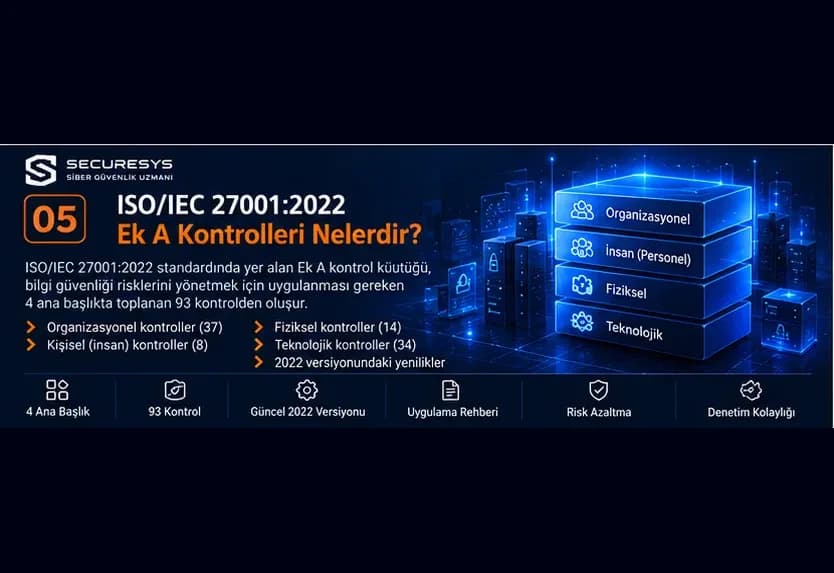
ISO/IEC 27001:2022 Annex A Controls: 93 Information Security Controls and Implementation Guide
Explore the 93 security controls in ISO 27001:2022 Annex A. Learn the organisational, people, physical and technological controls with implementation examples.
How to Conduct an ISO 27001 Internal Audit: Audit Plan, Nonconformity Management and Certification Readiness
How is an ISO 27001 internal audit done? Learn the audit plan, checklist, major and minor nonconformities, corrective actions and certification readiness.
Looking for professional support on this topic?
Our expert team will reach out for a free consultation as soon as possible.