What Should a Penetration Test Report Contain?
Executive summary, technical report, proof of concept, risk prioritisation and re-test — what a professional report delivers and what it means for each stakeholder.
The most important output of a professional penetration test is not the vulnerabilities found. Analysing those findings correctly, prioritising them and reporting them in a form people can act on matters at least as much as the testing itself.
A good report helps technical teams close the vulnerabilities, while giving senior management a clear view of the organisation's current security level, the risks it faces and the improvements that need to be made.
In a penetration testing service that meets international standards, reporting must bring together the technical detail and the management-level assessment.
Executive Summary
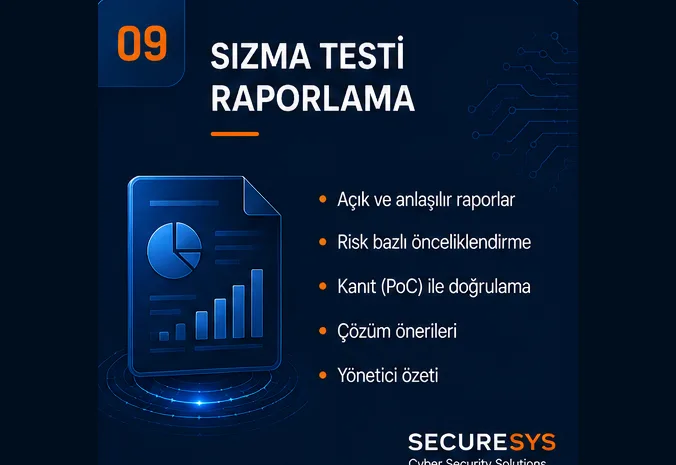
Not every executive needs to work through the technical detail. Professional reports therefore open with a short, readable executive summary aimed at decision-makers.
That section usually covers:
- The purpose of the test
- The scope of the systems tested
- The test dates
- The methodology used
- The overall security assessment
- The number of critical findings
- The impact on business continuity
- Recommended priority actions
This summary allows executives without a technical background to assess the current risk level quickly.
The Technical Report
The technical report is the most comprehensive document, setting out in detail every vulnerability identified during the engagement.
For each finding it should include:
- The name of the finding
- The risk level
- The CVSS score
- The affected system
- A description of the vulnerability
- The exploitation scenario
- Evidence (PoC)
- Screenshots
- Remediation recommendations
- References (OWASP, CWE, CVE and so on)
The technical report is the principal reference for IT teams and software developers.
Proof of Concept (PoC)
In a professional penetration test it is not enough to say "a vulnerability was found".
Every critical finding should be verified, as safely and as controllably as possible.
That verification process is called Proof of Concept (PoC).
The PoC demonstrates, with evidence:
- how the vulnerability was exploited,
- which steps were followed,
- what data could be obtained,
- the impact of the vulnerability.
This approach prevents false positives from reaching the report.
Risk Prioritisation
Not every vulnerability found represents the same level of risk.
For example:
A visible server version banner and unauthorised access to the customer database cannot be treated as equally urgent.
Professional reports therefore classify findings by risk level, generally as follows:
- Critical
- High
- Medium
- Low
- Informational
This classification makes it easier for organisations to decide which vulnerabilities to close first.
Remediation Recommendations
A penetration test report should not simply list problems.
It should offer workable solutions for every finding.
For example:
- Applying security patches
- Correcting misconfiguration
- Enabling multi-factor authentication
- Strengthening authorisation controls
- Applying secure coding principles
- Improving network segmentation
With these recommendations, technical teams can reduce risk systematically.
Presentation and Review Meeting
Professional penetration testing services rarely end with delivery of the report.
The team that carried out the test reviews the findings together with the relevant stakeholders.
In those meetings:
- Critical findings are explained.
- Risk levels are assessed.
- Technical teams' questions are answered.
- A remediation plan is drawn up.
- Priorities are set.
This makes the report considerably more useful.
Re-Test (Verification Testing)
Once the organisation has closed the vulnerabilities, professional service providers usually carry out a verification test, or re-test.
At that stage:
- The findings identified earlier are checked again.
- It is confirmed that the vulnerabilities really have been closed.
- The report is updated where necessary.
- The organisation's current risk position is reassessed.
This process matters a great deal in confirming that the improvements made were effective.
A Real-World Scenario
After a comprehensive penetration test, one organisation received a report containing roughly 120 security findings.
At first glance the number looked alarming, but detailed analysis showed the following distribution:
- 2 Critical
- 9 High
- 34 Medium
- 51 Low
- 24 Informational
The technical team focused first on the critical and high-risk findings. After roughly three weeks of remediation work, a re-test confirmed that every critical finding had been closed.
By taking that approach the organisation directed its limited resources at the areas carrying the greatest risk, and raised its security level substantially.
The SecureSys Approach
At SecureSys we deliver more than a technical report at the end of every penetration testing project.
Our clients receive:
- An Executive Summary
- A Detailed Technical Report
- Evidence Documentation (PoC)
- Risk Prioritisation Analysis
- Remediation Recommendations
- A Presentation of the Findings
- Re-Test and Verification Service
With outputs of this kind we support not only the identification of vulnerabilities but their effective remediation.
One of the most important elements of any penetration test report is the correct prioritisation of the vulnerabilities found. But on what criteria is a finding judged "critical" or "high"?
← Previous chapter: The Penetration Testing Process: A Step-by-Step Methodology
Next chapter → How Often Should Penetration Testing Be Carried Out?
Related Articles
Penetration Testing

Why Is Penetration Testing Necessary?
Why does the attack surface keep growing in a digital organisation, and why are security products not enough on their own? The case for verifying from an attacker's perspective.
What Is Penetration Testing?
The definition, the purpose, and how it differs from a vulnerability scan — what it delivers to the organisation and what it means for decision-makers and engineers.
Types of Penetration Testing
Web, API, mobile, internal and external network, Active Directory, wireless, cloud, OT/ICS, social engineering, DDoS, VoIP and continuous assessment — the scope, methodology and deliverables of each.
How Is the Scope of a Penetration Test Determined?
Which systems are in, which are out, and why that decision drives budget, duration and the quality of the findings — plus the five mistakes made most often.
Social Engineering: A Chain of Attacks That Starts With One Click
A real attack chain that began with a single email, the role of the human factor, and the measurable value of awareness work.
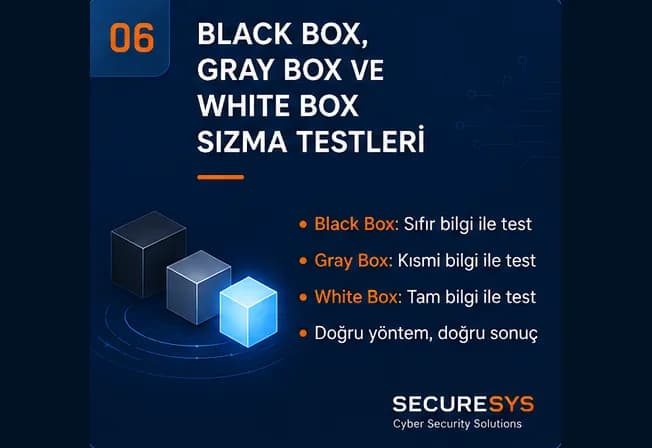
Black Box, Gray Box and White Box Penetration Testing
Three different starting points, three different perspectives. Which approach suits which system, and what each one reveals — with real-world scenarios.
Looking for professional support on this topic?
Our expert team will reach out for a free consultation as soon as possible.