The Penetration Testing Process: A Step-by-Step Methodology
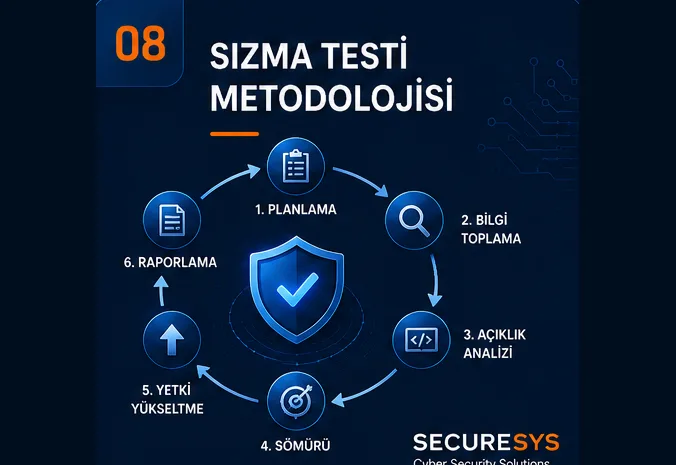
Six stages from planning to reporting: reconnaissance, vulnerability analysis, exploitation, privilege escalation and verification of every finding.
A penetration test is not a technical exercise in running security tools. A successful engagement is a disciplined process made up of planning, analysis, verification, reporting and remediation.
Conducted in line with internationally accepted methodologies — the OWASP Web Security Testing Guide, PTES, NIST SP 800-115 and OSSTMM — a professional penetration test sets out not only to find vulnerabilities but to assess what they would mean for the business.
This article works through the whole process, from the start of a professional engagement to the delivery of the report.
1. Planning and Scoping
Every successful penetration test begins with proper planning.
At this stage:
- The systems to be tested are agreed.
- The testing approach (black box, gray box or white box) is decided.
- Authorisation is completed.
- The test schedule is set.
- Critical systems are identified.
- Points of contact are defined.
The scope document produced here is the reference for all parties throughout the engagement.
2. Reconnaissance
Attackers do not go straight for the system.
They get to know their target first.
The first technical stage of a professional penetration test is the same: gathering information.
This stage examines:
- Domain analysis
- WHOIS records
- DNS records
- Subdomain discovery
- Open ports
- Technology fingerprinting
- SSL certificates
- Open-source intelligence (OSINT)
The aim is to map the attack surface as accurately as possible.
A Real-World Scenario
Suppose a company believes it only uses www.company.com.
Reconnaissance turns up the following subdomains:
- test.company.com
- old.company.com
- vpn.company.com
- crm.company.com
- dev.company.com
Examination reveals a critical remote code execution (RCE) vulnerability on old.company.com, a server forgotten years ago.
The IT team believed the system was no longer in use — but it was still reachable from the internet.
Real attackers rarely go for the newest systems first. They go for exactly this kind of forgotten, unpatched asset.
3. Identifying Vulnerabilities
Once reconnaissance is complete, the systems are analysed in detail.
This stage examines:
- Security configuration
- Software versions
- Authentication mechanisms
- Authorisation controls
- Business logic
- API security
- File upload functionality
- Input validation
Automated tools have their place, but the most important part of a professional penetration test is manual analysis.
4. Verifying the Vulnerabilities (Exploitation)
Not every vulnerability found is genuinely exploitable.
Specialists therefore only put verified findings in the report.
At this stage we test under control whether:
- the vulnerability actually works,
- it allows privilege escalation,
- it leaks data,
- it opens a route to other systems.
5. Privilege Escalation and Lateral Movement
Real attackers do not stop once they reach a single system.
They use the access they have to:
- gain further privilege,
- move on to other systems,
- take over the domain,
- reach sensitive data.
Professional penetration tests therefore assess complete attack chains, to the extent the scope allows.
6. Reporting
Once testing is complete, all findings are written up as technical and management reports.
A professional report is more than a list of vulnerabilities.
Each finding is presented with:
- Risk level
- Technical explanation
- Affected system
- Proof of concept
- Exploitation method
- Impact
- Remediation guidance
7. Retest
The purpose of a penetration test is not simply to find vulnerabilities.
It is to confirm that they have been closed properly.
Once the organisation has completed the necessary work, the specialist team tests again.
Findings confirmed as closed are updated in the report and the organisation's risk level is reassessed.
The SecureSys Approach
At SecureSys we plan our engagements in line with international methodology, carry out manual security analysis alongside automated scanning, and verify every finding before we report it.
At the end of every project we deliver more than a technical report: a summary assessment for management, actionable remediation guidance for the technical team, and — on request — a retest to verify the fixes.
A penetration test can produce hundreds or even thousands of findings. But they do not all carry the same weight.
← Previous chapter: What Should a Penetration Tester Know? Competencies and Certifications
Next chapter → What Should a Penetration Test Report Contain?
Related Articles
Penetration Testing

Why Is Penetration Testing Necessary?
Why does the attack surface keep growing in a digital organisation, and why are security products not enough on their own? The case for verifying from an attacker's perspective.

What Is Penetration Testing?
The definition, the purpose, and how it differs from a vulnerability scan — what it delivers to the organisation and what it means for decision-makers and engineers.

Types of Penetration Testing
Web, API, mobile, internal and external network, Active Directory, wireless, cloud, OT/ICS, social engineering, DDoS, VoIP and continuous assessment — the scope, methodology and deliverables of each.
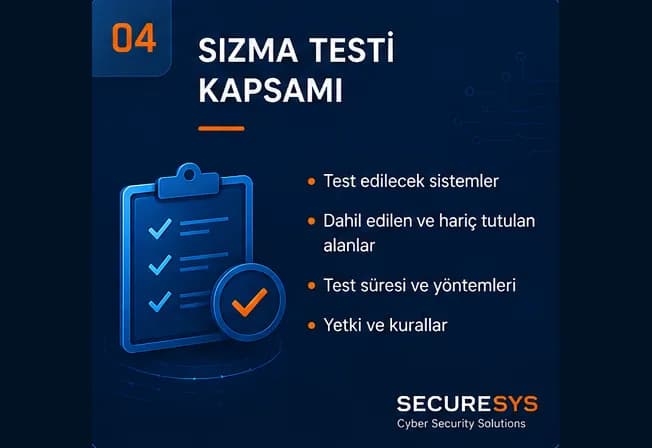
How Is the Scope of a Penetration Test Determined?
Which systems are in, which are out, and why that decision drives budget, duration and the quality of the findings — plus the five mistakes made most often.

Social Engineering: A Chain of Attacks That Starts With One Click
A real attack chain that began with a single email, the role of the human factor, and the measurable value of awareness work.

Black Box, Gray Box and White Box Penetration Testing
Three different starting points, three different perspectives. Which approach suits which system, and what each one reveals — with real-world scenarios.
Looking for professional support on this topic?
Our expert team will reach out for a free consultation as soon as possible.