What Are Black-Box, Gray-Box, and White-Box Penetration Tests?
The advantages of the zero-knowledge, partial-knowledge, and full-knowledge approaches, differences in processing time, and selecting the appropriate method based on the organization.
Not every penetration test starts from the same point.
In some tests, the penetration tester has no information about the organization. In others, limited user information is shared. In some projects, however, the entire system architecture, user accounts, and even source code are provided to the testing team.
These different approaches directly affect the scope of the penetration test, the methodology to be applied, and the results to be obtained.
According to international standards, penetration tests are generally conducted using three different approaches:
- Black Box
- Gray Box
- White Box
Each method has a different purpose and, when used in the right scenario, provides organizations with significant security benefits.
Black Box Penetration Testing
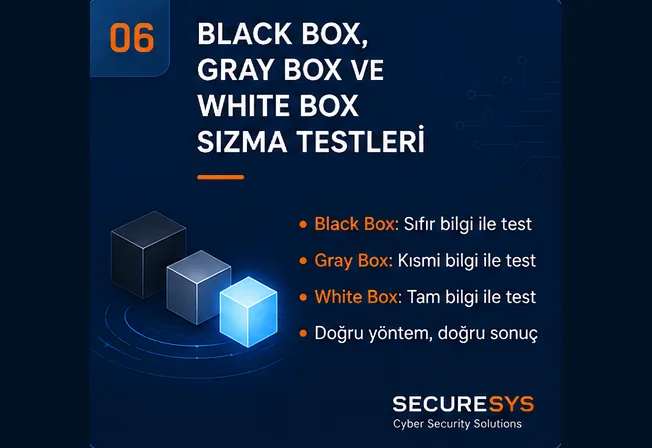
In the Black Box approach, the penetration testing expert is not provided with any prior technical information about the system.
The expert:
- Does not know the system architecture.
- Does not have a user account.
- Does not know the network structure.
- Cannot access the source code.
- Does not see server information.
The test begins entirely from the perspective of a real external attacker.
In the first phase, information gathering (reconnaissance) activities are conducted. Open-source intelligence (OSINT), DNS records, subdomains, internet-facing services, and other visible components are analyzed. Subsequently, potential attack scenarios are implemented based on the information gathered.
This method is highly effective for assessing an organization’s externally visible attack surface.
Advantages of Black Box Testing
- It simulates real attacker behavior.
- It measures the security of internet-facing systems.
- It uncovers data leaks.
- It demonstrates the level of preparedness against external threats.
Points to Consider
The information gathering process in black-box testing can be time-consuming. Additionally, since access to some internal systems is not available, only risks visible from the outside can be assessed.
A Real-Life Example
An attacker knows nothing about your company.
They only see your website.
They search for your company on Google.
They review your employees on LinkedIn.
They discover your subdomains.
They find your VPN login screen.
They notice that an old application is still exposed to the internet.
It gains initial access from there.
This is exactly the scenario that a Black Box test simulates.
Gray Box Penetration Testing (Gray Box Testing)
The Gray Box approach falls between Black Box and White Box.
The penetration testing team is provided with limited information.
For example:
- Standard user account
- Test users
- Limited documentation
- Specific IP information
This method simulates attacks that could be carried out by an attacker who has gained access to the system in real life or by a malicious employee.
Gray Box tests are particularly effective for:
- Customer portals
- Intranet applications
- ERP systems
- Human Resources applications
- Dealer portals
are quite suitable for this purpose.
Advantages of Gray Box Testing
- Authorization controls can be examined in detail.
- Security vulnerabilities in business logic are easier to identify.
- Test time is used more efficiently.
- Internal user risks can be assessed.
- Real-world user scenarios can be applied.
A Real-Life Example
Imagine that an attacker has obtained an employee’s username and password.
The attacker can now log into the system.
So what happens next?
Will they be able to view other users’ data?
Will they be able to elevate their privileges?
Will they be able to access administrative screens?
Will they be able to access records from other departments?
Gray Box testing seeks to answer exactly these questions.
White Box Penetration Testing (White Box Testing)
In the White Box approach, the testing team is provided with comprehensive information about the system.
For example:
- Network architecture
- User accounts
- Administrator accounts
- Source code
- API documentation
- System architecture
- Server information
- Security policies
The goal is to examine the system in as much detail as possible and identify any security vulnerabilities that might be overlooked.
This method is particularly suitable for:
- Critical public systems
- Financial institutions
- Software development processes
- Projects conducted in conjunction with source code analysis
.
Advantages of White Box Testing
- It allows for a more in-depth technical analysis.
- Hidden security vulnerabilities can be detected.
- Risks can be assessed at the code level.
- Test time can be used more efficiently.
- A higher coverage rate can be achieved.
A Real-Life Example
Consider a newly developed online banking application.
Before deployment:
- The software architecture is reviewed.
- API documentation is shared.
- Test users are recruited.
- The source code is analyzed.
- The admin panel is being tested.
The goal is not to conduct reconnaissance like an attacker, but to evaluate the entire system down to the finest detail from a security perspective.
This is why the White Box approach is used.
Which Method Is Better?
There is no single correct answer to this question.
The best method should be determined based on the organization’s needs and the purpose of the test.
| Test Approach | When Is It Preferred? |
|---|---|
| Black Box | To measure the resilience of internet-facing systems against external attacks |
| Gray Box | To evaluate authorization and business logic controls in systems accessible to authenticated users |
| White Box | For critical systems, during development processes, or in projects requiring in-depth security analysis |
Many mature organizations do not rely on a single method alone. By using these three approaches together at different stages or on different systems, they conduct a more comprehensive security assessment.
The Securesys Approach
At SecureSys, we begin every project by analyzing the organization’s needs, system architecture, and the objectives expected from the testing. We then recommend the most appropriate methodology—Black Box, Gray Box, or White Box—or a combination of these when necessary.
Our goal is not merely to list security vulnerabilities; it is to concretely highlight the risks the organization faces by simulating real-world attack scenarios and to provide actionable recommendations for improvement.
The success of a penetration test is not determined solely by the methodology used. The knowledge, experience, and internationally recognized certifications of the team conducting the test are just as important as the methods employed.
Related Articles
Penetration Testing
Why Is a Penetration Test Necessary?
Why is the attack surface growing in digitalizing organizations, and why aren’t security products enough on their own? The rationale for verification from the perspective of a real attacker.
What Is a Penetration Test?
Its definition, purpose, and how it differs from a vulnerability scan. What benefits it provides to the organization, and what it means for decision-makers and technical teams.
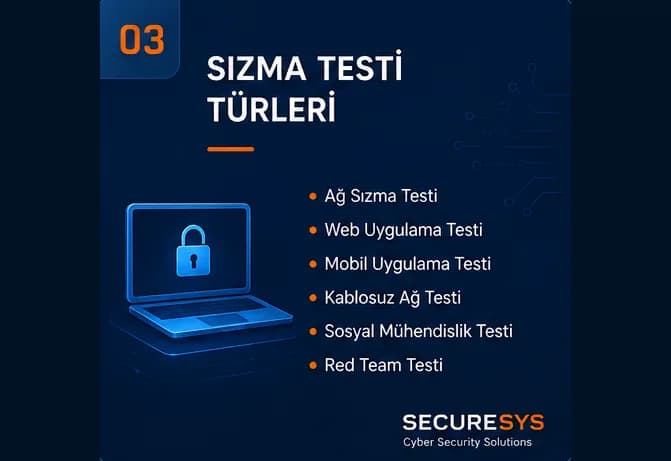
What Are the Types of Penetration Tests?
The scope of the topics "Network," "Web," "Mobile," "API," "Wireless," "Social Engineering," and "Red Team"; which one yields the correct result in which scenario.
How Is the Scope of a Penetration Test Determined?
Which systems are included, and which are excluded? The direct impact of the scope decision on the budget, timeline, and quality of findings.
Social Engineering: A Chain of Attacks That Starts with a Single Click
A real-life attack chain that began with a single email, the role of the human factor, and the measurable impact of awareness campaigns.
Skills and Certifications Required for a Penetration Testing Specialist
The significance of OSCP, CEH, and other certifications; why a certification alone is not enough; and questions to ask when purchasing services.
Looking for professional support on this topic?
Our expert team will reach out for a free consultation as soon as possible.