What Are the Types of Penetration Tests?
The scope of the topics "Network," "Web," "Mobile," "API," "Wireless," "Social Engineering," and "Red Team"; which one yields the correct result in which scenario.
Not every information technology system has the same architecture, the same risks, or the same attack surface. Security vulnerabilities encountered in a web application are entirely different from those in an enterprise Active Directory infrastructure or the security risks in a mobile application.
For this reason, there is no one-size-fits-all approach to penetration testing. The organization’s line of business, the technologies it uses, its internet-accessible systems, its business processes, and whether it is subject to regulations all directly influence the scope of the penetration test to be conducted.
A professional penetration testing project addresses not only the question “Which systems will be tested?” but also “Which attack scenarios will be applied?” A properly planned project identifies the organization’s actual risks while preventing unnecessary time and cost losses.
Below are the most commonly used types of penetration testing today.
Web Application Penetration Testing
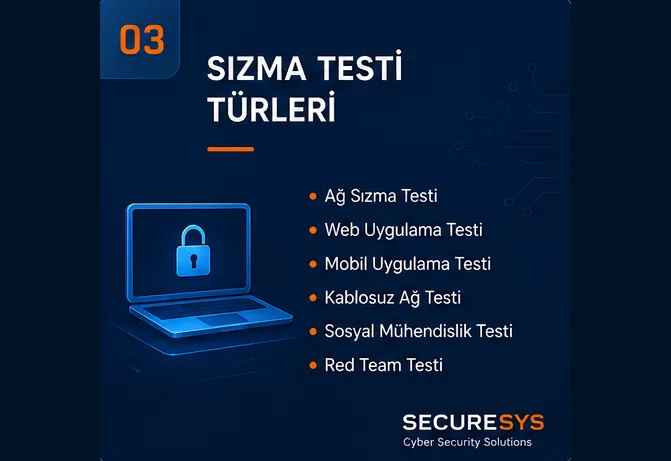
Web applications are among the most frequently targeted systems because they are directly accessible via the internet. Customer portals, e-commerce sites, ERP applications, human resources systems, and corporate dashboards fall under this category.
As part of Web Application Penetration Testing:
- OWASP Top 10 vulnerabilities,
- SQL Injection,
- Cross-Site Scripting (XSS),
- Broken Access Control,
- Authentication and session management vulnerabilities,
- Business logic vulnerabilities,
- File upload mechanisms,
- API integrations,
- Authorization controls
and many other security controls are assessed using both manual and automated methods.
The goal is to identify vulnerabilities that could allow attackers to gain access to the organization through the web application.
API Penetration Testing
Most modern applications communicate via REST APIs, GraphQL, or SOAP services.
Mobile apps, web applications, and third-party systems typically share data via APIs.
In API Penetration Testing:
- Broken Object Level Authorization (BOLA)
- Authorization Checks
- JWT security
- OAuth mechanisms
- Rate Limiting
- Mass Assignment
- Insecure data sharing
- Authentication mechanisms
are analyzed in detail.
A significant portion of data breaches, particularly in recent years, stem from misconfigured API services.
Mobile Application Penetration Testing
Mobile applications are not limited to just the user interface. API services running in the background, data stored on the device, certificate validation mechanisms, and the application’s source code must also be evaluated from a security perspective.
In mobile application testing:
- Android and iOS apps,
- Local data storage,
- Reverse engineering,
- SSL spinning,
- Certificate validation,
- Sensitive data storage,
- Authentication processes,
- API communication
are analyzed.
Internal Network Penetration Testing
Not every attack starts on the internet.
Once an attacker gains access to a user’s computer through a phishing attack, they begin to move within the organization’s internal network.
As part of the Internal Network Penetration Test:
- Network segmentation,
- Privilege escalation,
- Shared folders,
- Server security,
- SMB services,
- LDAP,
- RDP,
- Windows services,
- Linux services
are assessed.
The goal is to measure how far an attacker could penetrate the organization.
External Network Penetration Test
Systems accessible via the Internet are the attackers’ primary targets.
Servers located behind the firewall, VPN services, email systems, web services, and other services accessible via the Internet are analyzed in detail.
In these tests:
- Open ports,
- Misconfigurations,
- Outdated services,
- Vulnerabilities,
- VPN security,
- SSL/TLS configurations
are examined.
Active Directory Penetration Testing
The majority of corporate networks use an Active Directory infrastructure.
Even a minor configuration error in the domain structure can allow an attacker to take over the entire organization.
In these tests:
- Privilege escalation,
- Kerberoasting,
- AS-REPRoasting,
- NTLMRelay,
- LAPS,
- GPO security,
- Delegation settings,
- Service accounts,
- Domain configurations
are analyzed.
Wireless Network Penetration Testing
Wireless networks are a critical entry point not only for office users but also for attackers.
In wireless network security testing:
- WPA2/WPA3 configurations,
- Rogue Access Points,
- Evil Twin,
- Wireless client attacks,
- Password policies,
- Guest networks,
- Network isolation
are checked.
Cloud Security Penetration Testing
AWS, Microsoft Azure, Google Cloud, and private cloud infrastructures currently host organizations’ critical systems.
In penetration tests conducted in cloud environments,
- IAM configurations,
- storage services,
- Security groups,
- Virtual networks,
- container security,
- Kubernetes configurations,
- Serverless services,
- Identity and access policies
are examined.
OT/ICS Penetration Testing
Production facilities, power plants, factories, and critical infrastructure face risks that differ from those of traditional IT systems.
In OT/ICS penetration tests,
- SCADA systems,
- PLC devices,
- Industrial communication protocols,
- Operational networks,
- Segmentation structures,
- Security devices
are evaluated using methods that do not affect production.
Social Engineering Tests
No matter how robust technological security measures may be, the human factor is always one of the most critical risks.
In these tests,
- Phishing simulations,
- Vishing (Phone),
- Smishing (SMS),
- USB drop,
- Physical access attempts,
- Identity theft scenarios
are used to measure employee awareness and the organization’s resilience level.
Which Penetration Test Is Right for Your Organization?
Every organization has different testing requirements.
While web applications and API security may be a priority for an e-commerce company, OT/ICS systems may be more critical at a manufacturing facility. In the financial sector, Active Directory and internet-facing systems take center stage, whereas cloud security and API testing are of greater importance at a technology company offering SaaS services.
Therefore, a successful penetration test should not be planned using a pre-made checklist; rather, it must be tailored to the organization’s assets, threat model, and business processes.
The success of a penetration test is not determined solely by the systems being tested. The scope and perspective from which the test is conducted are also of great importance.
So, how is the scope determined when planning a penetration test? Which IP addresses, applications, user roles, and systems are included in the test? How are the test boundaries defined, and why is successful planning of critical importance?
Related Articles
Penetration Testing
Why Is a Penetration Test Necessary?
Why is the attack surface growing in digitalizing organizations, and why aren’t security products enough on their own? The rationale for verification from the perspective of a real attacker.
What Is a Penetration Test?
Its definition, purpose, and how it differs from a vulnerability scan. What benefits it provides to the organization, and what it means for decision-makers and technical teams.
How Is the Scope of a Penetration Test Determined?
Which systems are included, and which are excluded? The direct impact of the scope decision on the budget, timeline, and quality of findings.
Social Engineering: A Chain of Attacks That Starts with a Single Click
A real-life attack chain that began with a single email, the role of the human factor, and the measurable impact of awareness campaigns.
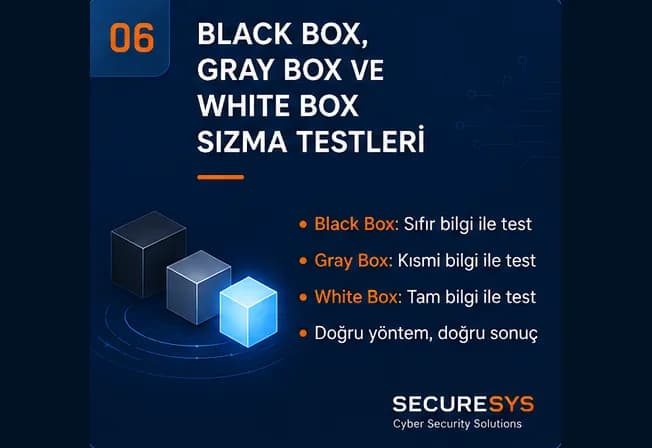
What Are Black-Box, Gray-Box, and White-Box Penetration Tests?
The advantages of the zero-knowledge, partial-knowledge, and full-knowledge approaches, differences in processing time, and selecting the appropriate method based on the organization.
Skills and Certifications Required for a Penetration Testing Specialist
The significance of OSCP, CEH, and other certifications; why a certification alone is not enough; and questions to ask when purchasing services.
Looking for professional support on this topic?
Our expert team will reach out for a free consultation as soon as possible.