How to Choose the Right Penetration Testing Partner?
Methodology, reporting quality, team competence, and the support process—criteria that should be evaluated in addition to price.
Why Is Choosing the Right Penetration Testing Partner So Important?
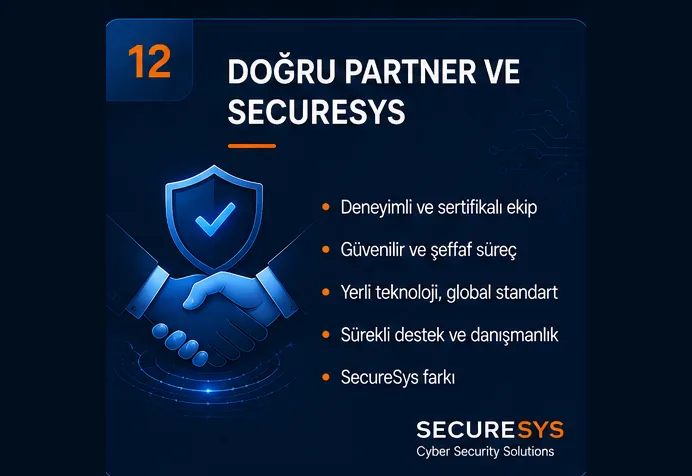
Cybersecurity investments gain meaning not only through the technologies purchased but also through expert teams that properly evaluate those technologies. Similarly, penetration testing is not merely a technical service involving the use of automated tools. A true penetration test is a comprehensive security assessment that combines an attacker’s perspective, technical expertise, industry experience, and international methodologies.
For this reason, when organizations procure penetration testing services, they must consider not only the price but also the team’s expertise, the methodologies they use, the quality of their reporting, and their project experience.
Choosing the right partner directly impacts not only the identification of existing security vulnerabilities but also the development of the organization’s long-term cybersecurity maturity.
What Should You Expect from a Professional Penetration Testing Service?
When purchasing a penetration testing service, the answers to the following questions must be carefully evaluated.
Is the methodology used compliant with international standards?
Professional practices include:
- OWASP Web Security Testing Guide
- OWASP API Security Top 10
- PTES
- NIST SP 800-115
- OSSTMM
and other internationally recognized methodologies.
Are tests performed exclusively using automated tools?
Automated security scanning tools provide significant support.
However;
- Business logic vulnerabilities
- Authentication errors
- Chain attacks
- Business logic vulnerabilities
- Complex API vulnerabilities
can often only be identified through manual analysis.
A professional penetration test should combine automated analysis with expert evaluation.
Does the expert team have sufficient experience?
Technical certifications are important.
However, real-world project experience is just as valuable as certifications.
In various industries;
- Finance
- Public Sector
- Defense Industry
- Energy
- Healthcare
- Manufacturing
- Telecommunications
Specialist teams that have worked on these projects can conduct more comprehensive assessments against various attack scenarios.
Is the report actionable?
A good report does more than just list security vulnerabilities.
It also:
- explains risk levels.
- It provides technical evidence.
- Includes recommendations for remediation.
- Prioritizes the vulnerabilities.
- Provides a summary assessment for management.
This way, both technical teams and managers can benefit from the same report.
Is a Re-Test service offered?
Verification tests (Re-Test) conducted after security vulnerabilities have been patched demonstrate whether the improvements were truly successful.
For this reason, the Re-Test process is an important quality indicator in professional services.
The SecureSys Approach
At SecureSys, we view penetration testing not merely as a security check, but as a strategic process that enhances organizations’ digital resilience.
For every project, we conduct:
- Scope analysis,
- Risk assessment,
- A test plan aligned with international methodologies,
- Manual and automated security analyses,
- Verified findings,
- Management and technical reports,
- Improvement consulting,
- Re-Test service
are part of our approach.
Our goal is not merely to identify security vulnerabilities, but to help organizations manage these risks.
Why SecureSys?
To date, we have carried out numerous security assessment projects across various sectors, ranging from public institutions to financial institutions, from the defense industry to manufacturing facilities, and from energy companies to e-commerce platforms.
Our team of experts,
- OSCP
- OSWE
- OSEP
- OSCE
- eWPTX
- LPT
- OSWP
- CEH
and other international technical certifications.
In the projects we undertake, we adhere to international standards, verify every finding, and provide our clients with practical solution recommendations.
Additionally, as an organization accredited by TSE, we provide security assessment services using methodologies compliant with national and international standards.
Cybersecurity Is Not a Product, It Is a Process
No single security product can protect organizations on its own.
Firewalls…
EDR solutions…
WAF systems…
SIEM platforms…
Cloud security services…
All of these are important components of a security architecture.
However, the only way to truly understand how secure these systems are is to test them against real-world attack scenarios.
This is precisely why penetration testing is not merely an audit activity, but one of the cornerstones of a continuously evolving security culture.
The goal of security is not merely to block attacks, but to identify vulnerabilities before attackers do and take the necessary precautions in a timely manner.
Final Thoughts
Throughout this guide, we’ve explored how penetration testing is not merely a technical service, but an essential part of risk management, business continuity, and organizational security.
Thanks to properly planned and regularly conducted penetration tests, organizations can:
- Protect their digital assets more effectively,
- Verify the effectiveness of their security investments,
- Support their regulatory compliance processes,
- Prevent potential data breaches,
- Enhance their cyber resilience.
Cyber threats are constantly evolving.
Security vulnerabilities change every day.
But one thing remains constant:
Security vulnerabilities discovered by attackers pose a risk. Security vulnerabilities you discover, on the other hand, strengthen your security.
📞 Contact SecureSys
Contact our team of experts to learn more about penetration testing, Red Team exercises, source code analysis, API security, mobile app security, and other cybersecurity services tailored to your organization.
"Let’s identify your security vulnerabilities together before real attackers do."
Related Articles
Penetration Testing
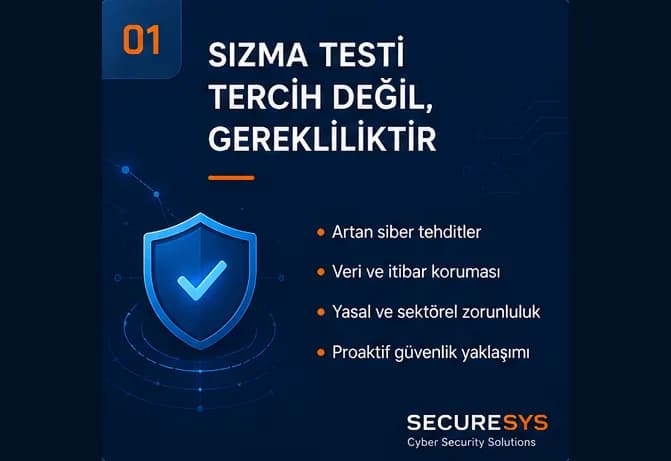
Why Is a Penetration Test Necessary?
Why is the attack surface growing in digitalizing organizations, and why aren’t security products enough on their own? The rationale for verification from the perspective of a real attacker.
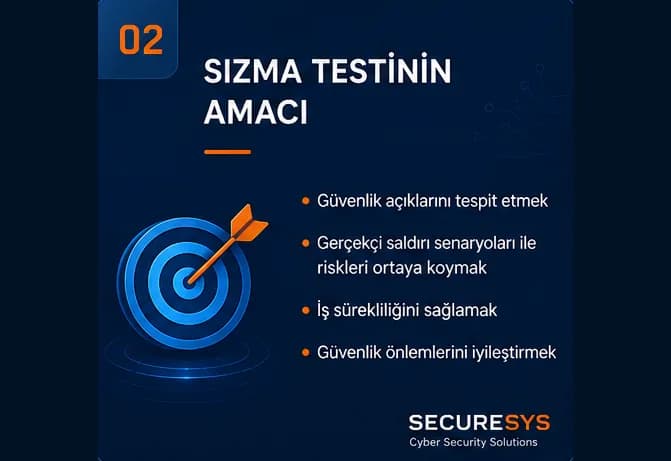
What Is a Penetration Test?
Its definition, purpose, and how it differs from a vulnerability scan. What benefits it provides to the organization, and what it means for decision-makers and technical teams.
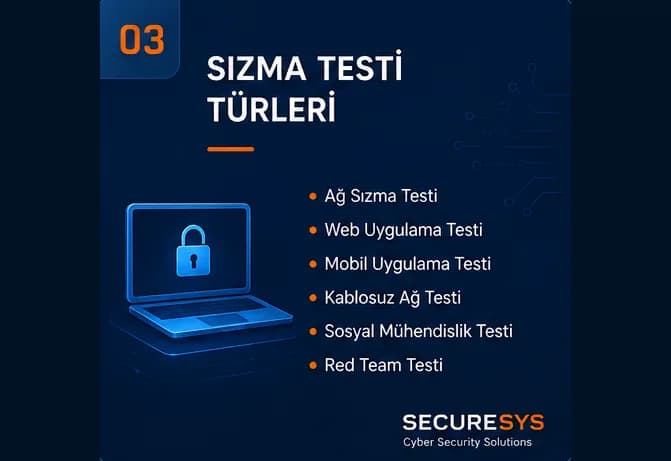
What Are the Types of Penetration Tests?
The scope of the topics "Network," "Web," "Mobile," "API," "Wireless," "Social Engineering," and "Red Team"; which one yields the correct result in which scenario.
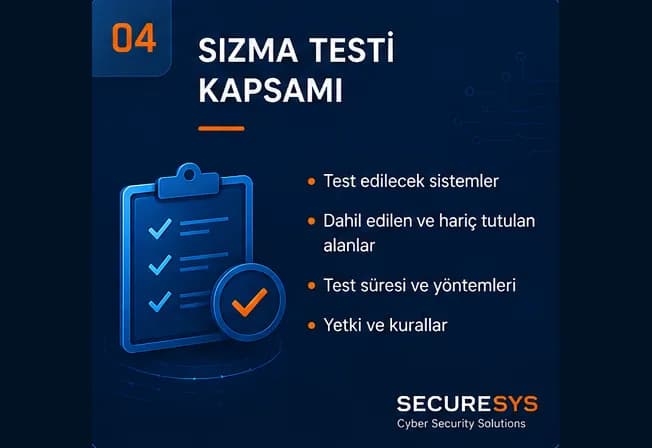
How Is the Scope of a Penetration Test Determined?
Which systems are included, and which are excluded? The direct impact of the scope decision on the budget, timeline, and quality of findings.
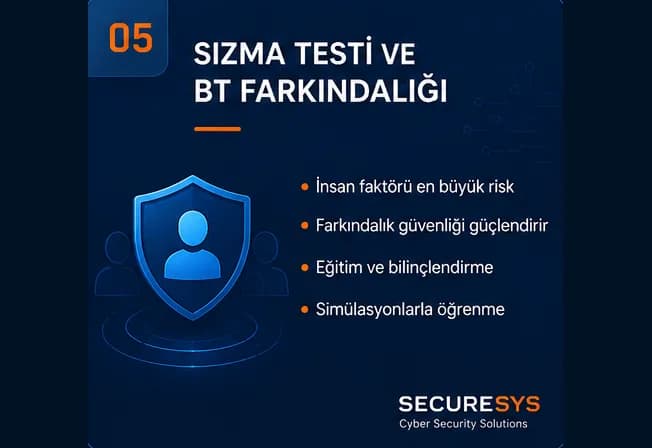
Social Engineering: A Chain of Attacks That Starts with a Single Click
A real-life attack chain that began with a single email, the role of the human factor, and the measurable impact of awareness campaigns.
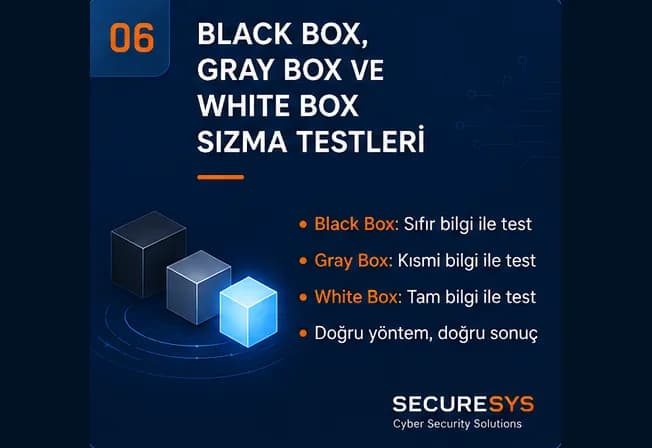
What Are Black-Box, Gray-Box, and White-Box Penetration Tests?
The advantages of the zero-knowledge, partial-knowledge, and full-knowledge approaches, differences in processing time, and selecting the appropriate method based on the organization.
Looking for professional support on this topic?
Our expert team will reach out for a free consultation as soon as possible.