Penetration Testing Process: A Step-by-Step Methodology
Six stages from planning to reporting: information gathering, vulnerability analysis, exploitation, privilege escalation, and verification of findings.
A penetration test is not merely a technical procedure involving the execution of security tools. A successful project is a disciplined process consisting of the phases of planning, analysis, validation, reporting, and remediation.
A professional penetration test conducted in accordance with internationally recognized methodologies (OWASP Web Security Testing Guide, PTES, NIST SP 800-115, and OSSTMM) aims not only to identify security vulnerabilities but also to assess their impact on the organization.
In this section, we will examine the entire process of a professional penetration testing project, step by step, from inception to report delivery.
1. Planning and Scope Definition
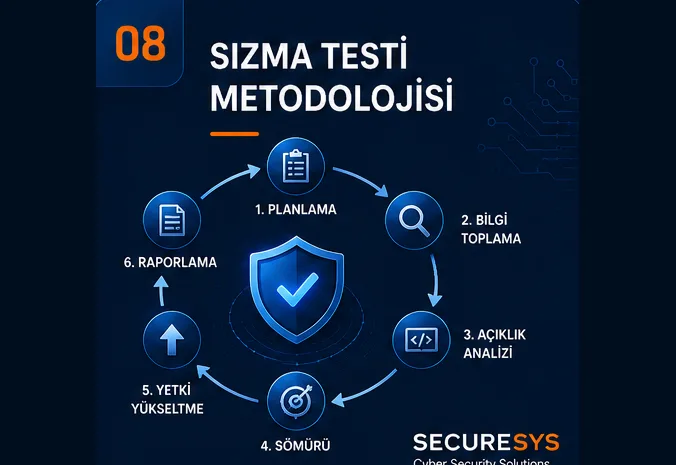
Every successful penetration test begins with proper planning.
In this phase:
- The systems to be tested are identified.
- The testing method (Black Box, Gray Box, or White Box) is determined.
- Authorization processes are completed.
- A test schedule is created.
- Critical systems are identified.
- Points of contact are identified.
The scope document prepared during this process serves as a reference for all parties throughout the testing phase.
2. Information Gathering (Reconnaissance)
Attackers do not attack the system directly.
First, they identify their targets.
In professional penetration testing, the first technical phase is also the information gathering process.
In this phase:
- Domain analysis
- WHOIS records
- DNS records
- Subdomain discovery
- Open ports
- Technology analysis
- SSL certificates
- Open-source intelligence (OSINT)
are examined.
The goal is to map the attack surface as accurately as possible.
A Real-Life Scenario
Let’s assume a company believes it uses onlywww.firmaadi.comadresini.
During the reconnaissance, the following subdomains were identified:
- test.companyname.com
- old.companyname.com
- vpn.companyname.com
- crm.companyname.com
- dev.companyname.com
The investigation revealed a critical remote code execution (RCE) vulnerability on the old.companyname.com server, which had been forgotten for years.
The organization’s IT team believed this system was no longer in active use; however, the server was still exposed to the internet.
Real attackers often target not the newest systems, but rather these forgotten and unpatched assets.
3. Identification of Security Vulnerabilities
Once the information gathering phase is complete, the systems are analyzed in detail.
At this stage:
- Security configurations
- Software versions
- Authentication mechanisms
- Authorization controls
- Business logic
- API security
- File upload fields
- Input validations
are reviewed.
Automated tools can be used; however, the most important part of a professional penetration test is manual analysis.
4. Verification of Security Vulnerabilities (Exploitation)
Not every security vulnerability found may actually be exploitable.
For this reason, experts include only verifiable findings in the report.
At this stage:
- Whether the vulnerability actually works,
- whether it allows for privilege escalation,
- whether it leaks data,
- and whether it provides a means of accessing other systems
are tested in a controlled manner.
5. Privilege Escalation and Lateral Movement
Real attackers don’t stop once they’ve gained access to a single system.
Using the access they’ve gained,
- gain additional privileges,
- Move to other systems,
- Take over the domain environment,
- Access sensitive data
.
For this reason, in professional penetration tests, attack chains are also evaluated to the extent permitted by the scope.
6. Reporting
After the test is completed, all findings are compiled into technical and managerial reports.
Professional reports do not consist solely of a list of vulnerabilities.
For each finding:
- Risk level
- Technical description
- Affected system
- Proof of Concept (PoC)
- Exploitation method
- Impact
- Proposed Solutions
are presented in detail.
7. Re-Test (Validation Test)
The purpose of a penetration test is not merely to find vulnerabilities.
The primary goal is to verify that these vulnerabilities have been securely patched.
After the organization has completed the necessary improvements, the expert team conducts a retest.
Findings confirmed to have been resolved are updated in the report, and the organization’s risk level is reassessed.
The SecureSys Approach
At SecureSys, we plan our projects in accordance with international methodologies, perform manual security analyses in addition to using automated scanning tools, and verify and report every finding.
At the end of each project, we do more than just provide a technical report; we also offer summary assessments for managers, actionable solution recommendations for technical teams, and, upon request, a re-verification (Re-Test) service.
During a penetration test, hundreds or even thousands of findings may be identified. However, not all of these findings carry the same level of importance.
Related Articles
Penetration Testing

Why Is a Penetration Test Necessary?
Why is the attack surface growing in digitalizing organizations, and why aren’t security products enough on their own? The rationale for verification from the perspective of a real attacker.
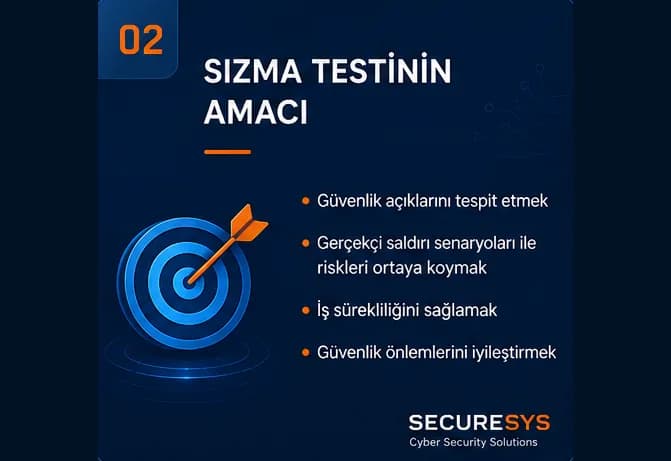
What Is a Penetration Test?
Its definition, purpose, and how it differs from a vulnerability scan. What benefits it provides to the organization, and what it means for decision-makers and technical teams.
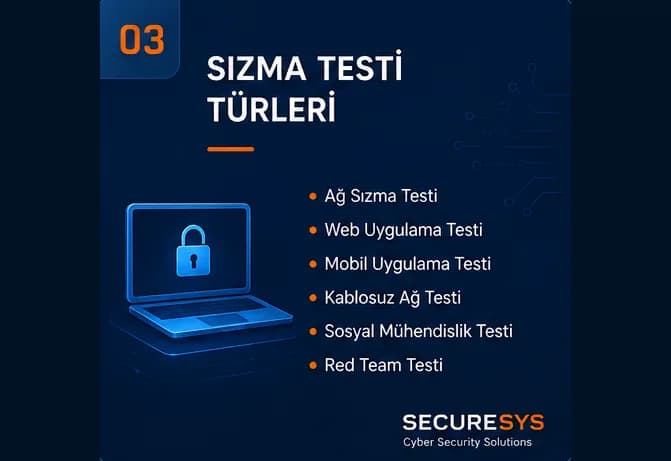
What Are the Types of Penetration Tests?
The scope of the topics "Network," "Web," "Mobile," "API," "Wireless," "Social Engineering," and "Red Team"; which one yields the correct result in which scenario.
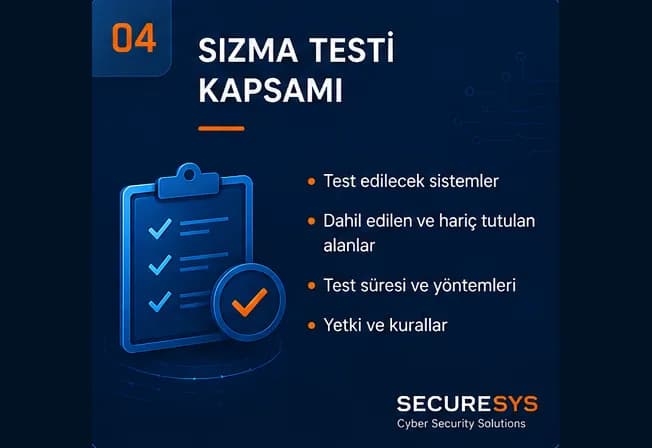
How Is the Scope of a Penetration Test Determined?
Which systems are included, and which are excluded? The direct impact of the scope decision on the budget, timeline, and quality of findings.
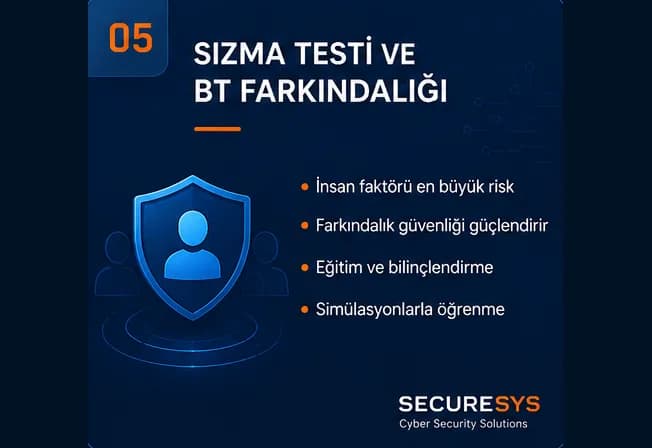
Social Engineering: A Chain of Attacks That Starts with a Single Click
A real-life attack chain that began with a single email, the role of the human factor, and the measurable impact of awareness campaigns.

What Are Black-Box, Gray-Box, and White-Box Penetration Tests?
The advantages of the zero-knowledge, partial-knowledge, and full-knowledge approaches, differences in processing time, and selecting the appropriate method based on the organization.
Looking for professional support on this topic?
Our expert team will reach out for a free consultation as soon as possible.