Penetration Testing and Regulations: ISO 27001, KVKK, PCI DSS
Compliance with the testing requirements of the ISO 27001, KVKK, PCI DSS, DORA, NIS2, NIST CSF, and SP 800-115 frameworks.
Penetration Testing and Cybersecurity Regulations
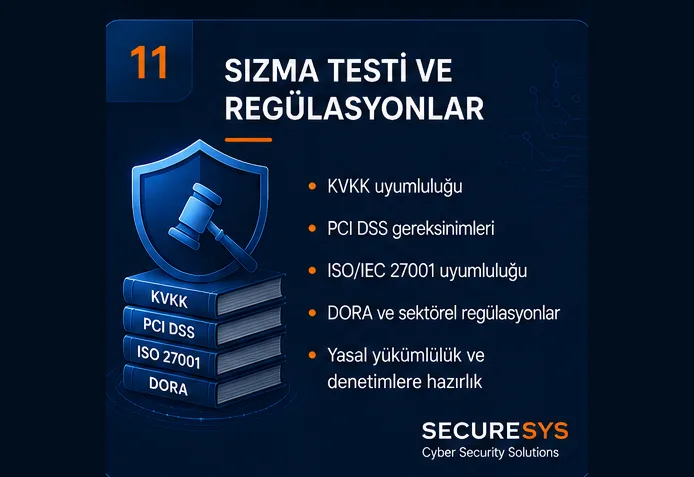
Today, penetration testing is not only a best security practice but also one of the technical security controls required under many national and international standards. In numerous sectors—including finance, government, healthcare, energy, e-commerce, and critical infrastructure—regular security testing is considered an integral part of risk management.
✅ISO/IEC 27001
✅KVKK
✅PCI DSS
✅DORA
✅NIS2
✅NIST CSF
✅NIST SP 800-115
✅Cyber Hygiene
✅DDoS Resilience Tests
The Relationship Between ISO/IEC 27001 and Penetration Testing
Information security today is not a matter that can be ensured simply by setting up a firewall, using antivirus software, or restricting access permissions. Organizations’ digital assets are constantly changing, new technologies are being adopted, and cyber threats are becoming more complex by the day. For this reason, international standards recommend that security be tested at regular intervals and that the effectiveness of implemented controls be verified.
One of the first standards that comes to mind when discussing information security management worldwide is the ISO/IEC 27001 Information Security Management System (ISMS) standard. ISO/IEC 27001 is an international management standard designed to enable organizations to systematically protect their information assets. The standard’s primary objective is not merely to use security products, but to identify information security risks, implement appropriate controls, and continuously evaluate the effectiveness of these controls.
In this regard, penetration testing stands out as one of the most important assessment methods for validating the technical security controls of ISO/IEC 27001.
Risk-Based Approach
One of the most important features of ISO/IEC 27001 is its adoption of a risk-based approach.
Every organization’s systems, business processes, and the threats it faces are different. Therefore, there is no single security model that applies to all organizations. The standard requires organizations to first identify their information assets, then analyze the risks associated with these assets, and implement the necessary controls until an acceptable risk level is achieved.
For example:
While protecting customer data may be a top priority for an e-commerce company, ensuring the uninterrupted operation of production systems may be more critical for a manufacturing facility. In the financial sector, the security of payment systems and customer accounts takes center stage.
This is why ISO/IEC 27001 aims to manage security based on the organization’s own risk profile, rather than through a “one-size-fits-all” approach.
Penetration tests, on the other hand, provide technical validation of the risk analyses conducted. Through security tests performed on systems identified as critical in the risk analysis, it is determined to what extent theoretically defined risks can actually be exploited in real-world scenarios.
Verifying the Effectiveness of Technical Controls
An organization may have implemented a firewall, an EDR solution, multi-factor authentication (MFA), network segmentation, and access policies. However, the mere presence of these controls does not, by itself, guarantee security.
The key question is:
“Are the security controls we’ve implemented actually working?”
It is not possible to answer this question simply by reviewing documentation.
Professional penetration tests evaluate the effectiveness of existing security controls through controlled tests conducted from an attacker’s perspective. This helps identify misconfigurations, missing access controls, security vulnerabilities, or unexpected attack scenarios.
For this reason, penetration testing is critical not only for identifying security vulnerabilities but also for verifying the effectiveness of the technical controls implemented by the organization.
Continuous Improvement Approach (Plan – Do – Check – Act)
ISO/IEC 27001 is based on the Plan–Do–Check–Act (PDCA) cycle, which is founded on the principle of continuous improvement.
In this approach:
- Security objectives are planned.
- The necessary controls are implemented.
- The implemented controls are tested regularly.
- Identified deficiencies are addressed.
- The process is reevaluated to ensure continuous improvement.
Penetration tests play a particularly important role in the “Check” phase of this cycle. This is because the effectiveness of implemented security measures against real-world attack scenarios can only be verified through controlled testing.
Why Is Penetration Testing Important Under ISO/IEC 27001?
ISO/IEC 27001 does not directly mandate that “every organization must conduct a penetration test once a year.” Instead, it requires organizations to assess their information security risks using appropriate methods and to verify the effectiveness of technical controls.
For this reason, many organizations conduct regular penetration tests—particularly for systems accessible via the internet, critical applications, and infrastructure hosting sensitive data—thereby both enhancing their security levels and supporting their information security management processes.
Through penetration testing:
- Critical security vulnerabilities are identified at an early stage.
- Risk analyses are supported by up-to-date data.
- The effectiveness of security investments is measured.
- The continuous improvement process is informed by technical findings.
- The information security management system becomes more mature.
ISO/IEC 27001 provides organizations with a robust framework for systematically managing information security. However, information security is not limited to policies and procedures alone. Regularly testing and validating implemented technical controls is one of the fundamental elements of an effective information security management system.
Penetration tests measure an organization’s resilience against real-world attack scenarios, revealing the technical effectiveness of the information security management system and supporting a continuous improvement approach.
For more information, please review our comprehensive guide titled “ISO/IEC 27001 Information Security Management System Guide.”
The Relationship Between the KVKK and Penetration Testing
The protection of personal data is not merely a legal obligation today; it is one of the most critical information security issues that directly impacts an organization’s reputation, customer trust, and operational continuity. As digital transformation has accelerated, the number of systems processing personal data has increased, and cyberattacks targeting these systems have grown significantly in parallel.
Law No. 6698 on the Protection of Personal Data (KVKK), the fundamental regulation governing the protection of personal data in Turkey, requires data controllers to take the necessary technical and administrative measures to ensure the security of personal data.
In this context, penetration testing is one of the most important methods used to evaluate the effectiveness of the technical security measures implemented by organizations and to identify potential security vulnerabilities before attackers do.
Technical Measures and Information Security
Under the KVKK, data controllers are required to take appropriate technical and administrative measures to prevent the unlawful processing of personal data they process, unauthorized access, and data loss.
Technical measures are not limited to security products alone.
Some of the technical measures commonly implemented in organizations include:
- Firewall
- Multi-Factor Authentication (MFA)
- Authorization controls
- Network segmentation
- Logging and monitoring systems
- EDR/XDR solutions
- Data backup systems
- Encryption technologies
- Security updates
- Penetration tests
However, verifying that these controls actually work is just as important as implementing them.
Professional penetration tests help organizations assess the effectiveness of the technical measures they have implemented by simulating real-world attack scenarios.
Security of Personal Data
The personal data processed by an organization is not limited to customer records.
The following information may also be considered personal data:
- Identification information
- Contact information
- Health data
- Financial information
- Employee information
- IP addresses
- User accounts
- Location information
- Biometric data
- Electronic transaction records
Security vulnerabilities in the web applications, mobile applications, API services, databases, and enterprise systems where this data is processed can lead to unauthorized access, data breaches, and serious legal consequences.
Through penetration testing, security vulnerabilities in these systems can be identified before they are exploited by malicious actors, allowing for the necessary improvements to be made.
The Role of Penetration Testing in Preventing Data Breaches
At the root of many data breaches in recent years are:
- Authentication errors,
- Security vulnerabilities,
- Misconfigurations,
- Outdated systems,
- Insecure API services,
- Weak authentication mechanisms
are present.
Such vulnerabilities can enable attackers to gain unauthorized access to millions of pieces of personal data.
Regular penetration testing helps identify these risks at an early stage, significantly reducing the likelihood of a data breach.
Of course, no security measure can guarantee that “a breach will not occur.” However, regular security testing serves as an important control mechanism for mitigating risks and enhancing security levels.
Penetration Testing Requirements Under the KVKK
The KVKK expects data controllers to take appropriate technical and administrative measures. The law does not explicitly mandate that “penetration testing must be conducted once a year.” However, guidelines and best practices published by the Personal Data Protection Authority support the regular review of technical security controls and the evaluation of their effectiveness.
For this reason, many organizations;
- systems exposed to the Internet,
- web applications,
- mobile applications,
- API services,
- internal network infrastructure,
- Critical databases
at regular intervals, thereby both enhancing security levels and continuously improving technical measures.
For more information, please review our knowledge base articles titled “KVKK Guide to Technical and Administrative Measures” and “KVKK Compliance Process.”
The Relationship Between PCI DSS and Penetration Testing
Organizations that accept credit card payments are obligated not only to securely process financial transactions but also to protect cardholder data. Today, e-commerce platforms, payment service providers, banks, and many other organizations that process card data are required to comply with security standards.
One of the most widely accepted standards in this field worldwide is PCI DSS (Payment Card Industry Data Security Standard).
PCI DSS is an international information security standard established to ensure the security of systems that process, transmit, or store cardholder data. The standard covers numerous areas, including network security, access management, security monitoring, secure software development, and technical security validation processes.
One of the most important components of these validation processes is the penetration test.
Requirement for Regular Penetration Testing
PCI DSS requires that the security level of systems processing cardholder data be verified on a regular basis.
In this context,
- A comprehensive penetration test must be conducted at least once a year,
- Tests must be repeated following significant infrastructure or application changes that could affect security,
- Test results must be evaluated, and identified risks must be mitigated
are required.
The purpose of this approach is not only to identify existing security vulnerabilities but also to verify whether changes in system architecture create new risks.
Why Should a Penetration Test Be Repeated After Major Changes?
Information systems are constantly evolving.
Changes such as the addition of a new payment module, an update to a web application, a change in server architecture, or the integration of a new API can lead to new security vulnerabilities in systems that were previously secure.
For this reason, PCI DSS does not consider annual testing alone to be sufficient.
For example, it is recommended to conduct a new penetration test following the changes listed below:
- Migration to a new payment infrastructure
- Major version update to the web application
- Deployment of new API services
- Changes to the network architecture
- Migration to a cloud environment
- Significant changes to the firewall or security architecture
This allows you to verify whether the changes introduce new security risks.
Why Are Web Applications Critical?
A significant portion of the systems that process card information operate through web applications.
E-commerce sites, payment pages, customer portals, and virtual POS integrations are among the areas most frequently targeted by attackers.
For this reason, penetration tests conducted under PCI DSS focus particularly on:
- Authentication mechanisms
- Authorization controls
- OWASP Top 10 vulnerabilities
- SQL injection
- Cross-Site Scripting (XSS)
- Business logic vulnerabilities
- API Security
- Session Management
and other critical controls are evaluated in detail.
The goal is to identify security vulnerabilities that could lead to unauthorized access to cardholder data before attackers do.
Internal and External Penetration Testing
PCI DSS does not consider testing only systems accessible via the internet to be sufficient.
Under the standard, security assessments of both external and internal networks are generally expected.
An External Penetration Test measures the resilience of systems accessible via the internet against external threats.
In this context:
- Web servers
- VPN services
- Email infrastructures
- Firewalls
- Internet-facing services
are assessed.
Internal Penetration Testing analyzes the risks that could arise if access to the organization’s network is gained.
In these tests:
- Network segmentation
- Active Directory
- Privilege escalation
- File servers
- Databases
- Management systems
and other critical components are examined.
Since many real-world attacks begin with external access and then progress toward systems within the organization, these two approaches complement each other.
PCI DSS is an international standard that requires the regular validation of technical security controls to ensure the security of payment card data. Penetration tests conducted within this framework help assess the resilience of internet-accessible systems, internal network infrastructures, and payment processes against real-world attack scenarios.
Through regularly conducted external and internal penetration testing, organizations not only meet standard requirements but also enhance the security of their payment infrastructure, thereby preventing potential data breaches and financial losses.
For more information, please review our Knowledge Center articles titled “PCI DSS Compliance Guide” and “PCI DSS Technical Security Requirements.”
The Relationship Between DORA and Penetration Testing
The financial sector is among the sectors most affected by cyberattacks. Banks, payment institutions, electronic money companies, investment firms, insurance companies, and financial technology (FinTech) firms are constantly targeted by evolving cyber threats because they process sensitive data belonging to millions of customers.
The Digital Operational Resilience Act (DORA), enacted by the European Union, is a comprehensive regulation aimed at strengthening not only information security but also digital operational resilience for organizations operating in the financial sector.
DORA’s fundamental approach acknowledges that it is not always possible to completely prevent cyberattacks; instead, it ensures that organizations are prepared for attacks, can continue to provide services during an attack, and can recover quickly afterward.
For this reason, penetration testing and advanced security assessments are among the most important technical validation activities under DORA.
Digital Operational Resilience in the Financial Sector
DORA’s primary objective is to ensure that financial institutions’ information technology infrastructures are not only secure but also resilient against disruptions and cyberattacks.
Under this approach, institutions are required to:
- Manage their information technology risks,
- Identify their critical systems,
- Establish continuous monitoring mechanisms,
- Develop incident response processes,
- Conduct regular security tests,
- and manage third-party technology providers
are expected.
Penetration testing is one of the most important tools that helps technically validate these processes.
Threat-Led Penetration Testing (TLPT)
One of DORA’s key concepts is the Threat-Led Penetration Testing (TLPT) approach.
While traditional penetration tests mostly focus on identifying technical vulnerabilities in systems, the TLPT approach is based on the methods used by real threat actors.
In tests conducted under this framework:
- Current threat intelligence is used.
- Real attacker behaviors are modeled.
- Multiple attack techniques are applied simultaneously.
- People, processes, and technology are evaluated together.
- The organization’s ability to detect and respond to attacks is measured.
This approach reveals not only security vulnerabilities but also the organization’s level of operational readiness against a real cyberattack.
The Importance of Penetration Testing Within the DORA Framework
The purpose of security tests conducted in the financial sector is not merely to identify technical vulnerabilities.
They also aim to answer the following questions:
- How resilient are critical financial systems against real attacks?
- Can security teams detect attacks in a timely manner?
- Are incident response processes working effectively?
- Can business continuity plans be activated as expected?
- Can critical services be maintained without interruption?
Through these assessments, financial institutions have the opportunity to measure not only their current security levels but also their operational resilience.
DORA is a modern regulatory framework for the financial sector that does not limit cybersecurity to technical controls alone, but rather focuses on the operational resilience of institutions. Penetration tests and Threat-Led Penetration Testing conducted in line with this approach help financial institutions assess their readiness against real-world attack scenarios and enhance their security maturity.
In today’s world, where cyber threats are constantly evolving, regular security testing and operational resilience assessments have become a key component of delivering reliable and uninterrupted services in the financial sector.
For more information, please review our knowledge center articles titled “DORA (Digital Operational Resilience Act) Guide” and “Cybersecurity and Operational Resilience in the Financial Sector.”
The Relationship Between the NIS2 Directive and Penetration Testing
Cyberattacks now directly impact not only information systems but also energy production, healthcare, the financial sector, transportation, communications, and public services. With the rise in attacks targeting critical infrastructure, the European Union has developed more comprehensive and binding regulations on cybersecurity.
One of the most important of these regulations is the NIS2 Directive (Network and Information Security Directive 2).
NIS2 aims to ensure that critical and important organizations effectively manage cybersecurity risks, are prepared for security incidents, and ensure the continuity of essential services.
In this context, penetration testing stands out as one of the most important validation methods for assessing the effectiveness of the technical security controls implemented by organizations.
The Core Approach of NIS2
NIS2 aims not only at the use of security products but also at enabling organizations to establish a risk-based cybersecurity management framework.
Under this approach, organizations are required to:
- Regularly assess their cybersecurity risks,
- Identify their critical assets,
- Implement security controls,
- Develop incident response processes,
- Develop business continuity plans,
- and regularly test the effectiveness of their security measures
are expected.
For this reason, penetration tests are one of the key technical assessment activities that support risk management under NIS2.
Security Testing for Critical Infrastructure
Sectors covered by NIS2 include:
- Energy
- Finance
- Healthcare
- Transportation
- Drinking water services
- Digital infrastructure
- Cloud service providers
- Data centers
- Electronic communications services
- Public services
There are organizations of critical importance to the digital society.
A cyberattack on these organizations could have consequences that affect not only the organization itself but also millions of people.
For this reason, it is of great importance to regularly test security measures.
The Role of Penetration Testing Under NIS2
While NIS2 does not mandate a specific testing methodology, it requires that the effectiveness of technical security controls be verified.
Penetration tests conducted in this context make it possible to:
- Security vulnerabilities in internet-facing systems can be identified.
- Critical applications can be evaluated using real-world attack scenarios.
- Authentication mechanisms can be verified.
- Network segmentation can be tested.
- The readiness level of incident response teams can be measured.
- The effectiveness of security investments can be evaluated.
These efforts contribute to service continuity by enhancing organizations’ cyber resilience.
NIS2 addresses cybersecurity not merely as a technical IT issue, but as an integral part of organizations’ corporate risk management and business continuity strategies.
Regularly conducted penetration tests verify the effectiveness of security controls, thereby enhancing organizations’ cyber resilience, supporting the continuity of critical services, and helping to build a structure that is better prepared against evolving threats.
For more information, please review our knowledge center content titled “NIS2 Directive Guide” and “Cybersecurity in Critical Infrastructure.”
NIST Cybersecurity Framework (CSF) and Penetration Testing
Cybersecurity is not merely about preventing attacks. Organizations must identify their digital assets, manage their risks, implement security controls, detect attacks, respond to incidents, and resume operations. One of the most widely used examples of this holistic approach is the NIST Cybersecurity Framework (NIST CSF).
Developed by the U.S. National Institute of Standards and Technology (National Institute of Standards and Technology—NIST), the NIST CSF is an international cybersecurity framework that is widely used today not only by government agencies but also by companies in the finance, energy, healthcare, manufacturing, telecommunications, and technology sectors.
The purpose of the NIST CSF is not to recommend a specific security product but to provide a systematic approach that will enhance organizations’ cybersecurity maturity.
Within this approach, penetration testing is one of the most important assessment methods for validating technical security controls.
Core Functions of the NIST CSF
The NIST Cybersecurity Framework addresses security management under six core functions.
Identify
The first step is to identify the organization’s assets and risks.
In this context;
- Information assets
- Servers
- Web applications
- API services
- Network devices
- Cloud systems
- Critical business processes
are inventoried and risk assessments are performed.
The scope of the penetration test is also planned based on the critical systems identified at this stage.
Protect
Once the risks have been identified, appropriate security controls are implemented.
For example:
- Firewall
- WAF
- EDR / XDR
- Multi-Factor Authentication (MFA)
- Encryption
- Authorization
- Network Segmentation
- Secure software development
Technical and administrative controls are implemented at this stage.
However, implementing these controls alone is not sufficient
Detect
No security measure can provide 100% protection.
Therefore, it is of the utmost importance to detect attacks as quickly as possible.
In this context;
- SIEM
- SOC
- Log management
- IDS / IPS
- Behavioral Analysis
- Threat Intelligence
and similar solutions are used.
Controlled attacks carried out during penetration tests can also be used to evaluate how effectively detection mechanisms are working.
Respond (Intervene)
When a security incident occurs, how quickly and accurately the organization responds is of critical importance.
At this stage,
- Incident response teams
- Communication plans
- Forensic processes
- Isolation procedures
- Crisis management
are evaluated.
In particular, advanced penetration tests and Red Team exercises provide important opportunities to measure the readiness level of incident response teams against real attacks.
Recover
The goal is to ensure that systems resume service securely following an attack.
In this context;
- Backup
- Disaster Recovery Center (DRC)
- Business Continuity
- System Restore
- Normalization of Operations
and similar processes are initiated.
Govern
The “Govern” function, introduced with NIST CSF 2.0, emphasizes that cybersecurity is the responsibility not only of IT teams but also of senior management.
In this context;
- Security policies
- Roles and responsibilities
- Risk management
- Regulatory compliance
- Third-party risks
- Cybersecurity Strategy
is addressed within a corporate governance framework.
The Role of Penetration Testing Within the NIST CSF
Penetration tests contribute not to a single phase of the NIST CSF, but to many of its functions.
For example,
- They help identify critical assets in the Identify stage.
- In the “Protect” phase, they verify the effectiveness of the security controls implemented.
- In the "Detect" phase, they measure the success of security monitoring systems in detecting attacks.
- In the "Respond" phase, they evaluate the readiness level of incident response teams.
- In the "Recover" phase, it verifies the effectiveness of remediation efforts.
- In the Governance phase, it provides technical data for risk management and security maturity processes.
Therefore, a penetration test is not merely a technical exercise aimed at identifying security vulnerabilities; it is a strategic assessment activity that supports corporate cybersecurity management.
Conclusion
The NISTCybersecurityFramework offers organizations not just the use of security products, but a holistic cybersecurity approach that encompasses risk management, technical controls, monitoring, incident response, and continuous improvement.
Penetration testing, as one of the most important technical validation mechanisms within this approach, helps measure the effectiveness of implemented security controls against real-world attack scenarios and contributes to enhancing an organization’s cyber resilience.
For more information, please review our knowledge center articles titled “NIST Cybersecurity Framework (CSF) Guide” and “NIST CSF Implementation Guide.”
NIST SP 800-115 and Penetration Testing Methodology
The success of penetration tests depends not only on experienced professionals but also on their being planned and executed in accordance with internationally recognized methodologies. Security tests conducted haphazardly may fail to fully reveal actual risks and could even lead to incorrect results.
For this reason, many organizations rely on international standards and guidelines when planning their penetration testing processes.
One of the most important resources in this field is the NIST SP 800-115 – Technical Guide to Information Security Testing and Assessment, published by the National Institute of Standards and Technology (NIST).
This guide provides a globally recognized methodological approach for how security tests to be conducted on information systems should be planned, implemented, reported, and how their results should be evaluated.
NIST SP 800-115 provides a comprehensive framework that covers not only penetration testing but also security assessments, configuration reviews, vulnerability analyses, and technical validation activities.
Purpose of NIST SP 800-115
The primary purpose of the guide is to ensure that organizations conduct information security tests using a systematic, controlled, and repeatable method.
With this approach:
- Tests are conducted in a planned manner.
- Critical systems are prioritized.
- Operational risks during the testing process are reduced.
- The findings obtained become more reliable.
- Actionable outputs are generated for technical teams.
NIST SP 800-115 treats security testing not merely as a standalone activity, but as an integral part of the organization’s overall risk management process.
Planning
The first step in a successful penetration test is comprehensive planning.
During this phase:
- The scope of the test is defined.
- Critical systems are identified.
- Test methods are selected.
- Authorization processes are completed.
- Operational risks are assessed.
- A communication plan is prepared.
A poorly planned penetration test can lead to both incomplete results and unwanted disruptions in production environments.
Information Gathering and Discovery
Once planning is complete, information is gathered about the target systems.
At this stage:
- IP addresses
- Domain names
- Subdomains
- DNS records
- Open ports
- Running services
- Software versions
- Network topology
and similar information is analyzed.
The goal is to determine the attack surface as accurately as possible.
Vulnerability Analysis
Based on the information obtained during the discovery phase, systems are examined in detail.
During this process:
- Misconfigurations
- Security vulnerabilities
- Authentication issues
- Authorization deficiencies
- Business logic errors
- Insecure services
- Outdated software
are identified.
While automated tools provide significant support in professional penetration testing, manual analysis always plays a critical role.
Verification of Security Vulnerabilities
Not every finding identified may pose a real security risk.
For this reason, the expert team verifies in a controlled manner whether the findings can actually be exploited.
At this stage:
- The exploitability of the security vulnerability
- The possibility of privilege escalation
- Data access
- System impact
- Chain attack scenarios
are evaluated.
This approach prevents false positives from being included in the report.
Analysis of Findings and Risk Assessment
NIST SP 800-115 does not merely recommend listing technical vulnerabilities.
Each finding;
- Business impact
- Ease of Exploitation
- Affected system
- Risk it poses
- Possible consequences
should be evaluated in this context.
This allows organizations to more accurately determine which security vulnerabilities should be addressed first.
Reporting
One of the most important outputs of a professional penetration test is the report.
A report compliant with NIST SP 800-115 includes:
- Executive summary,
- Technical findings,
- Risk assessment,
- Proofs of Concept (PoC),
- Solution recommendations,
- Prioritization
should be included.
A well-prepared report not only illustrates the current state but also provides a roadmap to enhance the organization’s security level.
Continuous Improvement
In the NIST approach, security testing is not a one-time activity.
The findings obtained from the tests are incorporated into
- Risk management,
- security policies,
- Secure software development processes,
- Incident response plans,
- and security architecture
.
Thanks to this approach, organizations can improve their security maturity levels after each test.
NIST SP 800-115 is an internationally recognized methodological guide for planning, conducting, reporting, and managing the improvement processes of penetration tests.
Thanks to this approach, security testing goes beyond merely identifying technical vulnerabilities; it transforms into a strategic security assessment that supports the organization’s risk management, security maturity, and continuous improvement processes.
At SecureSys, we also utilize international methodologies in the penetration tests we conduct, executing each project with a systematic approach—from the planning phase through reporting and validation testing—to provide our clients with technically reliable and actionable results.
For more information, please review our knowledge center articles titled “NIST SP 800-115 Guide,” “Penetration Testing Methodologies,” and “Cybersecurity Assessment Processes.”
Cyber Hygiene and Penetration Testing
An organization’s security cannot be measured solely by its investments in advanced security products. No matter how advanced firewalls, intrusion detection systems, EDR solutions, and AI-powered security platforms may be, organizations can face serious risks if basic security practices are neglected.
These fundamental security practices are referred to as “Cyber Hygiene” in the international literature.
Just as personal hygiene forms the foundation of a healthy life, cyber hygiene constitutes the indispensable first line of defense for an organization’s information security.
Cyber hygiene encompasses a set of fundamental security practices that include regularly checking, updating, securely configuring, and continuously monitoring information systems.
However, it should not be forgotten that a robust cyber hygiene program is not a substitute for penetration testing. On the contrary, penetration testing is one of the most important technical validation methods for objectively measuring an organization’s level of cyber hygiene.
Why Is Cybersecurity Hygiene Important?
A significant portion of today’s cyberattacks stem not from advanced “zero-day” attacks, but from long-known and preventable security vulnerabilities.
At the root of many data breaches are
- Outdated servers,
- Weak passwords,
- Unnecessary open services,
- Improperly configured access permissions,
- Unused user accounts,
- Missing multi-factor authentication,
- Unmonitored log records
are among the fundamental security vulnerabilities.
Therefore, a robust cybersecurity program begins with the proper implementation of basic security disciplines.
Key Components of an Effective Cybersecurity Hygiene Program
The primary cybersecurity hygiene activities that organizations should implement on a regular basis are as follows:
Asset Inventory (Asset Management)
You cannot secure a system you cannot protect.
For this reason, organizations must:
- Their servers
- Web applications
- API services
- Network devices
- Mobile applications
- Cloud resources
should be tracked using an up-to-date asset inventory.
Patch and Update Management
Failure to apply published security updates in a timely manner is one of the most common entry points exploited by attackers.
Operating systems, applications, databases, and network devices must be updated regularly; critical security patches must be applied without delay.
Identity and Access Management
Each user must have only the privileges necessary to perform their job.
In this context:
- The Principle of Least Privilege (LeastPrivilege)
- Multi-factor authentication (MFA)
- Strong password policies
- Privileged Account Management (PAM)
- Regular user account audits
significantly enhance the organization’s security level.
Secure Configuration Management
Default settings are often insufficient from a security perspective.
Configuring servers, network devices, databases, and applications in accordance with security standards significantly reduces the attack surface.
Logging and Continuous Monitoring
To enable the early detection of cyber incidents, log records generated by systems must be centrally collected and analyzed.
In this process,
- SIEM solutions
- SOC services
- Security monitoring platforms
- Threat intelligence
play a significant role.
Security Awareness
The human factor is just as critical as technological measures.
Regular awareness training, phishing simulations, and social engineering tests can help increase employees’ security awareness.
How Do Cyber Hygiene and Penetration Testing Complement Each Other?
Cybersecurity hygiene forms the foundation of security.
Penetration testing, on the other hand, measures how strong that foundation is.
For example:
An organization may believe it keeps all its servers up to date.
However, a penetration test might reveal that a single, unpatched test server is exposed to the internet.
Or, while it is assumed that MFA is enabled for all user accounts, it may be discovered that the administrator account is exempt from this policy.
Similarly, while it is assumed that network segmentation is configured correctly, it may be observed that, due to a misconfiguration, an attacker is able to perform lateral movement on critical systems.
Penetration tests are the most important technical assessment method for verifying the actual effectiveness of an organization’s cyber hygiene policies in the field.
Cyber hygiene is the foundation of a strong security culture. Up-to-date systems, proper configurations, strong authentication mechanisms, and regular security checks significantly reduce an organization’s attack surface.
However, the most accurate way to understand just how effective security really is, is to test these controls against real attack scenarios.
For this reason, penetration testing is a natural complement to cybersecurity hygiene efforts and should be considered one of the most important technical validation activities for enhancing an organization’s security maturity.
For more information, please review our Knowledge Center articles titled “Cybersecurity Hygiene Guide,” “Patch Management,” and “Identity and Access Management (IAM/PAM).”
DDoS Resilience Tests
DDoS Resilience Tests and Business Continuity
When it comes to cybersecurity, the first thing that often comes to mind is attackers attempting to gain unauthorized access to systems. However, not every attack aims to steal data. Some attacks target disrupting operations by preventing the organization from providing its services.
One of the most common examples of such attacks is Distributed Denial of Service (DDoS) attacks.
The goal of DDoS attacks is to render web applications, API services, email systems, or critical infrastructure inoperable by overwhelming them with excessive traffic. For e-commerce sites, financial institutions, government agencies, and companies providing online services in particular, even a few minutes of downtime can result in significant financial losses and reputational damage.
For this reason, simply identifying security vulnerabilities is not enough. Organizations must also assess whether they can continue to provide services under high traffic conditions.
Why Are DDoS Attacks Important?
Today, DDoS attacks do not target only large technology companies. Organizations of all sizes can be targeted by automated botnets, DDoS-as-a-Service (DDoS-aaS) providers, and organized attack groups.
A successful DDoS attack:
- make websites inaccessible,
- API services to stop responding,
- halt customer transactions,
- disruptions to online sales,
- increased call center volume,
- breaches of Service Level Agreements (SLAs),
- Damage to corporate reputation
.
For this reason, service continuity is an integral part of a modern cybersecurity strategy.
What Is a DDoS Resilience Test?
A DDoS Resilience Test is a security test that evaluates how an organization’s internet-based services behave under intense and controlled traffic.
The purpose of these tests is to
- To measure the infrastructure’s capacity,
- To validate traffic filtering mechanisms,
- To evaluate load balancing configurations,
- To measure the effectiveness of DDoS protection services,
- To test the availability of critical services,
- Monitor incident response processes
and identifying potential bottlenecks before attackers do.
These tests must be planned in a way that does not put the production environment at risk and must be conducted using controlled scenarios.
DDoS Protection Is Not Just a Security Device
Many organizations believe that purchasing a DDoS protection service is sufficient on its own.
However, effective protection requires
- Network architecture,
- Internet service providers,
- CDN usage,
- Web Application Firewall (WAF),
- Load balancing infrastructure,
- Cloud-based DDoS protection services,
- Traffic analysis systems,
- Incident response plans
require the coordinated operation of many such components.
True resilience is demonstrated by testing whether these components work in a coordinated manner.
Business Continuity and DDoS Resilience
A successful security strategy should aim not only to block attacks but also to maintain service during an attack.
For this reason, DDoS resilience tests;
- Business Continuity (BC)
- Disaster Recovery Center (DRC)
- High Availability (HighAvailability)
- Redundancy
- Traffic Routing Scenarios
should be evaluated together.
The fundamental question for organizations should be:
"Will our customers be able to continue receiving services under a heavy attack?"
The answer to this question can only be determined through controlled resilience tests.
The Difference Between Penetration Testing and DDoS Testing
These two tests complement each other but have different objectives.
A Penetration Test evaluates whether an attacker can gain unauthorized access to the system and exploit security vulnerabilities.
A DDoS resilience test, on the other hand, measures whether systems can continue to provide service under heavy traffic and assesses the operational resilience of the infrastructure.
Both assessments play a crucial role in a mature cybersecurity program.
Cyberattacks are not limited to data theft. DDoS attacks, which target service continuity, are among the major threats that can halt an organization’s operations and cause significant financial losses.
Therefore, a modern security approach must address penetration testing, DDoS resilience testing, business continuity plans, and disaster recovery scenarios collectively.
True security is not just about preventing attacks; it is also about being able to continue providing services during an attack.
For more information, please review our knowledge base articles titled “DDoS Protection Guide,” “Business Continuity and Disaster Recovery (BCP/DRP),” and “Enterprise DDoS Resilience Testing.”
Related Articles
Penetration Testing

Why Is a Penetration Test Necessary?
Why is the attack surface growing in digitalizing organizations, and why aren’t security products enough on their own? The rationale for verification from the perspective of a real attacker.
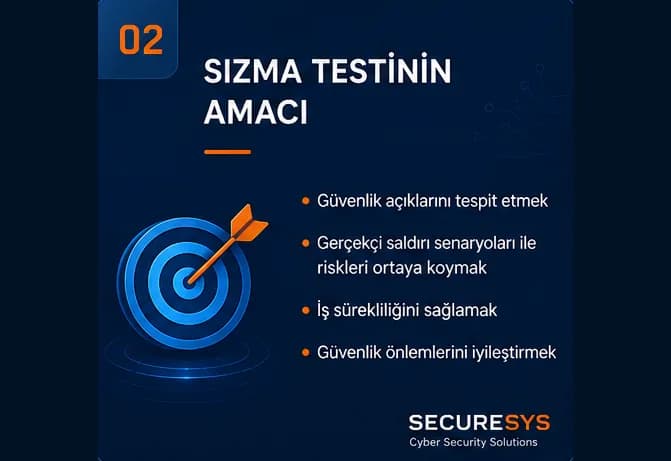
What Is a Penetration Test?
Its definition, purpose, and how it differs from a vulnerability scan. What benefits it provides to the organization, and what it means for decision-makers and technical teams.
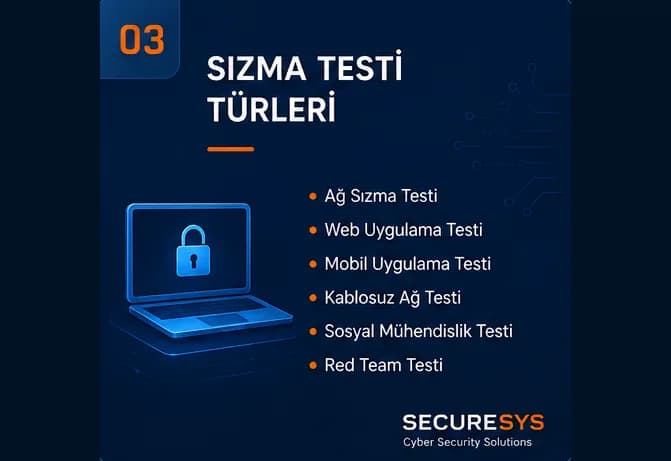
What Are the Types of Penetration Tests?
The scope of the topics "Network," "Web," "Mobile," "API," "Wireless," "Social Engineering," and "Red Team"; which one yields the correct result in which scenario.
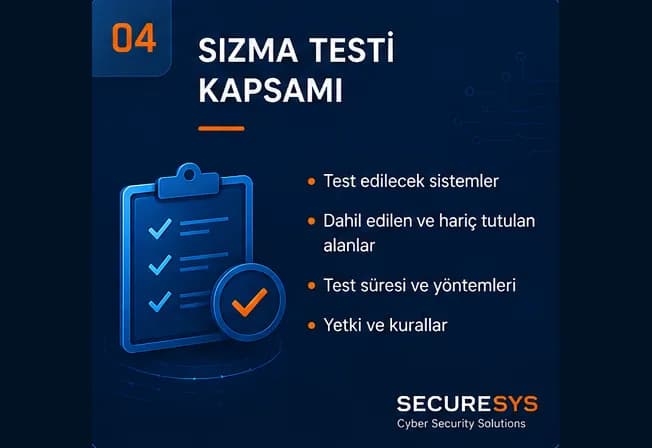
How Is the Scope of a Penetration Test Determined?
Which systems are included, and which are excluded? The direct impact of the scope decision on the budget, timeline, and quality of findings.
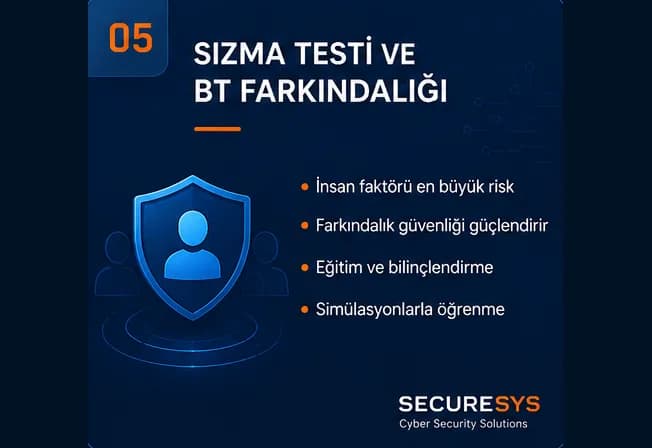
Social Engineering: A Chain of Attacks That Starts with a Single Click
A real-life attack chain that began with a single email, the role of the human factor, and the measurable impact of awareness campaigns.

What Are Black-Box, Gray-Box, and White-Box Penetration Tests?
The advantages of the zero-knowledge, partial-knowledge, and full-knowledge approaches, differences in processing time, and selecting the appropriate method based on the organization.
Looking for professional support on this topic?
Our expert team will reach out for a free consultation as soon as possible.