What Does a Penetration Testing Report Include?
Executive summary, technical findings, proof-of-concept (PoC) evidence, and risk prioritization — the section-by-section content of the delivered document.
The most important outcome of a professional penetration test is not merely the security vulnerabilities identified. The proper analysis, prioritization, and clear reporting of these findings are just as important as the testing process itself.
The reports prepared not only help technical teams address security vulnerabilities but also provide senior management with a clear overview of the organization’s current security level, the risks it faces, and the necessary improvements.
In a penetration testing service that complies with international standards, reporting should include both technical details and management-level assessments.
Executive Summary
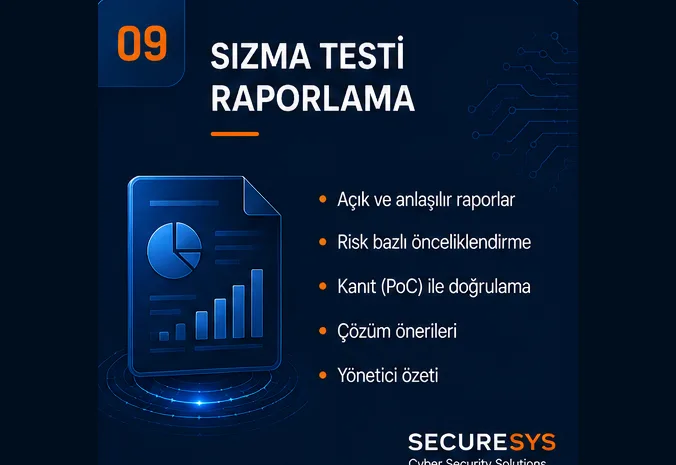
Not every manager is required to review technical details. Therefore, the first section of professional reports includes a brief and clear executive summary aimed at decision-makers.
This section typically includes the following information:
- The purpose of the test
- Scope of the systems tested
- Test dates
- Methodology used
- General security assessment
- Number of critical findings
- Impact on business continuity
- Recommended priority actions
This summary enables managers without technical expertise to quickly assess the current risk level.
Technical Report
The technical report is the most comprehensive document detailing all security vulnerabilities identified during the penetration testing process.
The following information must be included for each finding:
- Name of the finding
- Risk level
- CVSS score
- Affected system
- Description of the vulnerability
- Exploit Scenario
- Proof-of-Concept (PoC)
- Screenshots
- Mitigation Recommendations
- References (OWASP, CWE, CVE, etc.)
The technical report serves as a fundamental reference source for IT teams and software developers.
Proof of Concept (PoC)
In professional penetration testing, simply stating that a "vulnerability was found" is not sufficient.
Every critical finding must be verified in as controlled and secure a manner as possible.
This verification process is called Proof of Concept (PoC).
The PoC includes:
- How the vulnerability was exploited,
- What steps were followed,
- What data can be obtained,
- The impact of the security vulnerability,
are all presented along with evidence.
This approach helps prevent false positives.
Risk Prioritization
Not all identified security vulnerabilities pose the same level of risk.
For example,
Exposing a server’s version information cannot be assessed with the same priority as unauthorized access to a customer database.
For this reason, findings in professional reports are generally classified according to the following risk levels:
- Critical
- High
- Medium
- Low
- Informational
This classification makes it easier for organizations to determine which vulnerabilities to address first.
Recommendations for Improvement
A penetration test report should do more than just list problems.
It should also provide actionable solutions for each finding.
For example:
- Applying security patches
- Correcting misconfigurations
- Enabling multi-factor authentication
- Strengthening authorization controls
- Implementation of secure coding practices
- Improving network segmentation
Thanks to these recommendations, technical teams can systematically reduce risks.
Presentation and Evaluation Meeting
Professional penetration testing services often do not end with the delivery of a report.
The team that conducted the test reviews the findings together with the relevant stakeholders.
During these meetings:
- Critical findings are explained.
- Risk levels are assessed.
- Questions from technical teams are answered.
- An improvement plan is developed.
- Priorities are set.
This process ensures more effective use of the report.
Re-Test (Validation Test)
After the organization has addressed the security vulnerabilities, professional service providers typically conduct a verification test (Re-Test).
At this stage:
- Findings identified previously are re-examined.
- It is verified that the vulnerabilities have indeed been patched.
- If necessary, the report is updated.
- The organization’s current risk status is reassessed.
This process is of great importance in verifying the effectiveness of the improvements made.
A Real-Life Scenario
An organization received a report containing approximately 120 security findings following a comprehensive penetration test.
While this number may seem alarming at first glance, a detailed analysis revealed the following distribution of findings:
- 2 Critical
- 9 High
- 34 Medium
- 51 Low
- 24 Informational
The technical team focused primarily on resolving critical and high-risk findings. Following approximately three weeks of remediation efforts, a retest confirmed that all critical findings had been resolved.
Thanks to this approach, the organization significantly increased its security level by directing its limited resources toward the areas posing the highest risk.
The Securesys Approach
At SecureSys, we do more than just provide a technical report at the end of every penetration testing project.
We provide our clients with:
- Executive Summary
- Detailed Technical Report
- Proof-of-Concept (PoC) Documentation
- Risk Prioritization Analysis
- Improvement Recommendations
- Presentation of Findings
- Re-Testing and Validation Service
By providing such comprehensive outputs, we support not only the identification of security vulnerabilities but also their effective resolution.
One of the most important elements in a penetration test report is the proper prioritization of security vulnerabilities. But what criteria are used to classify a finding as “critical” or “high”?
Related Articles
Penetration Testing

Why Is a Penetration Test Necessary?
Why is the attack surface growing in digitalizing organizations, and why aren’t security products enough on their own? The rationale for verification from the perspective of a real attacker.
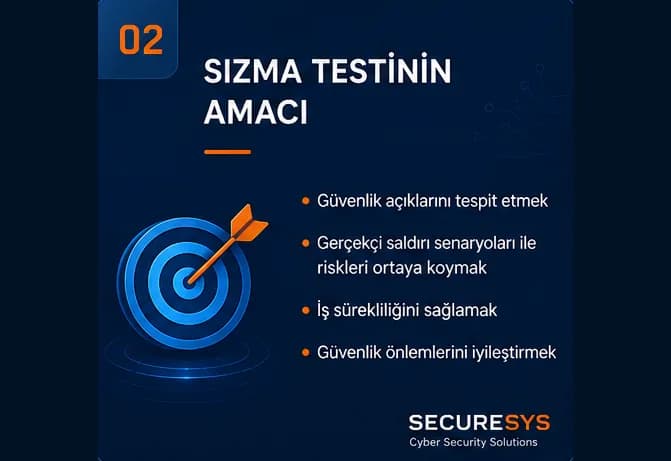
What Is a Penetration Test?
Its definition, purpose, and how it differs from a vulnerability scan. What benefits it provides to the organization, and what it means for decision-makers and technical teams.
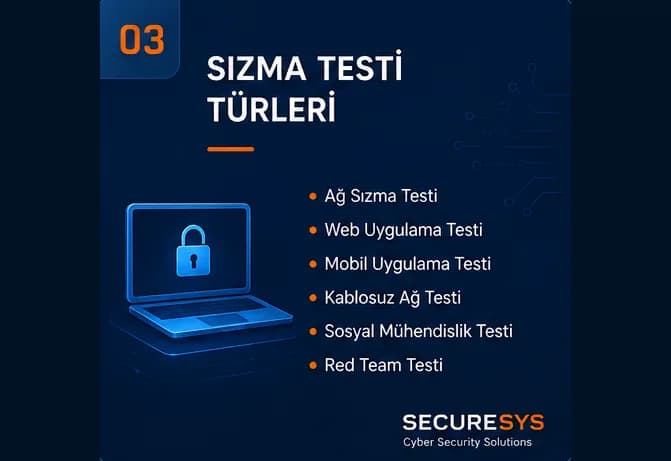
What Are the Types of Penetration Tests?
The scope of the topics "Network," "Web," "Mobile," "API," "Wireless," "Social Engineering," and "Red Team"; which one yields the correct result in which scenario.
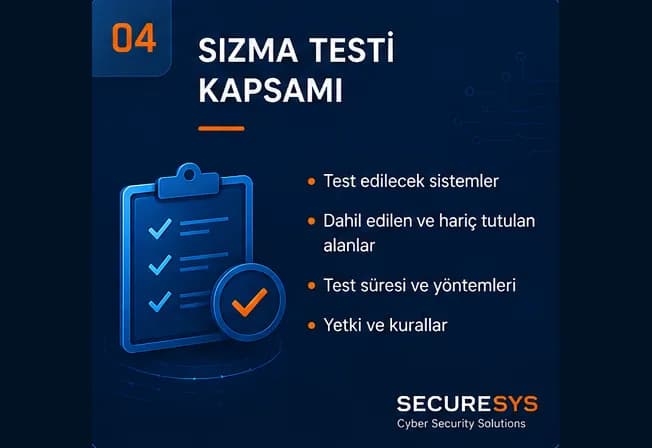
How Is the Scope of a Penetration Test Determined?
Which systems are included, and which are excluded? The direct impact of the scope decision on the budget, timeline, and quality of findings.
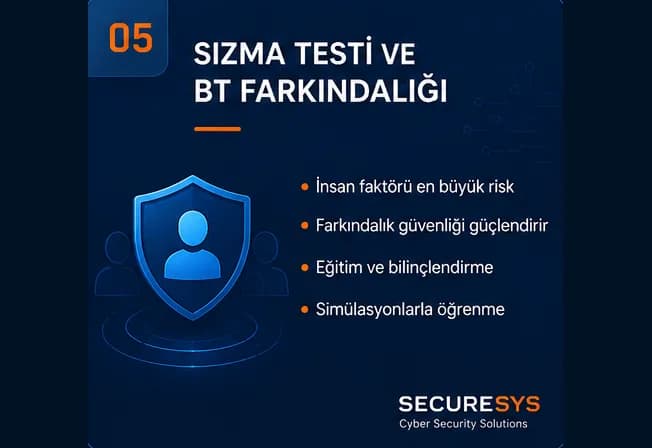
Social Engineering: A Chain of Attacks That Starts with a Single Click
A real-life attack chain that began with a single email, the role of the human factor, and the measurable impact of awareness campaigns.
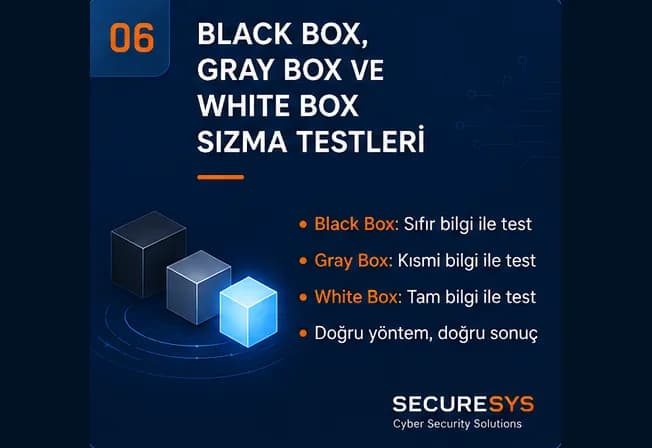
What Are Black-Box, Gray-Box, and White-Box Penetration Tests?
The advantages of the zero-knowledge, partial-knowledge, and full-knowledge approaches, differences in processing time, and selecting the appropriate method based on the organization.
Looking for professional support on this topic?
Our expert team will reach out for a free consultation as soon as possible.